Denmark Compressor Oil Market Top 5 Importing Countries and Market Competition (HHI) Analysis
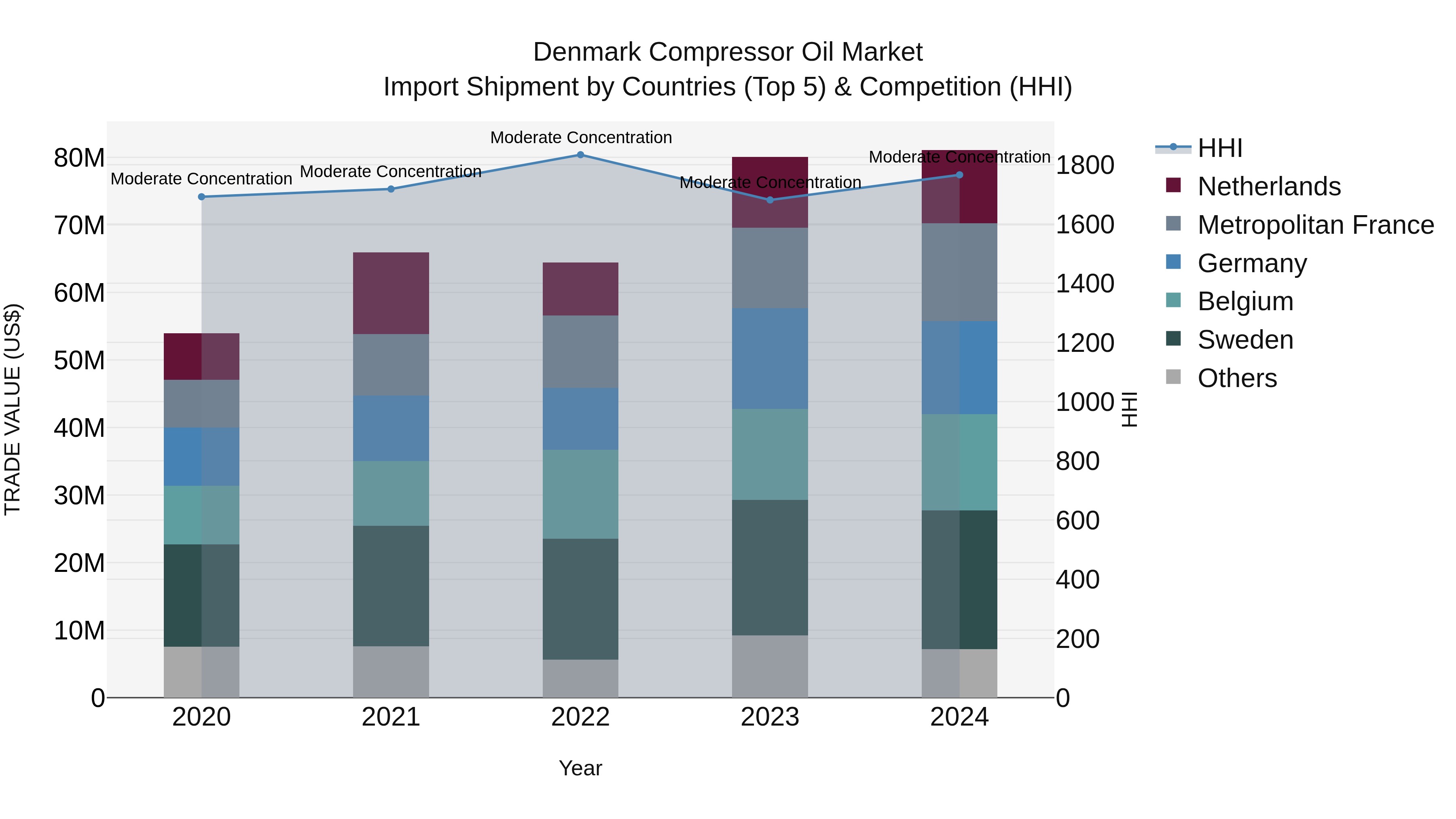
Denmark compressor oil import shipments in 2024 saw a steady growth rate, with top exporters being Sweden, Metropolitan France, Belgium, Germany, and the Netherlands. The market remained moderately concentrated, indicating a competitive landscape. The compound annual growth rate (CAGR) from 2020 to 2024 was strong at 10.73%, showing a positive trend in demand. Additionally, the growth rate from 2023 to 2024 stood at 1.23%, suggesting continued growth and stability in the market for compressor oil imports in Denmark.
Denmark Compressor Oil Market Overview
The compressor oil market in Denmark is growing as industries prioritize the maintenance and performance of their compressor systems. Compressor oils play a crucial role in ensuring the efficient operation of compressors by reducing friction and wear, enhancing reliability, and extending equipment life. The increasing focus on energy efficiency and the use of advanced lubricant formulations are driving demand in this market. As industries continue to invest in maintaining their equipment, the compressor oil market is anticipated to expand further.
Drivers of the market
Denmarks Compressor Oil market is driven by the growing industrial sector, where compressors are widely used in various applications. The demand for high-performance oils that enhance the efficiency and lifespan of compressors is a key factor supporting market growth.
Challenges of the market
In the Denmark Compressor Oil Market, companies face challenges related to product differentiation and regulatory compliance. With numerous players offering similar products, establishing a unique selling proposition becomes critical for market success. Additionally, the increasing emphasis on environmental sustainability drives the need for eco-friendly compressor oils, requiring manufacturers to innovate continuously. Compliance with stringent regulations regarding emissions and safety standards adds complexity to the formulation and marketing of compressor oils, necessitating ongoing investment in research and development.
Government Policy of the market
Denmark`s regulatory framework governing the use of lubricants and oils, including compressor oils, emphasizes environmental sustainability and safety. Government policies encourage the development and use of high-performance, eco-friendly oils that reduce environmental impact and enhance machinery efficiency, shaping the compressor oil market`s dynamics.
Key Highlights of the Report:
- Denmark Compressor Oil Market Outlook
- Market Size of Denmark Compressor Oil Market, 2024
- Forecast of Denmark Compressor Oil Market, 2031
- Historical Data and Forecast of Denmark Compressor Oil Revenues & Volume for the Period 2021-2031
- Denmark Compressor Oil Market Trend Evolution
- Denmark Compressor Oil Market Drivers and Challenges
- Denmark Compressor Oil Price Trends
- Denmark Compressor Oil Porter`s Five Forces
- Denmark Compressor Oil Industry Life Cycle
- Historical Data and Forecast of Denmark Compressor Oil Market Revenues & Volume By Base oil for the Period 2021-2031
- Historical Data and Forecast of Denmark Compressor Oil Market Revenues & Volume By Synthetic for the Period 2021-2031
- Historical Data and Forecast of Denmark Compressor Oil Market Revenues & Volume By Mineral for the Period 2021-2031
- Historical Data and Forecast of Denmark Compressor Oil Market Revenues & Volume By Semi-Synthetic for the Period 2021-2031
- Historical Data and Forecast of Denmark Compressor Oil Market Revenues & Volume By Bio-based for the Period 2021-2031
- Historical Data and Forecast of Denmark Compressor Oil Market Revenues & Volume By Compressor Type for the Period 2021-2031
- Historical Data and Forecast of Denmark Compressor Oil Market Revenues & Volume By Dynamic for the Period 2021-2031
- Historical Data and Forecast of Denmark Compressor Oil Market Revenues & Volume By Positive Displacement for the Period 2021-2031
- Historical Data and Forecast of Denmark Compressor Oil Market Revenues & Volume By Application for the Period 2021-2031
- Historical Data and Forecast of Denmark Compressor Oil Market Revenues & Volume By Gas for the Period 2021-2031
- Historical Data and Forecast of Denmark Compressor Oil Market Revenues & Volume By Air for the Period 2021-2031
- Denmark Compressor Oil Import Export Trade Statistics
- Market Opportunity Assessment By Base oil
- Market Opportunity Assessment By Compressor Type
- Market Opportunity Assessment By Application
- Denmark Compressor Oil Top Companies Market Share
- Denmark Compressor Oil Competitive Benchmarking By Technical and Operational Parameters
- Denmark Compressor Oil Company Profiles
- Denmark Compressor Oil Key Strategic Recommendations






































