Denmark Dishwasher Market Size (2020-2030)

Denmark Dishwasher Market has experienced a declining trend in recent years. The peak market size was recorded at €84.58 million in 2022, followed by a decrease to €71.82 million in 2024. The forecasted market size from 2025 to 2030 shows a continued downward trajectory, with an estimated value of €41.19 million in 2030. The CAGR values reflect this trend, with a decline of -7.85% from 2022 to 2024 and -8.85% from 2025 to 2030. The downturn can be attributed to changing consumer preferences towards more sustainable and eco-friendly options, impacting traditional dishwasher sales. Looking ahead, Denmark is focusing on promoting energy-efficient appliances and smart home technologies to revitalize the market. Initiatives such as subsidies for energy-efficient appliances and collaborations with tech companies for smart dishwasher innovations are expected to drive future growth in the industry.
Denmark Dishwasher Market: Production & Trade Performance (2019-2025)
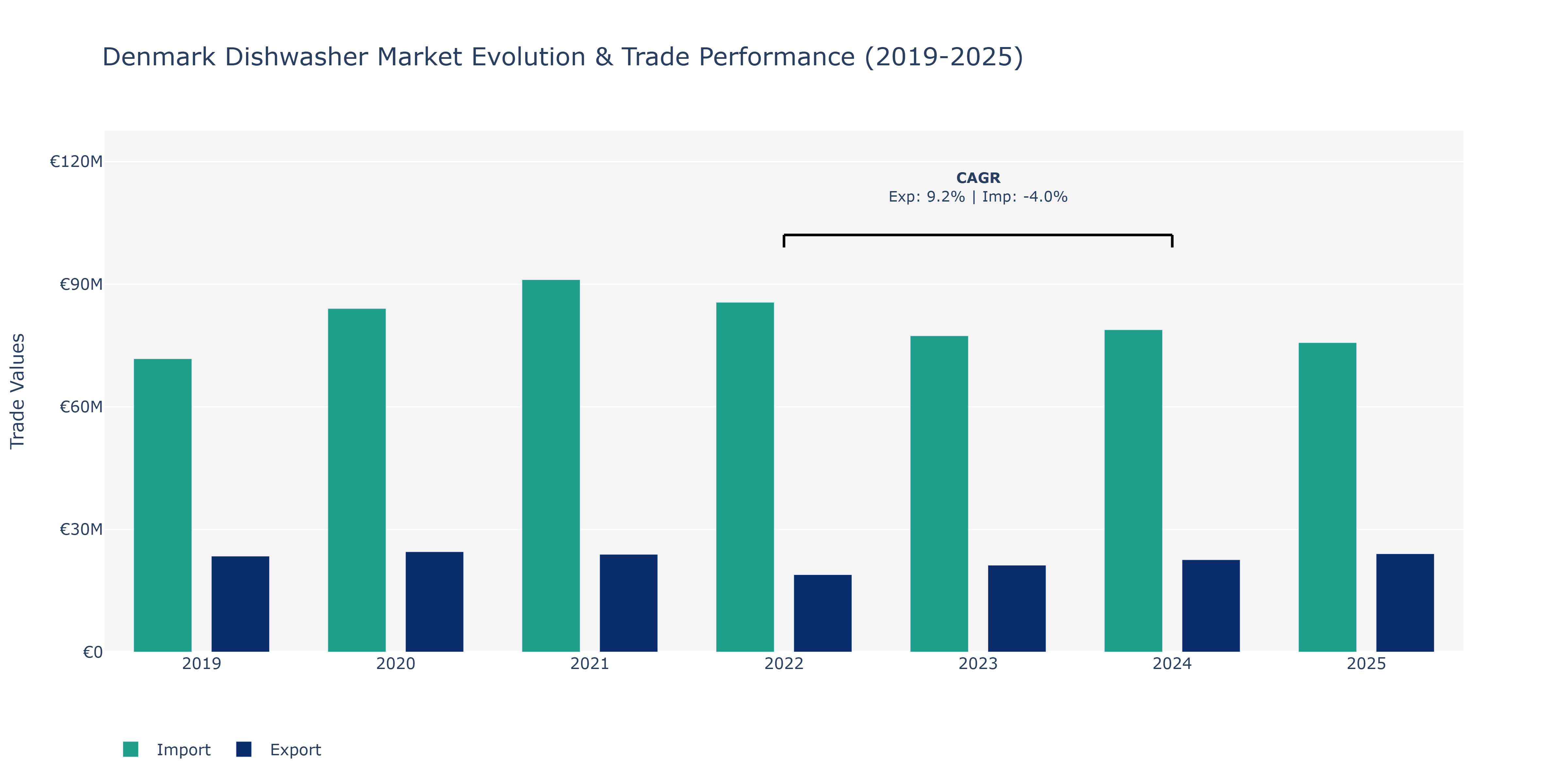
The Denmark Dishwasher Market witnessed fluctuations in both exports and imports from 2019 to 2025. In 2019, exports stood at €23.47 million, steadily increasing to €24.06 million in 2025. Conversely, imports started at €71.77 million in 2019, peaked at €91.11 million in 2021, and then experienced a gradual decline to €75.7 million in 2025. The peak in imports in 2021 could be attributed to increased consumer demand for dishwashers or potentially the introduction of new dishwasher models requiring higher imports. The fluctuations in exports and imports may have been influenced by various factors such as changes in consumer preferences, economic conditions impacting purchasing power, and advancements in dishwasher technology driving market dynamics. The decline in imports post-2021 could signal a shift towards more sustainable domestic production in response to environmental concerns or trade policy changes favoring local manufacturing. This trend aligns with the global movement towards sustainability and self-reliance in manufacturing processes.
Key Highlights of the Report:
- Denmark Dishwasher Market Outlook
- Market Size of Denmark Dishwasher Market, 2025
- Forecast of Denmark Dishwasher Market, 2032
- Historical Data and Forecast of Denmark Dishwasher Revenues & Volume for the Period 2022 - 2032F
- Denmark Dishwasher Market Trend Evolution
- Denmark Dishwasher Market Drivers and Challenges
- Denmark Dishwasher Price Trends
- Denmark Dishwasher Porter`s Five Forces
- Denmark Dishwasher Industry Life Cycle
- Historical Data and Forecast of Denmark Dishwasher Market Revenues & Volume By Type for the Period 2022 - 2032F
- Historical Data and Forecast of Denmark Dishwasher Market Revenues & Volume By Freestanding dishwasher for the Period 2022 - 2032F
- Historical Data and Forecast of Denmark Dishwasher Market Revenues & Volume By Built-in dishwasher for the Period 2022 - 2032F
- Historical Data and Forecast of Denmark Dishwasher Market Revenues & Volume By Application for the Period 2022 - 2032F
- Historical Data and Forecast of Denmark Dishwasher Market Revenues & Volume By Industrial for the Period 2022 - 2032F
- Historical Data and Forecast of Denmark Dishwasher Market Revenues & Volume By Residential for the Period 2022 - 2032F
- Historical Data and Forecast of Denmark Dishwasher Market Revenues & Volume By Distribution Channel for the Period 2022 - 2032F
- Historical Data and Forecast of Denmark Dishwasher Market Revenues & Volume By Offline for the Period 2022 - 2032F
- Historical Data and Forecast of Denmark Dishwasher Market Revenues & Volume By Online for the Period 2022 - 2032F
- Denmark Dishwasher Import Export Trade Statistics
- Market Opportunity Assessment By Type
- Market Opportunity Assessment By Application
- Market Opportunity Assessment By Distribution Channel
- Denmark Dishwasher Top Companies Market Share
- Denmark Dishwasher Competitive Benchmarking By Technical and Operational Parameters
- Denmark Dishwasher Company Profiles
- Denmark Dishwasher Key Strategic Recommendations






































