Denmark Electric Mobility Market Top 5 Importing Countries and Market Competition (HHI) Analysis
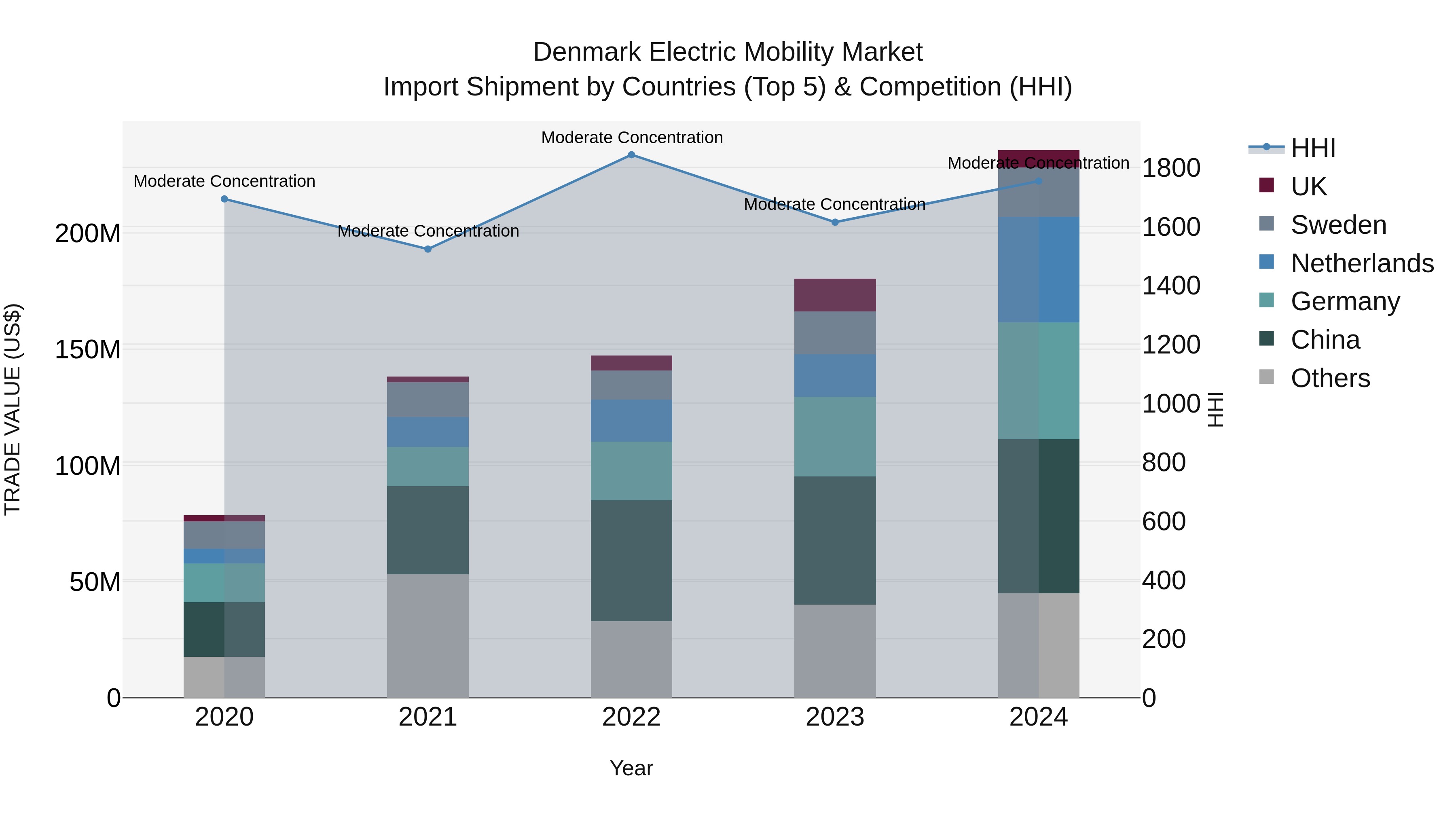
Denmark electric mobility import shipments in 2024 continue to be dominated by top exporters such as China, Germany, Netherlands, Sweden, and Poland. The Herfindahl-Hirschman Index (HHI) indicates a moderate level of concentration in the market. With a high Compound Annual Growth Rate (CAGR) of 31.61% from 2020 to 2024, the electric mobility sector in Denmark is experiencing rapid expansion. The impressive growth rate of 30.7% from 2023 to 2024 further underscores the increasing demand for electric vehicles in the Danish market.
Denmark Electric Mobility Market Overview
The electric mobility market in Denmark is experiencing rapid growth due to government incentives, environmental awareness, and technological advancements. The country has a well-developed charging infrastructure, with public charging stations widely available, which encourages the adoption of electric vehicles (EVs). Denmark offers various financial incentives to promote EV adoption, such as tax exemptions, reduced registration fees, and access to bus lanes. Additionally, the government has set ambitious targets to phase out internal combustion engine vehicles by 2030, further driving the demand for electric vehicles. With a strong focus on sustainability and a supportive regulatory environment, Denmark`s electric mobility market is poised for continued expansion in the coming years.
Denmark Electric Mobility Market Trends and Opportunities
The Denmark Electric Mobility Market is experiencing significant growth due to government initiatives promoting sustainable transportation and increasing awareness of environmental concerns. The market is witnessing a rise in electric vehicle adoption, with a focus on both passenger cars and commercial vehicles. Opportunities in the market include the expansion of charging infrastructure, development of innovative battery technologies, and collaboration between automakers and energy companies to enhance the overall electric mobility ecosystem. Additionally, the shift towards electric mobility is creating opportunities for new players to enter the market, such as electric vehicle manufacturers, charging station providers, and software developers offering solutions for smart charging and energy management. Overall, the Denmark Electric Mobility Market presents promising prospects for growth and innovation in the coming years.
Denmark Electric Mobility Market Challenges
In the Denmark Electric Mobility Market, challenges include the high cost of electric vehicles, limited charging infrastructure, and range anxiety among consumers. The upfront cost of electric vehicles remains a barrier for many potential buyers, despite long-term cost savings on fuel and maintenance. Additionally, the need for a more extensive and reliable charging network is crucial to encourage widespread adoption of electric vehicles. Range anxiety, or the fear of running out of battery power mid-journey, also hinders consumer confidence in electric mobility. These challenges require investment in infrastructure, government incentives, and consumer education to drive the growth of the electric vehicle market in Denmark.
Denmark Electric Mobility Market Drivers
The Denmark Electric Mobility Market is primarily driven by government initiatives and policies promoting sustainable transportation, including tax incentives, subsidies, and infrastructure development for electric vehicles (EVs). Growing environmental awareness and concerns about air pollution have also fueled the demand for EVs among consumers. The availability of a wide range of electric vehicle models and technological advancements in battery technology have increased the appeal and feasibility of electric vehicles in Denmark. Additionally, the country`s ambitious targets to reduce greenhouse gas emissions and dependence on fossil fuels have further accelerated the adoption of electric mobility solutions. Overall, a combination of supportive government policies, environmental consciousness, technological advancements, and ambitious sustainability goals are key drivers propelling the growth of the Electric Mobility Market in Denmark.
Denmark Electric Mobility Market Government Policy
The Danish government has implemented various policies to support the growth of the Electric Mobility Market. These include tax incentives for electric vehicles (EVs), exemption from registration taxes, reduced ownership taxes, and free parking and charging facilities for EVs. Additionally, Denmark aims to phase out the sale of new fossil-fueled cars by 2030, encouraging the adoption of electric vehicles. The government has also invested in expanding the charging infrastructure network across the country to facilitate EV adoption. These policies align with Denmark`s commitment to reducing greenhouse gas emissions and promoting sustainable transportation options, positioning the country as a leader in the transition towards electric mobility.
Denmark Electric Mobility Market Future Outlook
The future outlook for the Denmark Electric Mobility Market is highly promising as the country continues to prioritize sustainability and environmental consciousness. With ambitious targets to phase out internal combustion engine vehicles by 2030, the demand for electric vehicles (EVs) is expected to surge in the coming years. Government incentives such as tax exemptions, reduced registration fees, and investment in charging infrastructure are further driving the adoption of EVs. Additionally, Denmark`s strong focus on renewable energy sources will enhance the appeal of EVs as a cleaner transportation option. The market is likely to witness rapid growth with increased offerings of EV models, advancements in battery technology, and growing consumer awareness about the benefits of electric mobility, positioning Denmark as a key player in the global shift towards sustainable transportation.
Key Highlights of the Report:
- Denmark Electric Mobility Market Outlook
- Market Size of Denmark Electric Mobility Market, 2024
- Forecast of Denmark Electric Mobility Market, 2031
- Historical Data and Forecast of Denmark Electric Mobility Revenues & Volume for the Period 2021- 2031
- Denmark Electric Mobility Market Trend Evolution
- Denmark Electric Mobility Market Drivers and Challenges
- Denmark Electric Mobility Price Trends
- Denmark Electric Mobility Porter's Five Forces
- Denmark Electric Mobility Industry Life Cycle
- Historical Data and Forecast of Denmark Electric Mobility Market Revenues & Volume By Product for the Period 2021- 2031
- Historical Data and Forecast of Denmark Electric Mobility Market Revenues & Volume By Electric Bikes for the Period 2021- 2031
- Historical Data and Forecast of Denmark Electric Mobility Market Revenues & Volume By Electric Scooters for the Period 2021- 2031
- Historical Data and Forecast of Denmark Electric Mobility Market Revenues & Volume By Electric Motorized Scooters for the Period 2021- 2031
- Historical Data and Forecast of Denmark Electric Mobility Market Revenues & Volume By Electric Motorcycles for the Period 2021- 2031
- Historical Data and Forecast of Denmark Electric Mobility Market Revenues & Volume By Drive for the Period 2021- 2031
- Historical Data and Forecast of Denmark Electric Mobility Market Revenues & Volume By Belt Drive for the Period 2021- 2031
- Historical Data and Forecast of Denmark Electric Mobility Market Revenues & Volume By Chain Drive for the Period 2021- 2031
- Historical Data and Forecast of Denmark Electric Mobility Market Revenues & Volume By Hub Drive for the Period 2021- 2031
- Historical Data and Forecast of Denmark Electric Mobility Market Revenues & Volume By Battery for the Period 2021- 2031
- Historical Data and Forecast of Denmark Electric Mobility Market Revenues & Volume By Lead Acid Battery for the Period 2021- 2031
- Historical Data and Forecast of Denmark Electric Mobility Market Revenues & Volume By Li-Ion Battery for the Period 2021- 2031
- Historical Data and Forecast of Denmark Electric Mobility Market Revenues & Volume By End-use for the Period 2021- 2031
- Historical Data and Forecast of Denmark Electric Mobility Market Revenues & Volume By Personal for the Period 2021- 2031
- Historical Data and Forecast of Denmark Electric Mobility Market Revenues & Volume By Commercial for the Period 2021- 2031
- Denmark Electric Mobility Import Export Trade Statistics
- Market Opportunity Assessment By Product
- Market Opportunity Assessment By Drive
- Market Opportunity Assessment By Battery
- Market Opportunity Assessment By End-use
- Denmark Electric Mobility Top Companies Market Share
- Denmark Electric Mobility Competitive Benchmarking By Technical and Operational Parameters
- Denmark Electric Mobility Company Profiles
- Denmark Electric Mobility Key Strategic Recommendations






































