Denmark Glycerol Market Size (2020-2030)
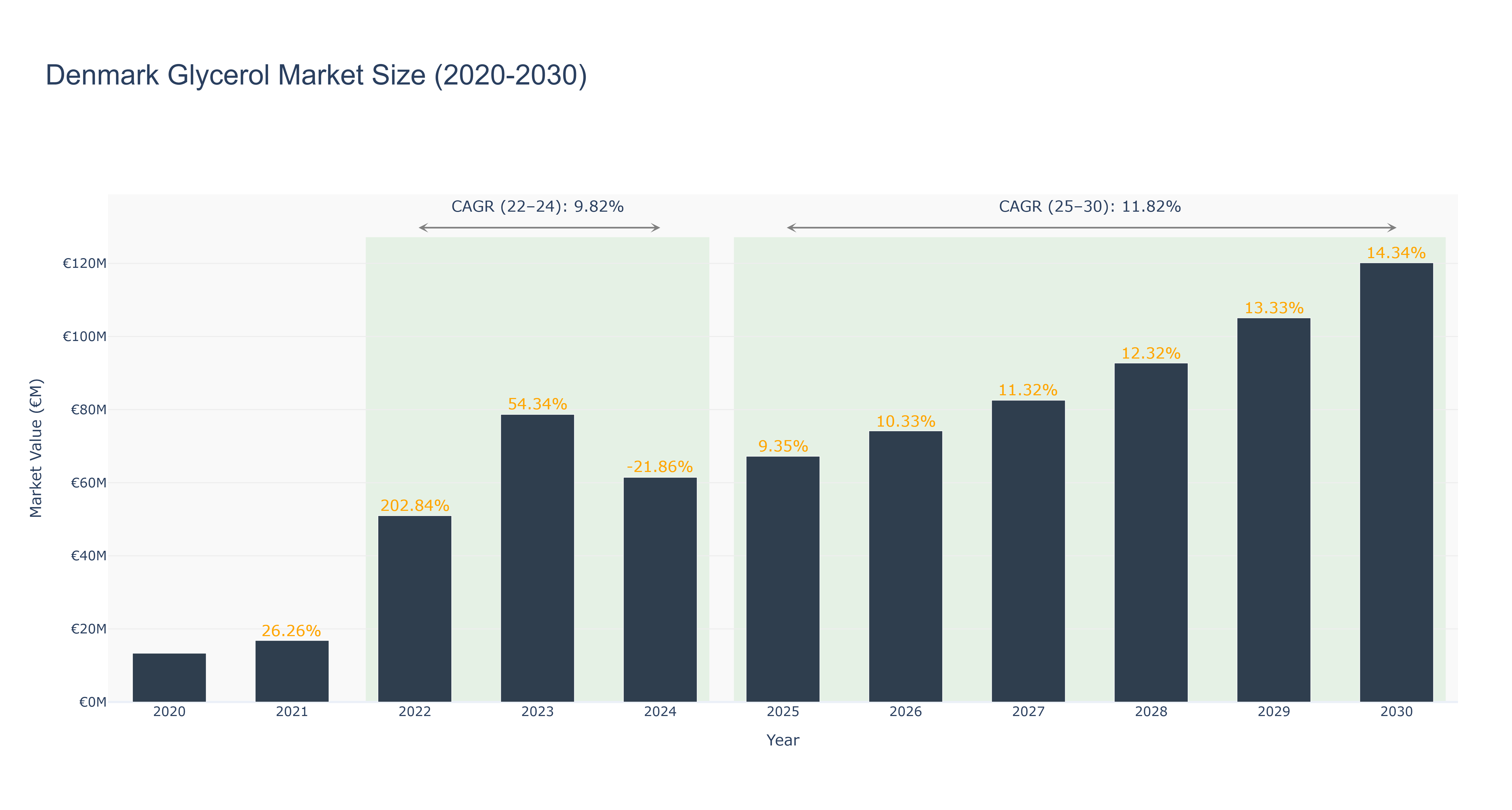
Denmark Glycerol Market has shown a fluctuating trend over the past decade. The peak market size of €120.15 million was reached in 2030, with a steady growth rate. From 2020 to 2024, the market size varied from €13.33 million to €61.47 million, experiencing a significant dip in 2024 due to external factors impacting demand. However, from 2025 to 2030, the market is forecasted to grow steadily, with an expected size of €120.15 million in 2030. The CAGR for the periods 2022-24 and 2025-30 are 9.82% and 11.82% respectively, indicating a positive growth trajectory. Industry drivers such as increasing demand for glycerol in pharmaceuticals and personal care products are expected to fuel market growth. Recent developments in Denmark include investments in sustainable production methods for glycerol, aligning with the country's focus on environmental sustainability.
Denmark Glycerol Market: Production & Trade Performance (2019-2025)
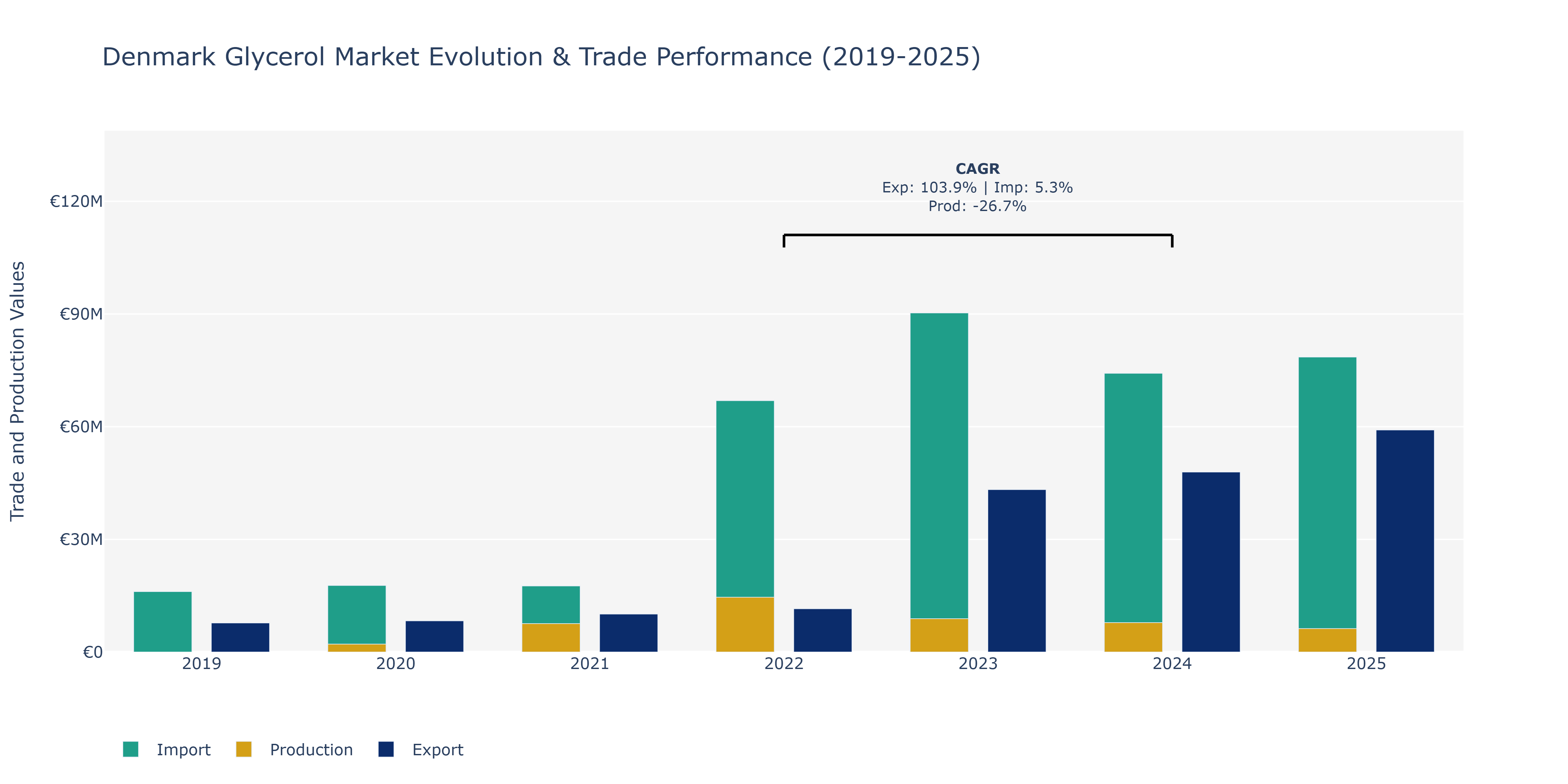
Between 2019 and 2025, the Denmark Glycerol Market saw notable shifts in Exports, Imports, and Production. Exports displayed a steady upward trajectory, increasing from €7.74 million in 2019 to €59.11 million in 2025, showcasing consistent growth over the period. In contrast, Imports experienced fluctuations, reaching €90.28 million in 2023 before decreasing to €78.53 million in 2025. Production exhibited a significant decline from €9.51 million in 2019 to €6.24 million in 2025, with a peak in 2020 at €21.18 million. The surge in Exports can be attributed to increasing global demand for glycerol-based products, coupled with Denmark's reputation for high-quality goods. Import fluctuations may reflect changing domestic consumption patterns and international trade dynamics. The production decline could stem from shifts in production technologies, environmental regulations, or market saturation leading to a more strategic product focus in the industry.
Denmark Glycerol Market Overview
The glycerol market in Denmark is witnessing growth, driven by the rising demand for this multifunctional compound in various applications. Glycerol is widely used in pharmaceuticals, personal care products, and food as a sweetener and humectant. The trend towards natural and organic formulations is boosting the demand for glycerol derived from sustainable sources. Additionally, the increasing awareness of glycerol`s benefits in various applications is contributing to its growing market presence in Denmark.
Drivers of the market
The Denmark glycerol market is primarily driven by the increasing use of glycerol in the food and beverage industry as a sugar substitute and humectant. The rising health consciousness among consumers is leading to a shift towards lower-calorie food options, boosting the demand for glycerol. Moreover, glycerol`s applications in pharmaceuticals, cosmetics, and personal care products enhance its market appeal. The growing trend of sustainable and natural ingredients also supports the demand for glycerol in various formulations.
Challenges of the market
The glycerol market in Denmark faces challenges similar to those of the glycerin market, including raw material price volatility and competition from synthetic substitutes. Additionally, the market must navigate complex regulations concerning food safety and environmental impact. Consumer demand for sustainable and biodegradable products can also influence market dynamics, requiring manufacturers to adapt their offerings accordingly.
Government Policy of the market
The glycerol market in Denmark is influenced by government policies that promote sustainable sourcing and production practices. Support for the bioeconomy encourages the use of glycerol derived from renewable resources, which aligns with Denmarks environmental objectives. Regulations emphasizing product safety and quality standards ensure that glycerol used in cosmetics and food products meets strict requirements, fostering consumer confidence.
Key Highlights of the Report:
- Denmark Glycerol Market Outlook
- Market Size of Denmark Glycerol Market, 2024
- Forecast of Denmark Glycerol Market, 2031
- Historical Data and Forecast of Denmark Glycerol Revenues & Volume for the Period 2021-2031
- Denmark Glycerol Market Trend Evolution
- Denmark Glycerol Market Drivers and Challenges
- Denmark Glycerol Price Trends
- Denmark Glycerol Porter`s Five Forces
- Denmark Glycerol Industry Life Cycle
- Historical Data and Forecast of Denmark Glycerol Market Revenues & Volume By Source for the Period 2021-2031
- Historical Data and Forecast of Denmark Glycerol Market Revenues & Volume By Biodiesel for the Period 2021-2031
- Historical Data and Forecast of Denmark Glycerol Market Revenues & Volume By Fatty Alcohols for the Period 2021-2031
- Historical Data and Forecast of Denmark Glycerol Market Revenues & Volume By Fatty Acids for the Period 2021-2031
- Historical Data and Forecast of Denmark Glycerol Market Revenues & Volume By Soap for the Period 2021-2031
- Historical Data and Forecast of Denmark Glycerol Market Revenues & Volume By Type for the Period 2021-2031
- Historical Data and Forecast of Denmark Glycerol Market Revenues & Volume By Crude for the Period 2021-2031
- Historical Data and Forecast of Denmark Glycerol Market Revenues & Volume By Refined for the Period 2021-2031
- Historical Data and Forecast of Denmark Glycerol Market Revenues & Volume By End-use for the Period 2021-2031
- Historical Data and Forecast of Denmark Glycerol Market Revenues & Volume By Food & Beverage for the Period 2021-2031
- Historical Data and Forecast of Denmark Glycerol Market Revenues & Volume By Pharmaceutical for the Period 2021-2031
- Historical Data and Forecast of Denmark Glycerol Market Revenues & Volume By Nutraceutical for the Period 2021-2031
- Historical Data and Forecast of Denmark Glycerol Market Revenues & Volume By Personal Care & Cosmetics for the Period 2021-2031
- Historical Data and Forecast of Denmark Glycerol Market Revenues & Volume By Industrial for the Period 2021-2031
- Historical Data and Forecast of Denmark Glycerol Market Revenues & Volume By Others for the Period 2021-2031
- Denmark Glycerol Import Export Trade Statistics
- Market Opportunity Assessment By Source
- Market Opportunity Assessment By Type
- Market Opportunity Assessment By End-use
- Denmark Glycerol Top Companies Market Share
- Denmark Glycerol Competitive Benchmarking By Technical and Operational Parameters
- Denmark Glycerol Company Profiles
- Denmark Glycerol Key Strategic Recommendations






































