Denmark Industrial Hemp Market Top 5 Importing Countries and Market Competition (HHI) Analysis
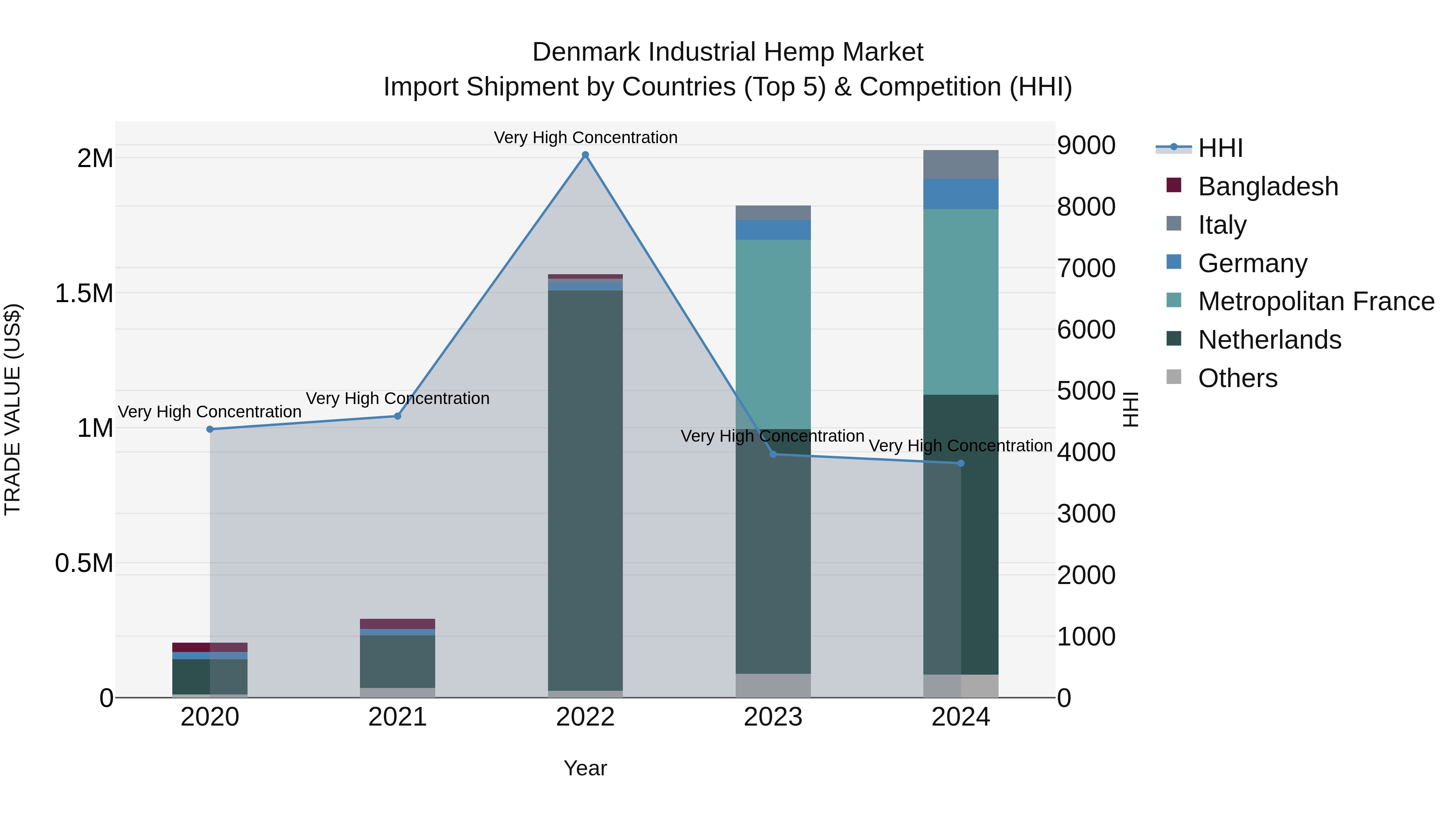
Denmark industrial hemp import market in 2024 saw significant growth, with top exporters like Netherlands, Metropolitan France, Germany, Italy, and Lithuania dominating the scene. The high Herfindahl-Hirschman Index (HHI) indicates a concentrated market, suggesting the dominance of these key players. The impressive compound annual growth rate (CAGR) of 77.69% from 2020 to 2024 underscores the increasing demand for industrial hemp in Denmark. Moreover, the growth rate of 11.26% from 2023 to 2024 signals a continued upward trajectory, making it an attractive market for stakeholders.
Industrial Hemp Market: Denmark vs Top 5 Major Economies in 2027 (Europe)
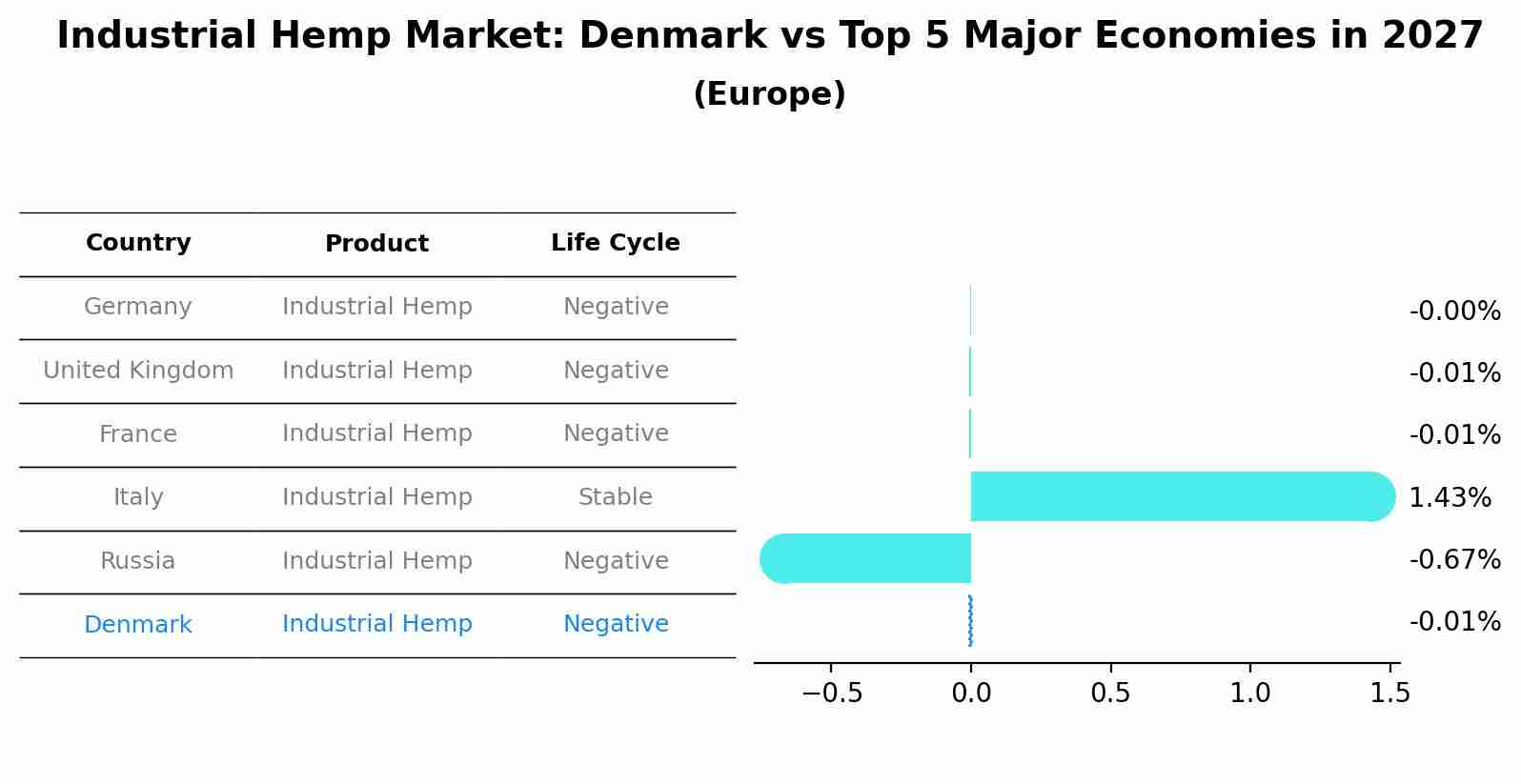
The Industrial Hemp market in Denmark is projected to grow at a negative growth rate of -0.01% by 2027, within the Europe region led by Germany, along with other countries like United Kingdom, France, Italy and Russia, collectively shaping a dynamic and evolving market environment driven by innovation and increasing adoption of emerging technologies.
Denmark Industrial Hemp Market Overview
Denmark`s industrial hemp market is experiencing growth as the country focuses on sustainable agricultural practices and the development of eco-friendly products. Industrial hemp is utilized in a wide range of applications, including textiles, construction materials, and bio-composites. The market benefits from favorable regulatory frameworks and increasing consumer awareness regarding the environmental benefits of hemp products.
Drivers of the market
The industrial hemp market in Denmark is driven by the increasing awareness of the environmental benefits and versatility of hemp products. The demand for sustainable and biodegradable materials in industries such as textiles, construction, and automotive is growing. Additionally, the government`s supportive policies and the legalization of hemp cultivation have created new opportunities for farmers and entrepreneurs, further driving the market.
Challenges of the market
The industrial hemp market in Denmark faces regulatory challenges, including strict EU guidelines on THC levels, which complicate cultivation and processing. Market expansion is also hindered by the limited consumer awareness and acceptance of hemp-based products. Additionally, the nascent nature of the industry leads to a lack of established supply chains and infrastructure.
Government Policy of the market
Denmark`s regulatory framework for industrial hemp is influenced by European Union guidelines, focusing on the legal cultivation, processing, and marketing of hemp products. The government supports the hemp industry through policies that promote sustainable agricultural practices and the use of hemp in various industrial applications, such as textiles and construction materials. Licensing requirements and THC content regulations are also key aspects of the policy environment.
Key Highlights of the Report:
- Denmark Industrial Hemp Market Outlook
- Market Size of Denmark Industrial Hemp Market, 2024
- Forecast of Denmark Industrial Hemp Market, 2031
- Historical Data and Forecast of Denmark Industrial Hemp Revenues & Volume for the Period 2021-2031
- Denmark Industrial Hemp Market Trend Evolution
- Denmark Industrial Hemp Market Drivers and Challenges
- Denmark Industrial Hemp Price Trends
- Denmark Industrial Hemp Porter`s Five Forces
- Denmark Industrial Hemp Industry Life Cycle
- Historical Data and Forecast of Denmark Industrial Hemp Market Revenues & Volume By Product for the Period 2021-2031
- Historical Data and Forecast of Denmark Industrial Hemp Market Revenues & Volume By Seeds for the Period 2021-2031
- Historical Data and Forecast of Denmark Industrial Hemp Market Revenues & Volume By Fiber for the Period 2021-2031
- Historical Data and Forecast of Denmark Industrial Hemp Market Revenues & Volume By Shives for the Period 2021-2031
- Historical Data and Forecast of Denmark Industrial Hemp Market Revenues & Volume By Application for the Period 2021-2031
- Historical Data and Forecast of Denmark Industrial Hemp Market Revenues & Volume By Animal Care for the Period 2021-2031
- Historical Data and Forecast of Denmark Industrial Hemp Market Revenues & Volume By Textiles for the Period 2021-2031
- Historical Data and Forecast of Denmark Industrial Hemp Market Revenues & Volume By Automotive for the Period 2021-2031
- Historical Data and Forecast of Denmark Industrial Hemp Market Revenues & Volume By Furniture for the Period 2021-2031
- Historical Data and Forecast of Denmark Industrial Hemp Market Revenues & Volume By Food & Beverages for the Period 2021-2031
- Historical Data and Forecast of Denmark Industrial Hemp Market Revenues & Volume By Paper for the Period 2021-2031
- Historical Data and Forecast of Denmark Industrial Hemp Market Revenues & Volume By Construction Materials for the Period 2021-2031
- Historical Data and Forecast of Denmark Industrial Hemp Market Revenues & Volume By Other for the Period 2021-2031
- Denmark Industrial Hemp Import Export Trade Statistics
- Market Opportunity Assessment By Product
- Market Opportunity Assessment By Application
- Denmark Industrial Hemp Top Companies Market Share
- Denmark Industrial Hemp Competitive Benchmarking By Technical and Operational Parameters
- Denmark Industrial Hemp Company Profiles
- Denmark Industrial Hemp Key Strategic Recommendations






































