Denmark Molasses Market Top 5 Importing Countries and Market Competition (HHI) Analysis
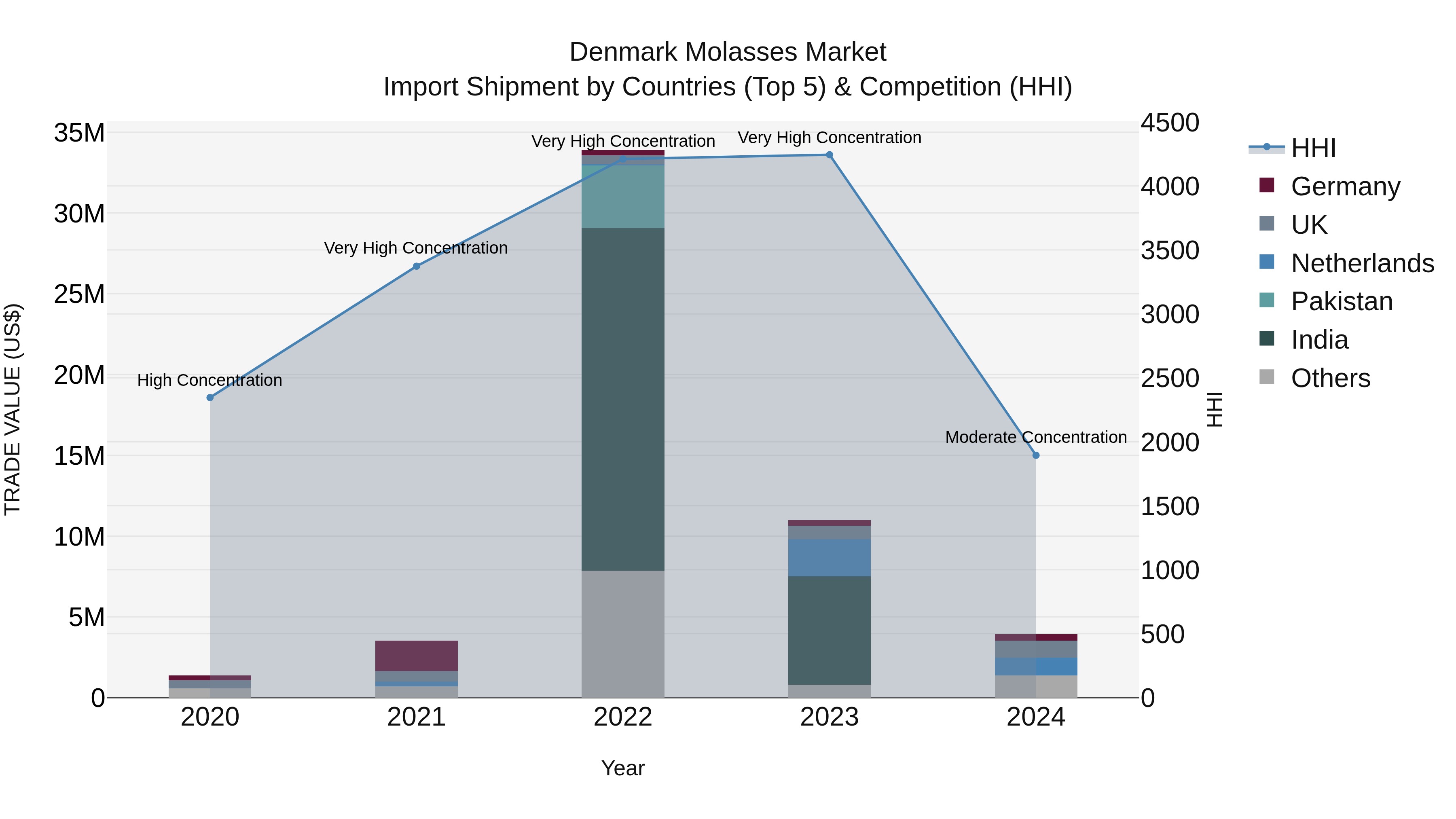
Denmark molasses import market saw a shift in 2024 with a more diverse range of suppliers, including the Netherlands, UK, Metropolitan France, Germany, and Lithuania. This diversification has led to a decrease in market concentration, transitioning from very high in 2023 to moderate in 2024. Despite the high CAGR of 30.06% from 2020 to 2024, the market experienced a significant decline in growth rate from 2023 to 2024 at -64.22%. This fluctuation indicates changing dynamics within the molasses import industry in Denmark, creating opportunities and challenges for both suppliers and buyers.
Denmark Molasses Market Overview
The molasses market in Denmark is driven by the demand for molasses in the food, beverage, and animal feed industries. Molasses is a by-product of sugar production and is used as a sweetener, fermentation agent, and feed ingredient. The market is supported by the growing demand for natural sweeteners and sustainable agriculture practices.
Drivers of the market
The Molasses Market in Denmark is influenced by the rising demand for natural sweeteners and feed additives in the food and agriculture sectors. As consumers seek healthier alternatives to refined sugars, the adoption of molasses as a sweetening agent increases. The growing focus on sustainable agriculture and organic products further drives market expansion, supporting the molasses industry`s growth.
Challenges of the market
In the molasses market, challenges arise from fluctuations in raw material availability and pricing, impacting production stability. As the demand for molasses in various applications, including food production and animal feed, increases, ensuring a consistent supply becomes essential. Additionally, navigating regulatory requirements for food safety and quality complicates the production and distribution of molasses products. The competitive landscape necessitates ongoing investment in research and development to enhance product offerings and meet evolving market demands.
Government Policy of the market
The molasses market is growing due to the rising demand for sweeteners and fermentation products. The Danish government supports sustainable agricultural practices that influence the production of molasses. Policies aimed at promoting food safety and quality standards are essential for ensuring the integrity of molasses products.
Key Highlights of the Report:
- Denmark Molasses Market Outlook
- Market Size of Denmark Molasses Market, 2024
- Forecast of Denmark Molasses Market, 2031
- Historical Data and Forecast of Denmark Molasses Revenues & Volume for the Period 2021-2031
- Denmark Molasses Market Trend Evolution
- Denmark Molasses Market Drivers and Challenges
- Denmark Molasses Price Trends
- Denmark Molasses Porter`s Five Forces
- Denmark Molasses Industry Life Cycle
- Historical Data and Forecast of Denmark Molasses Market Revenues & Volume By Source for the Period 2021-2031
- Historical Data and Forecast of Denmark Molasses Market Revenues & Volume By Sugarcane for the Period 2021-2031
- Historical Data and Forecast of Denmark Molasses Market Revenues & Volume By Sugarbeet for the Period 2021-2031
- Historical Data and Forecast of Denmark Molasses Market Revenues & Volume By Type for the Period 2021-2031
- Historical Data and Forecast of Denmark Molasses Market Revenues & Volume By Regular Molasses for the Period 2021-2031
- Historical Data and Forecast of Denmark Molasses Market Revenues & Volume By Blackstrap Molasses for the Period 2021-2031
- Historical Data and Forecast of Denmark Molasses Market Revenues & Volume By Nature for the Period 2021-2031
- Historical Data and Forecast of Denmark Molasses Market Revenues & Volume By Organic for the Period 2021-2031
- Historical Data and Forecast of Denmark Molasses Market Revenues & Volume By Conventional for the Period 2021-2031
- Historical Data and Forecast of Denmark Molasses Market Revenues & Volume By End-Use for the Period 2021-2031
- Historical Data and Forecast of Denmark Molasses Market Revenues & Volume By Industrial for the Period 2021-2031
- Historical Data and Forecast of Denmark Molasses Market Revenues & Volume By Commercial for the Period 2021-2031
- Historical Data and Forecast of Denmark Molasses Market Revenues & Volume By Household for the Period 2021-2031
- Historical Data and Forecast of Denmark Molasses Market Revenues & Volume By Sales Channel for the Period 2021-2031
- Historical Data and Forecast of Denmark Molasses Market Revenues & Volume By Direct for the Period 2021-2031
- Historical Data and Forecast of Denmark Molasses Market Revenues & Volume By Indirect for the Period 2021-2031
- Denmark Molasses Import Export Trade Statistics
- Market Opportunity Assessment By Source
- Market Opportunity Assessment By Type
- Market Opportunity Assessment By Nature
- Market Opportunity Assessment By End-Use
- Market Opportunity Assessment By Sales Channel
- Denmark Molasses Top Companies Market Share
- Denmark Molasses Competitive Benchmarking By Technical and Operational Parameters
- Denmark Molasses Company Profiles
- Denmark Molasses Key Strategic Recommendations






































