Denmark Printed Signage Market Top 5 Importing Countries and Market Competition (HHI) Analysis
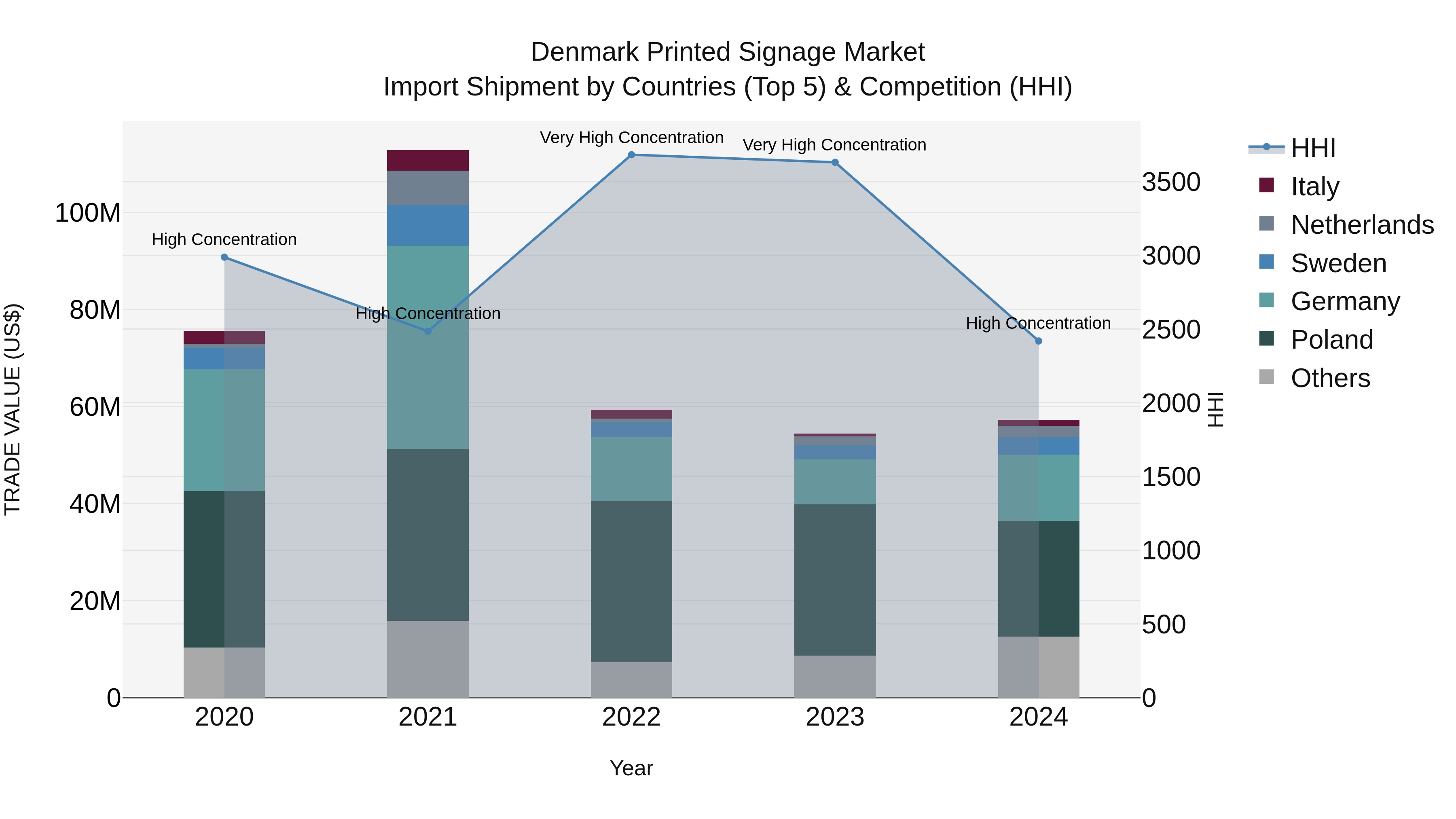
Denmark printed signage import shipments in 2024 continued to show a high concentration of top exporting countries, with Poland, Germany, Sweden, Portugal, and the Netherlands leading the way. Despite a decrease in the Herfindahl-Hirschman Index (HHI) from very high concentration in 2023 to high concentration in 2024, the industry still exhibits a significant level of market dominance by key players. The negative Compound Annual Growth Rate (CAGR) from 2020 to 2024 highlights challenges faced by the market, but a positive growth rate of 5.27% from 2023 to 2024 indicates a recent uptick in demand and opportunities for future expansion.
Denmark Printed Signage Market Synopsis
The Denmark Printed Signage Market is a dynamic and growing industry driven by increasing demand for visually appealing and informative signage across various sectors such as retail, hospitality, transportation, and healthcare. The market offers a wide range of printed signage solutions including banners, posters, billboards, and vehicle wraps, catering to diverse advertising and promotional needs. With a focus on sustainability, there is a rising trend towards the use of eco-friendly materials and digital printing technologies in the production of signage. Key players in the market are investing in innovative designs, customization options, and quick turnaround times to meet the evolving requirements of businesses and organizations. Overall, the Denmark Printed Signage Market is characterized by innovation, quality, and a customer-centric approach, making it a competitive and promising sector within the country`s advertising and marketing landscape.
Denmark Printed Signage Market Trends
The Denmark Printed Signage Market is experiencing a shift towards more sustainable and eco-friendly materials, driven by increasing environmental awareness among businesses and consumers. There is a growing demand for signage solutions that use recyclable or biodegradable materials, such as cardboard, bamboo, or recycled plastics. Personalized and interactive signage is also gaining popularity, as businesses look for innovative ways to engage with their target audience. Digital printing technologies are being increasingly adopted, allowing for faster turnaround times and higher customization options. Additionally, there is a trend towards minimalist and Scandinavian-influenced designs, emphasizing clean lines, simplicity, and high-quality aesthetics. Overall, the market is evolving towards more sustainable, interactive, and visually appealing printed signage solutions in Denmark.
Denmark Printed Signage Market Challenges
The Denmark Printed Signage Market faces challenges such as increasing competition from digital signage solutions, rising costs of raw materials, and the need to adhere to strict environmental regulations. With the growing popularity of digital advertising, traditional printed signage is facing pressure to innovate and offer unique value propositions to attract customers. Additionally, fluctuating prices of materials like ink, paper, and substrates can impact the profitability of signage companies. Moreover, Denmark`s stringent environmental policies require signage manufacturers to use eco-friendly materials and production processes, adding complexity and costs to their operations. Overall, staying competitive, managing costs, and meeting environmental standards are key challenges for the Printed Signage Market in Denmark.
Denmark Printed Signage Market Investment Opportunities
The Denmark Printed Signage Market presents various investment opportunities for growth and innovation. With a strong focus on sustainability and eco-friendly practices, investors can capitalize on the growing demand for environmentally conscious signage solutions. Additionally, the adoption of digital signage technology is on the rise in Denmark, offering opportunities for investments in interactive and dynamic signage solutions. Leveraging the increasing trend towards personalized and customized signage, investors can explore opportunities in offering tailored signage products and services to cater to diverse customer needs. Furthermore, collaborations with design agencies and marketing firms can enhance the market presence and reach of signage companies, creating avenues for strategic partnerships and expansion. Overall, the Denmark Printed Signage Market offers a fertile ground for investments in sustainable practices, digital signage technology, customization, and collaborations to drive growth and innovation in the industry.
Jordan Agar Market Government Policies
In Denmark, the Printed Signage Market is governed by various regulations and policies aimed at ensuring quality, safety, and environmental sustainability. The government has implemented strict guidelines regarding the use of materials and inks in printed signage to minimize environmental impact. Additionally, there are regulations in place to ensure that signage meets certain safety standards to protect both consumers and workers. The government also encourages the use of sustainable and recyclable materials in printed signage through incentives and subsidies. Overall, the policies in Denmark emphasize the importance of responsible and sustainable practices in the Printed Signage Market to promote environmental conservation and public safety.
Denmark Printed Signage Market Future Outlook
The Denmark Printed Signage Market is expected to witness steady growth in the coming years, driven by increasing demand for visually appealing and informative signs across various industries such as retail, hospitality, and transportation. With advancements in printing technologies allowing for high-quality and cost-effective signage production, businesses are increasingly investing in printed signage to enhance their marketing and branding efforts. Additionally, the growing focus on sustainability and eco-friendly practices is likely to drive the adoption of environmentally friendly materials and printing processes in the signage industry. As the economy continues to recover from the impacts of the COVID-19 pandemic, the demand for printed signage for advertising, wayfinding, and promotional purposes is expected to remain robust, supporting the overall growth of the market in Denmark.
Key Highlights of the Report:
- Denmark Printed Signage Market Outlook
- Market Size of Denmark Printed Signage Market, 2024
- Forecast of Denmark Printed Signage Market, 2031
- Historical Data and Forecast of Denmark Printed Signage Revenues & Volume for the Period 2021- 2031
- Denmark Printed Signage Market Trend Evolution
- Denmark Printed Signage Market Drivers and Challenges
- Denmark Printed Signage Price Trends
- Denmark Printed Signage Porter's Five Forces
- Denmark Printed Signage Industry Life Cycle
- Historical Data and Forecast of Denmark Printed Signage Market Revenues & Volume By Product for the Period 2021- 2031
- Historical Data and Forecast of Denmark Printed Signage Market Revenues & Volume By Billboard for the Period 2021- 2031
- Historical Data and Forecast of Denmark Printed Signage Market Revenues & Volume By Backlit Display for the Period 2021- 2031
- Historical Data and Forecast of Denmark Printed Signage Market Revenues & Volume By Pop Display for the Period 2021- 2031
- Historical Data and Forecast of Denmark Printed Signage Market Revenues & Volume By Banner for the Period 2021- 2031
- Historical Data and Forecast of Denmark Printed Signage Market Revenues & Volume By Corporate Graphics for the Period 2021- 2031
- Historical Data and Forecast of Denmark Printed Signage Market Revenues & Volume By Others for the Period 2021- 2031
- Historical Data and Forecast of Denmark Printed Signage Market Revenues & Volume By Type for the Period 2021- 2031
- Historical Data and Forecast of Denmark Printed Signage Market Revenues & Volume By Indoor Printed Signage for the Period 2021- 2031
- Historical Data and Forecast of Denmark Printed Signage Market Revenues & Volume By Outdoor Printed Signage for the Period 2021- 2031
- Historical Data and Forecast of Denmark Printed Signage Market Revenues & Volume By End-user Vertical for the Period 2021- 2031
- Historical Data and Forecast of Denmark Printed Signage Market Revenues & Volume By BFSI for the Period 2021- 2031
- Historical Data and Forecast of Denmark Printed Signage Market Revenues & Volume By Retail for the Period 2021- 2031
- Historical Data and Forecast of Denmark Printed Signage Market Revenues & Volume By Sports and Leisure for the Period 2021- 2031
- Historical Data and Forecast of Denmark Printed Signage Market Revenues & Volume By Entertainment for the Period 2021- 2031
- Historical Data and Forecast of Denmark Printed Signage Market Revenues & Volume By Transportation and Logistics for the Period 2021- 2031
- Historical Data and Forecast of Denmark Printed Signage Market Revenues & Volume By Healthcare for the Period 2021- 2031
- Historical Data and Forecast of Denmark Printed Signage Market Revenues & Volume By Others for the Period 2021- 2031
- Denmark Printed Signage Import Export Trade Statistics
- Market Opportunity Assessment By Product
- Market Opportunity Assessment By Type
- Market Opportunity Assessment By End-user Vertical
- Denmark Printed Signage Top Companies Market Share
- Denmark Printed Signage Competitive Benchmarking By Technical and Operational Parameters
- Denmark Printed Signage Company Profiles
- Denmark Printed Signage Key Strategic Recommendations






































