Ecuador Beef Market Year-wise Growth Rate (2021-2031F)
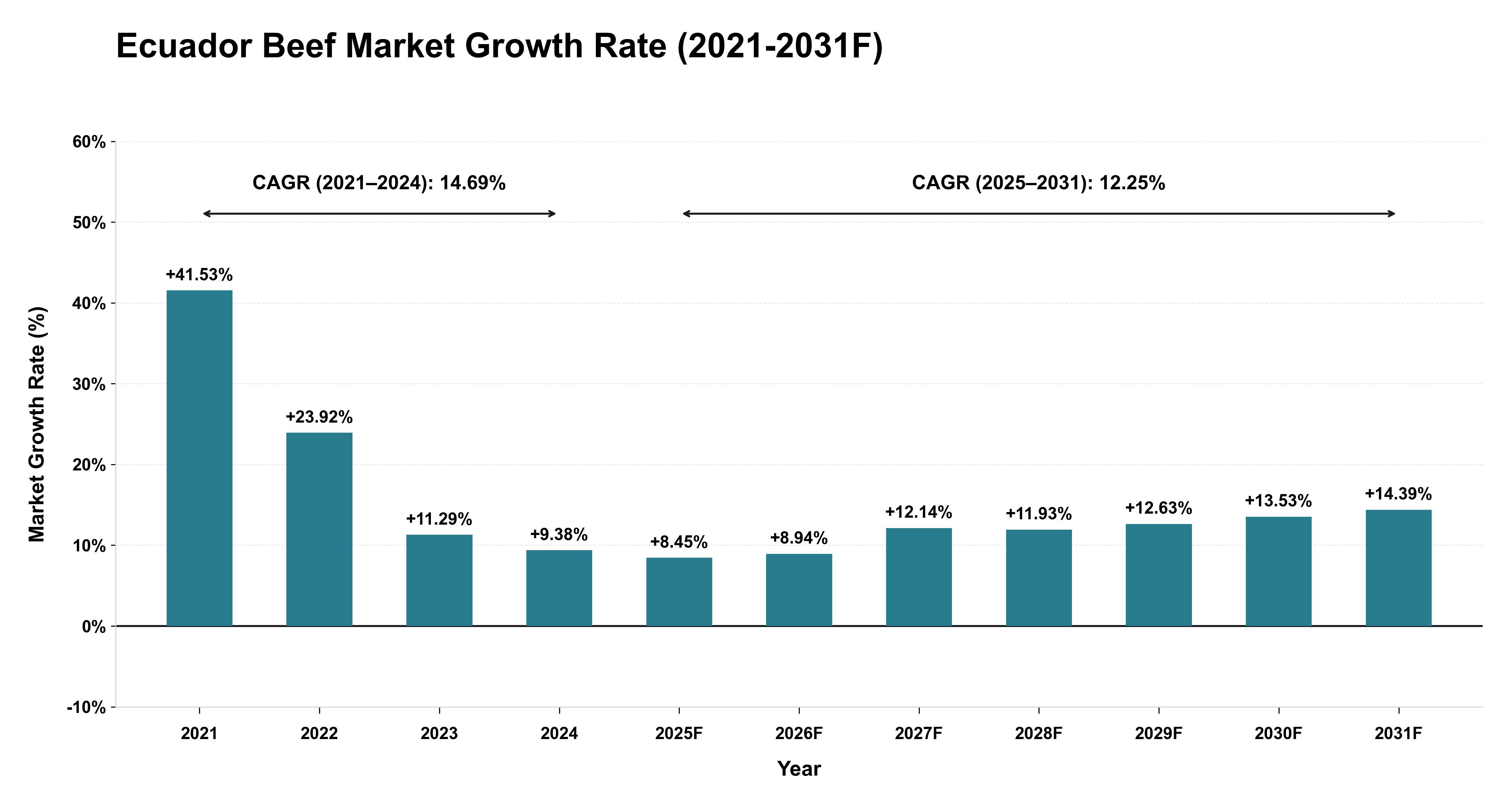
The Ecuador Beef Market witnessed robust growth from 2021 to 2024, with a significant CAGR of 14.69%. This surge was driven by increasing domestic consumption, export demand, and technological advancements in production. However, starting in 2025, the growth rate gradually decelerated, reflecting stabilizing demand and supply dynamics within the industry. Despite this slowdown, the market maintained a steady pace with growth rates ranging between 8.45% and 12.14%. Looking ahead to 2031, the market is expected to continue expanding at a more moderate pace with a forecasted CAGR of 12.25%, indicating sustained but slightly slower growth compared to the previous period. This trajectory suggests a maturing market with stable demand drivers and a more balanced supply chain response to meet consumer needs efficiently.
Key Highlights of the Report:
- Ecuador Beef Market Outlook
- Market Size of Ecuador Beef Market, 2024
- Forecast of Ecuador Beef Market, 2031
- Historical Data and Forecast of Ecuador Beef Revenues & Volume for the Period 2021-2031
- Ecuador Beef Market Trend Evolution
- Ecuador Beef Market Drivers and Challenges
- Ecuador Beef Price Trends
- Ecuador Beef Porter`s Five Forces
- Ecuador Beef Industry Life Cycle
- Historical Data and Forecast of Ecuador Beef Market Revenues & Volume By Beef Cut for the Period 2021-2031
- Historical Data and Forecast of Ecuador Beef Market Revenues & Volume By Brisket for the Period 2021-2031
- Historical Data and Forecast of Ecuador Beef Market Revenues & Volume By Shank for the Period 2021-2031
- Historical Data and Forecast of Ecuador Beef Market Revenues & Volume By Loin for the Period 2021-2031
- Historical Data and Forecast of Ecuador Beef Market Revenues & Volume By Others for the Period 2021-2031
- Historical Data and Forecast of Ecuador Beef Market Revenues & Volume By Beef Slaughter Method for the Period 2021-2031
- Historical Data and Forecast of Ecuador Beef Market Revenues & Volume By Kosher for the Period 2021-2031
- Historical Data and Forecast of Ecuador Beef Market Revenues & Volume By Halal for the Period 2021-2031
- Historical Data and Forecast of Ecuador Beef Market Revenues & Volume By Others for the Period 2021-2031
- Ecuador Beef Import Export Trade Statistics
- Market Opportunity Assessment By Beef Cut
- Market Opportunity Assessment By Beef Slaughter Method
- Ecuador Beef Top Companies Market Share
- Ecuador Beef Competitive Benchmarking By Technical and Operational Parameters
- Ecuador Beef Company Profiles
- Ecuador Beef Key Strategic Recommendations






































