Ecuador Caviar Market Year-wise Growth Rate (2021-2031F)
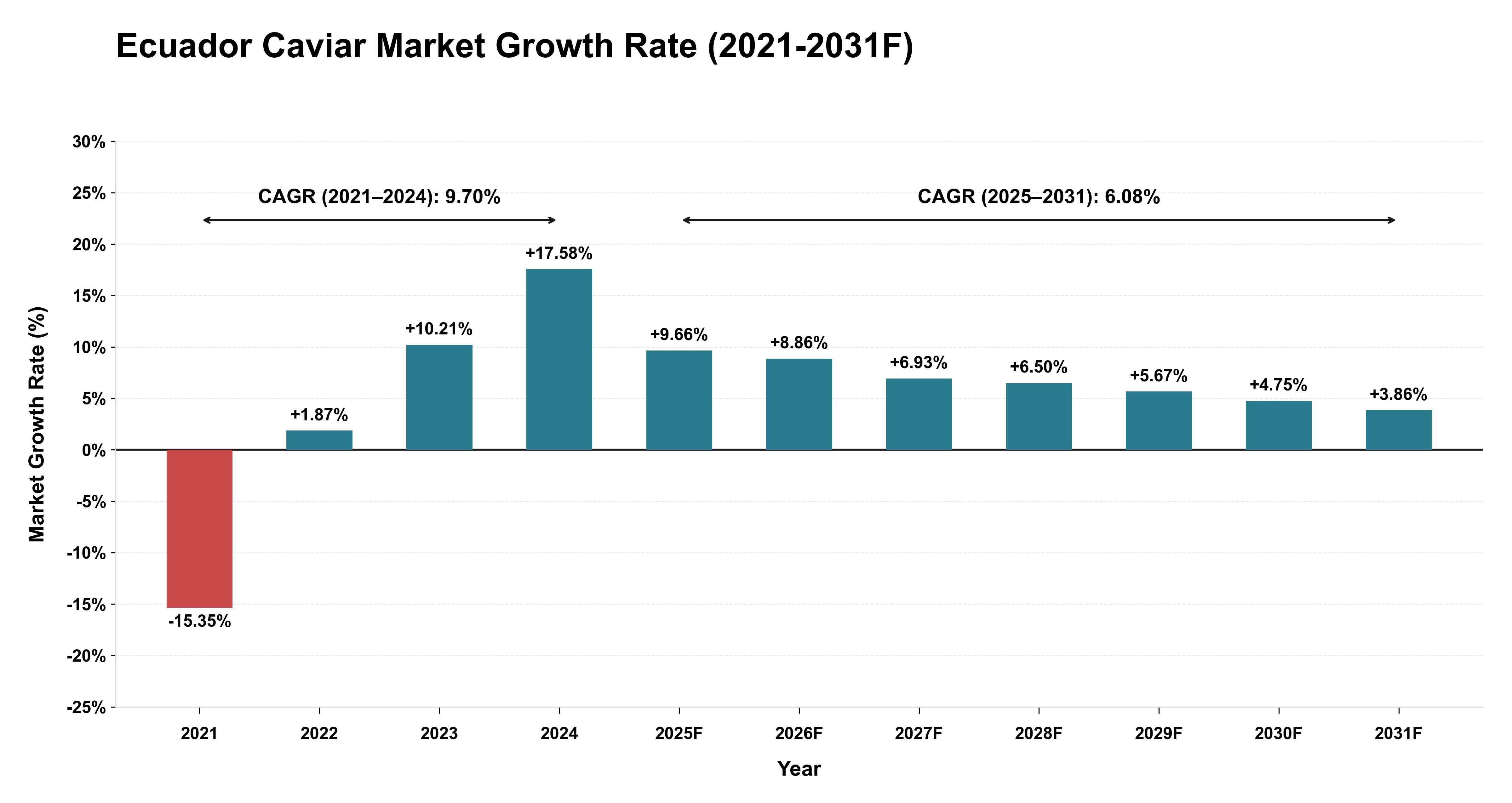
The Ecuador Caviar market experienced a tumultuous period from 2021 to 2024, marked by a significant contraction in 2021 followed by a gradual recovery with varying growth rates. The rebound in 2023 and 2024, with growth rates of 10.21% and 17.58% respectively, can be attributed to increased demand for luxury food products and possibly improved production efficiencies or market strategies. Looking ahead to 2025-2031, the market is forecasted to exhibit more stable growth, albeit at a slower pace with a CAGR of 6.08%. This deceleration could be due to factors such as evolving consumer preferences, changing competitive dynamics, or regulatory influences shaping the caviar industry in Ecuador. The decreasing growth trajectory indicates a shift towards a more mature and potentially competitive market landscape requiring strategic adaptation from industry players.
Ecuador Caviar Market Overview
The caviar market in Ecuador is gaining traction as consumer preferences shift towards gourmet and luxury food products. Ecuador`s unique aquaculture conditions enable the production of high-quality caviar. The increasing interest in culinary experiences and premium dining is driving demand for caviar, positioning it as an emerging market in the food industry.
Drivers of the market
The caviar market is influenced by the rising consumer demand for luxury food products and gourmet experiences. As the trend towards fine dining and premium food options grows, the market for caviar is expanding. Additionally, increasing awareness of the health benefits associated with caviar, such as its high omega-3 fatty acid content, is contributing to market growth.
Challenges of the market
The caviar market in Ecuador faces challenges with high production costs and limited consumer demand, as caviar is considered a luxury item. Import restrictions and limited local production also impact availability, while low awareness of the culinary uses of caviar affects market expansion.
Government Policy of the market
To promote Ecuadors aquaculture and luxury food markets, the government supports the production and export of caviar. Policies provide tax benefits and subsidies for sustainable fish farming practices, aligning with Ecuadors goals to expand its seafood industry and improve its position in global markets for premium products.
Key Highlights of the Report:
- Ecuador Caviar Market Outlook
- Market Size of Ecuador Caviar Market, 2024
- Forecast of Ecuador Caviar Market, 2031
- Historical Data and Forecast of Ecuador Caviar Revenues & Volume for the Period 2021-2031
- Ecuador Caviar Market Trend Evolution
- Ecuador Caviar Market Drivers and Challenges
- Ecuador Caviar Price Trends
- Ecuador Caviar Porter`s Five Forces
- Ecuador Caviar Industry Life Cycle
- Historical Data and Forecast of Ecuador Caviar Market Revenues & Volume By Product for the Period 2021-2031
- Historical Data and Forecast of Ecuador Caviar Market Revenues & Volume By Sevruga for the Period 2021-2031
- Historical Data and Forecast of Ecuador Caviar Market Revenues & Volume By Osetra for the Period 2021-2031
- Historical Data and Forecast of Ecuador Caviar Market Revenues & Volume By Salmon for the Period 2021-2031
- Historical Data and Forecast of Ecuador Caviar Market Revenues & Volume By Sushi for the Period 2021-2031
- Historical Data and Forecast of Ecuador Caviar Market Revenues & Volume By Others for the Period 2021-2031
- Historical Data and Forecast of Ecuador Caviar Market Revenues & Volume By Form for the Period 2021-2031
- Historical Data and Forecast of Ecuador Caviar Market Revenues & Volume By Fresh for the Period 2021-2031
- Historical Data and Forecast of Ecuador Caviar Market Revenues & Volume By Dried for the Period 2021-2031
- Historical Data and Forecast of Ecuador Caviar Market Revenues & Volume By Preserved & Frozen for the Period 2021-2031
- Historical Data and Forecast of Ecuador Caviar Market Revenues & Volume By Application for the Period 2021-2031
- Historical Data and Forecast of Ecuador Caviar Market Revenues & Volume By Restaurants for the Period 2021-2031
- Historical Data and Forecast of Ecuador Caviar Market Revenues & Volume By Household for the Period 2021-2031
- Ecuador Caviar Import Export Trade Statistics
- Market Opportunity Assessment By Product
- Market Opportunity Assessment By Form
- Market Opportunity Assessment By Application
- Ecuador Caviar Top Companies Market Share
- Ecuador Caviar Competitive Benchmarking By Technical and Operational Parameters
- Ecuador Caviar Company Profiles
- Ecuador Caviar Key Strategic Recommendations






































