Ecuador Lactase Market Top 5 Importing Countries and Market Competition (HHI) Analysis
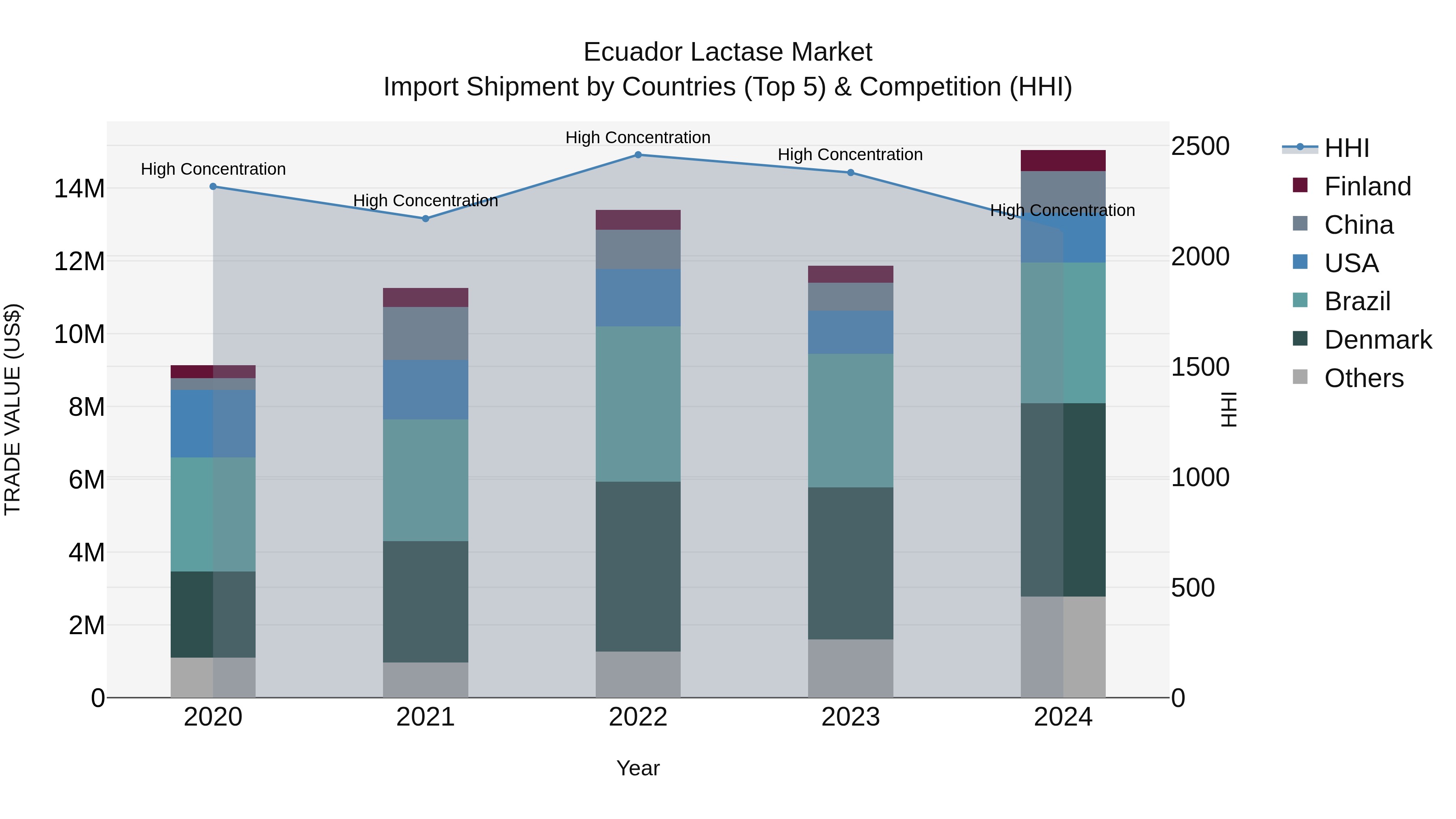
Ecuador`s lactase import Market Top 5 Importing Countries and Market Competition (HHI) Analysis continues to thrive, with key suppliers in 2024 being Denmark, Brazil, USA, China, and Spain. The high Herfindahl-Hirschman Index (HHI) indicates a concentrated Market Top 5 Importing Countries and Market Competition (HHI) Analysis, while the impressive Compound Annual Growth Rate (CAGR) of 13.3% from 2020 to 2024 underscores sustained demand. Notably, the robust growth rate of 26.74% from 2023 to 2024 signals accelerating momentum in the sector. As Ecuador`s appetite for lactase products grows, opportunities for suppliers to capitalize on this trend are abundant.
Ecuador Lactase Market Overview
The lactase market in Ecuador is growing as lactose intolerance awareness rises among consumers. Lactase enzymes allow lactose-intolerant individuals to digest dairy, expanding their dietary options. Ecuadorian dietary supplement companies and dairy producers are increasingly incorporating lactase in their products, catering to the needs of a health-conscious population.
Drivers of the market
The lactase market in Ecuador is driven by the increasing awareness of lactose intolerance among the population. As more individuals seek solutions to manage their lactose sensitivity, the demand for lactase supplements and lactase-treated dairy products grows. Additionally, the rising trend of health-conscious consumption and the focus on digestive health further enhance market dynamics. The expansion of dairy alternatives and the introduction of innovative lactase products contribute to the market potential, as consumers seek enjoyable dairy experiences without discomfort.
Challenges of the market
The lactase market encounters challenges related to consumer awareness and competition. While lactase supplements are essential for individuals with lactose intolerance, many consumers may not fully understand their benefits and applications. Educating potential customers about the advantages of lactase in promoting digestive health is critical for driving adoption. Additionally, the market faces competition from alternative digestive aids, necessitating differentiation in product offerings. Ensuring product quality and reliability is crucial for maintaining consumer trust and market credibility.
Government Policy of the market
Ecuador`s government is committed to promoting the lactase market to support individuals with lactose intolerance. Policies are being implemented to encourage the local production of lactase products that comply with food safety regulations. The government supports research initiatives aimed at exploring the health benefits of lactase supplementation. Public awareness campaigns will educate consumers about the importance of lactase for improving digestive health.
Key Highlights of the Report:
- Ecuador Lactase Market Outlook
- Market Size of Ecuador Lactase Market, 2024
- Forecast of Ecuador Lactase Market, 2031
- Historical Data and Forecast of Ecuador Lactase Revenues & Volume for the Period 2021-2031
- Ecuador Lactase Market Trend Evolution
- Ecuador Lactase Market Drivers and Challenges
- Ecuador Lactase Price Trends
- Ecuador Lactase Porter`s Five Forces
- Ecuador Lactase Industry Life Cycle
- Historical Data and Forecast of Ecuador Lactase Market Revenues & Volume By Source for the Period 2021-2031
- Historical Data and Forecast of Ecuador Lactase Market Revenues & Volume By Yeast for the Period 2021-2031
- Historical Data and Forecast of Ecuador Lactase Market Revenues & Volume By Fungi for the Period 2021-2031
- Historical Data and Forecast of Ecuador Lactase Market Revenues & Volume By Bacteria for the Period 2021-2031
- Historical Data and Forecast of Ecuador Lactase Market Revenues & Volume By Form for the Period 2021-2031
- Historical Data and Forecast of Ecuador Lactase Market Revenues & Volume By Liquid for the Period 2021-2031
- Historical Data and Forecast of Ecuador Lactase Market Revenues & Volume By Dry for the Period 2021-2031
- Historical Data and Forecast of Ecuador Lactase Market Revenues & Volume By Application for the Period 2021-2031
- Historical Data and Forecast of Ecuador Lactase Market Revenues & Volume By Food & Beverages for the Period 2021-2031
- Historical Data and Forecast of Ecuador Lactase Market Revenues & Volume By Pharmaceutical products & Dietary Supplements for the Period 2021-2031
- Ecuador Lactase Import Export Trade Statistics
- Market Opportunity Assessment By Source
- Market Opportunity Assessment By Form
- Market Opportunity Assessment By Application
- Ecuador Lactase Top Companies Market Share
- Ecuador Lactase Competitive Benchmarking By Technical and Operational Parameters
- Ecuador Lactase Company Profiles
- Ecuador Lactase Key Strategic Recommendations






































