Estonia High Strength Steel Market Top 5 Importing Countries and Market Competition (HHI) Analysis
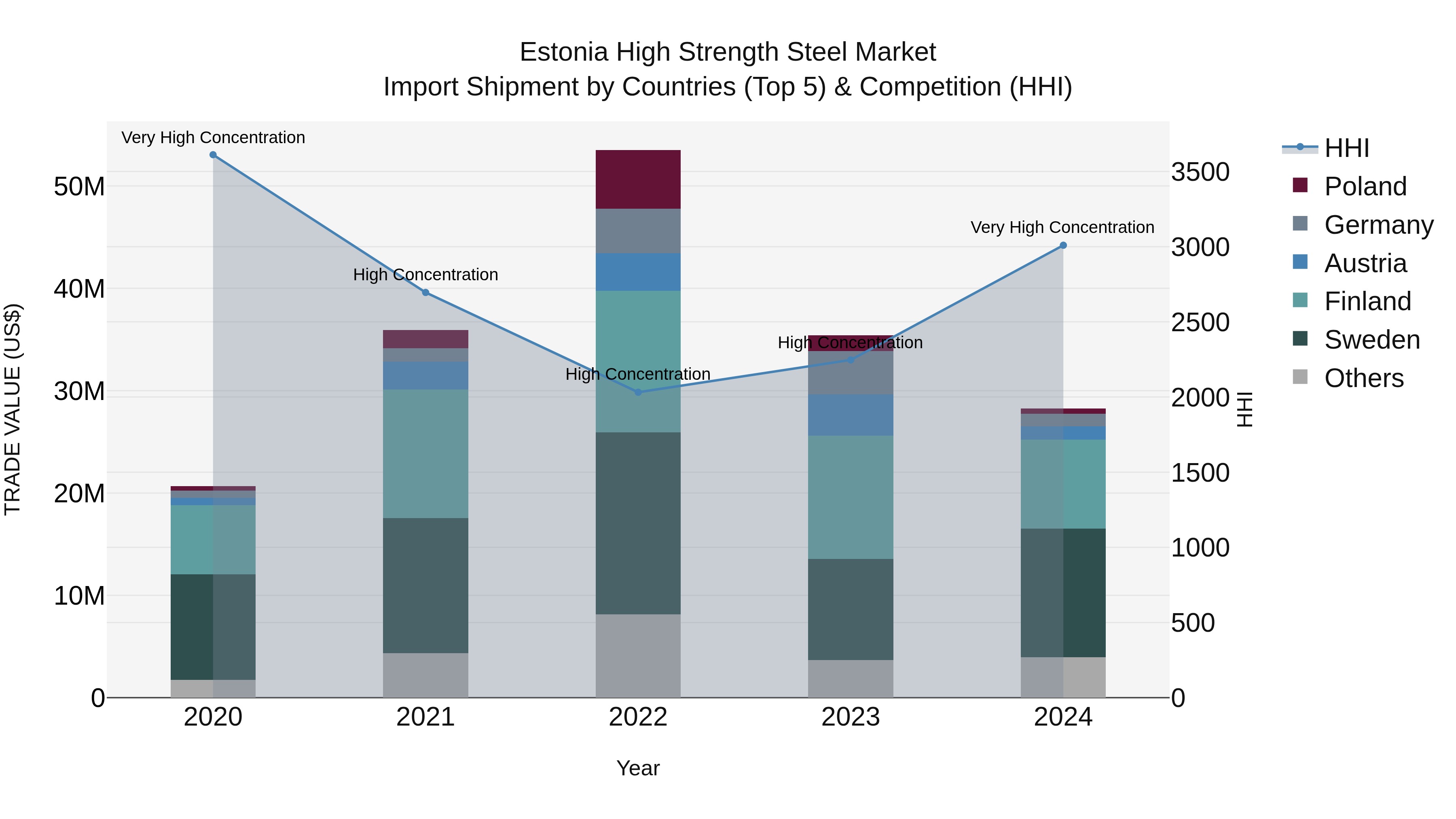
Estonia experienced a significant increase in high strength steel import shipments in 2024, with top exporting countries being Sweden, Finland, Latvia, Austria, and Germany. The market concentration, as measured by the HHI, saw a notable rise from high to very high in 2024. Despite a negative growth rate from 2023 to 2024, the compound annual growth rate (CAGR) for the period 2020-24 remained strong at 8.16%. This data suggests a competitive market landscape and a promising outlook for high strength steel imports in Estonia.
Estonia High Strength Steel Market Overview
The high-strength steel market in Estonia is growing in line with the country`s expanding construction and automotive industries. High-strength steel is crucial for producing lightweight, durable structures and components. With Estonia`s focus on infrastructure development and the automotive industry`s push for lighter and more efficient vehicles, the high-strength steel market is expected to see continued growth.
Drivers of the market
High-strength steel is in demand in Estonia due to its application in the automotive and construction sectors, where durability and performance under stress are essential. As industries continue to push for stronger, lighter materials to improve fuel efficiency and safety in vehicles, high-strength steel remains a preferred choice. Estonias robust manufacturing industry, combined with its strategic location within Europe, makes it a key market for high-strength steel used in heavy machinery, infrastructure projects, and advanced automotive designs.
Challenges of the market
The high-speed steel (HSS) market in Estonia faces challenges in terms of global competition and raw material price volatility. As a premium product, HSS is subject to fluctuations in the prices of key materials, such as tungsten and molybdenum. Moreover, technological advancements in alternative materials, such as carbide and ceramic cutting tools, pose a threat to traditional high-speed steel products. Market players must continually innovate and improve HSS properties to maintain their competitive edge.
Government Policy of the market
Estonias policies in the high-strength steel market support the adoption of advanced steel materials for use in industries such as automotive, construction, and infrastructure. The government encourages the use of high-strength steel to improve energy efficiency and reduce carbon emissions in line with EU sustainability goals.
Key Highlights of the Report:
- Estonia High Strength Steel Market Outlook
- Market Size of Estonia High Strength Steel Market, 2024
- Forecast of Estonia High Strength Steel Market, 2031
- Historical Data and Forecast of Estonia High Strength Steel Revenues & Volume for the Period 2021-2031
- Estonia High Strength Steel Market Trend Evolution
- Estonia High Strength Steel Market Drivers and Challenges
- Estonia High Strength Steel Price Trends
- Estonia High Strength Steel Porter`s Five Forces
- Estonia High Strength Steel Industry Life Cycle
- Historical Data and Forecast of Estonia High Strength Steel Market Revenues & Volume By Product Type for the Period 2021-2031
- Historical Data and Forecast of Estonia High Strength Steel Market Revenues & Volume By Dual Phase Steel for the Period 2021-2031
- Historical Data and Forecast of Estonia High Strength Steel Market Revenues & Volume By Bake Hardenable Steel for the Period 2021-2031
- Historical Data and Forecast of Estonia High Strength Steel Market Revenues & Volume By Carbon Manganese Steel for the Period 2021-2031
- Historical Data and Forecast of Estonia High Strength Steel Market Revenues & Volume By Other Product Types for the Period 2021-2031
- Historical Data and Forecast of Estonia High Strength Steel Market Revenues & Volume By Application for the Period 2021-2031
- Historical Data and Forecast of Estonia High Strength Steel Market Revenues & Volume By Automotive for the Period 2021-2031
- Historical Data and Forecast of Estonia High Strength Steel Market Revenues & Volume By Construction for the Period 2021-2031
- Historical Data and Forecast of Estonia High Strength Steel Market Revenues & Volume By Yellow Goods and Mining Equipment for the Period 2021-2031
- Historical Data and Forecast of Estonia High Strength Steel Market Revenues & Volume By Aviation and Marine for the Period 2021-2031
- Historical Data and Forecast of Estonia High Strength Steel Market Revenues & Volume By Other Applications for the Period 2021-2031
- Estonia High Strength Steel Import Export Trade Statistics
- Market Opportunity Assessment By Product Type
- Market Opportunity Assessment By Application
- Estonia High Strength Steel Top Companies Market Share
- Estonia High Strength Steel Competitive Benchmarking By Technical and Operational Parameters
- Estonia High Strength Steel Company Profiles
- Estonia High Strength Steel Key Strategic Recommendations






































