Estonia Maple Syrup Market Top 5 Importing Countries and Market Competition (HHI) Analysis
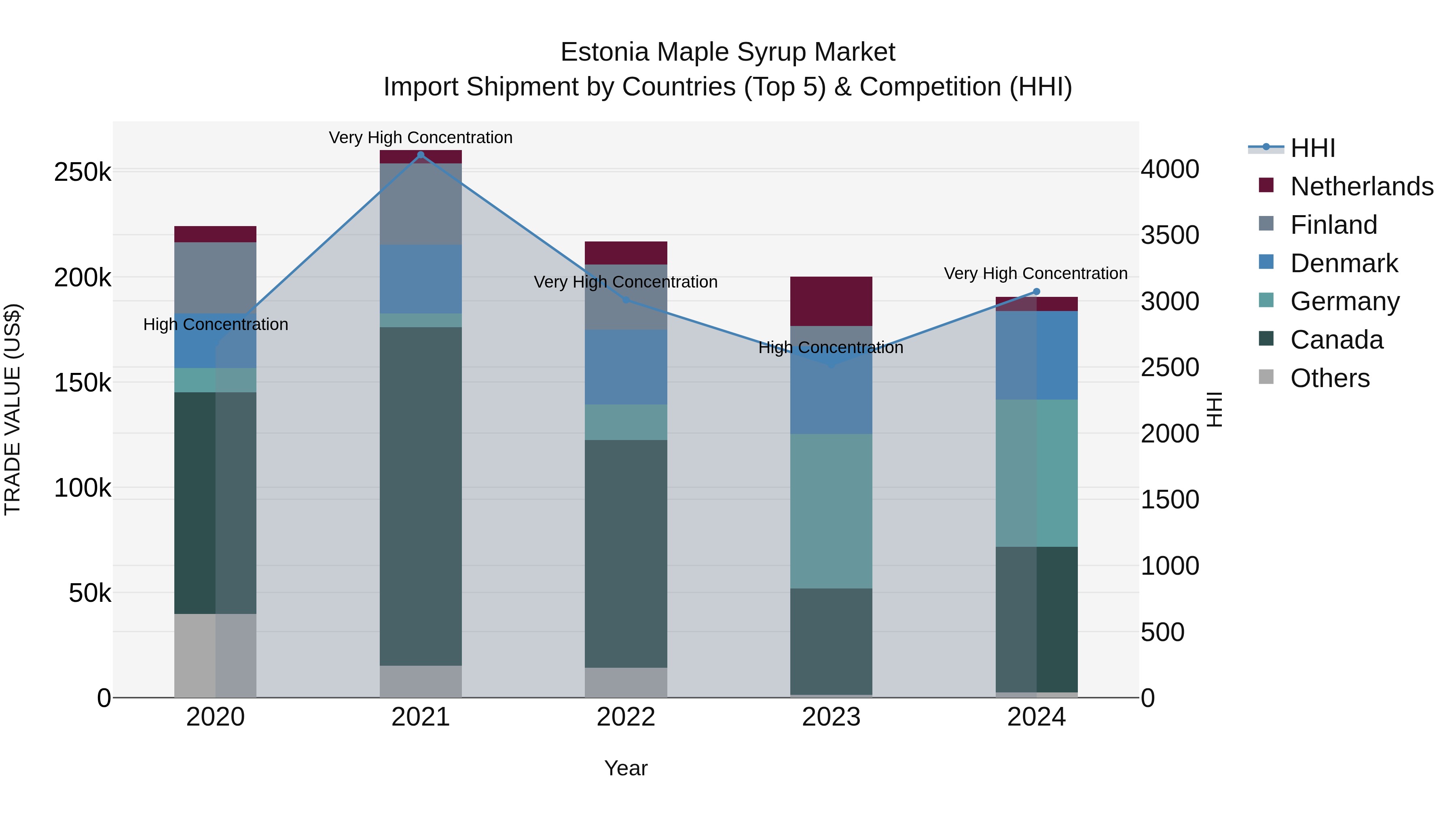
In 2024, Estonia saw an increase in maple syrup import shipments from top exporting countries such as Germany, Canada, Denmark, Netherlands, and Mexico. The high concentration of Herfindahl-Hirschman Index (HHI) in 2023 escalated to very high concentration in 2024, indicating a more consolidated market. Despite a negative Compound Annual Growth Rate (CAGR) of -3.97% from 2020 to 2024, the growth rate improved slightly in 2024 with a decrease of -4.8% compared to the previous year. This suggests a challenging market environment but also hints at potential stabilization in the future.
Estonia Maple syrup Market Overview
The maple syrup market in Estonia is growing as consumer preferences shift toward natural and organic sweeteners. Maple syrup, known for its rich flavor and health benefits, is increasingly popular as an alternative to refined sugars and artificial sweeteners. While Estonia does not produce maple syrup on a large scale, there is a rising demand for imported maple syrup, particularly in the premium food sector. The market is driven by the health-conscious trend, with consumers seeking out organic and sustainably sourced products. The demand for maple syrup in Estonia is also supported by growing interest in international cuisines and breakfast products.
Drivers of the market
The Estonia maple syrup market is driven by growing consumer interest in natural and organic sweeteners as healthier alternatives to refined sugar. Maple syrup, known for its unique flavor and natural composition, is gaining popularity among consumers who seek authentic, minimally processed food products. As Estonian consumers become more health-conscious and environmentally aware, the demand for organic and sustainably sourced maple syrup rises. Additionally, the expanding culinary use of maple syrup in baking, beverages, and sauces boosts its market growth.
Challenges of the market
The Estonia Maple Syrup Market is faced with challenges related to sourcing and pricing. Maple syrup is not native to Estonia, so there is a reliance on imports, and the supply chain is vulnerable to fluctuations in the production levels from key producing regions like Canada and the U.S. Additionally, there is growing competition from cheaper, artificial syrups, which pressure the market to reduce prices. Moreover, consumer awareness regarding the health benefits of maple syrup versus alternatives remains a challenge in growing demand.
Government Policy of the market
The government encourages the maple syrup market by promoting imports and fostering trade relations with key producers. Policies focus on ensuring product quality and compliance with EU food safety standards to meet consumer demand.
Key Highlights of the Report:
- Estonia Maple syrup Market Outlook
- Market Size of Estonia Maple syrup Market, 2024
- Forecast of Estonia Maple syrup Market, 2031
- Historical Data and Forecast of Estonia Maple syrup Revenues & Volume for the Period 2021-2031
- Estonia Maple syrup Market Trend Evolution
- Estonia Maple syrup Market Drivers and Challenges
- Estonia Maple syrup Price Trends
- Estonia Maple syrup Porter`s Five Forces
- Estonia Maple syrup Industry Life Cycle
- Historical Data and Forecast of Estonia Maple syrup Market Revenues & Volume By Raw Material for the Period 2021-2031
- Historical Data and Forecast of Estonia Maple syrup Market Revenues & Volume By Red Maple for the Period 2021-2031
- Historical Data and Forecast of Estonia Maple syrup Market Revenues & Volume By Black Maple for the Period 2021-2031
- Historical Data and Forecast of Estonia Maple syrup Market Revenues & Volume By Sugar Maple for the Period 2021-2031
- Historical Data and Forecast of Estonia Maple syrup Market Revenues & Volume By Application for the Period 2021-2031
- Historical Data and Forecast of Estonia Maple syrup Market Revenues & Volume By Baking Powder for the Period 2021-2031
- Historical Data and Forecast of Estonia Maple syrup Market Revenues & Volume By Waffles for the Period 2021-2031
- Historical Data and Forecast of Estonia Maple syrup Market Revenues & Volume By Pancakes for the Period 2021-2031
- Historical Data and Forecast of Estonia Maple syrup Market Revenues & Volume By French Toast for the Period 2021-2031
- Historical Data and Forecast of Estonia Maple syrup Market Revenues & Volume By Oatmeal for the Period 2021-2031
- Historical Data and Forecast of Estonia Maple syrup Market Revenues & Volume By Distribution Channel for the Period 2021-2031
- Historical Data and Forecast of Estonia Maple syrup Market Revenues & Volume By Online Stores for the Period 2021-2031
- Historical Data and Forecast of Estonia Maple syrup Market Revenues & Volume By Retail Stores for the Period 2021-2031
- Historical Data and Forecast of Estonia Maple syrup Market Revenues & Volume By Super/Hypermarket for the Period 2021-2031
- Estonia Maple syrup Import Export Trade Statistics
- Market Opportunity Assessment By Raw Material
- Market Opportunity Assessment By Application
- Market Opportunity Assessment By Distribution Channel
- Estonia Maple syrup Top Companies Market Share
- Estonia Maple syrup Competitive Benchmarking By Technical and Operational Parameters
- Estonia Maple syrup Company Profiles
- Estonia Maple syrup Key Strategic Recommendations






































