Estonia Modular Kitchen Market Top 5 Importing Countries and Market Competition (HHI) Analysis
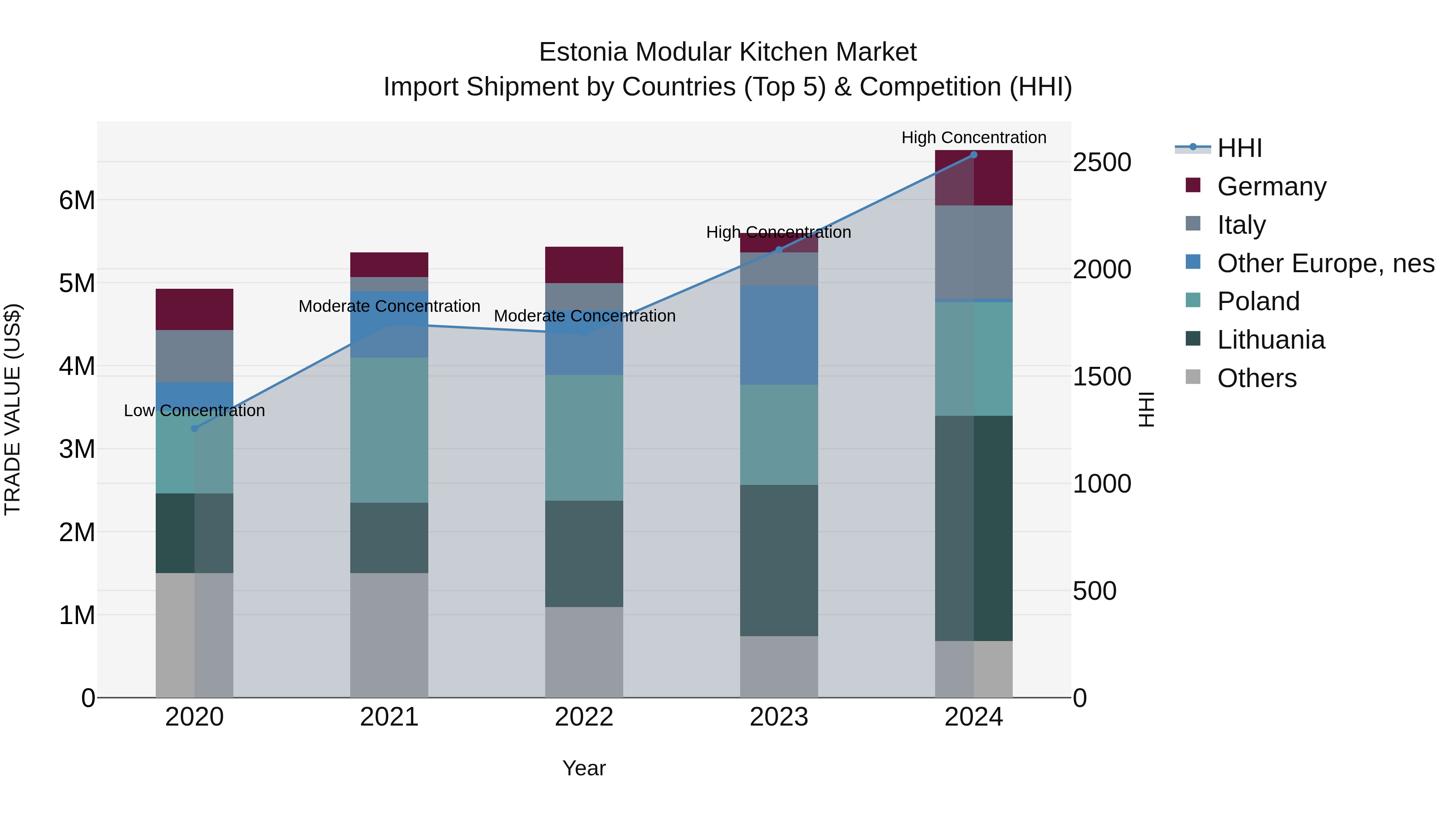
Estonia`s modular kitchen import market continues to thrive, with significant contributions from key exporting countries such as Lithuania, Poland, Italy, Germany, and Ukraine. The high Herfindahl-Hirschman Index (HHI) indicates a concentrated market, while the impressive Compound Annual Growth Rate (CAGR) of 7.58% from 2020 to 2024 reflects sustained industry expansion. Notably, the growth rate spiked to 17.81% in 2024, underscoring the increasing demand for modular kitchen solutions in Estonia. This data suggests a promising outlook for the import market, with opportunities for continued growth and development in the coming years.
Estonia Modular Kitchen Market Overview
The modular kitchen market in Estonia is experiencing growth as homeowners and businesses seek efficient, customizable, and space-saving kitchen solutions. Modular kitchens offer flexibility in design and are easy to install, making them a popular choice for both residential and commercial properties. As urbanization continues and the demand for modern kitchen designs increases, the modular kitchen market in Estonia is expected to grow, with an emphasis on aesthetics, functionality, and eco-friendly materials.
Drivers of the market
The demand for customizable, space-efficient, and modern kitchen designs is propelling the modular kitchen market in Estonia. As consumers place greater emphasis on functionality, design, and storage efficiency in home renovations, modular kitchens provide a flexible solution that can be tailored to meet individual preferences. The market is further supported by rising disposable incomes, urbanization, and the growing trend of home remodeling. Moreover, the sustainability factor plays a role as modular kitchens often utilize environmentally friendly materials and designs.
Challenges of the market
The modular kitchen market in Estonia faces challenges related to the rising demand for personalized and customized kitchen solutions. While modular kitchens offer flexibility, consumers often expect a high degree of customization, which can drive up costs and complexity for manufacturers. Additionally, competition from imported products, which may be cheaper or more readily available, creates pressure on local manufacturers. The fluctuating costs of raw materials, such as wood and metal, also affect pricing and profitability in this market.
Government Policy of the market
The Estonian government supports sustainable building practices and innovation in the modular kitchen market. Policies encourage the development and use of modular kitchen systems that are adaptable, energy-efficient, and environmentally friendly. This includes standards for materials, energy consumption, and waste reduction, aimed at creating sustainable kitchen designs that are widely accessible.
Key Highlights of the Report:
- Estonia Modular Kitchen Market Outlook
- Market Size of Estonia Modular Kitchen Market, 2024
- Forecast of Estonia Modular Kitchen Market, 2031
- Historical Data and Forecast of Estonia Modular Kitchen Revenues & Volume for the Period 2021-2031
- Estonia Modular Kitchen Market Trend Evolution
- Estonia Modular Kitchen Market Drivers and Challenges
- Estonia Modular Kitchen Price Trends
- Estonia Modular Kitchen Porter`s Five Forces
- Estonia Modular Kitchen Industry Life Cycle
- Historical Data and Forecast of Estonia Modular Kitchen Market Revenues & Volume By Product for the Period 2021-2031
- Historical Data and Forecast of Estonia Modular Kitchen Market Revenues & Volume By Floor Cabinet & Wall Cabinets for the Period 2021-2031
- Historical Data and Forecast of Estonia Modular Kitchen Market Revenues & Volume By Tall Storage Cabinets for the Period 2021-2031
- Historical Data and Forecast of Estonia Modular Kitchen Market Revenues & Volume By Others for the Period 2021-2031
- Historical Data and Forecast of Estonia Modular Kitchen Market Revenues & Volume By End-User for the Period 2021-2031
- Historical Data and Forecast of Estonia Modular Kitchen Market Revenues & Volume By Residential for the Period 2021-2031
- Historical Data and Forecast of Estonia Modular Kitchen Market Revenues & Volume By Commercial for the Period 2021-2031
- Historical Data and Forecast of Estonia Modular Kitchen Market Revenues & Volume By Distribution Channel for the Period 2021-2031
- Historical Data and Forecast of Estonia Modular Kitchen Market Revenues & Volume By Offline (Contractors, Builders, and Others) for the Period 2021-2031
- Historical Data and Forecast of Estonia Modular Kitchen Market Revenues & Volume By Online for the Period 2021-2031
- Estonia Modular Kitchen Import Export Trade Statistics
- Market Opportunity Assessment By Product
- Market Opportunity Assessment By End-User
- Market Opportunity Assessment By Distribution Channel
- Estonia Modular Kitchen Top Companies Market Share
- Estonia Modular Kitchen Competitive Benchmarking By Technical and Operational Parameters
- Estonia Modular Kitchen Company Profiles
- Estonia Modular Kitchen Key Strategic Recommendations






































