Estonia Molasses Market Top 5 Importing Countries and Market Competition (HHI) Analysis
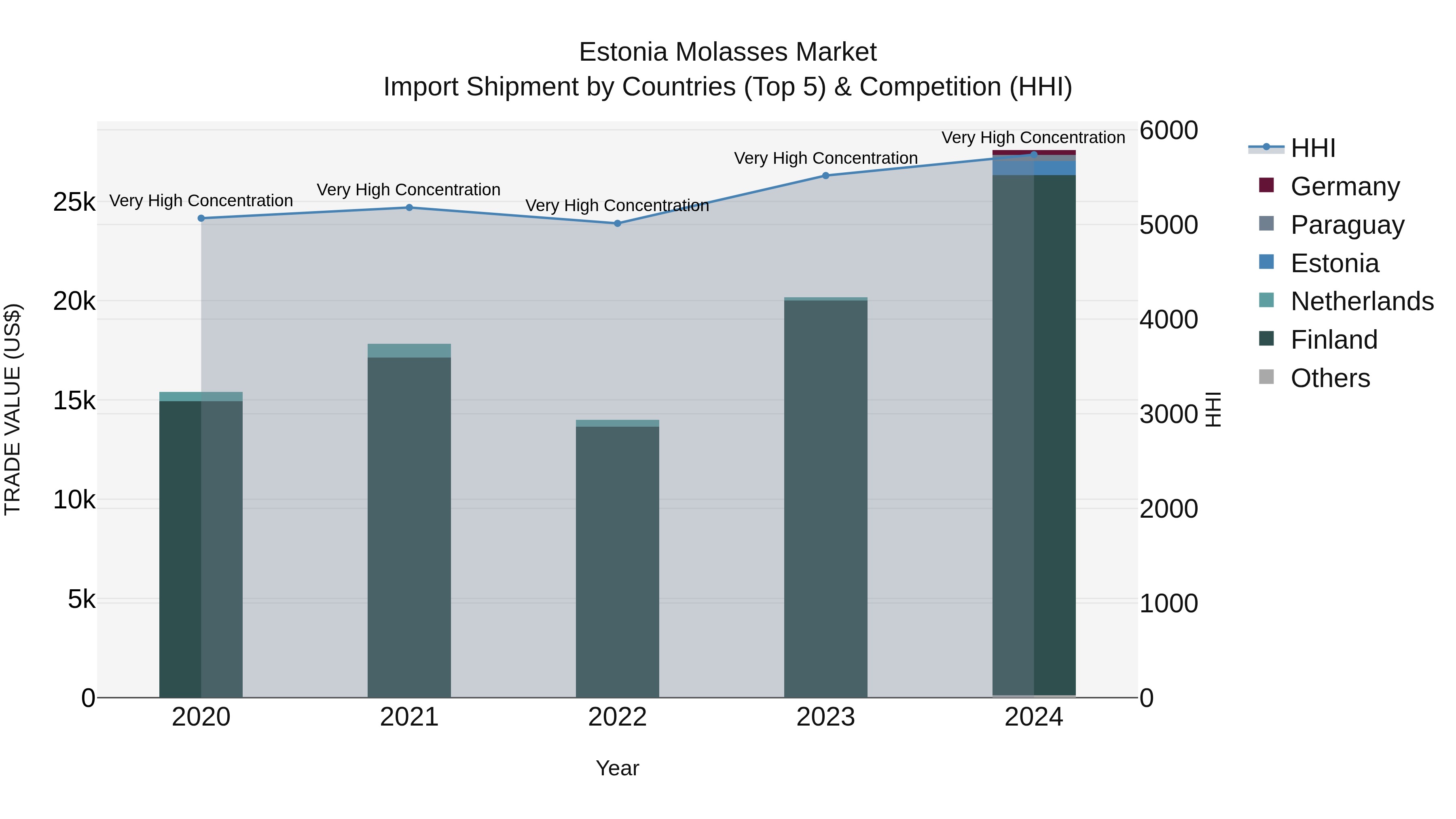
Estonia`s molasses import market in 2024 continues to showcase strong growth, with top exporting countries including Finland, Estonia, Paraguay, Germany, and the USA. The high Herfindahl-Hirschman Index (HHI) indicates a concentrated market, while the impressive Compound Annual Growth Rate (CAGR) of 15.67% from 2020-2024 underscores a thriving industry. Notably, the exceptional growth rate of 36.69% in 2024 signals a dynamic and evolving market landscape, offering lucrative opportunities for stakeholders in the molasses import sector.
Estonia Molasses Market Overview
The molasses market in Estonia is growing due to the increasing use of molasses in food production, animal feed, and the biofuel industry. Molasses is a by-product of sugar production and is highly valued for its nutritional content and versatility. As the demand for sustainable agricultural practices and biofuels increases, the molasses market in Estonia is expected to expand, driven by both domestic production and imports for various industrial uses.
Drivers of the market
The molasses market in Estonia is largely driven by its use as a raw material in the food and beverage industry, as well as in the production of biofuels and animal feed. As the global demand for bioethanol increases, Estonia`s growing focus on renewable energy sources has boosted the demand for molasses as a biofuel. Additionally, the agricultural sector in Estonia continues to support the use of molasses in animal feed and as a sweetener in various products. The increasing interest in sustainable and natural ingredients in the food industry also promotes molasses demand.
Challenges of the market
The molasses market in Estonia faces challenges related to fluctuations in production due to variations in agricultural yields. Molasses is a byproduct of sugar production, and its availability is tied to the sugar industry, which can experience market instability. Additionally, the use of molasses as an ingredient in biofuels or animal feed faces competition from other, more widely available alternatives. Environmental concerns around the processing and disposal of molasses waste can also impact market dynamics, with increased scrutiny on sustainable practices.
Government Policy of the market
Estonian government policies on the molasses market focus on supporting sustainable agricultural practices, resource efficiency, and food production. The government provides funding and regulatory support for research and development in the molasses industry, including improving extraction processes, product utilization, and reducing environmental impact.
Key Highlights of the Report:
- Estonia Molasses Market Outlook
- Market Size of Estonia Molasses Market, 2024
- Forecast of Estonia Molasses Market, 2031
- Historical Data and Forecast of Estonia Molasses Revenues & Volume for the Period 2021-2031
- Estonia Molasses Market Trend Evolution
- Estonia Molasses Market Drivers and Challenges
- Estonia Molasses Price Trends
- Estonia Molasses Porter`s Five Forces
- Estonia Molasses Industry Life Cycle
- Historical Data and Forecast of Estonia Molasses Market Revenues & Volume By Source for the Period 2021-2031
- Historical Data and Forecast of Estonia Molasses Market Revenues & Volume By Sugarcane for the Period 2021-2031
- Historical Data and Forecast of Estonia Molasses Market Revenues & Volume By Sugarbeet for the Period 2021-2031
- Historical Data and Forecast of Estonia Molasses Market Revenues & Volume By Type for the Period 2021-2031
- Historical Data and Forecast of Estonia Molasses Market Revenues & Volume By Regular Molasses for the Period 2021-2031
- Historical Data and Forecast of Estonia Molasses Market Revenues & Volume By Blackstrap Molasses for the Period 2021-2031
- Historical Data and Forecast of Estonia Molasses Market Revenues & Volume By Nature for the Period 2021-2031
- Historical Data and Forecast of Estonia Molasses Market Revenues & Volume By Organic for the Period 2021-2031
- Historical Data and Forecast of Estonia Molasses Market Revenues & Volume By Conventional for the Period 2021-2031
- Historical Data and Forecast of Estonia Molasses Market Revenues & Volume By End-Use for the Period 2021-2031
- Historical Data and Forecast of Estonia Molasses Market Revenues & Volume By Industrial for the Period 2021-2031
- Historical Data and Forecast of Estonia Molasses Market Revenues & Volume By Commercial for the Period 2021-2031
- Historical Data and Forecast of Estonia Molasses Market Revenues & Volume By Household for the Period 2021-2031
- Historical Data and Forecast of Estonia Molasses Market Revenues & Volume By Sales Channel for the Period 2021-2031
- Historical Data and Forecast of Estonia Molasses Market Revenues & Volume By Direct for the Period 2021-2031
- Historical Data and Forecast of Estonia Molasses Market Revenues & Volume By Indirect for the Period 2021-2031
- Estonia Molasses Import Export Trade Statistics
- Market Opportunity Assessment By Source
- Market Opportunity Assessment By Type
- Market Opportunity Assessment By Nature
- Market Opportunity Assessment By End-Use
- Market Opportunity Assessment By Sales Channel
- Estonia Molasses Top Companies Market Share
- Estonia Molasses Competitive Benchmarking By Technical and Operational Parameters
- Estonia Molasses Company Profiles
- Estonia Molasses Key Strategic Recommendations






































