Estonia Transportation Composites Market Top 5 Importing Countries and Market Competition (HHI) Analysis
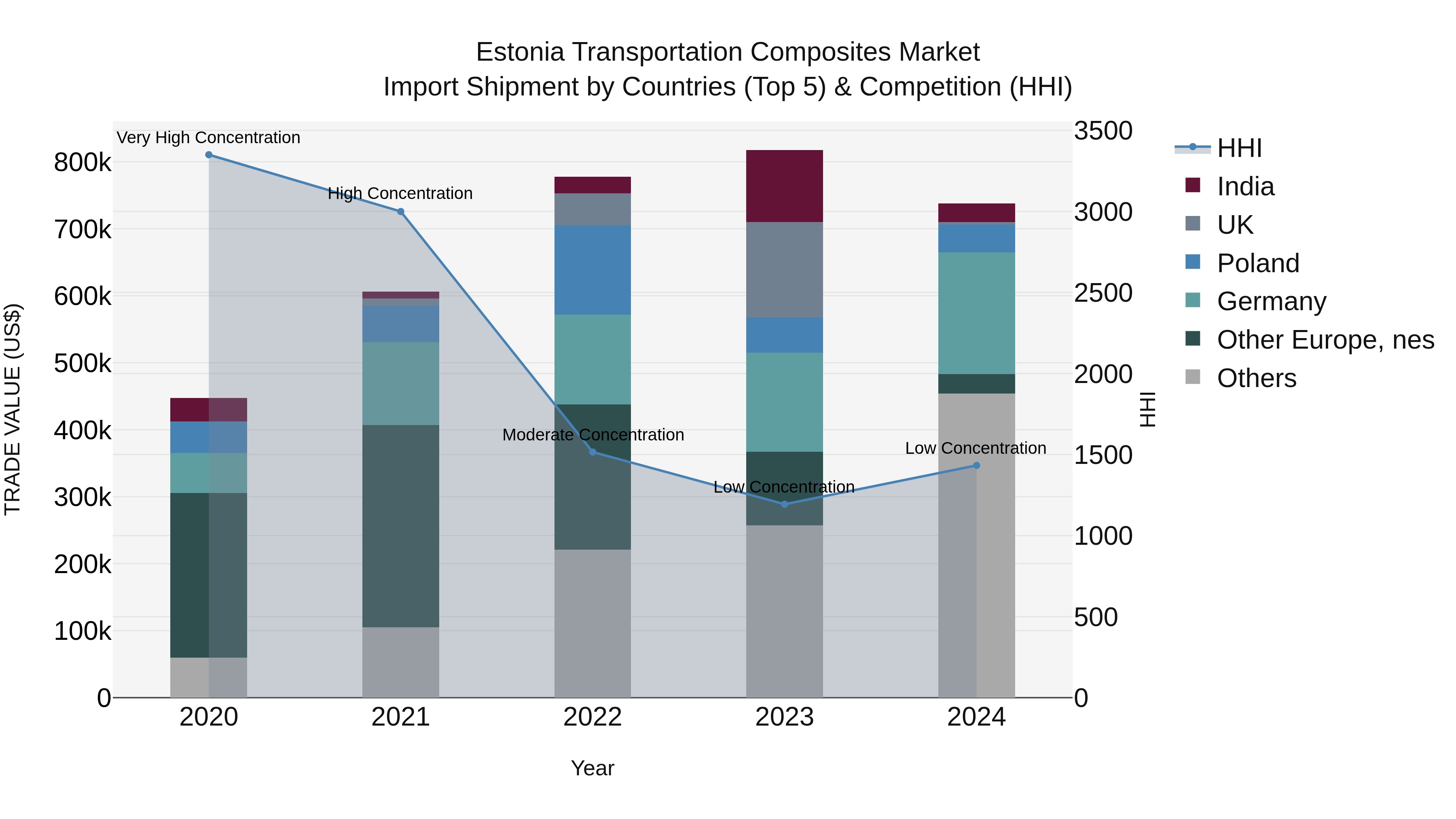
In 2024, Estonia saw a steady flow of transportation composites imports from top countries like Germany, Sweden, Norway, China, and Poland. The Herfindahl-Hirschman Index (HHI) indicated low market concentration, signaling a competitive import landscape. Despite a slight decline in growth rate from 2023 to 2024, the compound annual growth rate (CAGR) of 13.3% over the period 2020-24 reflects a promising upward trend in the Estonian transportation composites import market. This data suggests a dynamic and diverse import market, with opportunities for continued growth and market expansion in the coming years.
Estonia Transportation Composites Market Overview
The transportation composites market in Estonia is expanding as the demand for lightweight, strong, and durable materials grows in the automotive and aerospace industries. Transportation composites, such as carbon fiber and fiberglass, are used to reduce weight, improve fuel efficiency, and enhance the safety of vehicles and aircraft. As Estonias manufacturing and transportation sectors innovate to meet sustainability goals, the market for transportation composites is expected to grow, supported by advancements in material technologies and production methods.
Drivers of the market
The transportation composites market in Estonia is being propelled by the increasing demand for lightweight and durable materials in automotive and aerospace applications. Composites offer high strength-to-weight ratios, improving vehicle fuel efficiency and reducing emissions. Estonia`s commitment to green mobility, combined with advancements in manufacturing technologies such as automated fiber placement and 3D printing, is fostering the adoption of composites. Additionally, the expansion of the countrys logistics and public transportation sectors further supports this market`s growth.
Challenges of the market
The Estonia Transportation Composites Market faces challenges related to material costs, production scalability, and sustainability. Composites used in transportation applications, particularly in the automotive and aerospace industries, must provide a balance of strength, lightweight properties, and cost-efficiency. However, the cost of advanced composite materials, such as carbon fiber, remains high, limiting their widespread adoption. Scaling production to meet demand without compromising quality is also a challenge. Moreover, increasing pressure to develop more sustainable composites that can reduce the carbon footprint of transportation vehicles further complicates the market dynamics.
Government Policy of the market
The transportation composites market in Estonia benefits from policies supporting lightweight and high-strength materials for automotive and aerospace industries. Government initiatives promote R&D in advanced composite technologies.
Key Highlights of the Report:
- Estonia Transportation Composites Market Outlook
- Market Size of Estonia Transportation Composites Market, 2024
- Forecast of Estonia Transportation Composites Market, 2031
- Historical Data and Forecast of Estonia Transportation Composites Revenues & Volume for the Period 2021-2031
- Estonia Transportation Composites Market Trend Evolution
- Estonia Transportation Composites Market Drivers and Challenges
- Estonia Transportation Composites Price Trends
- Estonia Transportation Composites Porter`s Five Forces
- Estonia Transportation Composites Industry Life Cycle
- Historical Data and Forecast of Estonia Transportation Composites Market Revenues & Volume By Resin for the Period 2021-2031
- Historical Data and Forecast of Estonia Transportation Composites Market Revenues & Volume By Thermoplastic for the Period 2021-2031
- Historical Data and Forecast of Estonia Transportation Composites Market Revenues & Volume By Thermoset for the Period 2021-2031
- Historical Data and Forecast of Estonia Transportation Composites Market Revenues & Volume By Application for the Period 2021-2031
- Historical Data and Forecast of Estonia Transportation Composites Market Revenues & Volume By Interior for the Period 2021-2031
- Historical Data and Forecast of Estonia Transportation Composites Market Revenues & Volume By Exterior for the Period 2021-2031
- Historical Data and Forecast of Estonia Transportation Composites Market Revenues & Volume By Transportation Type for the Period 2021-2031
- Historical Data and Forecast of Estonia Transportation Composites Market Revenues & Volume By Airways for the Period 2021-2031
- Historical Data and Forecast of Estonia Transportation Composites Market Revenues & Volume By Roadways for the Period 2021-2031
- Historical Data and Forecast of Estonia Transportation Composites Market Revenues & Volume By Railways for the Period 2021-2031
- Historical Data and Forecast of Estonia Transportation Composites Market Revenues & Volume By Waterways for the Period 2021-2031
- Historical Data and Forecast of Estonia Transportation Composites Market Revenues & Volume By Manufacturing Process for the Period 2021-2031
- Historical Data and Forecast of Estonia Transportation Composites Market Revenues & Volume By Compression Molding for the Period 2021-2031
- Historical Data and Forecast of Estonia Transportation Composites Market Revenues & Volume By Injection Molding for the Period 2021-2031
- Historical Data and Forecast of Estonia Transportation Composites Market Revenues & Volume By Resin Transfer Molding for the Period 2021-2031
- Historical Data and Forecast of Estonia Transportation Composites Market Revenues & Volume By Others for the Period 2021-2031
- Historical Data and Forecast of Estonia Transportation Composites Market Revenues & Volume By Fiber for the Period 2021-2031
- Historical Data and Forecast of Estonia Transportation Composites Market Revenues & Volume By Glass for the Period 2021-2031
- Historical Data and Forecast of Estonia Transportation Composites Market Revenues & Volume By Carbon for the Period 2021-2031
- Historical Data and Forecast of Estonia Transportation Composites Market Revenues & Volume By Natural for the Period 2021-2031
- Historical Data and Forecast of Estonia Transportation Composites Market Revenues & Volume By Others for the Period 2021-2031
- Estonia Transportation Composites Import Export Trade Statistics
- Market Opportunity Assessment By Resin
- Market Opportunity Assessment By Application
- Market Opportunity Assessment By Transportation Type
- Market Opportunity Assessment By Manufacturing Process
- Market Opportunity Assessment By Fiber
- Estonia Transportation Composites Top Companies Market Share
- Estonia Transportation Composites Competitive Benchmarking By Technical and Operational Parameters
- Estonia Transportation Composites Company Profiles
- Estonia Transportation Composites Key Strategic Recommendations






































