Ethiopia Steel Market Size Growth Rate
The Ethiopia Steel Market is likely to experience consistent growth rate gains over the period 2025 to 2029. Commencing at 7.07% in 2025, growth builds up to 10.01% by 2029.
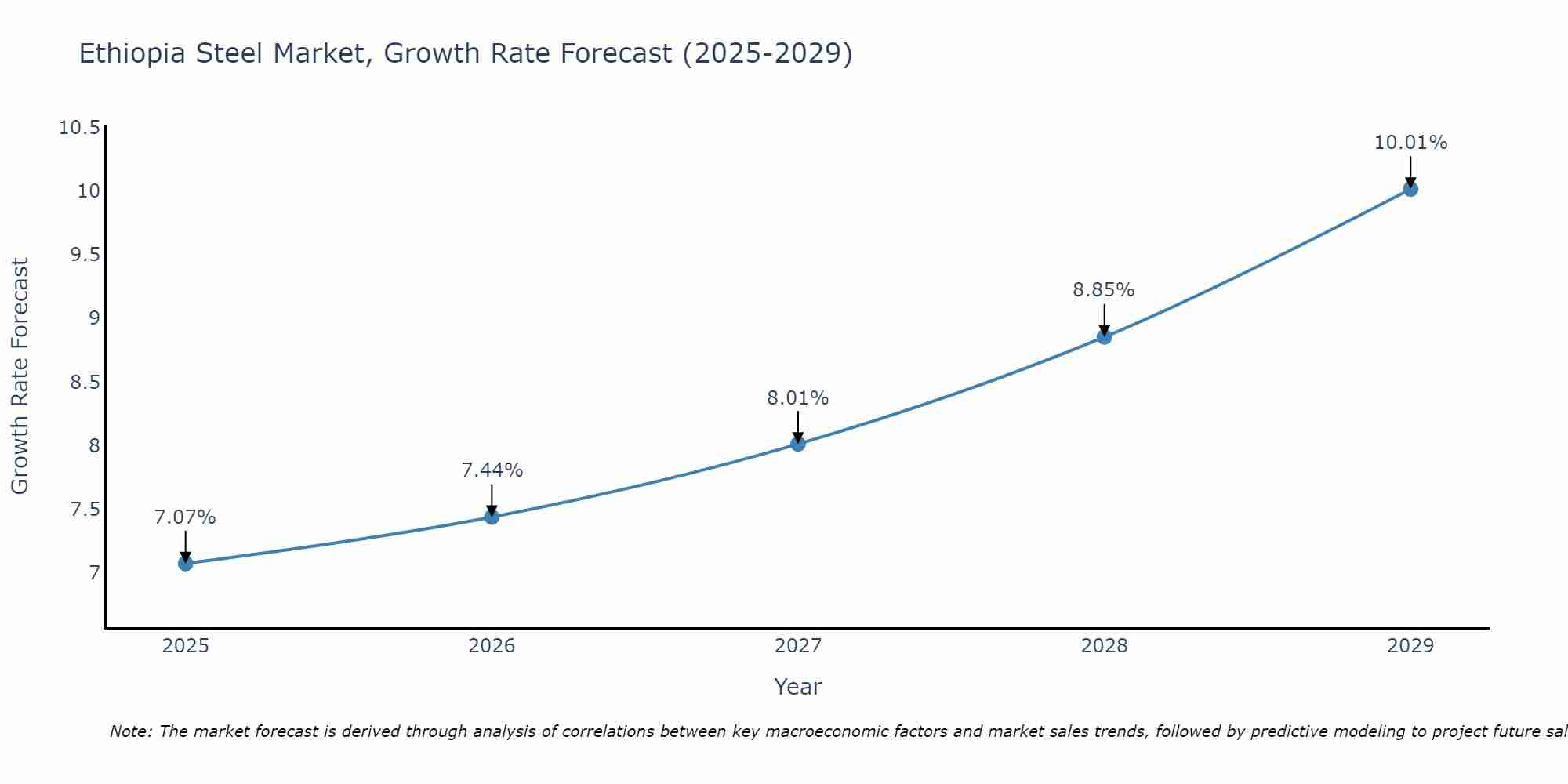
Ethiopia Steel Market Growth Rate
According to 6Wresearch internal database and industry insights, the Ethiopia Steel Market is projected to grow at a compound annual growth rate (CAGR) of 6.4% during the forecast period from 2026 to 2032.
Five-Year Growth Trajectory of the Ethiopia Steel Market with Core Drivers
Below mentioned are the evaluation of year-wise growth rate along with key drivers:
| Years | CAGR (%) | Growth Drivers |
| 2021 | 5.4% | Growing demand for construction and infrastructure development. |
| 2022 | 5.6% | Increase in government investments in the industrial sector. |
| 2023 | 5.8% | Expansion in automotive and electrical appliance sectors. |
| 2024 | 6% | Demand surge for flat steel products in the construction sector. |
| 2025 | 6.2% | Increasing applications in mechanical equipment and metal products. |
Topics Covered in the Ethiopia Steel Market Report
The Ethiopia Steel Market report thoroughly covers the market by types, product type, and application, providing an unbiased and detailed analysis of ongoing market trends, opportunities, challenges, and market drivers, helping stakeholders align their strategies with current and future market dynamics.
Ethiopia Steel Market Highlights
| Report Name | Ethiopia Steel Market |
| Forecast Period | 2026–2032 |
| CAGR | 6.4% |
| Growing Sector | Steel |
Ethiopia Steel Market Synopsis
Over the last several years, the Ethiopia Steel Market has been at a continual increase in overall steel demand, as well as overall demand for flat and long steel products due to increased usage of these products throughout construction and automotive manufacturing. Furthermore, government initiatives to promote industrialisation and develop the economy are likely to spur further investment into the Ethiopian Steel Industry, which is expected to continue to grow at or above current levels into future years.
Evaluation of Growth Drivers in the Ethiopia Steel Market
Below mentioned are some prominent drivers and their impact on the market dynamics:
| Drivers | Primary Segments Affected | Why It Matters (Evidence) |
| Increased Infrastructure Projects | Building & Construction, Automotive | Ongoing government infrastructure investments are increasing steel demand. |
| Growing Automotive Sector | Automotive, Mechanical Equipment | Rising automotive production requires steel for vehicle parts and bodywork. |
| Industrial Development | Mechanical Equipment, Electrical Appliances | Industrial growth increases demand for steel products for machinery and electrical components. |
| Urbanization | Building & Construction, Domestic Appliances | The growing urbanization is driving demand for construction materials, including steel. |
| Rise in Electrical Appliances Demand | Electrical Appliances | Increasing consumer demand for electronic goods is driving steel requirements for production. |
Ethiopia Steel Market Size is projected to grow at a CAGR of 6.4% from 2026 to 2032. With a growing demand for Steel products from within the Construction, Automotive and Infrastructure sectors, the Ethiopia Steel Market continues to experience rapid growth. The Ethiopian government’s focus on regulatory measures aimed at ensuring quality control and protecting both the environment and workers will strengthen this market. The promotion of local steel production through additional incentives will provide additional support to local manufacturers by improving their production capabilities. Technological advancements within the Steel production industry will help to drive continued growth for the Ethiopian Steel Market as well.
Evaluation of Restraints in the Ethiopia Steel Market
Below mentioned are some major restraints and their influence on the market dynamics:
| Restraints | Primary Segments Affected | What This Means (Evidence) |
| Price Sensitivity | Household, Automotive, Construction | High steel prices can restrict the affordability of steel-based products. |
| Dependence on Imports | All Product Segments | Reliance on imported steel affects the price and availability of locally produced steel. |
| Environmental Concerns | Manufacturing, Construction | Growing environmental regulations may increase production costs and limit supply. |
| Limited Domestic Steel Production | All Product Segments | Limited local manufacturing capacity results in higher reliance on imported steel. |
| Technological Challenges | Production and Manufacturing | Lack of advanced technology in steel production affects product quality and pricing. |
Ethiopia Steel Market Challenges
The Ethiopia Steel Industry faces several challenges such as steel costs is expensive when the country needs to import raw materials and as raw material prices keep changing and as local production capacity remains restricted. The challenges of the situation will prevent local industries from growing their operations. The market needs to expand its local production facilities which should include better production technologies and reduced import dependency to solve its current challenges. The government needs to support the economy through its efforts to attract foreign direct investments while it works to build domestic manufacturing capacity.
Ethiopia Steel Market Trends
Here are some major trends changing the Ethiopia Steel Market Growth dynamics:
- Rise in Demand for Sustainable Steel: Sustainable steel production methods, which meet environmental standards, experience higher demand as international environmental regulations and global green building trends.
- Integration of Technology in Steel Production: The incorporation of advanced technologies such as automation and smart manufacturing systems is enhancing the quality and efficiency of steel production, thus reducing costs.
- Demand for High-Strength Steel: The growing demand for high-strength steel, especially in automotive and construction sectors, to meet safety, durability, and performance standards is gaining momentum.
Investment Opportunities in the Ethiopia Steel Market
The Ethiopia Steel Market presents several investment opportunities, including:
- Expansion of Domestic Production Facilities: The project requires funding dedicated to constructing domestic steel manufacturing facilities which will enable the nation to decrease its import needs while expanding its market presence.
- Technological Innovations: The company needs to allocate funds for advanced technology development which will enhance its steel production processes through better quality and operational efficiency.
- Sustainable Steel Production: The company intends to use eco-friendly steel production methods through its adoption of environmentally sustainable technologies and practices.
Top 5 Leading Players in the Ethiopia Steel Market
Below is the list of prominent companies leading the Ethiopia Steel Market Share:
1. Ethiopian Steel PLC
| Company Name | Ethiopian Steel PLC |
|---|---|
| Established Year | 1998 |
| Headquarters | Addis Ababa, Ethiopia |
| Official Website | Click Here |
Ethiopian Steel PLC is a leading steel producer in Ethiopia, specializing in the manufacturing of various steel products used in construction, automotive, and industrial sectors. The company focuses on delivering high-quality steel solutions to support the country’s expanding infrastructure and manufacturing industries.
2. Beshay Steel
| Company Name | Beshay Steel |
|---|---|
| Established Year | 2000 |
| Headquarters | Addis Ababa, Ethiopia |
| Official Website | Click Here |
Beshay Steel is a major participant in Ethiopia’s steel industry, producing long and flat steel products. Its product portfolio supports demand from construction, automotive, and electrical sectors, contributing to the development of the country’s industrial base.
3. Jubilee Steel Industries
| Company Name | Jubilee Steel Industries |
|---|---|
| Established Year | 2005 |
| Headquarters | Addis Ababa, Ethiopia |
| Official Website | - |
Jubilee Steel Industries manufactures a variety of steel products including rods, bars, and structural steel materials. These products are widely used in construction projects, manufacturing activities, and infrastructure development across Ethiopia.
4. Mogadishu Steel Works
| Company Name | Mogadishu Steel Works |
|---|---|
| Established Year | 2002 |
| Headquarters | Addis Ababa, Ethiopia |
| Official Website | - |
Mogadishu Steel Works is a growing steel manufacturer that produces multiple steel products for domestic consumption and regional exports. The company focuses on delivering cost-effective and durable steel materials for construction and industrial applications.
5. Africa Steel & Iron
| Company Name | Africa Steel & Iron |
|---|---|
| Established Year | 2008 |
| Headquarters | Addis Ababa, Ethiopia |
| Official Website | - |
Africa Steel & Iron is a prominent steel manufacturer specializing in flat and long steel products. Its materials are widely used in construction, automotive manufacturing, and infrastructure projects, supporting Ethiopia’s growing industrial and development sectors.
Government Regulations Introduced in the Ethiopia Steel Market
According to Ethiopian government data, the Ministry of Trade and Industry enacted regulations that establish rules for steel production operations, which include requirements for product quality assessment, environmental conservation and employee protection protocols. The measures established by the government ensure that steel products achieve high quality standards, which results in market expansion. The government supports domestic manufacturers through financial incentives which promote the use of locally made steel products. These initiatives not only support industrial growth but also enhance Ethiopia’s steel production capabilities, which lead to a more sustainable and better competitive market environment that will last for many years.
Future Insights of the Ethiopia Steel Market
The Ethiopia Steel Market shows positive growth prospects as government infrastructure projects receive more funding construction and automotive sectors create higher demand. The steel industry will experience growth through technological advancements in production methods and the increasing demand for sustainable high-strength materials. The steel market in Ethiopia will achieve permanent stability and ongoing development as local production abilities will increase and technological advancements will continue.
Market Segmentation Analysis
The report offers a comprehensive study of the following market segments and their leading categories:
By Types – Long Steel to Dominate the Market
According to Ritika Kalra, Senior Research Analyst, 6Wresearch, Long steel is expected to dominate the market by type due to its extensive use in infrastructure, construction, and industrial applications. Products such as rebars, wire rods, and structural sections fall under long steel and are widely utilized in building frameworks, bridges, and large-scale infrastructure projects.
By Product Type – Structural Steel to Dominate the Market
Structural steel is anticipated to dominate the market by product type owing to its crucial role in construction and engineering projects. Structural steel products are widely used in the development of commercial buildings, residential complexes, industrial facilities, and infrastructure projects due to their high strength, durability, and load-bearing capacity.
By Applications – Building & Construction to Dominate the Market
The building and construction segment is expected to dominate the market by application due to the rising number of residential, commercial, and infrastructure development projects. Steel products are essential in construction because they provide structural stability, durability, and resistance to environmental conditions
Key Attractiveness of the Report
- 10 Years of Market Numbers
- Historical Data Starting from 2022 to 2025
- Base Year: 2025
- Forecast Data until 2032
- Key Performance Indicators Impacting the Market
- Major Upcoming Developments and Projects
Key Highlights of the Report:
- Ethiopia Steel Market Outlook
- Market Size of Ethiopia Steel Market, 2025
- Forecast of Ethiopia Steel Market, 2032
- Historical Data and Forecast of Ethiopia Steel Revenues & Volume for the Period 2022-2032
- Ethiopia Steel Market Trend Evolution
- Ethiopia Steel Market Drivers and Challenges
- Ethiopia Steel Price Trends
- Ethiopia Steel Porter`s Five Forces
- Ethiopia Steel Industry Life Cycle
- Historical Data and Forecast of Ethiopia Steel Market Revenues & Volume By Types for the Period 2022-2032
- Historical Data and Forecast of Ethiopia Steel Market Revenues & Volume By Flat Steel for the Period 2022-2032
- Historical Data and Forecast of Ethiopia Steel Market Revenues & Volume By Long Steel for the Period 2022-2032
- Historical Data and Forecast of Ethiopia Steel Market Revenues & Volume By Product Type for the Period 2022-2032
- Historical Data and Forecast of Ethiopia Steel Market Revenues & Volume By Structural Steel for the Period 2022-2032
- Historical Data and Forecast of Ethiopia Steel Market Revenues & Volume By Prestressing Steel for the Period 2022-2032
- Historical Data and Forecast of Ethiopia Steel Market Revenues & Volume By Bright Steel for the Period 2022-2032
- Historical Data and Forecast of Ethiopia Steel Market Revenues & Volume By Welding Wire/Rod for the Period 2022-2032
- Historical Data and Forecast of Ethiopia Steel Market Revenues & Volume By Iron Steel Wire for the Period 2022-2032
- Historical Data and Forecast of Ethiopia Steel Market Revenues & Volume By Ropes for the Period 2022-2032
- Historical Data and Forecast of Ethiopia Steel Market Revenues & Volume By Braids for the Period 2022-2032
- Historical Data and Forecast of Ethiopia Steel Market Revenues & Volume By Applications for the Period 2022-2032
- Historical Data and Forecast of Ethiopia Steel Market Revenues & Volume By Building & Construction for the Period 2022-2032
- Historical Data and Forecast of Ethiopia Steel Market Revenues & Volume By Electrical Appliances for the Period 2022-2032
- Historical Data and Forecast of Ethiopia Steel Market Revenues & Volume By Metal Products for the Period 2022-2032
- Historical Data and Forecast of Ethiopia Steel Market Revenues & Volume By Domestic Appliances for the Period 2022-2032
- Historical Data and Forecast of Ethiopia Steel Market Revenues & Volume By Mechanical Equipment for the Period 2022-2032
- Historical Data and Forecast of Ethiopia Steel Market Revenues & Volume By Automotive for the Period 2022-2032
- Historical Data and Forecast of Ethiopia Steel Market Revenues & Volume By Others for the Period 2022-2032
- Ethiopia Steel Import Export Trade Statistics
- Market Opportunity Assessment By Types
- Market Opportunity Assessment By Product Type
- Market Opportunity Assessment By Applications
- Ethiopia Steel Top Companies Market Share
- Ethiopia Steel Competitive Benchmarking By Technical and Operational Parameters
- Ethiopia Steel Company Profiles
- Ethiopia Steel Key Strategic Recommendations
Market Covered
The report offers a comprehensive study of the following market segments:
By Types
- Flat Steel
- Long Steel
By Product Type
- Structural Steel
- Prestressing Steel
- Bright Steel
- Welding Wire/Rod
- Iron Steel Wire
- Ropes
- Braids
By Applications
- Building & Construction
- Electrical Appliances
- Metal Products
- Domestic Appliances
- Mechanical Equipment
- Automotive
- Others






































