Fiji Chewing Gum Market Growth Rate Analysis (2021-2031)
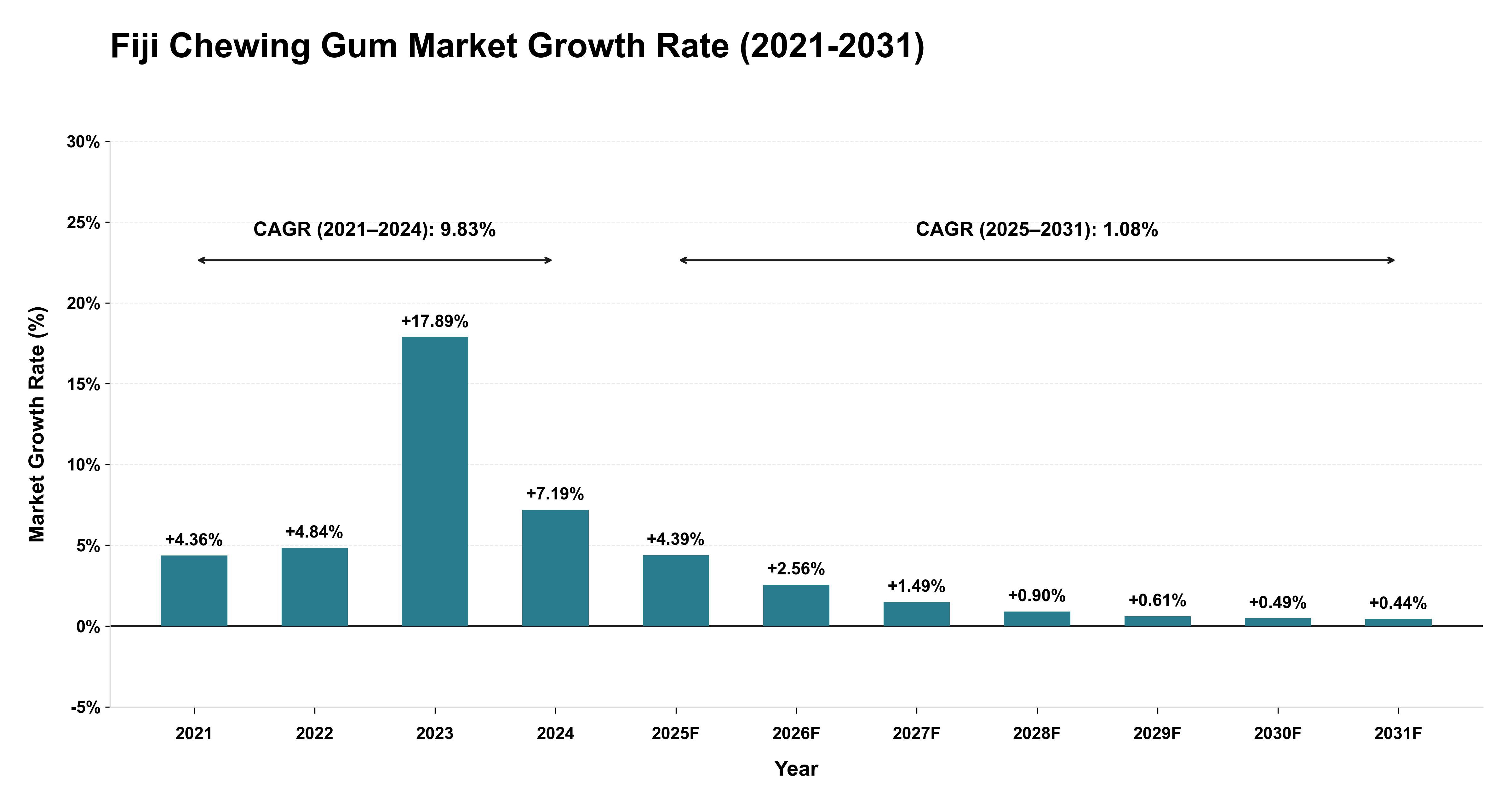
The Fiji Chewing Gum Market demonstrated robust growth from 2021 to 2024, with a significant CAGR of 9.83%. This period was characterized by steady expansion, driven by increasing consumer demand and market penetration. However, starting in 2025, the market began to experience a notable slowdown in growth rates, with figures dropping to single digits. The growth trajectory continued to decelerate through 2031, reflecting a structural consolidation phase as the market reached saturation levels and faced intensified competition. The forecasted CAGR of 1.08% for the period 2025-2031 indicates a stabilization following the initial rapid expansion, highlighting a mature market environment with limited room for further acceleration. This trend suggests that market players will need to focus on innovation and differentiation to maintain their positions in a competitive landscape.
Fiji Chewing Gum Market Overview
The chewing gum market in Fiji is growing, driven by increasing consumer demand for confectionery products. Chewing gum is a popular snack item, and as disposable incomes rise and consumer preferences shift toward innovative flavors and functional products, the market for chewing gum in Fiji is expected to continue expanding.
Drivers of the market
The chewing gum market in Fiji is driven by changing consumer preferences, with an increasing demand for sugar-free, functional, and innovative gum products. Chewing gum offers convenience and is popular among all age groups. As disposable incomes rise and consumers become more health-conscious, the demand for chewing gum with added benefits like oral care properties continues to grow.
Challenges of the market
The chewing gum market in Fiji faces challenges with limited consumer demand, which is constrained by cultural preferences and competition from other confectionery products. Importation of chewing gum is costly, leading to high retail prices that deter potential buyers. Additionally, the market is impacted by the small size of Fijis population and the limited scope for growth in the domestic food and beverage industry.
Government Policy of the market
The chewing gum market in Fiji is influenced by government policies related to food safety, health regulations, and consumer protection. The demand for chewing gum, especially sugar-free and functional varieties, is shaped by government initiatives that focus on improving public health, encouraging healthier lifestyles, and regulating the food industry. Policies on packaging, food labeling, and ingredient transparency impact the market for chewing gum. Additionally, government incentives for local food production and export contribute to the growth of the chewing gum market in Fiji.
Key Highlights of the Report:
- Fiji Chewing Gum Market Outlook
- Market Size of Fiji Chewing Gum Market, 2024
- Forecast of Fiji Chewing Gum Market, 2031
- Historical Data and Forecast of Fiji Chewing Gum Revenues & Volume for the Period 2021-2031
- Fiji Chewing Gum Market Trend Evolution
- Fiji Chewing Gum Market Drivers and Challenges
- Fiji Chewing Gum Price Trends
- Fiji Chewing Gum Porter`s Five Forces
- Fiji Chewing Gum Industry Life Cycle
- Historical Data and Forecast of Fiji Chewing Gum Market Revenues & Volume By Product Type for the Period 2021-2031
- Historical Data and Forecast of Fiji Chewing Gum Market Revenues & Volume By Sugared Chewing Gum for the Period 2021-2031
- Historical Data and Forecast of Fiji Chewing Gum Market Revenues & Volume By Sugar-free Chewing Gum for the Period 2021-2031
- Historical Data and Forecast of Fiji Chewing Gum Market Revenues & Volume By Distribution Channel for the Period 2021-2031
- Historical Data and Forecast of Fiji Chewing Gum Market Revenues & Volume By Supermarkets and Hypermarkets for the Period 2021-2031
- Historical Data and Forecast of Fiji Chewing Gum Market Revenues & Volume By Convenience Stores for the Period 2021-2031
- Historical Data and Forecast of Fiji Chewing Gum Market Revenues & Volume By Specialist Retailers for the Period 2021-2031
- Historical Data and Forecast of Fiji Chewing Gum Market Revenues & Volume By Online Retail for the Period 2021-2031
- Historical Data and Forecast of Fiji Chewing Gum Market Revenues & Volume By Others for the Period 2021-2031
- Fiji Chewing Gum Import Export Trade Statistics
- Market Opportunity Assessment By Product Type
- Market Opportunity Assessment By Distribution Channel
- Fiji Chewing Gum Top Companies Market Share
- Fiji Chewing Gum Competitive Benchmarking By Technical and Operational Parameters
- Fiji Chewing Gum Company Profiles
- Fiji Chewing Gum Key Strategic Recommendations






































