Fiji Kegs Market Top 5 Importing Countries and Market Competition (HHI) Analysis
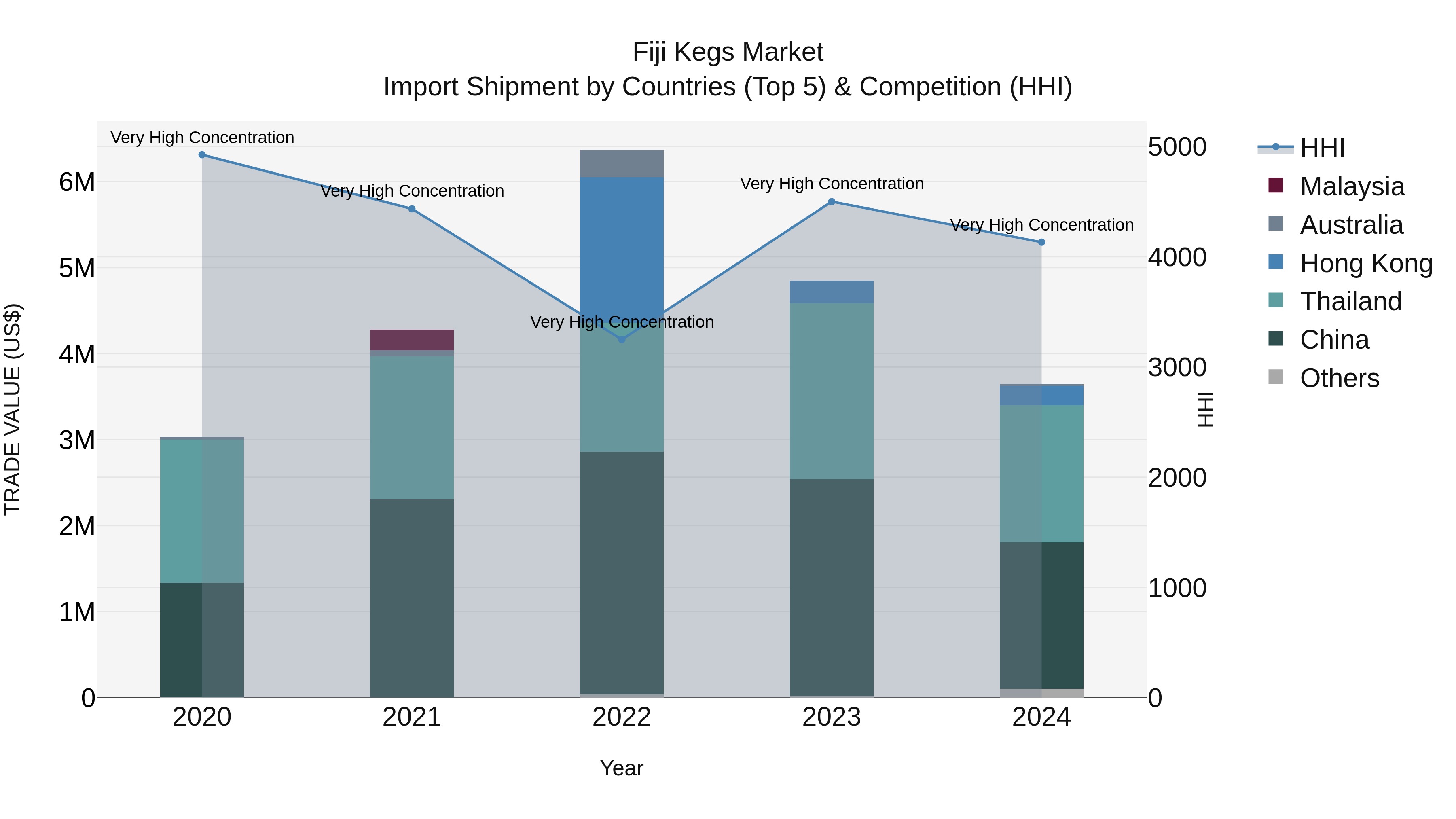
In 2024, Fiji continued to rely on key import sources for kegs such as China, Thailand, Hong Kong, Dem. People`s Rep. of Korea, and Australia. Despite a high concentration level, the compound annual growth rate (CAGR) from 2020 to 2024 stood at a steady 4.72%. However, there was a significant dip in growth rate from 2023 to 2024, with a -24.81% decrease. This indicates a potential shift in market dynamics or external factors impacting the importation of kegs into Fiji. Monitoring future trends and developments in these key exporting countries will be crucial for stakeholders in the industry.
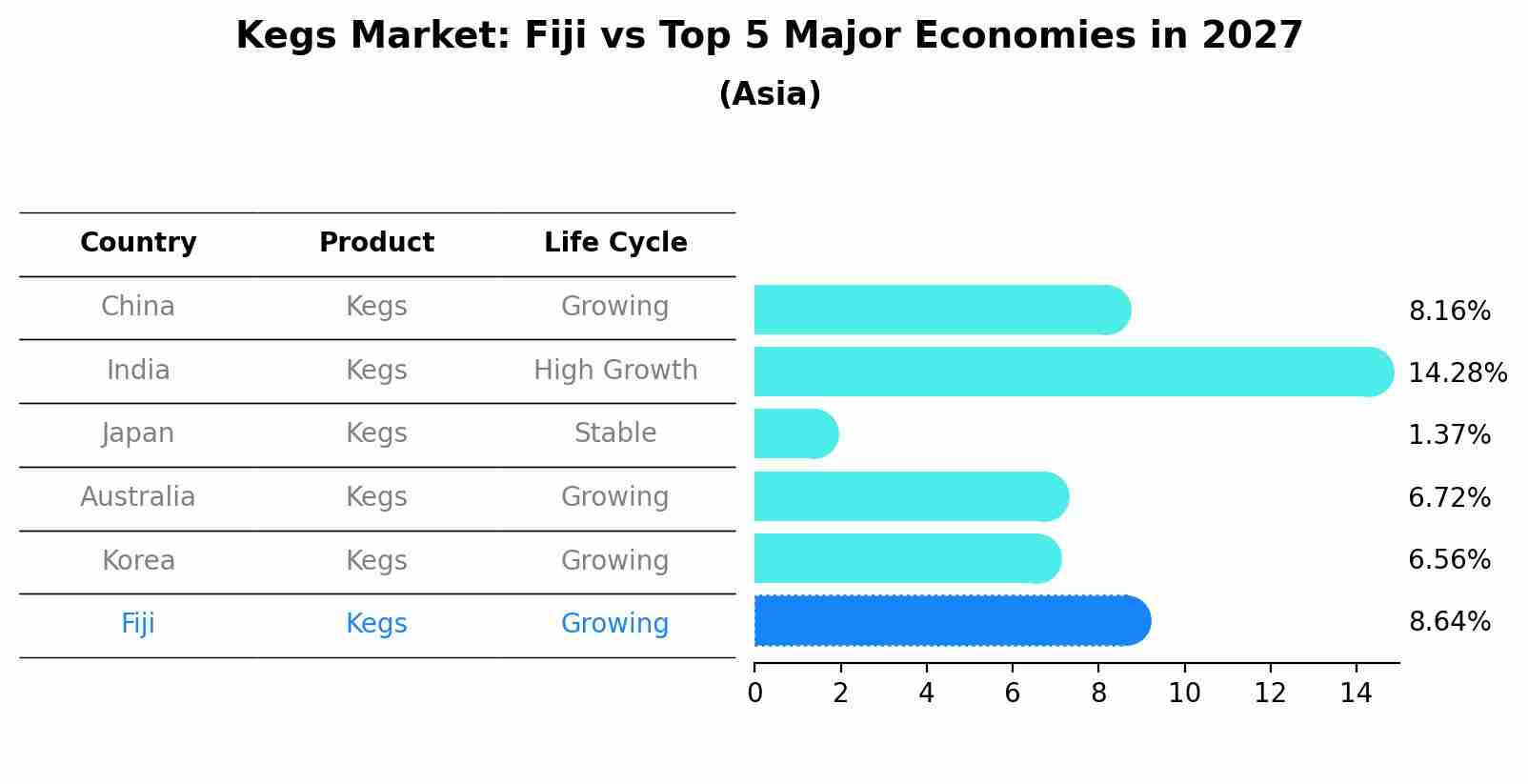
Kegs Market: Fiji vs Top 5 Major Economies in 2027 (Asia)
Fiji's Kegs market is anticipated to experience a growing growth rate of 8.64% by 2027, reflecting trends observed in the largest economy China, followed by India, Japan, Australia and South Korea.
Fiji Kegs Market Overview
The kegs market in Fiji is expanding with the growing demand for packaged beverages, particularly in the alcoholic drink sector. Kegs are widely used for storing and distributing draft beer, soft drinks, and other beverages. As the hospitality and beverage industries in Fiji grow, the demand for kegs is expected to increase, particularly in bars, restaurants, and pubs that serve draft beverages.
Drivers of the market
The kegs market in Fiji is growing as the demand for draft beer and other beverages in the food and beverage industry rises. Kegs are widely used by bars, restaurants, and breweries for the storage and dispensing of draft beer, cider, and soft drinks. As Fiji`s hospitality and tourism industries expand, there is an increasing demand for kegs to meet the needs of both local consumers and international tourists. The growing popularity of craft beer and the trend towards draught beverages are also contributing to the growth of the kegs market in Fiji.
Challenges of the market
The kegs market in Fiji faces challenges due to limited demand in the beverage and hospitality sectors. Kegs are primarily used for the distribution of beer and soft drinks, but the relatively small size of Fijis beverage industry means that demand for kegs remains low. Additionally, the high cost of importing kegs and the lack of local production capabilities make it difficult for businesses to access affordable kegs. The market is further limited by the small scale of the hospitality industry in Fiji, which reduces the need for large quantities of kegs.
Government Policy of the market
The government of Fiji promotes the sustainable use of kegs, particularly in the beverage industry, by supporting the reuse and recycling of kegs. Policies encourage the development of efficient logistics and distribution systems for kegs, while ensuring that the materials used in keg production are safe and environmentally friendly. Regulations ensure that kegs meet quality standards for consumer safety.
Key Highlights of the Report:
- Fiji Kegs Market Outlook
- Market Size of Fiji Kegs Market, 2024
- Forecast of Fiji Kegs Market, 2031
- Historical Data and Forecast of Fiji Kegs Revenues & Volume for the Period 2021-2031
- Fiji Kegs Market Trend Evolution
- Fiji Kegs Market Drivers and Challenges
- Fiji Kegs Price Trends
- Fiji Kegs Porter`s Five Forces
- Fiji Kegs Industry Life Cycle
- Historical Data and Forecast of Fiji Kegs Market Revenues & Volume By Material for the Period 2021-2031
- Historical Data and Forecast of Fiji Kegs Market Revenues & Volume By Plastic for the Period 2021-2031
- Historical Data and Forecast of Fiji Kegs Market Revenues & Volume By Tin for the Period 2021-2031
- Historical Data and Forecast of Fiji Kegs Market Revenues & Volume By Stainless Steel for the Period 2021-2031
- Historical Data and Forecast of Fiji Kegs Market Revenues & Volume By Capacity for the Period 2021-2031
- Historical Data and Forecast of Fiji Kegs Market Revenues & Volume By Up to 20 Liter for the Period 2021-2031
- Historical Data and Forecast of Fiji Kegs Market Revenues & Volume By 20 Liter to 40 Liter for the Period 2021-2031
- Historical Data and Forecast of Fiji Kegs Market Revenues & Volume By 40 Liter to 60 Liter for the Period 2021-2031
- Historical Data and Forecast of Fiji Kegs Market Revenues & Volume By Above 60 Liter for the Period 2021-2031
- Historical Data and Forecast of Fiji Kegs Market Revenues & Volume By End Use for the Period 2021-2031
- Historical Data and Forecast of Fiji Kegs Market Revenues & Volume By Alcoholic Beverages for the Period 2021-2031
- Historical Data and Forecast of Fiji Kegs Market Revenues & Volume By Non-Alcoholic Beverages for the Period 2021-2031
- Historical Data and Forecast of Fiji Kegs Market Revenues & Volume By Cooking Oil for the Period 2021-2031
- Historical Data and Forecast of Fiji Kegs Market Revenues & Volume By Chemicals for the Period 2021-2031
- Historical Data and Forecast of Fiji Kegs Market Revenues & Volume By Others for the Period 2021-2031
- Historical Data and Forecast of Fiji Kegs Market Revenues & Volume By Distribution Channel for the Period 2021-2031
- Historical Data and Forecast of Fiji Kegs Market Revenues & Volume By Supermarket/Hypermarket for the Period 2021-2031
- Historical Data and Forecast of Fiji Kegs Market Revenues & Volume By Commercial Liquor Store for the Period 2021-2031
- Historical Data and Forecast of Fiji Kegs Market Revenues & Volume By Others for the Period 2021-2031
- Fiji Kegs Import Export Trade Statistics
- Market Opportunity Assessment By Material
- Market Opportunity Assessment By Capacity
- Market Opportunity Assessment By End Use
- Market Opportunity Assessment By Distribution Channel
- Fiji Kegs Top Companies Market Share
- Fiji Kegs Competitive Benchmarking By Technical and Operational Parameters
- Fiji Kegs Company Profiles
- Fiji Kegs Key Strategic Recommendations






































