Finland First Aid Market Top 5 Importing Countries and Market Competition (HHI) Analysis
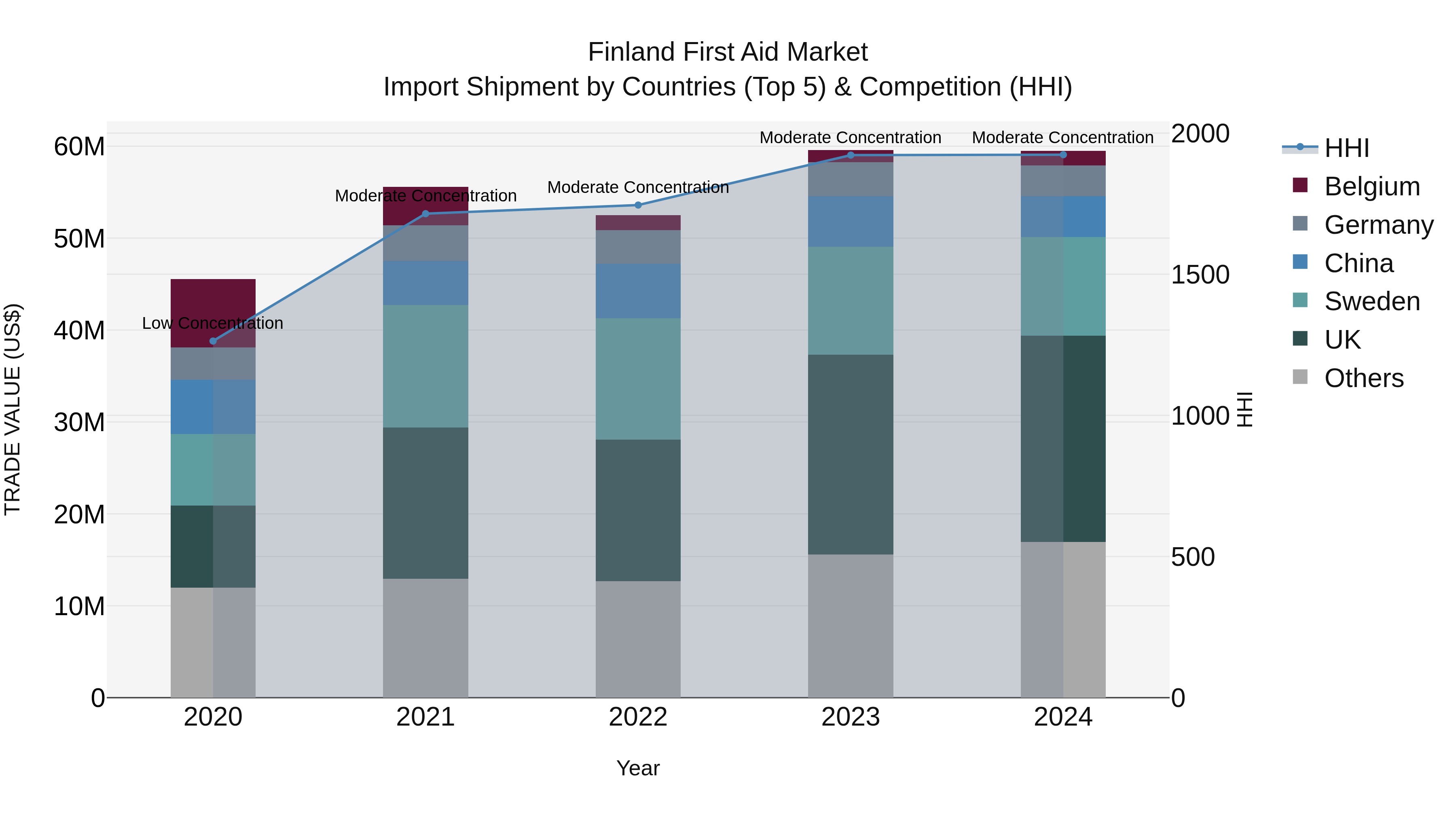
In 2024, Finland`s first aid import market continued to show steady growth with a moderate concentration level. Key exporters to Finland included the UK, Sweden, China, Germany, and Czechia. The Compound Annual Growth Rate (CAGR) from 2020 to 2024 was a robust 6.9%, indicating a healthy market expansion. Despite a slight decline in growth rate from 2023 to 2024 (-0.15%), the overall trend remains positive, suggesting a resilient and competitive first aid import market in Finland.
Finland First Aid Market Overview
The Finland First Aid Market is characterized by a growing emphasis on health and safety in both professional and personal settings. The market offers a wide range of first aid products, including basic kits for homes and cars, as well as specialized kits for workplaces and outdoor activities. Key players in the market include companies such as Tervakoski First Aid, Berner Oy, and MedKit Finland Oy, offering products such as bandages, antiseptics, CPR masks, and first aid manuals. The increasing awareness of the importance of first aid training and preparedness in emergencies is driving market growth. Government initiatives promoting first aid education and the presence of stringent workplace safety regulations further contribute to the market`s expansion. With a focus on quality, innovation, and accessibility, the Finland First Aid Market is expected to continue flourishing in the coming years.
Finland First Aid Market Trends and Opportunities
The Finland First Aid Market is witnessing a growing demand for innovative first aid solutions, driven by an increased focus on workplace safety, public awareness campaigns, and the rising number of outdoor activities. There is a notable trend towards compact and portable first aid kits that cater to specific needs, such as sports-related injuries or travel emergencies. Additionally, the market is experiencing a shift towards digital solutions, including first aid apps and online training programs. Opportunities exist for companies to develop eco-friendly and sustainable first aid products to align with Finland`s strong emphasis on environmental protection. Collaborations with healthcare providers and government agencies for first aid training initiatives also present avenues for growth in the market.
Finland First Aid Market Challenges
In the Finland First Aid Market, some challenges include a lack of awareness and education about the importance of first aid training and products, resulting in lower demand for such services. Additionally, the market may face competition from alternative healthcare solutions and home remedies. Another challenge is the need for continuous innovation and adaptation to meet the changing needs of consumers, as well as complying with strict regulations and standards for first aid products. Furthermore, the relatively small population of Finland may limit the overall market size and growth potential. Overall, overcoming these challenges will require targeted marketing efforts, investment in education and awareness campaigns, as well as product development to cater to evolving consumer needs and preferences.
Finland First Aid Market Drivers
The Finland First Aid Market is primarily driven by the increasing awareness about the importance of first aid in emergency situations, coupled with the rising number of accidents and injuries. The government initiatives promoting first aid training and education, as well as the growing emphasis on workplace safety regulations, are also contributing to the market growth. Moreover, the expanding healthcare infrastructure in Finland, along with the availability of advanced first aid products and services, is fueling the demand for first aid supplies and training programs. Additionally, the rising participation in outdoor activities and sports is driving the need for accessible and effective first aid solutions among the general population, further boosting the market for first aid products and services in Finland.
Finland First Aid Market Government Policies
In Finland, the government has implemented various policies to regulate and promote the first aid market. The Finnish Red Cross plays a significant role in providing first aid training and services, supported by government funding. The government emphasizes the importance of first aid education and training, with initiatives to ensure that a high proportion of the population is trained in basic first aid skills. Additionally, there are regulations in place to ensure the quality and standards of first aid products and services offered in the market, with certification requirements for first aid training providers. The government also encourages businesses and public spaces to have adequate first aid equipment and trained personnel on-site to respond to emergencies effectively.
Finland First Aid Market Future Outlook
The future outlook for the Finland First Aid Market appears promising, driven by increasing awareness about the importance of first aid training and supplies, coupled with a growing emphasis on workplace safety and emergency preparedness. The market is expected to witness steady growth as the Finnish government and private organizations continue to invest in promoting first aid education and training programs. Additionally, the rising number of outdoor enthusiasts and adventure tourism activities in Finland is likely to boost the demand for first aid kits and supplies. Technological advancements, such as the development of smart first aid devices and mobile applications for quick assistance, are also expected to contribute to market growth. Overall, the Finland First Aid Market is poised for expansion in the coming years, presenting opportunities for both established companies and new entrants in the industry.
Key Highlights of the Report:
- Finland First Aid Market Outlook
- Market Size of Finland First Aid Market, 2024
- Forecast of Finland First Aid Market, 2031
- Historical Data and Forecast of Finland First Aid Revenues & Volume for the Period 2021- 2031
- Finland First Aid Market Trend Evolution
- Finland First Aid Market Drivers and Challenges
- Finland First Aid Price Trends
- Finland First Aid Porter's Five Forces
- Finland First Aid Industry Life Cycle
- Historical Data and Forecast of Finland First Aid Market Revenues & Volume By Type for the Period 2021- 2031
- Historical Data and Forecast of Finland First Aid Market Revenues & Volume By First Aid Room Equipment for the Period 2021- 2031
- Historical Data and Forecast of Finland First Aid Market Revenues & Volume By Automated External Defibrillators for the Period 2021- 2031
- Historical Data and Forecast of Finland First Aid Market Revenues & Volume By First Aid Training Products for the Period 2021- 2031
- Historical Data and Forecast of Finland First Aid Market Revenues & Volume By End-use for the Period 2021- 2031
- Historical Data and Forecast of Finland First Aid Market Revenues & Volume By Hospital & Clinics for the Period 2021- 2031
- Historical Data and Forecast of Finland First Aid Market Revenues & Volume By Home & Offices for the Period 2021- 2031
- Finland First Aid Import Export Trade Statistics
- Market Opportunity Assessment By Type
- Market Opportunity Assessment By End-use
- Finland First Aid Top Companies Market Share
- Finland First Aid Competitive Benchmarking By Technical and Operational Parameters
- Finland First Aid Company Profiles
- Finland First Aid Key Strategic Recommendations






































