Finland Hams Market Size (2020-2030)
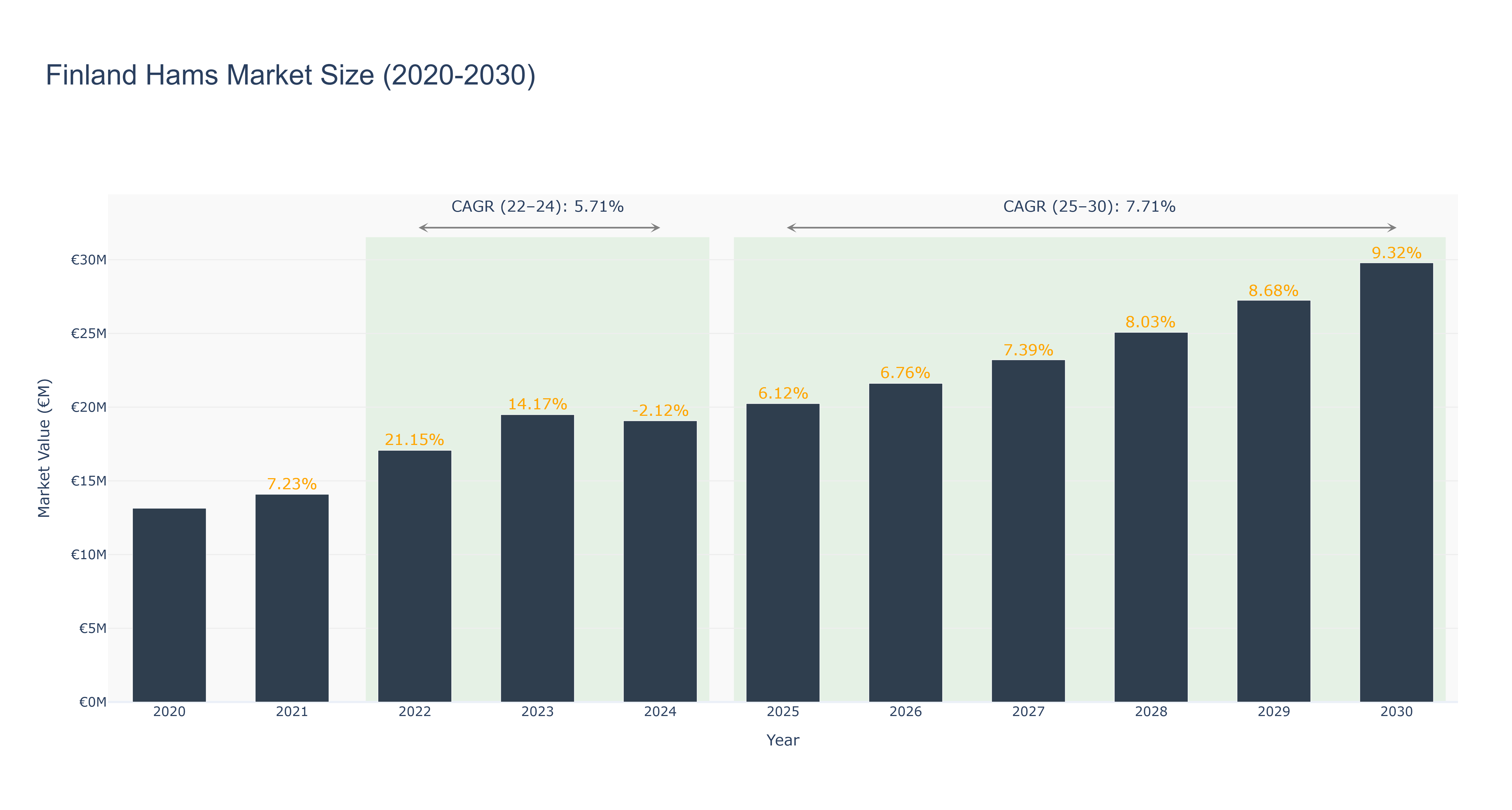
Finland Hams Market has shown a steady growth trajectory over the years. The peak market size was €29.79 million in 2030, with a consistent increase from €13.14 million in 2020. The market experienced a slight dip in 2024 to €19.08 million, attributed to a temporary shift in consumer preferences. However, subsequent years saw a rebound, with forecasted growth to reach €29.79 million by 2030. The CAGR for 2022-24 was 5.71%, while the CAGR for 2025-30 is projected to be 7.71%. Industry drivers such as increasing health consciousness and demand for premium quality hams have been pivotal in driving market expansion. Looking ahead, Finland is set to introduce new sustainable packaging initiatives in the ham industry, aligning with growing environmental concerns and consumer preferences for eco-friendly products.
Finland Hams Market: Production & Trade Performance (2019-2025)
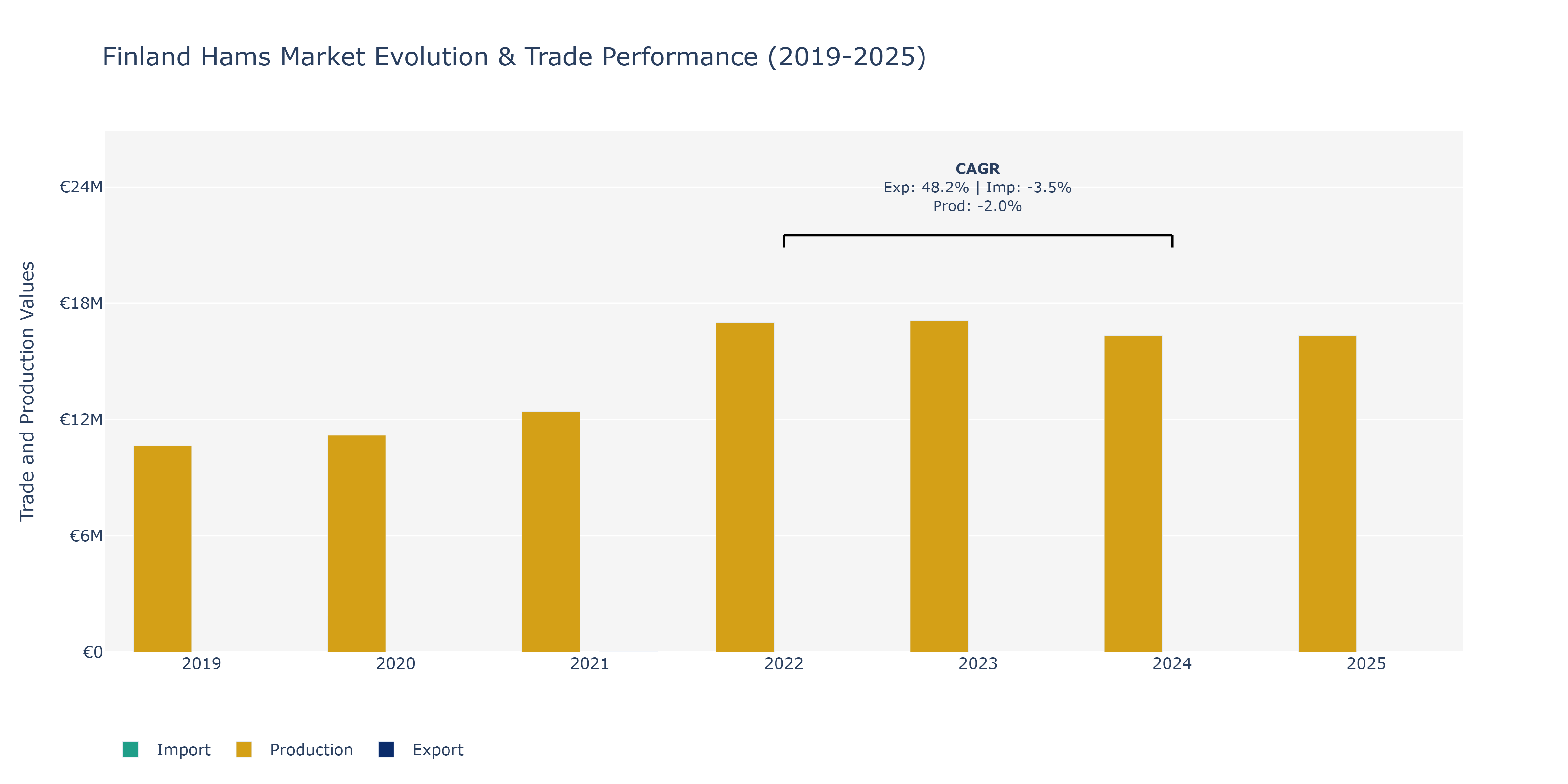
Between 2019 and 2025, the Finland Hams Market experienced notable fluctuations in Exports, Imports, and Production. Exports showed a fluctuating trend, with a peak in 2021 at €7.1 thousand followed by a slight decline in subsequent years. Imports consistently increased from 2019 to 2023, reaching its peak in 2023 at €2.12 million, then slightly decreased in 2024 and 2025. Production exhibited a peak in 2022 at €17 billion, followed by a marginal decline in the subsequent years. These shifts could be attributed to various factors, such as changing consumer preferences, global economic conditions impacting trade, and evolving production capacities in the market. The increase in imports till 2023 could signify growing demand for hams in Finland, while the fluctuations in exports might reflect changing market dynamics and competition from other regions. To capitalize on these trends, market players could focus on enhancing product quality, exploring new export markets, and optimizing production processes to meet changing consumer demands.
Key Highlights of the Report:
- Finland Hams Market Outlook
- Market Size of Finland Hams Market, 2025
- Forecast of Finland Hams Market, 2032
- Historical Data and Forecast of Finland Hams Revenues & Volume for the Period 2022 - 2032F
- Finland Hams Market Trend Evolution
- Finland Hams Market Drivers and Challenges
- Finland Hams Price Trends
- Finland Hams Porter`s Five Forces
- Finland Hams Industry Life Cycle
- Historical Data and Forecast of Finland Hams Market Revenues & Volume By Type for the Period 2022 - 2032F
- Historical Data and Forecast of Finland Hams Market Revenues & Volume By Air Dried Cured Hams for the Period 2022 - 2032F
- Historical Data and Forecast of Finland Hams Market Revenues & Volume By Smoked Hams for the Period 2022 - 2032F
- Historical Data and Forecast of Finland Hams Market Revenues & Volume By Applications for the Period 2022 - 2032F
- Historical Data and Forecast of Finland Hams Market Revenues & Volume By Supermarkets and Hypermarkets for the Period 2022 - 2032F
- Historical Data and Forecast of Finland Hams Market Revenues & Volume By Independent Retailers for the Period 2022 - 2032F
- Historical Data and Forecast of Finland Hams Market Revenues & Volume By Convenience Stores for the Period 2022 - 2032F
- Historical Data and Forecast of Finland Hams Market Revenues & Volume By Specialist Retailers for the Period 2022 - 2032F
- Historical Data and Forecast of Finland Hams Market Revenues & Volume By Online Retailers for the Period 2022 - 2032F
- Finland Hams Import Export Trade Statistics
- Market Opportunity Assessment By Type
- Market Opportunity Assessment By Applications
- Finland Hams Top Companies Market Share
- Finland Hams Competitive Benchmarking By Technical and Operational Parameters
- Finland Hams Company Profiles
- Finland Hams Key Strategic Recommendations






































