Finland Molasses Market Top 5 Importing Countries and Market Competition (HHI) Analysis
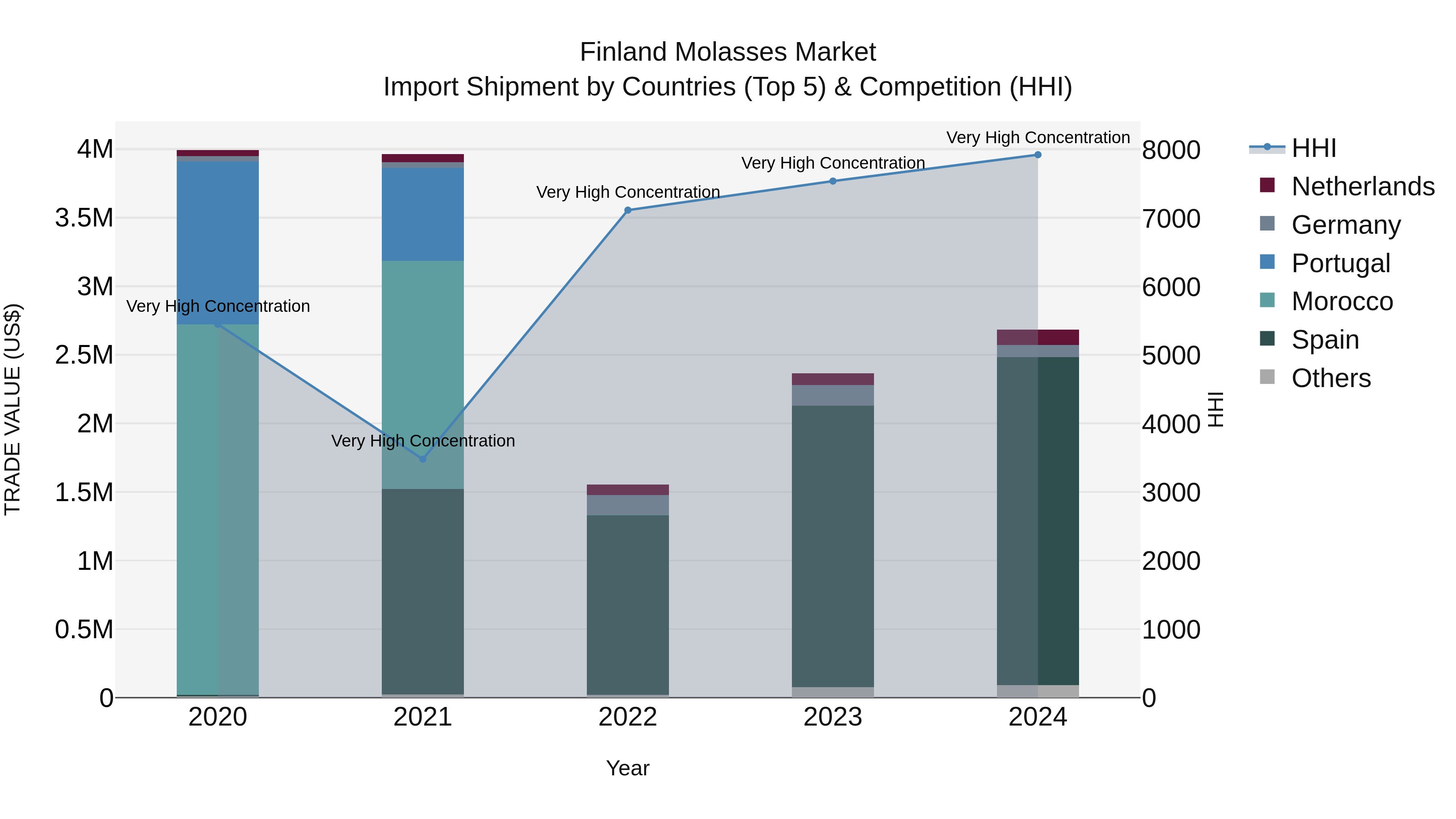
In 2024, Finland`s molasses import market continued to be dominated by Spain, Netherlands, Germany, Denmark, and Sweden. Despite a negative Compound Annual Growth Rate (CAGR) of -9.45% from 2020 to 2024, there was a notable growth spurt in 2024 with a growth rate of 13.5%. The High Herfindahl-Hirschman Index (HHI) indicates a high level of market concentration, suggesting that these top exporting countries hold significant market share. This data highlights the competitive landscape and dynamics of the molasses import market in Finland.
Finland Molasses Market Overview
The molasses market in Finland is expanding due to its diverse applications in food production, animal feed, and industrial processes. Molasses is a byproduct of sugar refining and is valued for its high sugar content and nutritional benefits. As demand for natural sweeteners and animal feed ingredients increases, the molasses market is expected to grow.
Drivers of the market
The molasses market in Finland is driven by its widespread use in the food and beverage industry, particularly in confectionery, bakery products, and alcoholic beverages. Additionally, molasses is used in animal feed and as a key ingredient in biofuel production, expanding its market across different sectors.
Challenges of the market
The molasses market in Finland faces challenges due to price fluctuations in raw materials, such as sugarcane and sugar beets, which directly impact production costs. The growing demand for healthier food products and natural sweeteners has reduced demand for molasses in food processing, limiting market growth. Furthermore, competition from alternative sweeteners like honey and agave syrup pressures the market.
Government Policy of the market
Government policies that encourage sustainable agriculture and food production support the growth of the molasses market in Finland. Policies promoting food processing and the use of agricultural by-products as sustainable ingredients influence market dynamics. Finlands commitment to environmental sustainability and circular economy practices boosts the demand for molasses in various industries.
Key Highlights of the Report:
- Finland Molasses Market Outlook
- Market Size of Finland Molasses Market, 2024
- Forecast of Finland Molasses Market, 2031
- Historical Data and Forecast of Finland Molasses Revenues & Volume for the Period 2021-2031
- Finland Molasses Market Trend Evolution
- Finland Molasses Market Drivers and Challenges
- Finland Molasses Price Trends
- Finland Molasses Porter`s Five Forces
- Finland Molasses Industry Life Cycle
- Historical Data and Forecast of Finland Molasses Market Revenues & Volume By Source for the Period 2021-2031
- Historical Data and Forecast of Finland Molasses Market Revenues & Volume By Sugarcane for the Period 2021-2031
- Historical Data and Forecast of Finland Molasses Market Revenues & Volume By Sugarbeet for the Period 2021-2031
- Historical Data and Forecast of Finland Molasses Market Revenues & Volume By Type for the Period 2021-2031
- Historical Data and Forecast of Finland Molasses Market Revenues & Volume By Regular Molasses for the Period 2021-2031
- Historical Data and Forecast of Finland Molasses Market Revenues & Volume By Blackstrap Molasses for the Period 2021-2031
- Historical Data and Forecast of Finland Molasses Market Revenues & Volume By Nature for the Period 2021-2031
- Historical Data and Forecast of Finland Molasses Market Revenues & Volume By Organic for the Period 2021-2031
- Historical Data and Forecast of Finland Molasses Market Revenues & Volume By Conventional for the Period 2021-2031
- Historical Data and Forecast of Finland Molasses Market Revenues & Volume By End-Use for the Period 2021-2031
- Historical Data and Forecast of Finland Molasses Market Revenues & Volume By Industrial for the Period 2021-2031
- Historical Data and Forecast of Finland Molasses Market Revenues & Volume By Commercial for the Period 2021-2031
- Historical Data and Forecast of Finland Molasses Market Revenues & Volume By Household for the Period 2021-2031
- Historical Data and Forecast of Finland Molasses Market Revenues & Volume By Sales Channel for the Period 2021-2031
- Historical Data and Forecast of Finland Molasses Market Revenues & Volume By Direct for the Period 2021-2031
- Historical Data and Forecast of Finland Molasses Market Revenues & Volume By Indirect for the Period 2021-2031
- Finland Molasses Import Export Trade Statistics
- Market Opportunity Assessment By Source
- Market Opportunity Assessment By Type
- Market Opportunity Assessment By Nature
- Market Opportunity Assessment By End-Use
- Market Opportunity Assessment By Sales Channel
- Finland Molasses Top Companies Market Share
- Finland Molasses Competitive Benchmarking By Technical and Operational Parameters
- Finland Molasses Company Profiles
- Finland Molasses Key Strategic Recommendations






































