Finland Naphtha Market Top 5 Importing Countries and Market Competition (HHI) Analysis
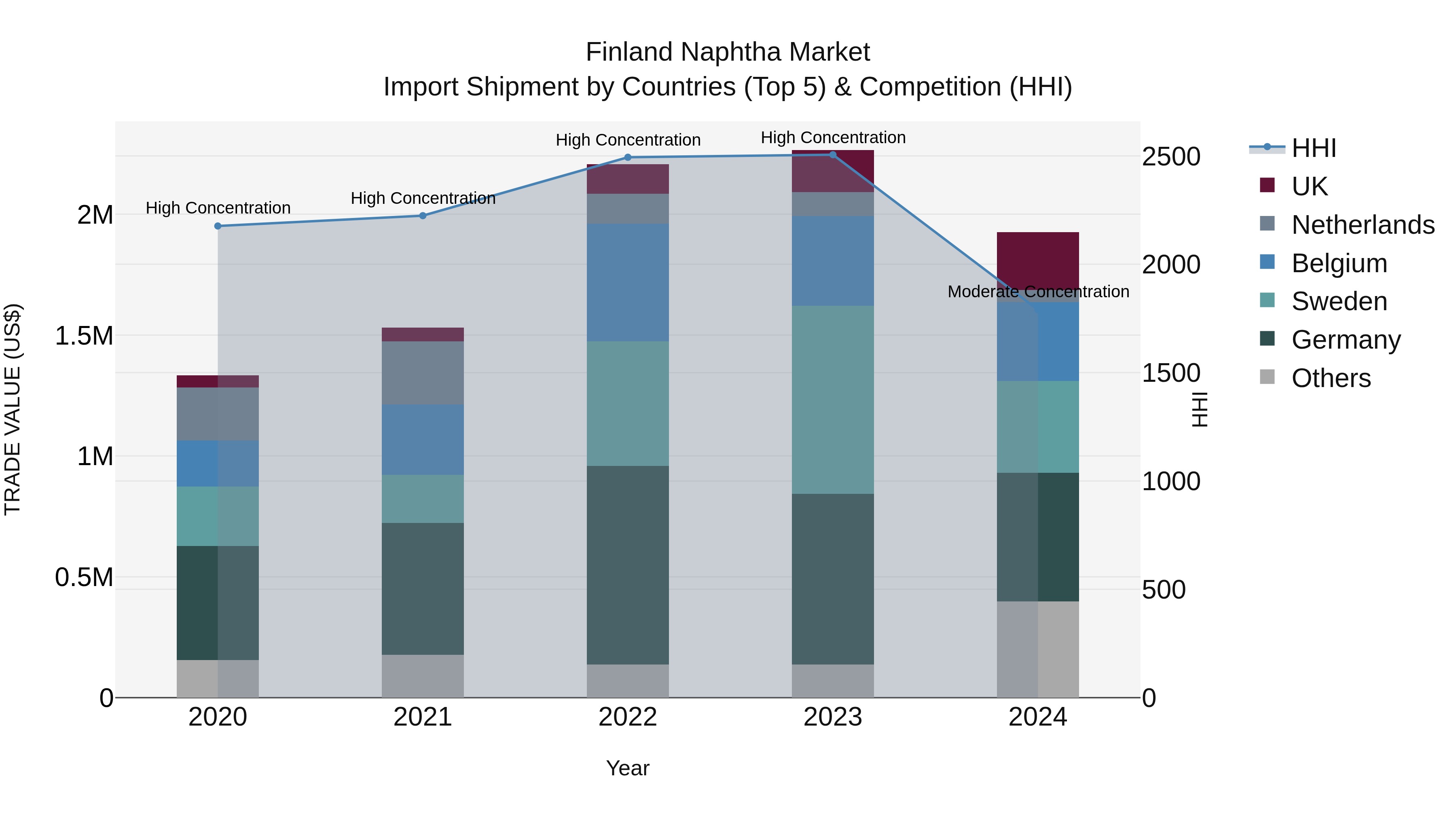
The Finland naphtha import market saw a shift in concentration levels from high to moderate in 2024, indicating a more balanced distribution among top exporting countries like Germany, Sweden, Belgium, UK, and Switzerland. Despite a negative growth rate of -14.98% in 2024, the compound annual growth rate (CAGR) from 2020 to 2024 remained strong at 9.63%, reflecting overall market resilience and long-term potential. This dynamic landscape suggests a competitive market environment with opportunities for both domestic and international suppliers to explore in the coming years.
Finland Naphtha Market Synopsis
The Finland Naphtha market is influenced by various factors such as the country`s strong petrochemical industry, which drives demand for naphtha as a feedstock. Finland`s strategic location and well-developed infrastructure also make it a key player in the European naphtha market. The market is characterized by a mix of domestic production and imports, with key suppliers including Russia, the Netherlands, and the Baltic states. Naphtha is primarily used in Finland for petrochemical production, as well as in the manufacturing of gasoline and other fuel products. The market is expected to witness steady growth in the coming years, supported by increasing demand for petrochemicals and ongoing investments in the country`s refining and petrochemical sectors.
Finland Naphtha Market Trends
The Finland Naphtha Market is experiencing growth due to increased demand from industries such as petrochemicals, refineries, and transportation. One of the key trends in the market is the shift towards using naphtha as a feedstock for producing petrochemicals, as it offers a cost-effective and versatile option. Additionally, the push towards cleaner energy sources and environmental regulations are driving the development of naphtha as a cleaner fuel alternative. Opportunities in the Finland Naphtha Market lie in expanding production capacities, investing in research and development for innovative naphtha-based products, and exploring export opportunities to tap into international markets. Overall, the market shows promise for growth and diversification in the coming years.
Finland Naphtha Market Challenges
In the Finland Naphtha Market, some challenges that are faced include fluctuating crude oil prices which directly impact naphtha prices, increasing competition from alternative feedstocks such as natural gas liquids, regulatory uncertainties surrounding environmental policies, and the shift towards renewable energy sources which may reduce the demand for naphtha-based products. Additionally, the market may also face logistical challenges in terms of transportation and storage of naphtha due to its volatile nature. Companies operating in the Finland Naphtha Market need to continuously monitor these challenges and adapt their strategies to remain competitive in a rapidly evolving market landscape.
Finland Naphtha Market Investment Opportunities
The Finland Naphtha Market is primarily driven by the demand from the petrochemical industry, specifically for the production of ethylene and other chemicals. The growth in the automotive and construction sectors also contributes to the demand for naphtha as a feedstock for plastics and resins. Additionally, the increasing focus on renewable and sustainable sources of energy has led to a shift towards bio-based naphtha, further influencing the market. Government regulations and initiatives promoting the use of bio-based feedstocks also play a role in driving the market towards more environmentally friendly options. Overall, factors such as industrial growth, demand from key end-use industries, and sustainability considerations are key drivers shaping the Finland Naphtha Market.
Finland Naphtha Market Government Polices
In Finland, government policies related to the naphtha market primarily focus on promoting sustainability and reducing greenhouse gas emissions. The government has implemented measures such as the National Energy and Climate Strategy, which aims to increase the use of renewable energy sources and improve energy efficiency. Additionally, Finland is part of the European Union Emissions Trading System, which sets limits on carbon dioxide emissions from industrial sectors, including naphtha production. The government also supports research and development in the energy sector to encourage innovation and the adoption of cleaner technologies. Overall, Finland`s policies aim to transition towards a more sustainable energy system and reduce the environmental impact of naphtha production and consumption.
Finland Naphtha Market Future Outlook
The future outlook for the Finland Naphtha Market is expected to be positive, driven by various factors such as increasing demand from the petrochemical industry, growth in the automotive sector, and expanding applications in the energy sector. Finland`s strategic location and strong infrastructure are likely to attract investments in naphtha production and distribution. Additionally, the country`s focus on sustainability and transitioning towards cleaner energy sources may lead to the development of bio-based naphtha products. However, challenges such as fluctuating crude oil prices and regulatory uncertainties may impact market growth. Overall, with the right investments and strategies in place, the Finland Naphtha Market is poised for steady growth in the coming years.
Key Highlights of the Report:
- Finland Naphtha Market Outlook
- Market Size of Finland Naphtha Market, 2024
- Forecast of Finland Naphtha Market, 2031
- Historical Data and Forecast of Finland Naphtha Revenues & Volume for the Period 2021- 2031
- Finland Naphtha Market Trend Evolution
- Finland Naphtha Market Drivers and Challenges
- Finland Naphtha Price Trends
- Finland Naphtha Porter's Five Forces
- Finland Naphtha Industry Life Cycle
- Historical Data and Forecast of Finland Naphtha Market Revenues & Volume By Application for the Period 2021- 2031
- Historical Data and Forecast of Finland Naphtha Market Revenues & Volume By Chemicals for the Period 2021- 2031
- Historical Data and Forecast of Finland Naphtha Market Revenues & Volume By Energy/Fuel for the Period 2021- 2031
- Historical Data and Forecast of Finland Naphtha Market Revenues & Volume By Others for the Period 2021- 2031
- Finland Naphtha Import Export Trade Statistics
- Market Opportunity Assessment By Application
- Finland Naphtha Top Companies Market Share
- Finland Naphtha Competitive Benchmarking By Technical and Operational Parameters
- Finland Naphtha Company Profiles
- Finland Naphtha Key Strategic Recommendations






































