Finland Primer Market Size (2020-2030)
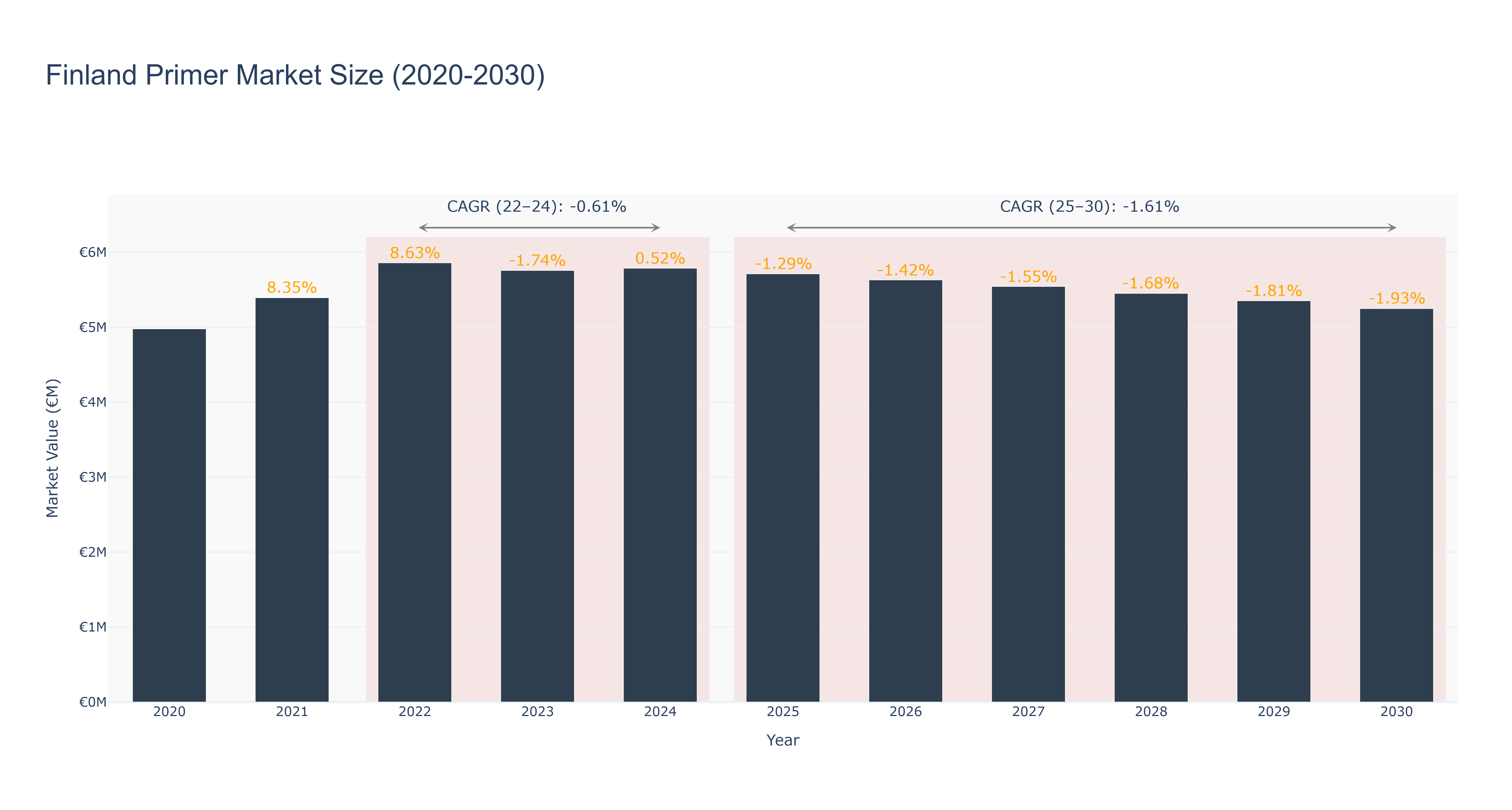
Finland Primer Market has shown a fluctuating trend over the past decade. The peak market size of €5.86 million was recorded in 2022, followed by a slight decline in the subsequent years. By 2024, the market size stood at €5.79 million. The forecasted trend indicates a continued decrease, with an expected market size of €5.25 million by 2030. The CAGR values reflect a negative growth rate, with -0.61% from 2022 to 2024 and -1.61% from 2025 to 2030. The market's decline can be attributed to various factors such as economic uncertainties, changing consumer preferences, and increased competition. Looking ahead, Finland is focusing on renewable energy initiatives to drive market growth, with upcoming projects aimed at sustainable development and environmental conservation. These efforts align with the industry drivers towards a greener and more sustainable future.
Finland Primer Market: Production & Trade Performance (2019-2025)
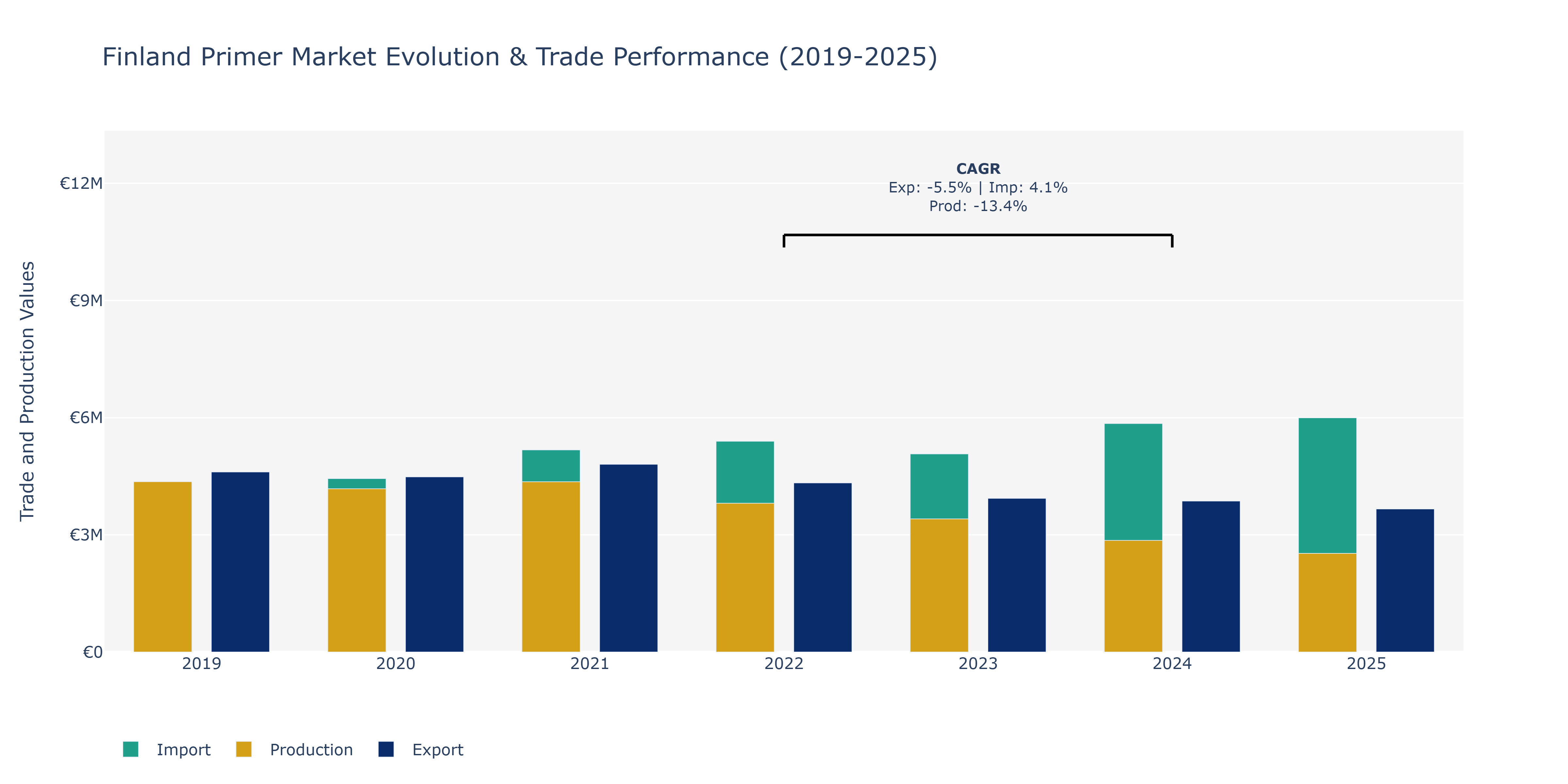
In the Finland Primer Market, exports, imports, and production exhibited distinct trends over the years. From 2019 to 2025, exports saw a steady decline from €4.61 million to around €3.66 million, attributed to global economic challenges impacting demand for Finnish products. Imports, on the other hand, showed fluctuation, reaching a peak of €6.0 million in 2025 after a slight decrease in the preceding years, possibly driven by evolving consumer preferences and international trade dynamics. Production value followed a notable downward trajectory, declining from €4.61 million in 2019 to approximately €2.5 million in 2025, indicating potential shifts in domestic manufacturing capabilities or technological advancements affecting output efficiencies. The market may benefit from strategic trade agreements or innovations in production processes to enhance competitiveness given the observed fluctuations and declines.
Finland Primer Market Synopsis
The Finland primer market is characterized by a steady demand for high-quality primers used in construction and painting applications. With a growing construction industry and increasing focus on sustainable building practices, there is a rising trend towards eco-friendly and low-VOC primers in the market. Key players in the Finland primer market include both domestic manufacturers and international brands, offering a wide range of products to cater to different customer needs. The market is driven by factors such as urbanization, renovation projects, and the popularity of DIY home improvement activities among consumers. Overall, the Finland primer market is expected to continue its growth trajectory, fueled by innovation, product diversification, and a strong emphasis on environmental sustainability.
Finland Primer Market Trends
The Finland primer market is experiencing growth driven by the increasing demand for high-quality and environmentally friendly products. Water-based primers are gaining popularity due to their low VOC content and ease of application. Consumers are also showing a preference for primers with enhanced durability and adhesion properties to ensure long-lasting results. The market is witnessing a surge in demand for eco-friendly and sustainable primers, with manufacturers focusing on developing innovative formulations using bio-based materials. Additionally, there is a growing interest in multi-functional primers that offer benefits such as mold resistance and improved coverage. Overall, the Finland primer market is characterized by a shift towards more sustainable and efficient products that cater to the evolving needs and preferences of consumers.
Finland Primer Market Challenges
In the Finland primer market, some challenges faced include intense competition among both domestic and international brands, leading to price wars and pressure on profit margins. Additionally, changing consumer preferences and increasing demand for eco-friendly and sustainable products require primer manufacturers to continually innovate and adapt their formulations. Regulatory constraints and compliance with stringent environmental standards also pose challenges in product development and marketing. Furthermore, fluctuations in raw material prices and availability, as well as the impact of global economic conditions, can affect the overall performance and growth of the primer market in Finland. Overall, staying competitive, meeting consumer demands, and navigating regulatory complexities are key challenges faced by players in the Finland primer market.
Finland Primer Market Investment Opportunities
The Finland primer market offers promising investment opportunities due to the country`s stable economy and strong demand for high-quality primers. With a growing construction sector and increasing focus on sustainable building practices, there is a rising need for innovative and eco-friendly primers in Finland. Investors can capitalize on this trend by investing in companies that specialize in producing environmentally friendly primers or by introducing new technologies to improve product efficiency and performance. Additionally, partnerships with local distributors and construction firms can help penetrate the market more effectively. Overall, the Finland primer market presents a favorable environment for investors looking to benefit from the country`s construction industry growth and sustainability initiatives.
Jordan Agar Market Government Policies
In Finland, the government has implemented various policies to regulate and support the primer market. These policies include strict regulations on product quality and safety to ensure that primers meet certain standards before they can be sold to consumers. Additionally, the government has also put in place measures to promote sustainability and environmental protection within the primer industry, encouraging the use of eco-friendly and non-toxic ingredients. Furthermore, there are initiatives to support research and development in the sector, aiming to promote innovation and the development of new primer products. Overall, the government is focused on creating a competitive and sustainable primer market that prioritizes consumer safety and environmental responsibility.
Finland Primer Market Future Outlook
The Finland Primer Market is expected to experience steady growth in the coming years, driven by factors such as increasing demand for high-quality paints and coatings in the construction and automotive industries. The market is likely to be influenced by rising awareness about the importance of surface preparation for long-lasting finishes, leading to a higher adoption of primers. Additionally, innovation in primer formulations, including eco-friendly and low-VOC products, is anticipated to attract environmentally conscious consumers. With the construction sector showing signs of recovery and the growing trend towards DIY projects among consumers, the Finland Primer Market is poised for expansion. Market players may benefit from focusing on product differentiation, strategic partnerships, and effective marketing strategies to capitalize on the evolving needs and preferences of customers in the region.
Key Highlights of the Report:
- Finland Primer Market Outlook
- Market Size of Finland Primer Market, 2024
- Forecast of Finland Primer Market, 2031
- Historical Data and Forecast of Finland Primer Revenues & Volume for the Period 2021- 2031
- Finland Primer Market Trend Evolution
- Finland Primer Market Drivers and Challenges
- Finland Primer Price Trends
- Finland Primer Porter's Five Forces
- Finland Primer Industry Life Cycle
- Historical Data and Forecast of Finland Primer Market Revenues & Volume By Ingredient for the Period 2021- 2031
- Historical Data and Forecast of Finland Primer Market Revenues & Volume By Resin for the Period 2021- 2031
- Historical Data and Forecast of Finland Primer Market Revenues & Volume By Additives for the Period 2021- 2031
- Historical Data and Forecast of Finland Primer Market Revenues & Volume By Others for the Period 2021- 2031
- Historical Data and Forecast of Finland Primer Market Revenues & Volume By End-User Industry for the Period 2021- 2031
- Historical Data and Forecast of Finland Primer Market Revenues & Volume By Automotive for the Period 2021- 2031
- Historical Data and Forecast of Finland Primer Market Revenues & Volume By Building and Construction for the Period 2021- 2031
- Historical Data and Forecast of Finland Primer Market Revenues & Volume By Furniture for the Period 2021- 2031
- Historical Data and Forecast of Finland Primer Market Revenues & Volume By Industrial for the Period 2021- 2031
- Historical Data and Forecast of Finland Primer Market Revenues & Volume By Packaging for the Period 2021- 2031
- Historical Data and Forecast of Finland Primer Market Revenues & Volume By Others for the Period 2021- 2031
- Finland Primer Import Export Trade Statistics
- Market Opportunity Assessment By Ingredient
- Market Opportunity Assessment By End-User Industry
- Finland Primer Top Companies Market Share
- Finland Primer Competitive Benchmarking By Technical and Operational Parameters
- Finland Primer Company Profiles
- Finland Primer Key Strategic Recommendations






































