Finland Vegetable Oils Market Top 5 Importing Countries and Market Competition (HHI) Analysis
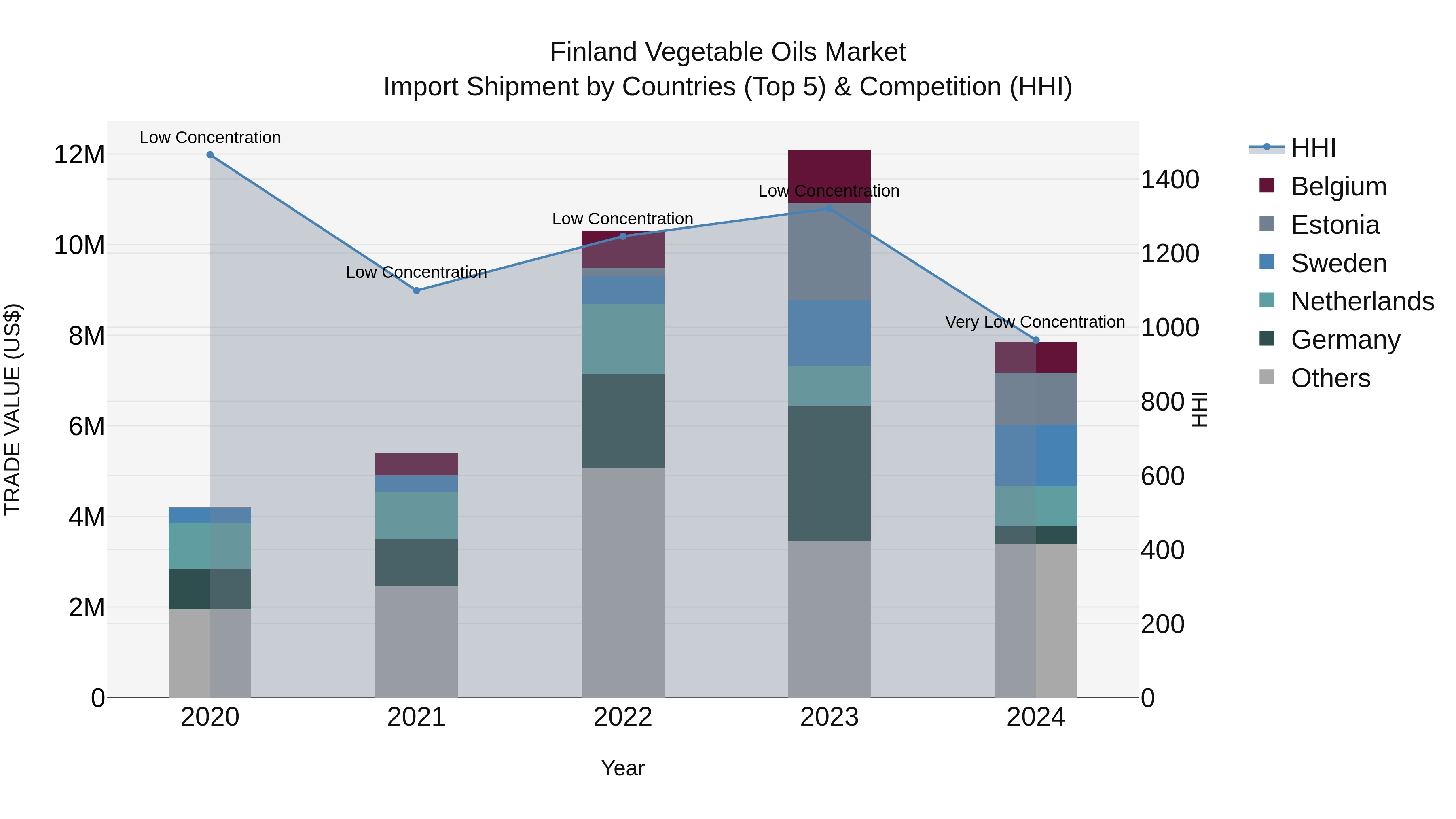
Finland`s vegetable oils import market saw a notable shift in concentration levels in 2024, with a very low Herfindahl-Hirschman Index (HHI) indicating increased competition among top exporting countries like Sweden, Estonia, and Netherlands. Despite a significant decline in growth rate from 2023 to 2024, the impressive compound annual growth rate (CAGR) of 16.94% over the past five years highlights the market`s overall expansion. This dynamic landscape suggests opportunities for both established and emerging players to capitalize on Finland`s growing demand for vegetable oils.
Finland Vegetable oils Market Overview
The vegetable oils market in Finland caters to food production, biofuel, and industrial applications. Sustainable and cold-pressed oils are gaining popularity among health-conscious consumers and industries focused on eco-friendly practices.
Drivers of the market
The Finland Vegetable Oils Market benefits from the growing demand for cooking oils as a healthier alternative to animal-based fats. Increased awareness of the nutritional benefits of plant-based oils, such as omega-3 fatty acids and antioxidants, is driving consumer preferences. Additionally, the use of vegetable oils in a wide range of industries, including food production, cosmetics, and pharmaceuticals, contributes to market growth.
Challenges of the market
Finland`s vegetable oils market is constrained by a dependency on imports due to limited domestic production. Price volatility in the global market, driven by supply chain disruptions and weather conditions, impacts affordability. Rising demand for sustainable and non-GMO oils adds pressure on producers to meet evolving consumer expectations.
Government Policy of the market
In Finland, the Vegetable Oils market is influenced by government policies focused on health and environmental sustainability. Finnish regulations encourage the use of vegetable oils in food production due to their health benefits over animal-based oils. The government supports sustainable farming practices and environmentally friendly oil extraction processes, providing incentives for businesses that meet strict health and environmental standards in their production processes.
Key Highlights of the Report:
- Finland Vegetable oils Market Outlook
- Market Size of Finland Vegetable oils Market, 2024
- Forecast of Finland Vegetable oils Market, 2031
- Historical Data and Forecast of Finland Vegetable oils Revenues & Volume for the Period 2021-2031
- Finland Vegetable oils Market Trend Evolution
- Finland Vegetable oils Market Drivers and Challenges
- Finland Vegetable oils Price Trends
- Finland Vegetable oils Porter`s Five Forces
- Finland Vegetable oils Industry Life Cycle
- Historical Data and Forecast of Finland Vegetable oils Market Revenues & Volume By Types for the Period 2021-2031
- Historical Data and Forecast of Finland Vegetable oils Market Revenues & Volume By Palm Oil for the Period 2021-2031
- Historical Data and Forecast of Finland Vegetable oils Market Revenues & Volume By Soybean Oil for the Period 2021-2031
- Historical Data and Forecast of Finland Vegetable oils Market Revenues & Volume By Rapeseed Oil for the Period 2021-2031
- Historical Data and Forecast of Finland Vegetable oils Market Revenues & Volume By Sunflower Oil for the Period 2021-2031
- Historical Data and Forecast of Finland Vegetable oils Market Revenues & Volume By Olive Oil for the Period 2021-2031
- Historical Data and Forecast of Finland Vegetable oils Market Revenues & Volume By Others for the Period 2021-2031
- Historical Data and Forecast of Finland Vegetable oils Market Revenues & Volume By Applications for the Period 2021-2031
- Historical Data and Forecast of Finland Vegetable oils Market Revenues & Volume By Food for the Period 2021-2031
- Historical Data and Forecast of Finland Vegetable oils Market Revenues & Volume By Feed for the Period 2021-2031
- Historical Data and Forecast of Finland Vegetable oils Market Revenues & Volume By Industrial for the Period 2021-2031
- Finland Vegetable oils Import Export Trade Statistics
- Market Opportunity Assessment By Types
- Market Opportunity Assessment By Applications
- Finland Vegetable oils Top Companies Market Share
- Finland Vegetable oils Competitive Benchmarking By Technical and Operational Parameters
- Finland Vegetable oils Company Profiles
- Finland Vegetable oils Key Strategic Recommendations






































