France Ammonia Market Size (2020-2030)
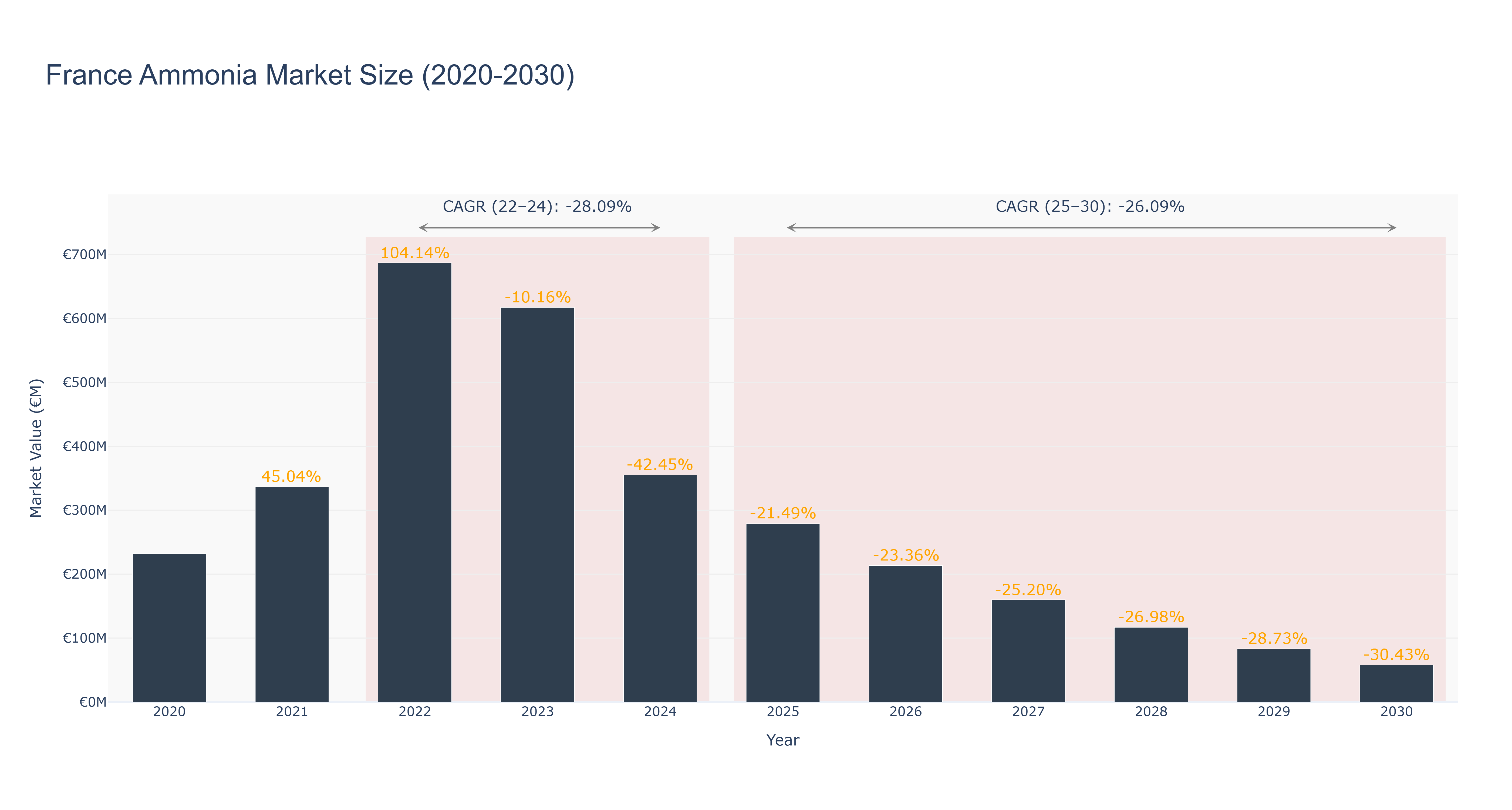
France Ammonia Market has experienced a significant decline in market size over the past few years. The peak market size of €686.98 million was recorded in 2022, followed by a sharp decrease to €355.20 million in 2024. The market is forecasted to continue shrinking, with an estimated size of €57.88 million in 2030. The CAGR from 2022 to 2024 is -28.09%, while the CAGR from 2025 to 2030 is projected at -26.09%. The downward trend can be attributed to factors such as changes in consumer preferences towards more sustainable alternatives and stricter environmental regulations. To counter this trend, France is investing in research and development for green ammonia production technologies to meet the growing demand for eco-friendly fertilizers and energy storage solutions. This initiative aims to revitalize the ammonia market and drive future growth opportunities.
France Ammonia Market: Production & Trade Performance (2019-2025)
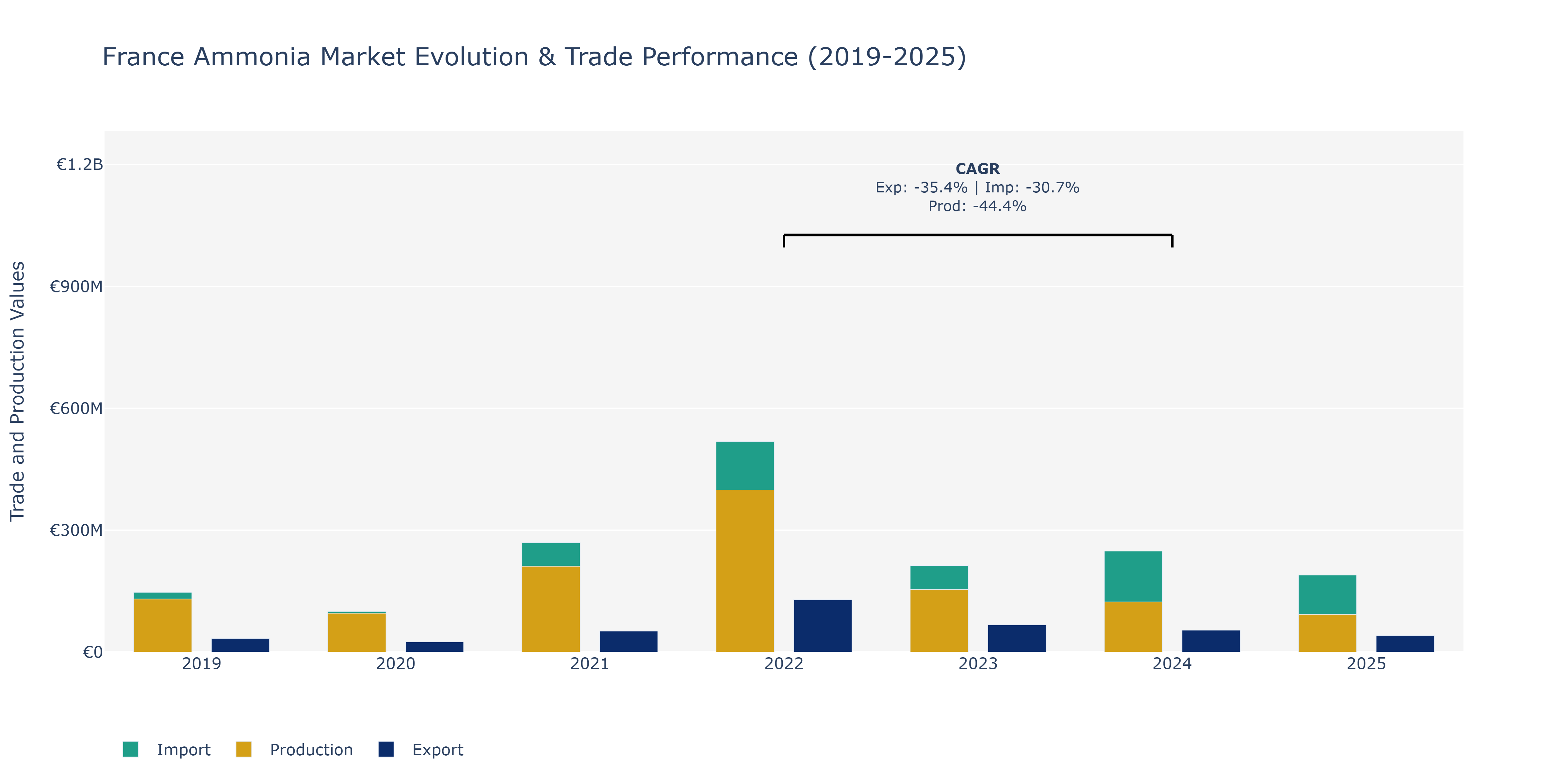
The France Ammonia Market witnessed notable fluctuations in Exports, Imports, and Production over the years. In 2019, Exports stood at €33.42 million, dropping to €24.84 million in 2020 before rebounding to €51.72 million in 2021. The peak Export value was recorded in 2022 at €128.81 million, showcasing a substantial increase. Imports followed a similar pattern, with a peak of €517.75 million in 2022 after a decline in 2020. Production value also experienced significant variations, hitting a peak of €211.17 million in 2021 before decreasing to €92.59 million in 2025. The industry's production capacity might have been affected by factors like fluctuating raw material costs, regulatory changes, and evolving market demand. These shifts emphasize the market's sensitivity to both global and domestic economic conditions, necessitating strategic planning to navigate such fluctuations effectively.
France Ammonia Market Overview
The France Ammonia Market is experiencing steady growth driven by the increasing demand from various industries such as agriculture, pharmaceuticals, and chemicals. The agriculture sector is a major consumer of ammonia for fertilizer production, contributing significantly to market growth. Additionally, the expanding pharmaceutical and chemical industries are further propelling the demand for ammonia in various applications like pharmaceutical manufacturing and chemical synthesis. The market is also witnessing a shift towards sustainable practices, with a focus on ammonia production methods that reduce environmental impact. Key players in the France Ammonia Market include Yara International, BASF SE, and CF Industries Holdings, among others. Overall, the market is expected to continue its growth trajectory, supported by the diverse industrial applications of ammonia and the increasing emphasis on sustainable production practices.
France Ammonia Market Trends
In the France Ammonia Market, there has been a growing focus on sustainable production methods and environmentally friendly practices. Companies are increasingly investing in green ammonia production, which involves using renewable energy sources such as wind or solar power to produce ammonia through electrolysis. This trend is driven by the push towards reducing carbon emissions and meeting sustainability goals. Additionally, there is a rising demand for ammonia in sectors such as agriculture for fertilizer production and in the chemical industry for various applications. The market is also witnessing technological advancements in ammonia production processes to improve efficiency and reduce environmental impact. Overall, the France Ammonia Market is evolving towards a more sustainable and innovative future.
France Ammonia Market Challenges
In the France Ammonia Market, some key challenges include regulatory constraints related to environmental impact and safety measures, fluctuating prices of raw materials such as natural gas, competition from other nitrogen-based fertilizers, and the need for sustainable production practices. Additionally, the market faces pressure to adopt more eco-friendly and efficient ammonia production technologies to reduce carbon emissions and comply with stringent environmental regulations. Furthermore, the industry must navigate market volatility, geopolitical factors affecting supply chains, and evolving consumer preferences towards organic and environmentally-friendly products. Overall, addressing these challenges will require innovation, strategic partnerships, and investment in sustainable practices to ensure the long-term growth and competitiveness of the France Ammonia Market.
France Ammonia Market Investment Opportunities
The France Ammonia Market presents various investment opportunities due to the growing demand for ammonia in agriculture, industrial, and pharmaceutical sectors. With the increasing focus on sustainable agriculture practices, there is a rising need for ammonia-based fertilizers to improve crop yields. Additionally, the industrial sector utilizes ammonia for various processes such as manufacturing of chemicals, refrigeration, and wastewater treatment. Investing in companies involved in ammonia production, distribution, or technology development can be lucrative. Furthermore, with the push towards renewable energy sources, there is potential for investment in green ammonia production technologies that reduce carbon emissions. Overall, the France Ammonia Market offers diverse investment prospects for those looking to capitalize on the demand for this essential chemical compound.
France Ammonia Market Government Policy
In France, government policies related to the ammonia market primarily focus on environmental regulations and sustainability. The French government has implemented strict regulations to reduce ammonia emissions from agricultural activities, which are a major source of air pollution and contribute to environmental degradation. Additionally, there are financial incentives and subsidies available to encourage the adoption of cleaner ammonia production technologies and processes. The government also supports research and development initiatives aimed at improving the efficiency and environmental performance of the ammonia industry. Overall, the policies aim to promote sustainable production practices, reduce environmental impact, and ensure compliance with European Union regulations regarding ammonia emissions and environmental protection.
France Ammonia Market Future Outlook
The future outlook for the France Ammonia Market looks promising, driven by various factors such as increasing demand for fertilizers in the agriculture sector, growing use of ammonia in various industrial applications including refrigeration, and the rising adoption of ammonia as a clean energy source in power generation and transportation. Additionally, the focus on sustainable agriculture practices and the shift towards eco-friendly refrigerants are expected to further boost the demand for ammonia in France. However, challenges related to regulatory compliance and the need for technological advancements to improve production efficiency and reduce environmental impact may pose some hurdles. Overall, with the right strategies in place to address these challenges, the France Ammonia Market is likely to experience steady growth in the coming years.
Key Highlights of the Report:
- France Ammonia Market Outlook
- Market Size of France Ammonia Market, 2021
- Forecast of France Ammonia Market, 2031
- Historical Data and Forecast of France Ammonia Revenues & Volume for the Period 2018 - 2031
- France Ammonia Market Trend Evolution
- France Ammonia Market Drivers and Challenges
- France Ammonia Price Trends
- France Ammonia Porter's Five Forces
- France Ammonia Industry Life Cycle
- Historical Data and Forecast of France Ammonia Market Revenues & Volume By Type for the Period 2018 - 2031
- Historical Data and Forecast of France Ammonia Market Revenues & Volume By Liquid for the Period 2018 - 2031
- Historical Data and Forecast of France Ammonia Market Revenues & Volume By Gas for the Period 2018 - 2031
- Historical Data and Forecast of France Ammonia Market Revenues & Volume By End-user Industry for the Period 2018 - 2031
- Historical Data and Forecast of France Ammonia Market Revenues & Volume By Agriculture for the Period 2018 - 2031
- Historical Data and Forecast of France Ammonia Market Revenues & Volume By Textiles for the Period 2018 - 2031
- Historical Data and Forecast of France Ammonia Market Revenues & Volume By Mining for the Period 2018 - 2031
- Historical Data and Forecast of France Ammonia Market Revenues & Volume By Pharmaceutical for the Period 2018 - 2031
- Historical Data and Forecast of France Ammonia Market Revenues & Volume By Refrigeration for the Period 2018 - 2031
- Historical Data and Forecast of France Ammonia Market Revenues & Volume By Others for the Period 2018 - 2031
- France Ammonia Import Export Trade Statistics
- Market Opportunity Assessment By Type
- Market Opportunity Assessment By End-user Industry
- France Ammonia Top Companies Market Share
- France Ammonia Competitive Benchmarking By Technical and Operational Parameters
- France Ammonia Company Profiles
- France Ammonia Key Strategic Recommendations






































