France Content Analytics Market Size & Growth Rate (2026-2032)
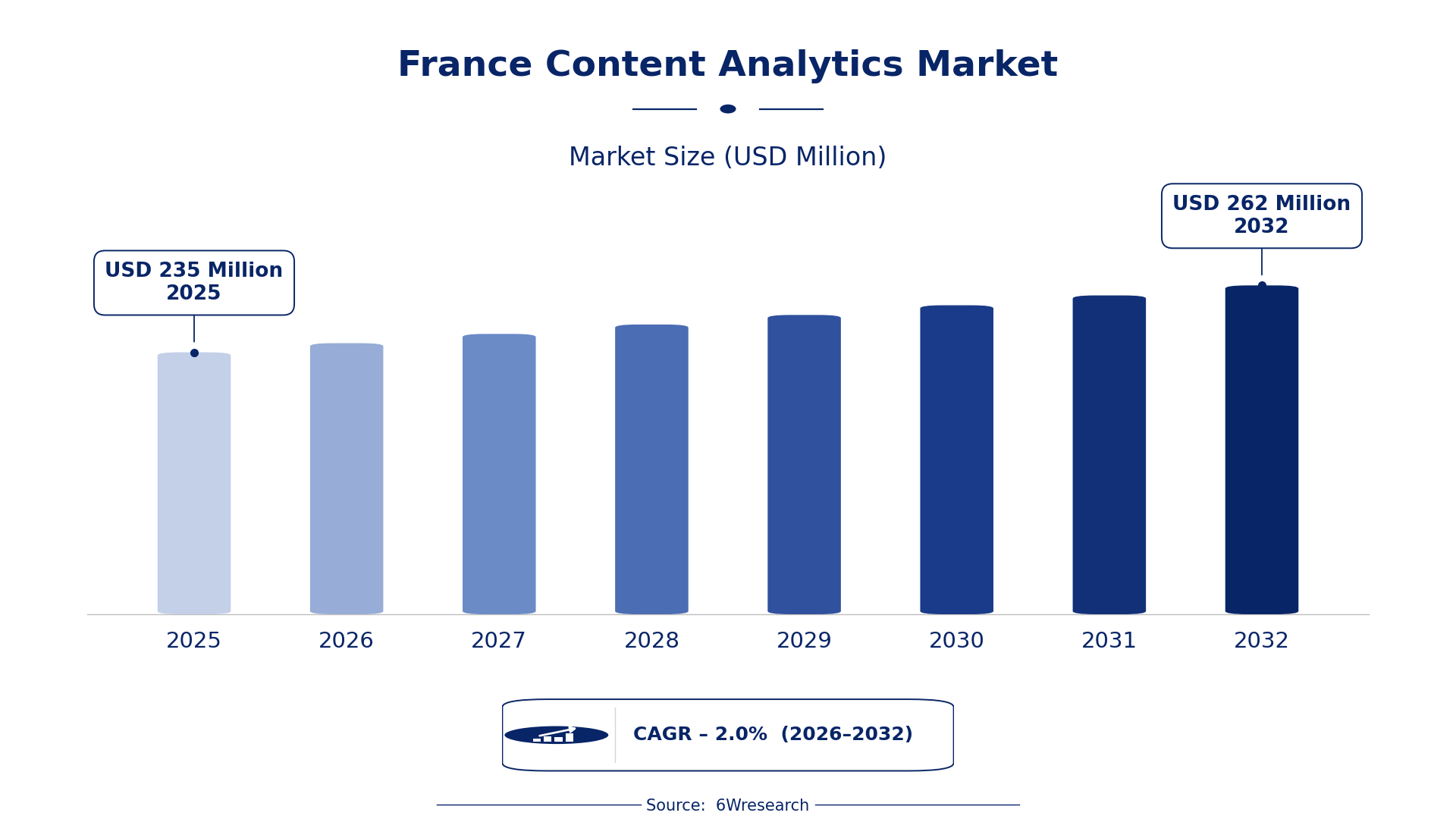
The France Content Analytics Market was estimated at USD 235 Million in 2025 and is projected to reach USD 262 Million by 2032, growing at a CAGR of 2.0% from 2026 to 2032.
France Content Analytics Market Synopsis
The France Content Analytics Market has gained notable momentum, driven by an increasing reliance on data to enhance customer engagement and streamline operations. As organizations recognize the potential of unstructured data, they are increasingly adopting content analytics tools to extract actionable insights from diverse content formats.
Looking ahead, the market is set to evolve with technological advancements that enable deeper analysis and integration of various data types. While the current growth trajectory is promising, there are hurdles such as data quality and integration challenges that must be addressed to realize the full potential of content analytics in France.
France Content Analytics Market Year-wise Growth Rate and Key Drivers
This graph illustrates the annual growth rates of the France Content Analytics Market from 2021 to 2032, highlighting a steady upward trajectory and projected expansion over the forecast period.
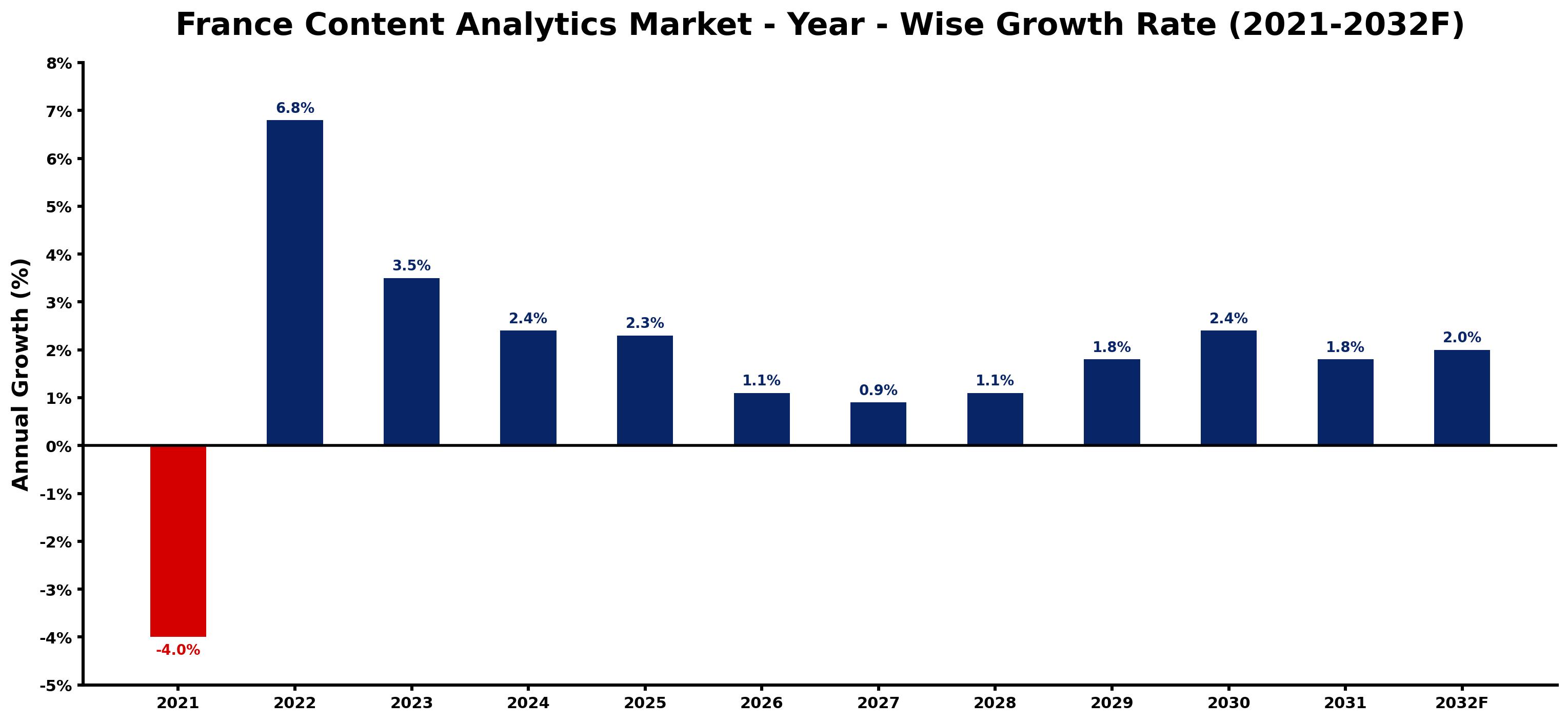
The table below presents the year‑wise growth rates along with the key drivers influencing the market
| Year | Growth Rate | Major Drivers |
| 2021 | -4.0% | French data privacy laws hindered analytics adoption. |
| 2022 | 6.8% | Increase in French GDPR compliance driving analytics adoption. |
| 2023 | 3.5% | Growing investments in AI-driven content analysis technologies. |
| 2024 | 2.4% | Surge in demand for video content analytics in France. |
| 2025 | 2.3% | Popularity of French influencer marketing boosting content insights. |
| 2026 | 1.1% | Emergence of local startups focusing on content optimization. |
| 2027 | 0.9% | Increased digital literacy among French consumers and businesses. |
| 2028 | 1.1% | Rising interest in user-generated content analytics strategies. |
| 2029 | 1.8% | Growth in French media consumption on mobile platforms. |
| 2030 | 2.4% | French government funding for digital innovation initiatives. |
| 2031 | 1.8% | Stronger focus on audience engagement metrics in publishing. |
| 2032 | 2.0% | Adoption of cloud platforms enhancing content analytics capabilities. |
Note: Market size estimations and growth projections presented in this report are based on 6Wresearch's proprietary forecasting methodology, utilizing the latest available industry data, government publications, and primary research inputs.
France Content Analytics Market Key Takeaways
Below are some of the specific key takeaways from the market, including:
- Organizations in retail, healthcare, and media are leading the charge in adopting content analytics solutions.
- Artificial intelligence and machine learning advancements are significantly enhancing the capabilities of content analytics tools.
- Data silos and quality issues remain critical barriers to effective content analytics implementation.
- Government initiatives aimed at digital transformation are facilitating the growth of content analytics in France.
- The demand for improved customer experiences is driving the search for effective content analytics solutions.
Evaluation of Restraints in France Content Analytics Market
Despite the promising outlook, the France Content Analytics Market faces several constraints. Data silos present a significant challenge, hindering organizations' ability to consolidate and analyze data effectively. on top of that, issues related to data quality can compromise the reliability of insights drawn from analytics tools. Many organizations also lack advanced analytics skills, which limits their ability to leverage these technologies fully. Privacy regulations, particularly GDPR compliance, add another layer of complexity that organizations must navigate, often resulting in delays in deployment and implementation.
France Content Analytics Market Trends
A key trend shaping the France Content Analytics Market is the integration of artificial intelligence and machine learning into analytics platforms. These technologies are enabling more sophisticated data processing and predictive analytics capabilities, allowing organizations to derive deeper insights from their content. Another trend is the increasing focus on customer-centric strategies, with businesses prioritizing analytics that enhances user experiences. Additionally, the rise of cloud-based solutions is facilitating easier access to analytics tools, making them more appealing to organizations of all sizes.
France Content Analytics Market Opportunities
The market offers several avenues for growth and investment. Businesses that prioritize data integration solutions are likely to reap substantial benefits by overcoming existing silos. on top of that, organizations looking to invest in training and upskilling employees in analytics can gain a competitive edge. With the French government backing digital transformation initiatives, there are also potential collaborations between public and private sectors that can enhance the overall analytics ecosystem.
Government Initiatives in the France Content Analytics Market
Government policies are playing a vital role in shaping the France Content Analytics Market by promoting digital transformation and encouraging cloud adoption. With a focus on modernizing the economy, France is fostering an environment conducive to the growth of content analytics solutions. This support is crucial as it aligns public-sector priorities with the needs of businesses seeking to leverage data analytics effectively.
- A national digital infrastructure upgrade programme launched in 2025 aims to improve connectivity across various sectors, facilitating better data sharing and analytics capabilities.
- Currently, initiatives are underway to support small and medium-sized enterprises (SMEs) in adopting cloud-based analytics tools, enhancing their competitiveness in the market.
- Upcoming regulatory frameworks are expected to be introduced in 2026, focusing on data privacy and compliance to support responsible content analytics practices.
- A public-private partnership initiative planned for 2027 aims to develop advanced training programs in analytics, equipping the workforce with necessary skills.
Future Insights of the France Content Analytics Market
From 2026 to 2032, the France Content Analytics Market is anticipated to see a steady progression as businesses continue to prioritize data-driven decision-making. The ongoing advancements in analytics technologies will enable organizations to not only gather insights but also forecast trends with greater accuracy. As competition intensifies across industries, those adopting innovative content analytics solutions will likely secure a stronger market position.
France Content Analytics Market Latest Developments
Recent developments in the France Content Analytics Market reflect a growing enthusiasm for advanced analytics solutions. Over the past year, organizations have increasingly recognized the value of harnessing unstructured data for strategic decision-making. This shift is evidenced by the surge in partnerships and technology enhancements aimed at improving content analytics capabilities.
- A leading analytics software provider announced a new product launch in early 2025, focusing on enhanced data visualization tools tailored for French enterprises.
- An initiative that began in mid-2025 and remains underway focuses on integrating machine learning algorithms into existing analytics platforms to improve predictive capabilities.
- A major technology vendor is expected to roll out a comprehensive training program in Q3 2025, aimed at upskilling employees in advanced analytics techniques.
- Plans for a collaborative project between key stakeholders in the analytics sector are set to be unveiled in late 2026, aimed at addressing data quality issues across industries.
France Content Analytics Market - Key Attractiveness of the Report
- 10 Years of Market Numbers
- Historical Data Starting from 2022 to 2025
- Base Year: 2025
- Forecast Data until 2032
- Key Performance Indicators Impacting the Market
- Major Upcoming Developments and Projects
Key Highlights of the Report:
- France Content Analytics Market Outlook
- Market Size of France Content Analytics Market, 2025
- Forecast of France Content Analytics Market, 2032
- Historical Data and Forecast of France Content Analytics Revenues & Volume for the Period 2022-2032F
- France Content Analytics Market Trend Evolution
- France Content Analytics Market Drivers and Challenges
- France Content Analytics Price Trends
- France Content Analytics Porter's Five Forces
- France Content Analytics Industry Life Cycle
- Historical Data and Forecast of France Content Analytics Market Revenues & Volume By Application for the Period 2022-2032F
- Historical Data and Forecast of France Content Analytics Market Revenues & Volume By Speech Analytics for the Period 2022-2032F
- Historical Data and Forecast of France Content Analytics Market Revenues & Volume By Text Analytics for the Period 2022-2032F
- Historical Data and Forecast of France Content Analytics Market Revenues & Volume By Web Analytics for the Period 2022-2032F
- Historical Data and Forecast of France Content Analytics Market Revenues & Volume By Social Media Analytics for the Period 2022-2032F
- Historical Data and Forecast of France Content Analytics Market Revenues & Volume By Others for the Period 2022-2032F
- Historical Data and Forecast of France Content Analytics Market Revenues & Volume By Deployment Type for the Period 2022-2032F
- Historical Data and Forecast of France Content Analytics Market Revenues & Volume By On-Premises for the Period 2022-2032F
- Historical Data and Forecast of France Content Analytics Market Revenues & Volume By Cloud/Hosted for the Period 2022-2032F
- Historical Data and Forecast of France Content Analytics Market Revenues & Volume By Vertical for the Period 2022-2032F
- Historical Data and Forecast of France Content Analytics Market Revenues & Volume By BFSI (Banking, Financial Services and Insurance) for the Period 2022-2032F
- Historical Data and Forecast of France Content Analytics Market Revenues & Volume By Retail & Consumer Goods for the Period 2022-2032F
- Historical Data and Forecast of France Content Analytics Market Revenues & Volume By IT & Telecom for the Period 2022-2032F
- Historical Data and Forecast of France Content Analytics Market Revenues & Volume By Healthcare for the Period 2022-2032F
- Historical Data and Forecast of France Content Analytics Market Revenues & Volume By Media & Entertainment for the Period 2022-2032F
- Historical Data and Forecast of France Content Analytics Market Revenues & Volume By Government for the Period 2022-2032F
- Historical Data and Forecast of France Content Analytics Market Revenues & Volume By Travel & Hospitality for the Period 2022-2032F
- Historical Data and Forecast of France Content Analytics Market Revenues & Volume By Others for the Period 2022-2032F
- France Content Analytics Import Export Trade Statistics
- Market Opportunity Assessment By Application
- Market Opportunity Assessment By Deployment Type
- Market Opportunity Assessment By Vertical
- France Content Analytics Top Companies Market Share
- France Content Analytics Competitive Benchmarking By Technical and Operational Parameters
- France Content Analytics Company Profiles
- France Content Analytics Key Strategic Recommendations






































