France Glassware Market Top 5 Importing Countries and Market Competition (HHI) Analysis
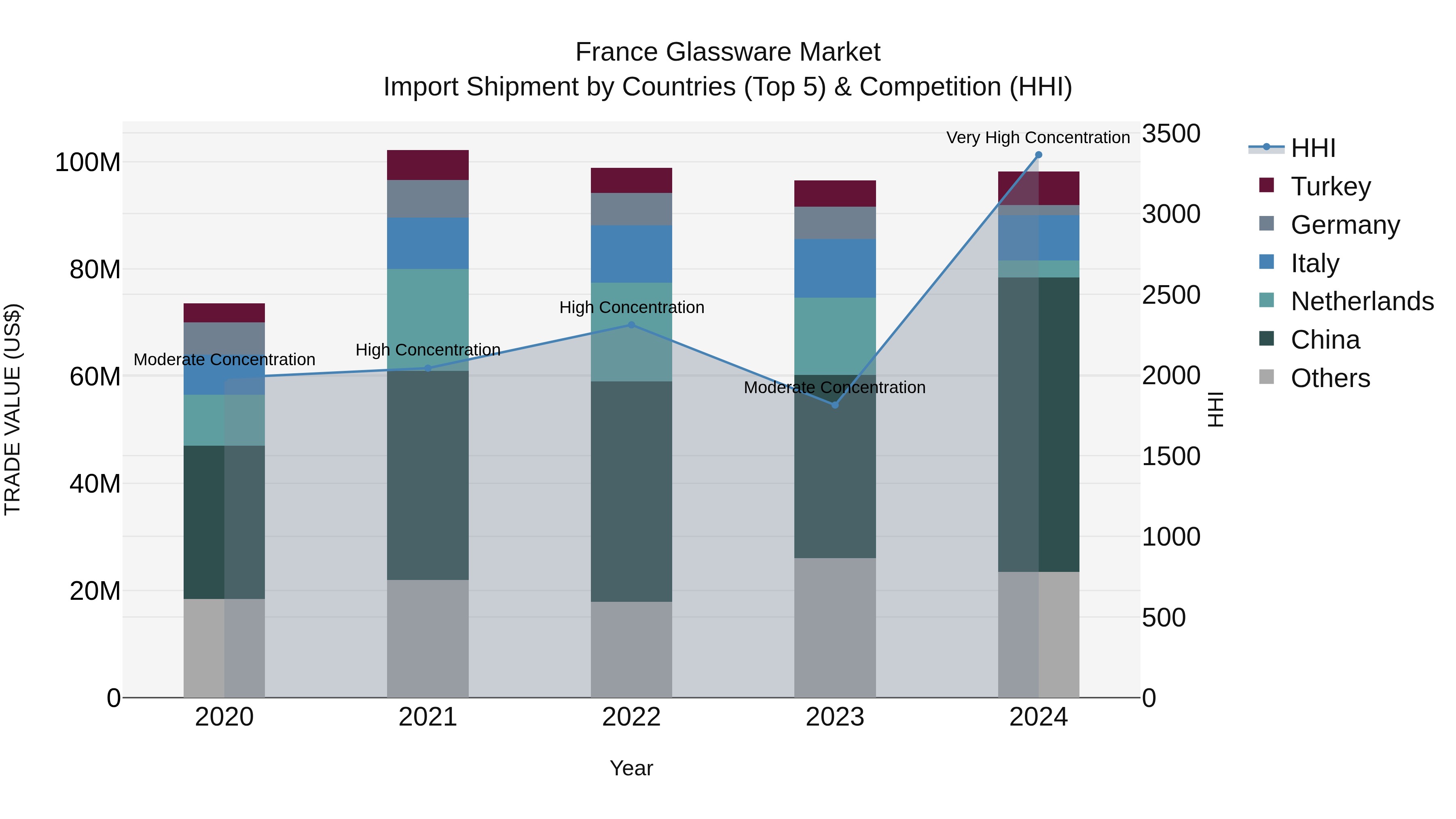
France`s glassware import market saw a notable shift in 2024, with top exporters including China, UAE, Italy, Turkey, and Netherlands. The market concentration, as measured by the HHI, significantly increased from moderate in 2023 to very high in 2024. The compound annual growth rate (CAGR) for the period 2020-2024 stood at a healthy 7.48%, while the growth rate from 2023 to 2024 was 1.7%. This data suggests a dynamic and rapidly evolving market landscape, with potential implications for importers, exporters, and industry stakeholders in the glassware sector.
France Glassware Market Overview
The Glassware market in France encompasses a diverse range of glass products for household, commercial, and industrial applications, including drinking glasses, stemware, laboratory glassware, and specialty glass containers. Glassware is valued for its transparency, purity, and hygienic properties, making it a preferred choice for storing, serving, and displaying food, beverages, and laboratory samples. The market is driven by consumer preferences for premium quality, design innovation, and sustainability in glassware products, stimulating investments in glass manufacturing technologies and eco-friendly production practices.
Drivers of the market
The Glassware market in France is experiencing growth due to its applications in food and beverage service, hospitality, retail, and gifting for serving, storing, and presenting beverages such as wine, spirits, water, and specialty drinks. Glassware encompasses a wide range of products including drinking glasses, stemware, decanters, pitchers, and carafes, offering advantages such as transparency, purity, and hygiene. The increasing demand for premium and artisanal beverages, dining experiences, and home entertaining drives the adoption of glassware. Moreover, the growing trend of experiential dining, mixology, and cocktail culture further stimulates market growth by creating opportunities for innovative and specialized glassware designs. Additionally, collaborations between glassware manufacturers, sommeliers, bartenders, and designers contribute to market expansion by fostering product innovation, brand partnerships, and consumer education initiatives.
Challenges of the market
The France Glassware Market confronts challenges related to consumer preferences, manufacturing technology, and market competition. One significant challenge is meeting diverse consumer preferences for glassware products that range from traditional to contemporary designs and from everyday use to special occasions. Moreover, optimizing glass manufacturing processes, such as blowing, pressing, and molding, poses challenges for manufacturers in terms of production efficiency and product quality. Additionally, competition from alternative tableware materials, such as ceramics and plastics, poses challenges for the glassware market in maintaining market share and driving growth.
Government Policy of the market
Regulations concerning product safety, materials standards, and labeling requirements influence the glassware market in France. Government policies ensure that glassware products meet hygiene standards, chemical safety regulations, and consumer protection measures to maintain product quality and integrity.
Key Highlights of the Report:
- France Glassware Market Outlook
- Market Size of France Glassware Market, 2024
- Forecast of France Glassware Market, 2031
- Historical Data and Forecast of France Glassware Revenues & Volume for the Period 2021-2031
- France Glassware Market Trend Evolution
- France Glassware Market Drivers and Challenges
- France Glassware Price Trends
- France Glassware Porter's Five Forces
- France Glassware Industry Life Cycle
- Historical Data and Forecast of France Glassware Market Revenues & Volume By Type for the Period 2021-2031
- Historical Data and Forecast of France Glassware Market Revenues & Volume By Soda Lime Glass for the Period 2021-2031
- Historical Data and Forecast of France Glassware Market Revenues & Volume By Lead Glass for the Period 2021-2031
- Historical Data and Forecast of France Glassware Market Revenues & Volume By Heat Resistant Glass for the Period 2021-2031
- Historical Data and Forecast of France Glassware Market Revenues & Volume By Distribution Channel for the Period 2021-2031
- Historical Data and Forecast of France Glassware Market Revenues & Volume By e-Commerce for the Period 2021-2031
- Historical Data and Forecast of France Glassware Market Revenues & Volume By Supermarkets/Hypermarkets for the Period 2021-2031
- Historical Data and Forecast of France Glassware Market Revenues & Volume By Specialized Stores for the Period 2021-2031
- Historical Data and Forecast of France Glassware Market Revenues & Volume By End-user for the Period 2021-2031
- Historical Data and Forecast of France Glassware Market Revenues & Volume By Hotels & Restaurants for the Period 2021-2031
- Historical Data and Forecast of France Glassware Market Revenues & Volume By Corporate Canteens for the Period 2021-2031
- Historical Data and Forecast of France Glassware Market Revenues & Volume By Bars & Caf for the Period 2021-2031
- Historical Data and Forecast of France Glassware Market Revenues & Volume By Household for the Period 2021-2031
- Historical Data and Forecast of France Glassware Market Revenues & Volume By Others for the Period 2021-2031
- France Glassware Import Export Trade Statistics
- Market Opportunity Assessment By Type
- Market Opportunity Assessment By Distribution Channel
- Market Opportunity Assessment By End-user
- France Glassware Top Companies Market Share
- France Glassware Competitive Benchmarking By Technical and Operational Parameters
- France Glassware Company Profiles
- France Glassware Key Strategic Recommendations






































