France Hdpe Market Top 5 Importing Countries and Market Competition (HHI) Analysis
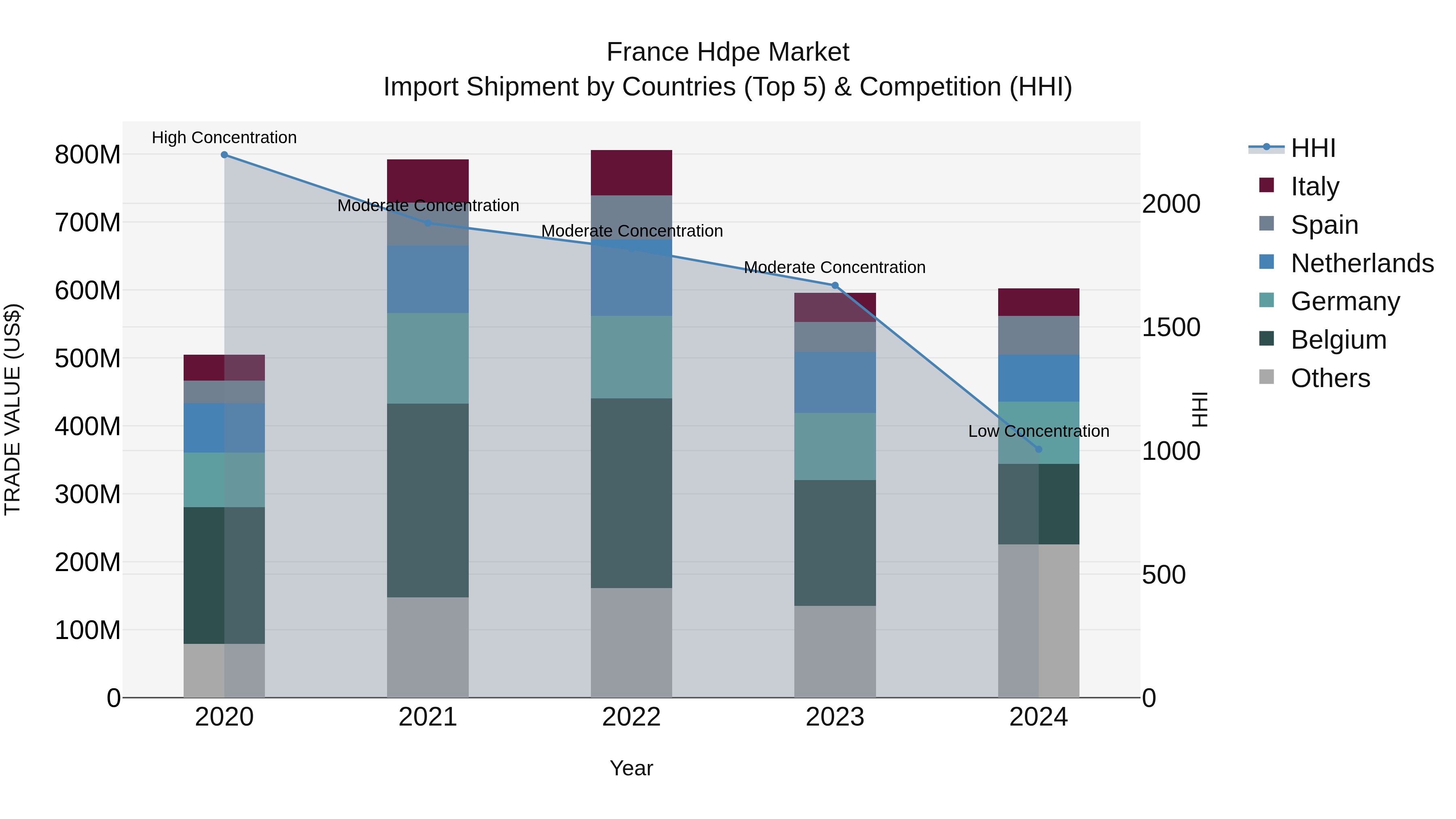
France`s HDPE import market in 2024 saw key suppliers such as Belgium, Germany, Netherlands, Spain, and Italy dominating the shipments. The market exhibited a shift from moderate to low concentration, indicating a more diversified import landscape. With a healthy CAGR of 4.53% from 2020 to 2024 and a steady growth rate of 1.16% in 2024, the HDPE import sector in France shows resilience and potential for further development in the coming years.
France Hdpe Market Overview
The High-Density Polyethylene (HDPE) market in France is experiencing steady growth driven by the increasing demand for packaging materials, particularly in the food and beverage industry. HDPE is preferred for its lightweight, durable, and recyclable properties, making it a popular choice for various applications such as bottles, containers, and pipes. The construction sector also contributes to the demand for HDPE in France due to its use in infrastructure projects. Key players in the market include Total S.A., LyondellBasell Industries, and INEOS Group. With an emphasis on sustainable practices and the circular economy, the HDPE market in France is expected to continue expanding, supported by ongoing innovation in product development and recycling technologies.
France Hdpe Market Trends
The current trends in the France HDPE (High-Density Polyethylene) market indicate a growing demand for sustainable packaging solutions, driving the adoption of HDPE materials due to their recyclability and versatility. With increasing environmental concerns and regulatory pressure to reduce plastic waste, companies are shifting towards using HDPE for products such as bottles, containers, and packaging. Additionally, the construction industry is also contributing to the demand for HDPE in France, as the material is being increasingly used in infrastructure projects and pipelines due to its durability and resistance to corrosion. Innovations in HDPE technology, such as the development of bio-based HDPE and enhanced recycling processes, are further shaping the market landscape as companies seek more eco-friendly alternatives.
France Hdpe Market Challenges
In the France HDPE market, some challenges faced include increasing competition from low-cost producers in other regions, fluctuating raw material prices, and stringent environmental regulations. The competition from low-cost producers puts pressure on pricing and profit margins for French HDPE manufacturers. Fluctuating raw material prices can impact production costs and overall profitability. Additionally, complying with strict environmental regulations adds complexity and cost to production processes. These challenges require companies in the France HDPE market to constantly innovate, improve operational efficiency, and adapt to changing market dynamics to remain competitive and sustain growth in the industry.
France Hdpe Market Investment Opportunities
In the France HDPE market, there are several promising investment opportunities to consider. One potential avenue is to invest in companies that specialize in the production or distribution of HDPE materials, as the demand for HDPE products is expected to rise due to its versatile applications in industries such as packaging, construction, and automotive. Another opportunity lies in investing in recycling facilities or technologies that focus on HDPE, as there is a growing trend towards sustainable practices and circular economy initiatives in France. Additionally, investing in research and development of innovative HDPE products or processes can offer long-term growth potential in the market. Overall, with the increasing demand for HDPE and the emphasis on sustainability, there are various avenues for investors to explore in the France HDPE market.
France Hdpe Market Government Policy
In France, government policies related to the High-Density Polyethylene (HDPE) market primarily focus on environmental sustainability and waste management. The French government has implemented regulations to encourage the use of recyclable materials, including HDPE, in packaging and products to reduce plastic waste and promote a circular economy. Additionally, there are initiatives such as extended producer responsibility (EPR) schemes that hold manufacturers accountable for the recycling and proper disposal of HDPE products. The government also supports research and development efforts to improve the recyclability and sustainability of HDPE materials. Overall, the policies aim to drive the adoption of eco-friendly practices within the HDPE market while balancing economic considerations and environmental concerns.
France Hdpe Market Future Outlook
The future outlook for the France HDPE (High-Density Polyethylene) market appears promising, driven by various factors such as increasing demand from end-use industries like packaging, construction, and automotive. The growing emphasis on sustainable packaging solutions and the government`s initiatives towards reducing plastic waste are expected to further boost the market growth. Additionally, technological advancements in HDPE production processes and the development of innovative applications are likely to create new opportunities in the market. However, challenges related to fluctuating raw material prices and increasing competition from alternative materials may pose some hindrances. Overall, with the ongoing focus on sustainability and the versatility of HDPE in various sectors, the France HDPE market is anticipated to witness steady growth in the coming years.
Key Highlights of the Report:
- France HDPE Market Outlook
- Market Size of France HDPE Market,2024
- Forecast of France HDPE Market, 2031
- Historical Data and Forecast of France HDPE Revenues & Volume for the Period 2021-2031
- France HDPE Market Trend Evolution
- France HDPE Market Drivers and Challenges
- France HDPE Price Trends
- France HDPE Porter's Five Forces
- France HDPE Industry Life Cycle
- Historical Data and Forecast of France HDPE Market Revenues & Volume By Type for the Period 2021-2031
- Historical Data and Forecast of France HDPE Market Revenues & Volume By PE80 Pipe for the Period 2021-2031
- Historical Data and Forecast of France HDPE Market Revenues & Volume By PE100 Pipe for the Period 2021-2031
- Historical Data and Forecast of France HDPE Market Revenues & Volume By Sales Channel for the Period 2021-2031
- Historical Data and Forecast of France HDPE Market Revenues & Volume By Direct Sales for the Period 2021-2031
- Historical Data and Forecast of France HDPE Market Revenues & Volume By Distribution Sales for the Period 2021-2031
- Historical Data and Forecast of France HDPE Market Revenues & Volume By Application for the Period 2021-2031
- Historical Data and Forecast of France HDPE Market Revenues & Volume By Water Supply for the Period 2021-2031
- Historical Data and Forecast of France HDPE Market Revenues & Volume By Oil and Gas for the Period 2021-2031
- Historical Data and Forecast of France HDPE Market Revenues & Volume By Sewage Systems for the Period 2021-2031
- Historical Data and Forecast of France HDPE Market Revenues & Volume By Agricultural Applications for the Period 2021-2031
- France HDPE Import Export Trade Statistics
- Market Opportunity Assessment By Type
- Market Opportunity Assessment By Sales Channel
- Market Opportunity Assessment By Application
- France HDPE Top Companies Market Share
- France HDPE Competitive Benchmarking By Technical and Operational Parameters
- France HDPE Company Profiles
- France HDPE Key Strategic Recommendations






































