France Label Market Top 5 Importing Countries and Market Competition (HHI) Analysis
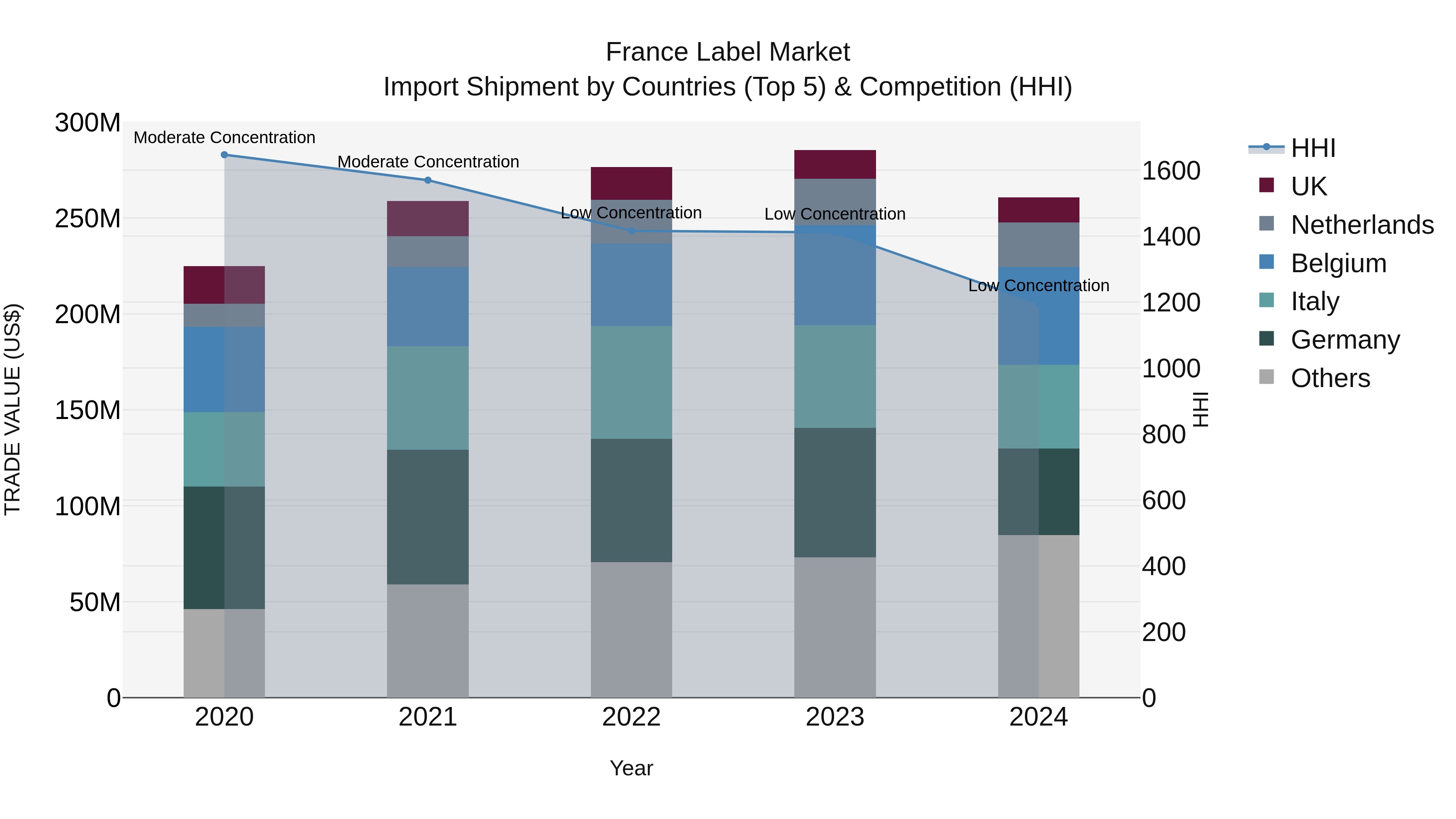
In 2024, France continued to see a diverse range of label import shipments, with key exporters including Belgium, Germany, Italy, Netherlands, and Poland. The market maintained low concentration levels with a Herfindahl-Hirschman Index (HHI) indicating a competitive landscape. Despite a moderate compound annual growth rate (CAGR) of 3.75% from 2020 to 2024, there was a slight decline in growth in 2024 with a rate of -8.64%. This suggests potential shifts in market dynamics or external factors impacting the import market for labels in France.
France Label Market Market Overview
The label market in France is a dynamic and growing industry driven by the demand for innovative and sustainable labeling solutions across various sectors such as food and beverage, pharmaceuticals, cosmetics, and logistics. The market is characterized by a wide range of label types including self-adhesive labels, shrink sleeves, in-mold labels, and wraparound labels, catering to the diverse needs of businesses. With a focus on eco-friendly practices, there is a shift towards the use of recyclable and biodegradable materials in label production. Technological advancements such as digital printing and RFID integration are also shaping the market landscape, offering enhanced customization and security features to companies. Overall, the France label market is poised for continued growth as companies seek efficient and visually appealing labeling solutions to differentiate their products in a competitive market environment.
France Label Market Trends
In the France label market, current trends include a growing demand for sustainable and eco-friendly labels as consumers become more environmentally conscious. This has led to an increase in the use of recyclable materials, such as paper and biodegradable plastics, in label production. Personalization and customization are also gaining popularity as brands seek to differentiate themselves in a competitive market. Digital printing technologies are being increasingly adopted to enable shorter print runs and quick turnaround times for customized labels. Additionally, there is a growing emphasis on incorporating innovative features like augmented reality and smart labels to enhance consumer engagement and provide valuable information. Overall, the France label market is experiencing a shift towards sustainability, customization, and innovation to meet evolving consumer preferences and market demands.
France Label Market Challenges
The France label market faces several challenges, such as increasing competition from foreign manufacturers offering lower-priced products, strict regulations regarding labeling requirements, and changing consumer preferences towards sustainable and eco-friendly labels. Additionally, the rapid advancement of technology has led to the need for more innovative and customizable labeling solutions to meet the demands of various industries. Companies in the France label market must continuously invest in research and development to keep up with the evolving market trends and offer high-quality, visually appealing labels that comply with regulations while also being cost-effective for their clients. Finding the right balance between meeting regulatory standards, keeping production costs low, and meeting customer expectations presents a significant challenge for players in the France label market.
France Label Market Investment Opportunities
The France label market presents various investment opportunities across different sectors. One potential area for investment is in the food and beverage industry, where the demand for high-quality, aesthetically pleasing labels is increasing due to evolving consumer preferences and stringent regulatory requirements. Another opportunity lies in the fashion and beauty sector, where labels play a crucial role in branding and product differentiation. Additionally, the pharmaceutical and healthcare industries in France also offer investment prospects in labels for packaging and product identification. With the increasing focus on sustainability and eco-friendly practices, investing in innovative and sustainable label solutions could prove to be a lucrative opportunity in the French market. Overall, the diverse applications and growing demand for labels across industries make the France label market an attractive space for investment.
France Label Market Government Policy
In France, the label market is subject to various government policies aimed at ensuring consumer protection and fair competition. The government regulates labeling requirements for products to provide accurate information to consumers regarding ingredients, origin, and certifications. Additionally, there are strict regulations in place to prevent misleading claims and false advertising on labels. The French government also promotes sustainability and environmental awareness through labeling policies, encouraging companies to use eco-friendly materials and practices. Overall, the government`s policies in the label market are focused on transparency, consumer rights, and promoting responsible business practices to maintain the integrity of the market.
France Label Market Future Outlook
The future outlook for the France label market is expected to remain positive, driven by factors such as the increasing demand for product differentiation, branding, and information communication. With the growing emphasis on sustainability and eco-friendly packaging solutions, there is a rising trend towards the adoption of labels made from recycled materials and those that are easily recyclable. Additionally, technological advancements such as smart labels and RFID technology are likely to further propel the market growth by offering enhanced tracking and authentication capabilities. The food and beverage, pharmaceutical, and retail sectors are anticipated to be key drivers of demand for labels in France, as companies continue to focus on enhancing their packaging strategies to meet consumer preferences and regulatory requirements. Overall, the France label market is poised for steady growth in the coming years.
Key Highlights of the Report:
- France Label Market Outlook
- Market Size of France Label Market,2024
- Forecast of France Label Market, 2031
- Historical Data and Forecast of France Label Revenues & Volume for the Period 2021-2031
- France Label Market Trend Evolution
- France Label Market Drivers and Challenges
- France Label Price Trends
- France Label Porter's Five Forces
- France Label Industry Life Cycle
- Historical Data and Forecast of France Label Market Revenues & Volume By Type for the Period 2021-2031
- Historical Data and Forecast of France Label Market Revenues & Volume By Pressure-sensitive Labels for the Period 2021-2031
- Historical Data and Forecast of France Label Market Revenues & Volume By Heat Transfer Labels for the Period 2021-2031
- Historical Data and Forecast of France Label Market Revenues & Volume By In-mold Labels for the Period 2021-2031
- Historical Data and Forecast of France Label Market Revenues & Volume By Shrink Sleeve Labels for the Period 2021-2031
- Historical Data and Forecast of France Label Market Revenues & Volume By RFID Labels for the Period 2021 - 2029
- Historical Data and Forecast of France Label Market Revenues & Volume By Material for the Period 2021-2031
- Historical Data and Forecast of France Label Market Revenues & Volume By Paper for the Period 2021-2031
- Historical Data and Forecast of France Label Market Revenues & Volume By Plastic for the Period 2021-2031
- Historical Data and Forecast of France Label Market Revenues & Volume By Fabric for the Period 2021-2031
- Historical Data and Forecast of France Label Market Revenues & Volume By Metal for the Period 2021-2031
- Historical Data and Forecast of France Label Market Revenues & Volume By Glass for the Period 2021 - 2029
- Historical Data and Forecast of France Label Market Revenues & Volume By Application for the Period 2021-2031
- Historical Data and Forecast of France Label Market Revenues & Volume By Packaging for the Period 2021-2031
- Historical Data and Forecast of France Label Market Revenues & Volume By Branding for the Period 2021-2031
- Historical Data and Forecast of France Label Market Revenues & Volume By Product Identification for the Period 2021-2031
- Historical Data and Forecast of France Label Market Revenues & Volume By Security for the Period 2021-2031
- Historical Data and Forecast of France Label Market Revenues & Volume By Decorative for the Period 2021 - 2029
- Historical Data and Forecast of France Label Market Revenues & Volume By Printing Technology for the Period 2021-2031
- Historical Data and Forecast of France Label Market Revenues & Volume By Digital Printing for the Period 2021-2031
- Historical Data and Forecast of France Label Market Revenues & Volume By Offset Printing for the Period 2021-2031
- Historical Data and Forecast of France Label Market Revenues & Volume By Flexographic Printing for the Period 2021-2031
- Historical Data and Forecast of France Label Market Revenues & Volume By Screen Printing for the Period 2021-2031
- Historical Data and Forecast of France Label Market Revenues & Volume By Gravure Printing for the Period 2021 - 2029
- Historical Data and Forecast of France Label Market Revenues & Volume By End-Use for the Period 2021-2031
- Historical Data and Forecast of France Label Market Revenues & Volume By Food & Beverage for the Period 2021-2031
- Historical Data and Forecast of France Label Market Revenues & Volume By Healthcare for the Period 2021-2031
- Historical Data and Forecast of France Label Market Revenues & Volume By Cosmetics for the Period 2021-2031
- Historical Data and Forecast of France Label Market Revenues & Volume By Electronics for the Period 2021 - 2029
- Historical Data and Forecast of France Label Market Revenues & Volume By Logistics for the Period 2021 - 2029
- France Label Import Export Trade Statistics
- Market Opportunity Assessment By Type
- Market Opportunity Assessment By Material
- Market Opportunity Assessment By Application
- Market Opportunity Assessment By Printing Technology
- Market Opportunity Assessment By End-Use
- France Label Top Companies Market Share
- France Label Competitive Benchmarking By Technical and Operational Parameters
- France Label Company Profiles
- France Label Key Strategic Recommendations






































