France Player Tracking Market Size & Growth Rate (2026-2032)
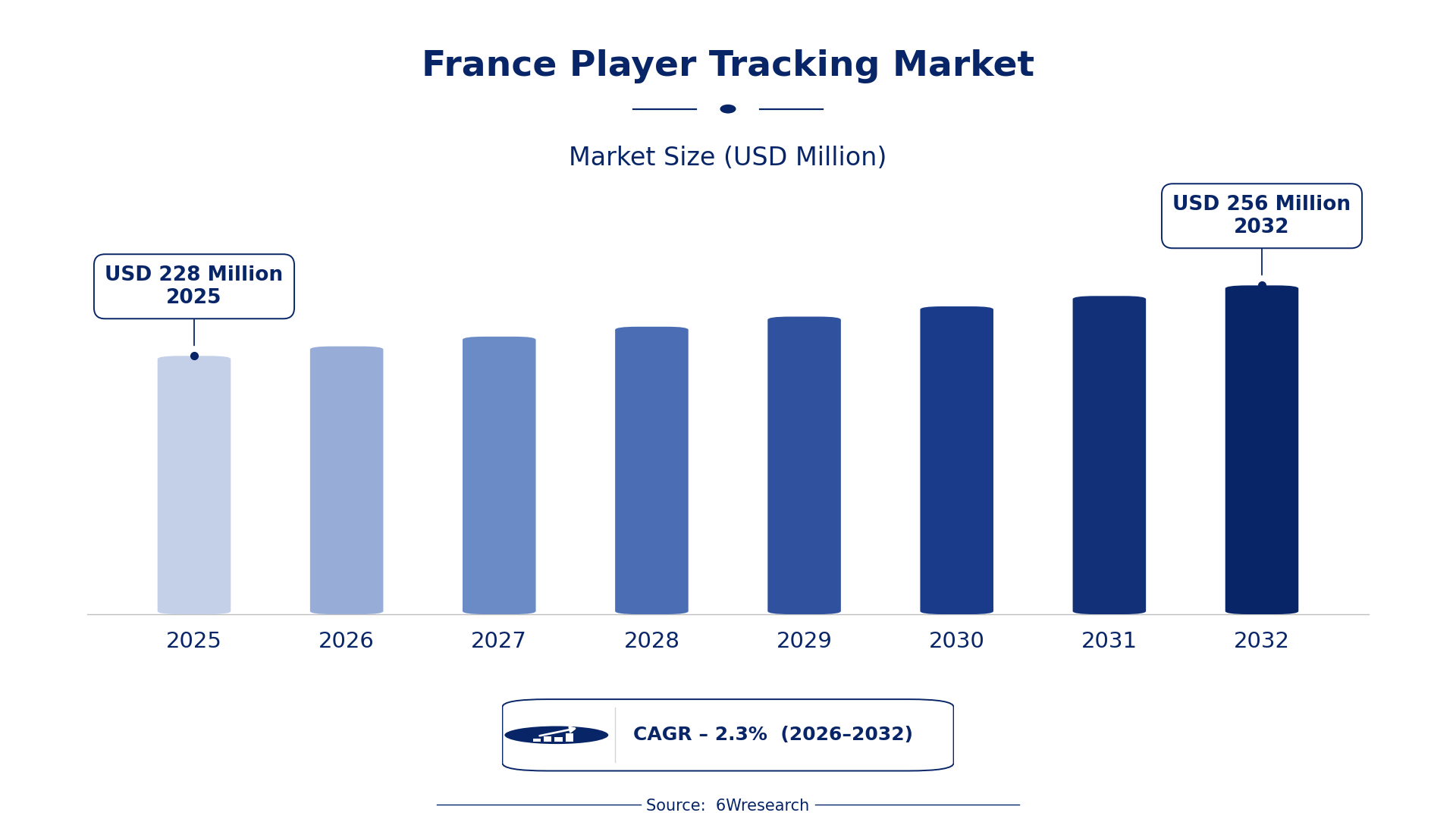
The France Player Tracking Market was estimated at USD 228 Million in 2025 and is projected to reach USD 256 Million by 2032, growing at a CAGR of 2.3% from 2026 to 2032.
France Player Tracking Market Synopsis
In recent years, the France Player Tracking Market has gained notable momentum, driven by an increased emphasis on sports analytics and performance monitoring technologies. This surge reflects a broader trend towards data-driven decision-making in sports, with teams recognizing the value of real-time insights to enhance player performance and safety.
Looking ahead, the market is set for sustained growth as technologies continue to advance. With a focus on integrating sophisticated analytics and wearable devices, stakeholders are prioritizing comprehensive player monitoring systems that not only optimize performance but also significantly mitigate injury risks.
France Player Tracking Market Year-wise Growth Rate and Key Drivers
This graph illustrates the annual growth rates of the France Player Tracking Market from 2021 to 2032, highlighting a steady upward trajectory and projected expansion over the forecast period.
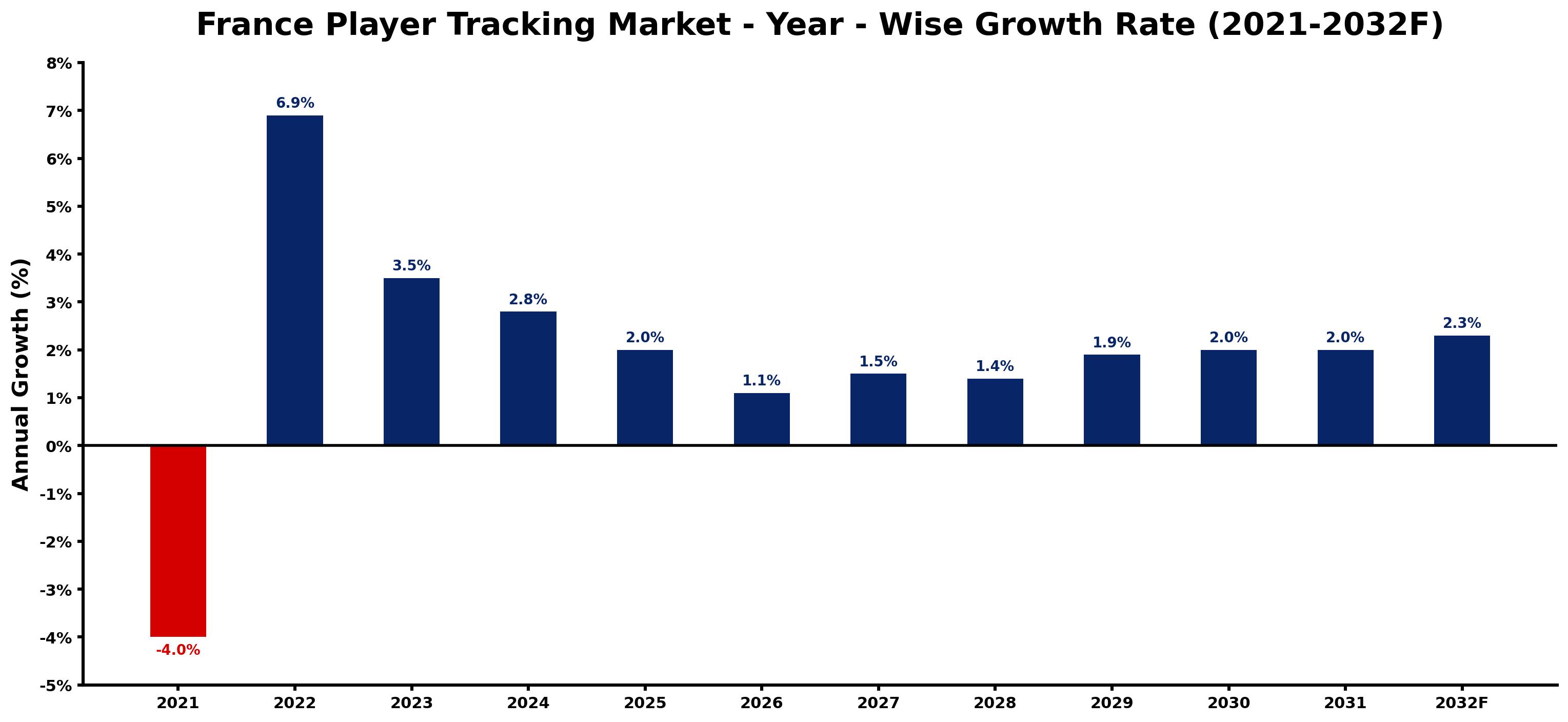
The table below presents the year‑wise growth rates along with the key drivers influencing the market
| Year | Growth Rate | Major Drivers |
| 2021 | -4.0% | Implementation of GDPR limiting data collection practices. |
| 2022 | 6.9% | Increased investments from Ligue 1 clubs in analytics. |
| 2023 | 3.5% | National sports federations adopting AI for player monitoring. |
| 2024 | 2.8% | Paris 2024 Olympics spurring technology investment in sports. |
| 2025 | 2.0% | Growth in eSports driving demand for tracking solutions. |
| 2026 | 1.1% | Local partnerships enhancing wearable tech for athletes. |
| 2027 | 1.5% | French government promoting sports technology innovation initiatives. |
| 2028 | 1.4% | Rise in youth sports programs requiring performance analysis. |
| 2029 | 1.9% | Increased sponsorships tied to advanced player metrics. |
| 2030 | 2.0% | European privacy regulations favoring secure data tracking tools. |
| 2031 | 2.0% | Popularity of sports betting increasing data accuracy demands. |
| 2032 | 2.3% | French universities launching programs in sports data science. |
Note: Market size estimations and growth projections presented in this report are based on 6Wresearch's proprietary forecasting methodology, utilizing the latest available industry data, government publications, and primary research inputs.
France Player Tracking Market Key Takeaways
Below are some of the specific key takeaways from the market, including:
- Growing adoption of GPS, RFID, and motion sensor technologies for player tracking.
- Increasing investments in data analytics to optimize training strategies and performance analysis.
- Rising demand for user-friendly wearable tracking devices that provide high accuracy.
- Integrating player tracking with video analysis to enhance tactical decisions.
- Focus on data privacy regulations impacting the implementation of tracking systems.
Evaluation of Restraints in France Player Tracking Market
The France Player Tracking Market is not without its challenges. A primary concern lies in data privacy and security. With the extensive collection of personal data, organizations must navigate the complexities of compliance with regulations, notably the GDPR. The high costs associated with implementing sophisticated tracking systems can deter smaller teams from adopting these technologies. on top of that, the potential resistance from athletes and coaching staff, who may be uncomfortable with constant monitoring, poses an additional barrier to widespread adoption.
France Player Tracking Market Trends
The market is witnessing a clear shift towards advanced technologies. Teams are increasingly employing GPS tracking, RFID, and artificial intelligence to gather and analyze data on player metrics. This trend is coupled with a growing emphasis on integrating player tracking systems with video analysis, offering a more thorough understanding of player performance. As teams seek a competitive edge, the demand for comfortable, lightweight wearable devices with high precision continues to rise.
France Player Tracking Market Opportunities
Investment opportunities abound in the France Player Tracking Market, particularly for companies focused on innovative sports technology. As the demand for real-time performance insights grows, stakeholders can benefit from developing advanced wearable technologies and analytics platforms. Collaborations with sports organizations can provide valuable market access and insights, paving the way for tailored solutions that meet the specific needs of teams and athletes.
Government Initiatives in the France Player Tracking Market
Government policies play a critical role in shaping the France Player Tracking Market, particularly concerning data protection and privacy. The French government’s commitment to safeguarding personal data through the GDPR and local data storage regulations is essential for building trust in tracking technologies. These initiatives aim to balance innovation in player tracking with the protection of individual rights, ensuring that companies operate within a clear regulatory framework.
- A regulatory framework introduced in 2023 mandating compliance with GDPR for all player tracking systems.
- Ongoing audits by the French data protection authority to assess adherence to data privacy laws in sports analytics.
- Recent guidelines issued in early 2024 to promote best practices in data collection and storage for sports organizations.
- A planned public initiative expected to launch in 2025, aimed at enhancing digital infrastructure for sports analytics.
Future Insights of the France Player Tracking Market
The outlook for the France Player Tracking Market remains positive through 2032. The increasing integration of advanced analytics into sports will drive demand for innovative tracking solutions. As teams strive to enhance their performance metrics, the need for comprehensive data insights will only grow stronger. This trend, coupled with a rising interest in fan engagement and interactive experiences, positions the market for ongoing expansion and evolution.
France Player Tracking Market Latest Developments
In the past year, the France Player Tracking Market has seen significant developments as organizations increasingly invest in technology-driven solutions. Companies are focusing on enhancing their product offerings and expanding partnerships within the sports industry to meet growing demands.
- A major technology vendor announced a partnership in early 2024 with a national football league to implement a new tracking system across multiple teams.
- An initiative that began in mid-2024 is currently underway, focusing on integrating AI analytics into existing tracking systems for enhanced performance insights.
- In late 2023, a leading regional operator launched a new line of lightweight wearable tracking devices aimed at professional athletes.
- A rollout expected to begin in the second half of 2025 will introduce an innovative data platform designed for real-time analytics in team sports.
France Player Tracking Market - Key Attractiveness of the Report
- 10 Years of Market Numbers
- Historical Data Starting from 2022 to 2025
- Base Year: 2025
- Forecast Data until 2032
- Key Performance Indicators Impacting the Market
- Major Upcoming Developments and Projects
Key Highlights of the Report:
- France Player Tracking Market Outlook
- Market Size of France Player Tracking Market, 2025
- Forecast of France Player Tracking Market, 2032
- Historical Data and Forecast of France Player Tracking Revenues & Volume for the Period 2022-2032F
- France Player Tracking Market Trend Evolution
- France Player Tracking Market Drivers and Challenges
- France Player Tracking Price Trends
- France Player Tracking Porter's Five Forces
- France Player Tracking Industry Life Cycle
- Historical Data and Forecast of France Player Tracking Market Revenues & Volume By Solution for the Period 2022-2032F
- Historical Data and Forecast of France Player Tracking Market Revenues & Volume By Wearables for the Period 2022-2032F
- Historical Data and Forecast of France Player Tracking Market Revenues & Volume By Opticals for the Period 2022-2032F
- Historical Data and Forecast of France Player Tracking Market Revenues & Volume By Application-Based for the Period 2022-2032F
- Historical Data and Forecast of France Player Tracking Market Revenues & Volume By Application for the Period 2022-2032F
- Historical Data and Forecast of France Player Tracking Market Revenues & Volume By Fitness Tracking for the Period 2022-2032F
- Historical Data and Forecast of France Player Tracking Market Revenues & Volume By Performance Tracking for the Period 2022-2032F
- Historical Data and Forecast of France Player Tracking Market Revenues & Volume By Fraud Detection for the Period 2022-2032F
- Historical Data and Forecast of France Player Tracking Market Revenues & Volume By Player Safety for the Period 2022-2032F
- Historical Data and Forecast of France Player Tracking Market Revenues & Volume By End User for the Period 2022-2032F
- Historical Data and Forecast of France Player Tracking Market Revenues & Volume By Individual Sports for the Period 2022-2032F
- Historical Data and Forecast of France Player Tracking Market Revenues & Volume By Team Sports for the Period 2022-2032F
- Historical Data and Forecast of France Player Tracking Market Revenues & Volume By Component for the Period 2022-2032F
- Historical Data and Forecast of France Player Tracking Market Revenues & Volume By Solution for the Period 2022-2032F
- Historical Data and Forecast of France Player Tracking Market Revenues & Volume By Wearables for the Period 2022-2032F
- Historical Data and Forecast of France Player Tracking Market Revenues & Volume By Optical for the Period 2022-2032F
- Historical Data and Forecast of France Player Tracking Market Revenues & Volume By Application-Based for the Period 2022-2032F
- Historical Data and Forecast of France Player Tracking Market Revenues & Volume By Services for the Period 2022-2032F
- France Player Tracking Import Export Trade Statistics
- Market Opportunity Assessment By Solution
- Market Opportunity Assessment By Application
- Market Opportunity Assessment By End User
- Market Opportunity Assessment By Component
- France Player Tracking Top Companies Market Share
- France Player Tracking Competitive Benchmarking By Technical and Operational Parameters
- France Player Tracking Company Profiles
- France Player Tracking Key Strategic Recommendations






































