France Publishing Market Summary
The france publishing market was estimated at USD 152 Million in 2025 and is projected to reach USD 170 Million by 2032, growing at a CAGR of 1.5% from 2026 to 2032.
France Publishing Market Year-wise Growth Rate and Key Drivers
This graph highlights how the France Publishing Market has steadily grown over the past five years, supported by major growth factors.
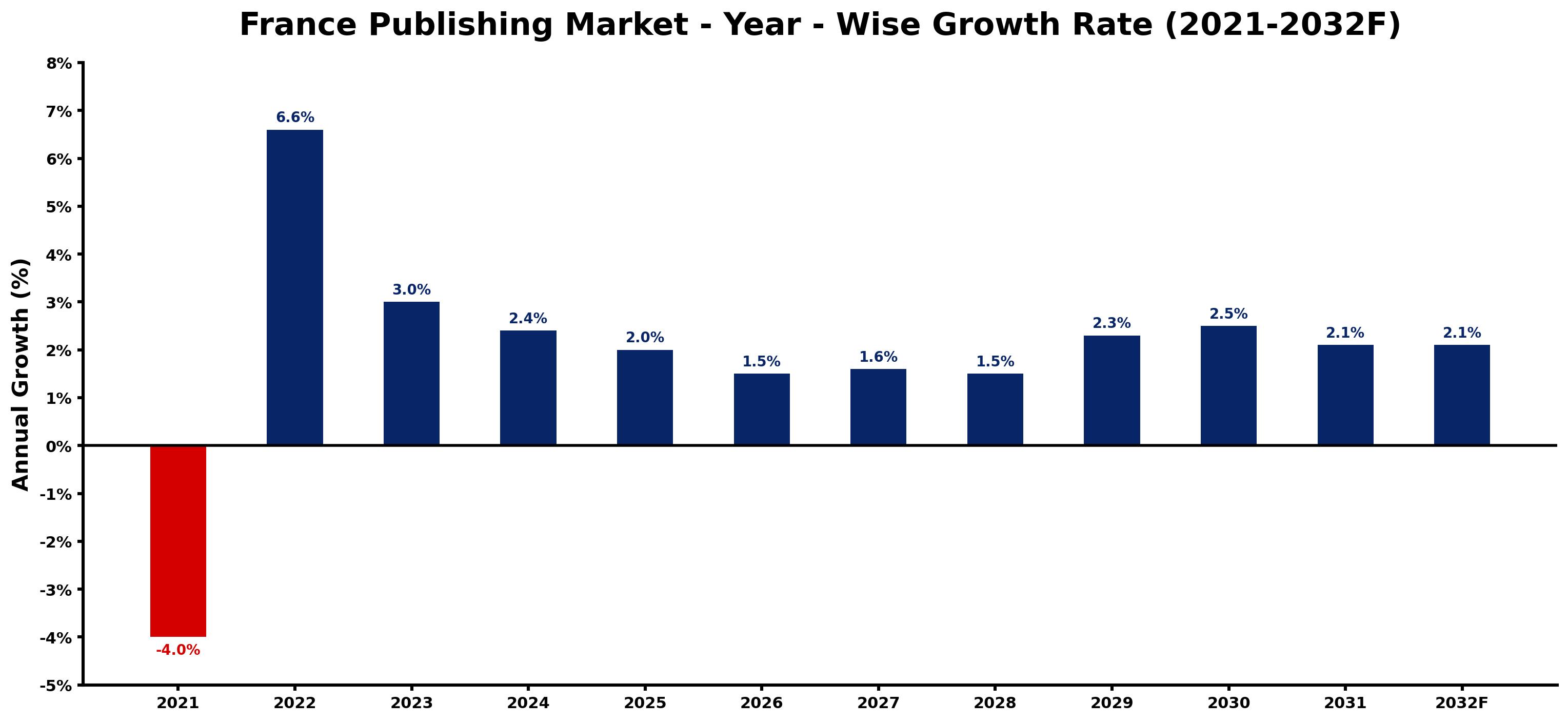
The table below presents the year wise growth rates along with the key drivers influencing the market
| Year | Growth Rate | Major Drivers |
| 2021 | -4.0% | A significant shift towards digital media consumption diminished print sales across the publishing sector. |
| 2022 | 6.6% | A notable increase in self-publishing platforms attracted new authors into the market. |
| 2023 | 3.0% | Analytical tools enabled publishers to better understand reader preferences and behaviors. |
| 2024 | 2.4% | Subscription models gained traction, reshaping traditional revenue streams within the industry. |
| 2025 | 2.0% | Mobile reading experiences became essential as smartphone usage expanded among consumers. |
| 2026 | 1.5% | The demand for localized content surged, reflecting cultural diversity across French regions. |
| 2027 | 1.6% | Educational publishing adapted to e-learning, bolstering the market during changing academic landscapes. |
| 2028 | 1.5% | Collaboration between authors and influencers enhanced visibility for niche titles and genres. |
| 2029 | 2.3% | Sustainability initiatives prompted publishers to explore eco-friendly printing and distribution methods. |
| 2030 | 2.5% | Cross-media storytelling began to blur lines between print, digital, and audio formats. |
| 2031 | 2.1% | Investment in augmented reality experiences transformed reader engagement in select narratives. |
| 2032 | 2.1% | Data analytics allowed predictive modeling for trends, shaping future publishing strategies. |
Note - Market size estimations and growth projections presented in this report are based on 6Wresearch's advanced forecasting approach, validated with industry datasets as of June 2026.
France Publishing Market Synopsis
The France Publishing Market is projected to reach 1.5% and witness significant growth during the forecast period (2026-2032). This transformation is increasingly influenced by digitalization, shifting consumer preferences towards e-books, audiobooks, and various online distribution platforms. The market encompasses a diverse range of sectors including book publishing, magazine publishing, academic publishing, and digital publishing, thereby catering to varied audiences and content formats.
France Publishing Market Growth Drivers
Several factors are propelling the France Publishing Market forward. Prominent among these is the rise of digital publishing formats, which offer greater accessibility and interactivity for readers across different demographics. The pervasive use of mobile devices, including smartphones and tablets, has significantly influenced reading habits, leading to a marked increase in demand for digital content. Additionally, the following drivers are critical for market growth:
- The growing acceptance of self-publishing platforms that empower authors to publish without traditional gatekeepers, thus diversifying content.
- The widespread adoption of digital distribution channels that streamline access to books and other media, making it easier for consumers to obtain content.
- Innovations in publishing software and digital printing technologies that enhance the quality and appeal of content.
- The increasing popularity of interactive e-books and audiobooks, catering to consumers' preferences for engaging and immersive reading experiences.
- The global reach afforded by digital platforms, enabling local authors and publishers to reach wider audiences beyond geographical limitations.
France Publishing Market Challenges and Restraints
Despite the strong growth trajectory, the France Publishing Market faces significant challenges. The transition to digital formats has not been seamless, with traditional print media experiencing declining sales. The following issues are particularly noteworthy:
- Adapting to rapid technological advancements poses a challenge for traditional publishers who may be slow to innovate.
- Ensuring copyright protection and combating piracy in digital publishing remains a significant concern, affecting revenues for content creators.
- The shift in consumer preferences necessitates new monetization strategies, complicating the transition from print to digital.
- Publishers must navigate a complex landscape of competition from both established firms and emerging self-published authors.
- Changes in reading habits are not uniform across demographics, leading to varying demand across different segments of the market.
France Publishing Market Trends and Opportunities
As the France Publishing Market evolves, several trends are emerging that present opportunities for growth. Publishers are leveraging these trends to reposition themselves in a changing landscape:
- There is an increasing focus on multimedia content that blends text, audio, and visual elements, enhancing the reader's experience.
- The rise in subscription models offers new revenue streams, appealing to consumers seeking access to a broad range of titles without the need for individual purchases.
- More emphasis is being placed on localized content that reflects regional culture and themes, resonating strongly with specific audiences.
- Innovative marketing techniques, including social media promotion and influencer partnerships, are becoming standard practices to engage with younger consumers.
- Sustainable publishing practices are gaining traction, with a focus on eco-friendly materials and production processes that appeal to environmentally conscious consumers.
France Publishing Market Government Investment and Initiatives
Government policies play a vital role in shaping the France Publishing Market, focusing on promoting cultural diversity, freedom of expression, and access to information. To foster growth, public initiatives include:
- Regulatory frameworks that govern copyright protections ensuring authors and publishers receive fair compensation for their contributions.
- Support programs aimed at enhancing literacy and reading habits among the population, emphasizing the importance of education and knowledge dissemination.
- Incentives for digital publishing innovation, encouraging investment in new technologies that enhance the overall reading experience.
- Promotion of cultural events and initiatives that celebrate literature and the arts, bolstering public interest and engagement with published works.
- Strategic public spending to support the development of local publishing houses, ensuring a competitive and diverse publishing ecosystem.
France Publishing Market Latest Developments (May 2025 - June 2026)
During the period from May 2025 to June 2026, the France Publishing Market has seen notable developments that indicate a shift in industry direction. The acceleration of digitalization has led to a surge in the availability of e-books and audiobooks, with publishers increasingly adapting to this demand. Furthermore, initiatives aimed at protecting intellectual property rights have gained momentum, addressing concerns over piracy and ensuring fair compensation. The market has also observed a growing trend towards hybrid publishing models, blending traditional and self-publishing approaches to cater to diverse author needs. Additionally, various publishing houses have begun exploring collaborative efforts to expand their reach through multi-channel distribution strategies.
France Publishing Market - Key Attractiveness of the Report
- 10 Years of Market Numbers
- Historical Data Starting from 2022 to 2025
- Base Year: 2025
- Forecast Data until 2032
- Key Performance Indicators Impacting the Market
- Major Upcoming Developments and Projects
Key Highlights of the Report:
- France Publishing Market Outlook
- Market Size of France Publishing Market, 2025
- Forecast of France Publishing Market, 2032
- Historical Data and Forecast of France Publishing Revenues & Volume for the Period 2022-2032F
- France Publishing Market Trend Evolution
- France Publishing Market Drivers and Challenges
- France Publishing Price Trends
- France Publishing Porter's Five Forces
- France Publishing Industry Life Cycle
- Historical Data and Forecast of France Publishing Market Revenues & Volume By Types for the Period 2022-2032F
- Historical Data and Forecast of France Publishing Market Revenues & Volume By Newspaper for the Period 2022-2032F
- Historical Data and Forecast of France Publishing Market Revenues & Volume By Journals for the Period 2022-2032F
- Historical Data and Forecast of France Publishing Market Revenues & Volume By Catalogues for the Period 2022-2032F
- Historical Data and Forecast of France Publishing Market Revenues & Volume By Magazine for the Period 2022-2032F
- Historical Data and Forecast of France Publishing Market Revenues & Volume By Books for the Period 2022-2032F
- Historical Data and Forecast of France Publishing Market Revenues & Volume By E-Books for the Period 2022-2032F
- Historical Data and Forecast of France Publishing Market Revenues & Volume By Platform for the Period 2022-2032F
- Historical Data and Forecast of France Publishing Market Revenues & Volume By Digital? for the Period 2022-2032F
- Historical Data and Forecast of France Publishing Market Revenues & Volume By Paper for the Period 2022-2032F
- France Publishing Import Export Trade Statistics
- Market Opportunity Assessment By Types
- Market Opportunity Assessment By Platform
- France Publishing Top Companies Market Share
- France Publishing Competitive Benchmarking By Technical and Operational Parameters
- France Publishing Company Profiles
- France Publishing Key Strategic Recommendations






































