Georgia Smart Locks Market Size, Share & Growth Rate
The Georgia Smart Locks Market was estimated at USD 882 Million in 2025 and is projected to reach USD 1596 Million by 2032, growing at a CAGR of 8.8% from 2026 to 2032. This impressive trajectory is propelled by an increasing consumer shift toward smart home technologies, where security plays a pivotal role. Homeowners are increasingly prioritizing convenience and peace of mind, leading to a heightened demand for smart locks equipped with advanced security features and seamless integration capabilities.
Georgia Smart Locks Market Year-wise Growth Rate and Key Drivers
This graph highlights how the Georgia Smart Locks Market has steadily grown over the years, supported by major growth factors.
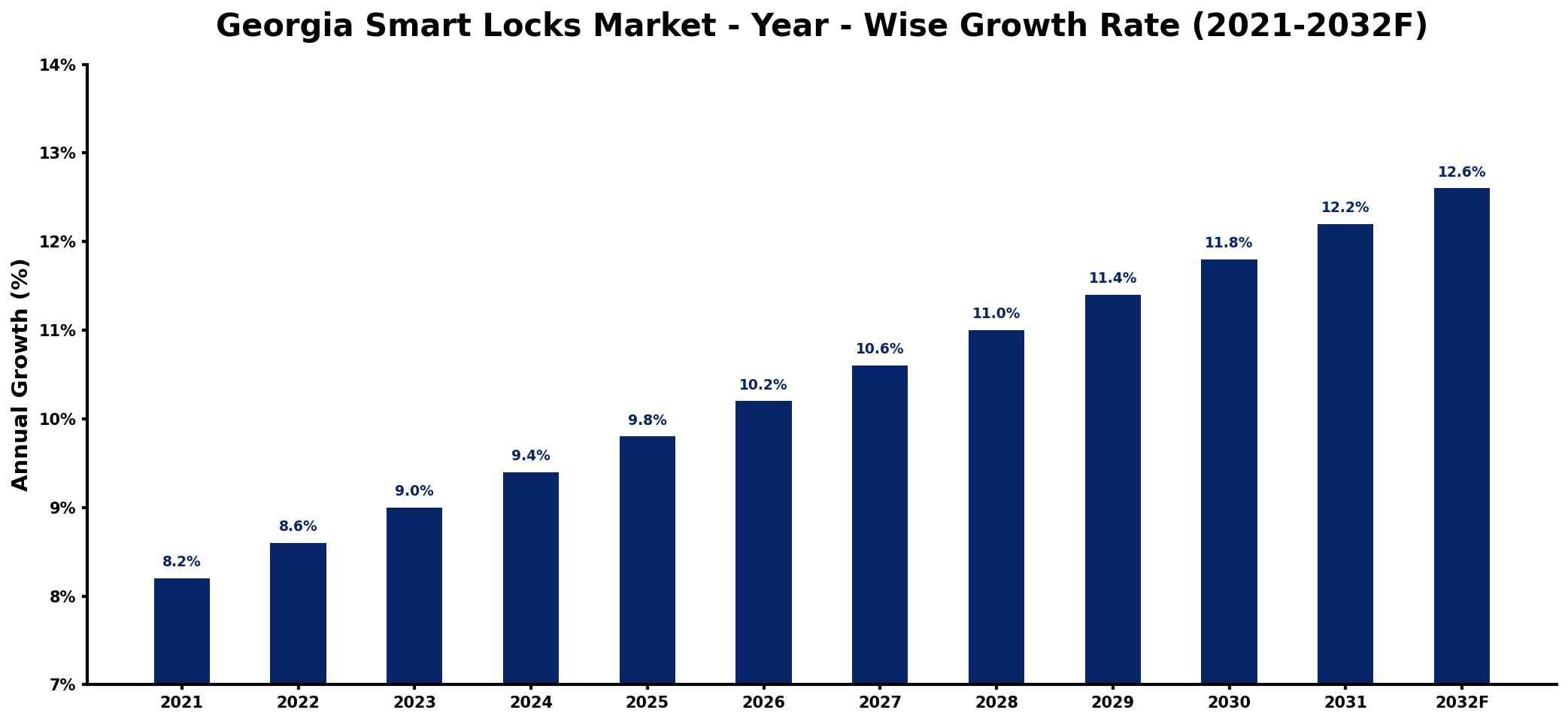
The table below presents the year‑wise growth rates along with the key drivers influencing the market
| Year | Growth Rate | Major Drivers |
| 2021 | 8.2% | Rising demand for home security |
| 2022 | 8.6% | Technological advancements in automation |
| 2023 | 9.0% | Increased consumer awareness for safety |
| 2024 | 9.4% | Growing adoption of IoT devices |
| 2025 | 9.8% | increased pharmaceutical industry usage |
| 2026 | 10.2% | Investment in residential security solutions |
| 2027 | 10.6% | Surge in urban living preferences |
| 2028 | 11.0% | Enhanced focus on cybersecurity measures |
| 2029 | 11.4% | Higher disposable income trends |
| 2030 | 11.8% | Growing interest in energy efficiency |
| 2031 | 12.2% | Increased integration with mobile apps |
| 2032 | 12.6% | Expansion of home automation services |
Note: Market size estimations and growth projections presented in this report are based on 6Wresearch's proprietary forecasting methodology, utilizing the latest available industry data, government publications, and primary research inputs.
Georgia Smart Locks Market Synopsis
The Georgia smart locks market has experienced a robust surge, characterized by a growing adoption of smart home solutions. This momentum is not merely a passing trend but a shift toward enhanced safety and convenience that homeowners and property managers alike are embracing. As technological advancements continue to reshape this landscape, the market is set to evolve even further, welcoming innovative offerings that meet the needs of a discerning consumer base.
Looking ahead, the expansion of the Georgia smart locks market is bolstered by the integration of Internet of Things (IoT) capabilities, enabling users to monitor their properties remotely. As awareness around cybersecurity and data privacy increases, consumers are more mindful of their home security systems, creating opportunities for advancements that enhance both functionality and trust.
Georgia Smart Locks Market Key Takeaways
- Robust market growth driven by increasing adoption of smart home technologies.
- Consumer demand is shifting toward advanced security features, such as keyless entry and remote access.
- Key players are innovating products to improve user experience and interoperability with existing systems.
- Challenges regarding cybersecurity and consumer hesitancy remain but can be mitigated.
- Investment opportunities exist in R&D and partnerships focusing on consumer-specific solutions.
Evaluation of Restraints in Georgia Smart Locks Market
While the Georgia smart locks market is on an upward trajectory, certain restraints are impeding its full potential. Concerns about cybersecurity pose significant risks, as connected devices can be susceptible to hacking without robust protections. This has led to consumer hesitancy in adopting smart lock technology, particularly among those who prioritize traditional security measures. Moreover, compatibility issues with existing smart home systems can present integration challenges, affecting the overall user experience and satisfaction. Price sensitivity in Georgia's market further complicates consumer adoption, as advanced security solutions may be viewed as financially burdensome by some households.
Georgia Smart Locks Market Trends
The landscape of the Georgia smart locks market is being shaped by several key trends. Notably, the integration of smart locks with broader home automation systems is becoming more prevalent, allowing for streamlined security management. Additionally, the rise of IoT technology is driving demand for solutions that enable remote monitoring and management, adding layers of convenience and control for homeowners. Sustainability is also a growing focus, with eco-friendly designs and energy-efficient features appealing to environmentally conscious consumers. Finally, as security concerns evolve, smart locks are increasingly incorporating biometric technologies, enhancing security measures and user-friendliness.
Georgia Smart Locks Market Opportunities
Investment opportunities in the Georgia smart locks market are abundant, fueled by an increasing consumer inclination toward sophisticated security solutions. As urbanization progresses, property owners and renters are more inclined to invest in smart locks for peace of mind. Collaborations with technology providers can yield innovations tailored to the regional market, addressing specific consumer needs while leveraging advancements in technology. Furthermore, education and awareness campaigns on the benefits and functionalities of smart locks can stimulate market growth, attracting a broader consumer base.
Government Initiatives in the Georgia Smart Locks Market
The government in Georgia is actively fostering a conducive environment for the smart locks market through policies that promote innovation and consumer safety. Regulatory frameworks are in place to ensure that smart lock solutions meet stringent security standards, enhancing user protection against cybersecurity threats. Additionally, guidelines focused on data privacy and consumer protection serve to build trust within the marketplace. Support for research and development initiatives through incentives further encourages the advancement of technology within the smart locks industry, driving growth and competitiveness.
Future Insights of the Georgia Smart Locks Market
As we look towards the future, the Georgia smart locks market is positioned for remarkable growth. The proliferation of smart home devices, coupled with rising disposable incomes, indicates a strong trend toward the adoption of advanced security technologies. By 2032, the market is likely to see a variety of innovative products that utilize biometrics, enhanced connectivity, and user-friendly interfaces. A focus on security and convenience will drive market expansion, making smart locks an essential component of modern home security solutions.
Georgia Smart Locks Market Latest Developments (2025 - 2026)
Recent developments in the Georgia smart locks market reflect an emphasis on technological advancements and consumer demands. Manufacturers are increasingly investing in R&D to enhance the functionality and security of smart lock systems. Industry collaborations are being forged to promote interoperability with existing smart home systems, easing integration for consumers. Additionally, educational initiatives aimed at raising consumer awareness about the benefits of smart locks are gaining traction, ultimately driving higher adoption rates across the region.
Georgia Smart Locks Market - Key Attractiveness of the Report
- 10 Years of Market Numbers
- Historical Data Starting from 2022 to 2025
- Base Year: 2025
- Forecast Data until 2032
- Key Performance Indicators Impacting the Market
- Major Upcoming Developments and Projects
Key Highlights of the Report:
- Georgia Smart Locks Market Outlook
- Market Size of Georgia Smart Locks Market, 2025
- Forecast of Georgia Smart Locks Market, 2032
- Historical Data and Forecast of Georgia Smart Locks Revenues & Volume for the Period 2022-2032F
- Georgia Smart Locks Market Trend Evolution
- Georgia Smart Locks Market Drivers and Challenges
- Georgia Smart Locks Price Trends
- Georgia Smart Locks Porter's Five Forces
- Georgia Smart Locks Industry Life Cycle
- Historical Data and Forecast of Georgia Smart Locks Market Revenues & Volume By Product for the Period 2022-2032F
- Historical Data and Forecast of Georgia Smart Locks Market Revenues & Volume By Deadbolts for the Period 2022-2032F
- Historical Data and Forecast of Georgia Smart Locks Market Revenues & Volume By Lever Handles for the Period 2022-2032F
- Historical Data and Forecast of Georgia Smart Locks Market Revenues & Volume By Padlocks for the Period 2022-2032F
- Historical Data and Forecast of Georgia Smart Locks Market Revenues & Volume By Others for the Period 2022-2032F
- Historical Data and Forecast of Georgia Smart Locks Market Revenues & Volume By Technology for the Period 2022-2032F
- Historical Data and Forecast of Georgia Smart Locks Market Revenues & Volume By Bluetooth for the Period 2022-2032F
- Historical Data and Forecast of Georgia Smart Locks Market Revenues & Volume By Wi-Fi for the Period 2022-2032F
- Historical Data and Forecast of Georgia Smart Locks Market Revenues & Volume By End User for the Period 2022-2032F
- Historical Data and Forecast of Georgia Smart Locks Market Revenues & Volume By Residential for the Period 2022-2032F
- Historical Data and Forecast of Georgia Smart Locks Market Revenues & Volume By Commercial for the Period 2022-2032F
- Georgia Smart Locks Import Export Trade Statistics
- Market Opportunity Assessment By Product
- Market Opportunity Assessment By Technology
- Market Opportunity Assessment By End User
- Georgia Smart Locks Top Companies Market Share
- Georgia Smart Locks Competitive Benchmarking By Technical and Operational Parameters
- Georgia Smart Locks Company Profiles
- Georgia Smart Locks Key Strategic Recommendations






































