Germany 3D Animation Market Size & Growth Rate (2026-2032)
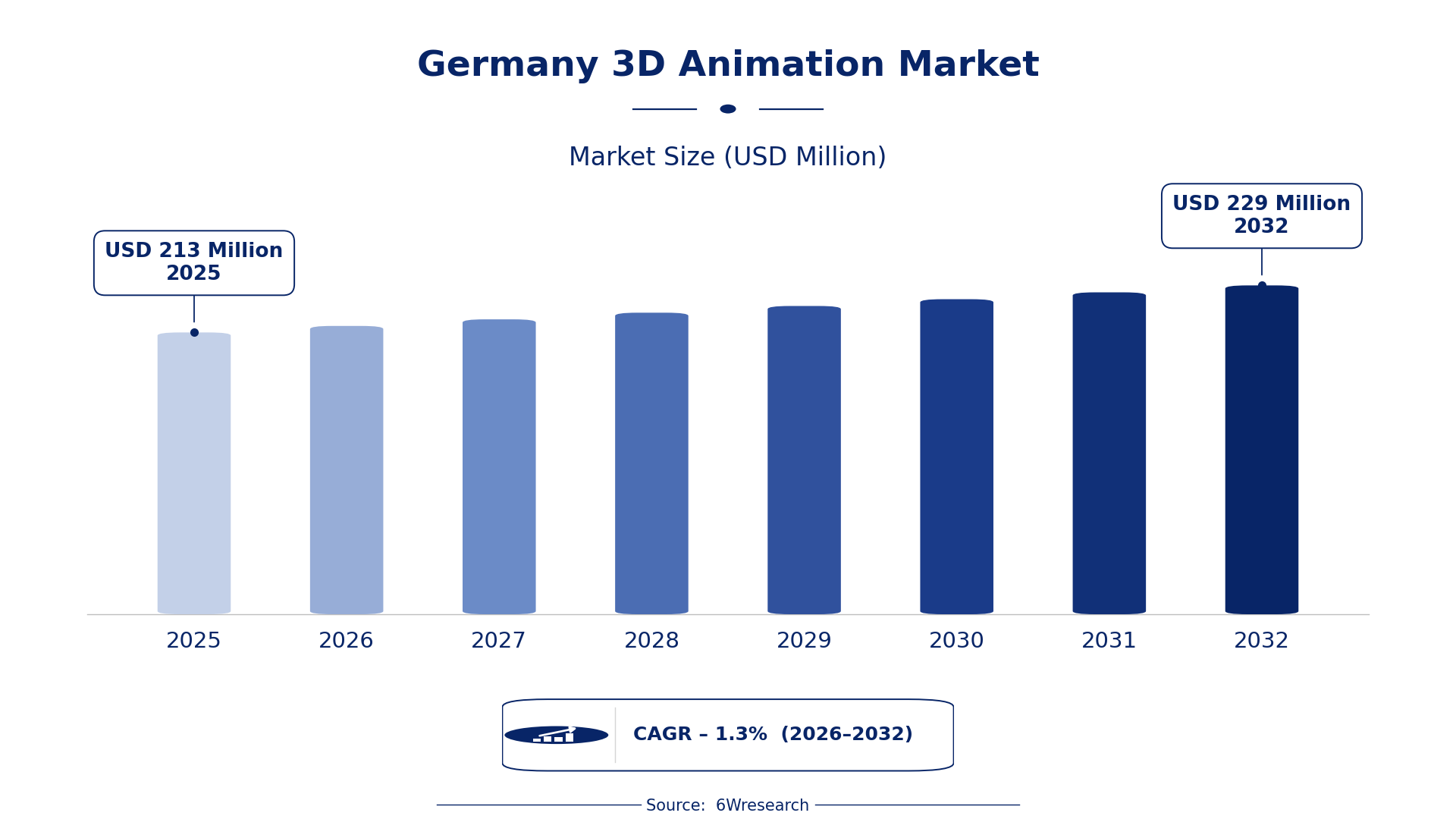
The Germany 3D Animation Market was estimated at USD 213 Million in 2025 and is projected to reach USD 229 Million by 2032, growing at a CAGR of 1.3% from 2026 to 2032.
Germany 3D Animation Market Synopsis
The German 3D animation market is significantly influenced by the thriving film, television, and gaming sectors, which demand high-quality visual effects. This push is compounded by the growing trend of using 3D animation in advertising, where brands seek to create engaging and memorable campaigns through immersive content.
As the digital consumption of animated content rises, traditional media is adapting to this shift, leading to an increased investment in animation studios. This surge in demand is not just limited to entertainment; sectors like education and healthcare are also recognizing the potential of 3D animation for effective communication and training.
Germany 3D Animation Market Year-wise Growth Rate and Key Drivers
This graph illustrates the annual growth rates of the Germany 3D Animation Market from 2021 to 2032, highlighting a steady upward trajectory and projected expansion over the forecast period.
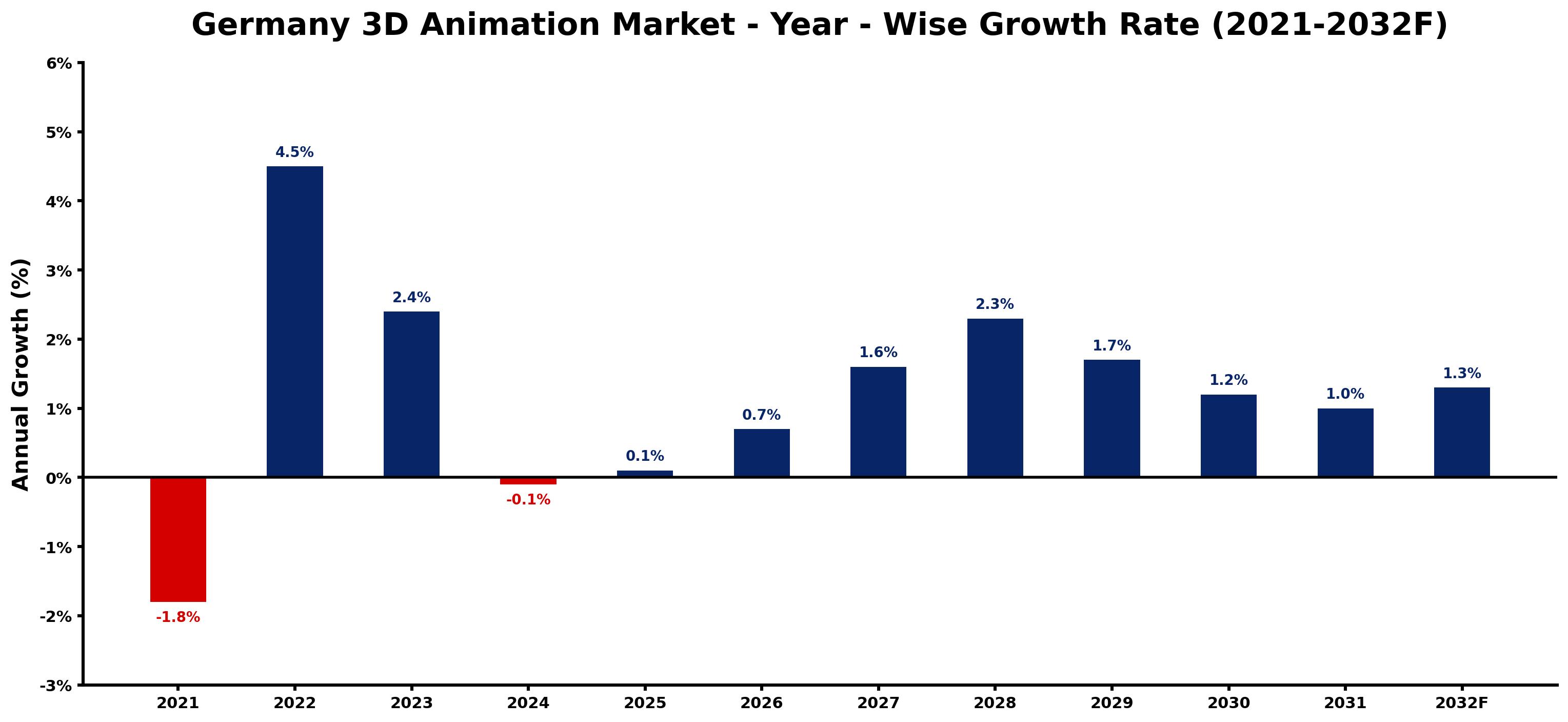
The table below presents the year‑wise growth rates along with the key drivers influencing the market
| Year | Growth Rate | Major Drivers |
| 2021 | -1.8% | COVID-19 pandemic reduced project budgets significantly. |
| 2022 | 4.5% | Increased investment in German film and media sectors. |
| 2023 | 2.4% | Rising interest in virtual reality for online education. |
| 2024 | -0.1% | Euros decline against the dollar affects software costs. |
| 2025 | 0.1% | Support from FilmFernsehFonds Bayern for animation projects. |
| 2026 | 0.7% | Growing 3D animation use in advertising campaigns. |
| 2027 | 1.6% | Emerging demand for animated content in e-sports. |
| 2028 | 2.3% | Collaboration between universities and studios for creative talent. |
| 2029 | 1.7% | Surge in popularity of animated content on streaming platforms. |
| 2030 | 1.2% | Growth of AR applications for tourism in Germany. |
| 2031 | 1.0% | Investment in 3D animation for cultural heritage preservation. |
| 2032 | 1.3% | Enhanced demand for animations in digital marketing strategies. |
Note: Market size estimations and growth projections presented in this report are based on 6Wresearch's proprietary forecasting methodology, utilizing the latest available industry data, government publications, and primary research inputs.
Germany 3D Animation Market Key Takeaways
Below are some of the specific key takeaways from the market, including:
- High demand for visual effects in film, television, and video games is a primary growth driver.
- The integration of virtual reality (VR) and augmented reality (AR) technologies is transforming content creation.
- Increased investment in animation studios supports the rise of original animated content on digital platforms.
- 3D animation is gaining traction in various industries, including healthcare and education, for visualization purposes.
- The government is actively promoting the market through financial incentives and partnerships with educational institutions.
Evaluation of Restraints in Germany 3D Animation Market
Despite its potential, the Germany 3D animation market faces challenges, particularly from fierce competition with international players that possess larger resources. This disparity often allows them to offer cutting-edge technology and services at competitive prices. The demand for high-quality content necessitates not just advanced software but also a skilled workforce. on top of that, companies must consistently innovate and adapt to rapidly changing trends to maintain their market relevance. The complexity of licensing and copyright regulations in Germany adds another layer of difficulty for local businesses, necessitating a strategic approach to navigate these challenges effectively.
Germany 3D Animation Market Trends
Several trends are shaping the Germany 3D animation market. The rise in demand for high-quality visual effects is being matched by technological advancements in VR and AR, which are enabling more interactive experiences. Streaming platforms are pushing for original animated content, leading to a surge in short films and series. Another trend is the emphasis on realism and detail in animation, which aims to meet the expectations of increasingly discerning audiences. Companies are exploring more innovative storytelling methods, making 3D animation an essential tool for engaging narratives.
Germany 3D Animation Market Opportunities
The Germany 3D animation market presents numerous investment opportunities across diverse sectors. The entertainment and gaming industries continue to be hotbeds for growth, but education and advertising are increasingly recognizing the value of animated content. Investing in animation studios or educational programs focused on 3D animation skills can yield attractive returns. Additionally, sectors like architecture and healthcare are incorporating 3D animation for simulation and visualization, further diversifying investment avenues in the market.
Government Initiatives in the Germany 3D Animation Market
The German government is actively shaping the 3D animation market through various supportive policies and initiatives. These efforts focus on fostering innovation, enhancing competitiveness, and attracting investments. By providing financial incentives and establishing partnerships with educational institutions, the government aims to ensure that the workforce is equipped with the necessary skills to thrive in this dynamic field.
- A recently completed initiative offered tax credits and grants to companies engaged in 3D animation production, stimulating industry growth.
- A current program supports research and development in animation technologies, encouraging innovation and collaboration among industry players.
- A planned public-private initiative aims to establish training programs in partnership with universities to cultivate a new generation of skilled animators by 2028.
- The government has introduced regulations to protect intellectual property rights, ensuring fair competition within the market.
- Ongoing funding is being allocated to develop digital infrastructure, enhancing the capabilities of animation studios across the country.
Future Insights of the Germany 3D Animation Market
Looking ahead to 2026-2032, the Germany 3D animation market is set for steady growth. The increasing demand for high-quality visual content across entertainment, advertising, and education sectors will drive this expansion. As technology continues to evolve, particularly with VR and AR, we can expect to see more immersive and interactive animated experiences. on top of that, the integration of 3D animation in product visualization and marketing strategies will likely create new opportunities for creators and investors alike, solidifying Germany's position as a key player in the global animation arena.
Germany 3D Animation Market Latest Developments
Recent developments in the Germany 3D animation market reflect a vigorous industry responding to new demands and technological advancements. Companies are increasingly focused on enhancing their capabilities to deliver top-notch animated content. This trend is visible in the partnerships being formed and the innovations being rolled out.
- A major technology vendor announced a service upgrade in late 2025, enhancing their animation software to support real-time rendering for VR experiences.
- An initiative that began in early 2025 is currently underway to create a collaborative platform for studios to share resources and expertise, aimed at bolstering local talent.
- A regional animation festival launched in mid-2025 aims to showcase emerging talent and foster networking opportunities within the industry.
- Plans are in motion for a government-funded program expected to begin in 2026, aimed at promoting 3D animation in educational curriculums across universities.
- In Q4 2025, a new investment fund was established to support innovative projects within the animation sector, focusing on sustainable practices.
Germany 3D Animation Market - Key Attractiveness of the Report
- 10 Years of Market Numbers
- Historical Data Starting from 2022 to 2025
- Base Year: 2025
- Forecast Data until 2032
- Key Performance Indicators Impacting the Market
- Major Upcoming Developments and Projects
Key Highlights of the Report:
- Germany 3D Animation Market Outlook
- Market Size of Germany 3D Animation Market, 2025
- Forecast of Germany 3D Animation Market, 2032
- Historical Data and Forecast of Germany 3D Animation Revenues & Volume for the Period 2022-2032F
- Germany 3D Animation Market Trend Evolution
- Germany 3D Animation Market Drivers and Challenges
- Germany 3D Animation Price Trends
- Germany 3D Animation Porter's Five Forces
- Germany 3D Animation Industry Life Cycle
- Historical Data and Forecast of Germany 3D Animation Market Revenues & Volume By Technology for the Period 2022-2032F
- Historical Data and Forecast of Germany 3D Animation Market Revenues & Volume By 3D Modeling for the Period 2022-2032F
- Historical Data and Forecast of Germany 3D Animation Market Revenues & Volume By Motion Graphics for the Period 2022-2032F
- Historical Data and Forecast of Germany 3D Animation Market Revenues & Volume By 3D Rendering for the Period 2022-2032F
- Historical Data and Forecast of Germany 3D Animation Market Revenues & Volume By Visual Effects for the Period 2022-2032F
- Historical Data and Forecast of Germany 3D Animation Market Revenues & Volume By Service for the Period 2022-2032F
- Historical Data and Forecast of Germany 3D Animation Market Revenues & Volume By Consulting for the Period 2022-2032F
- Historical Data and Forecast of Germany 3D Animation Market Revenues & Volume By Support and Maintenance for the Period 2022-2032F
- Historical Data and Forecast of Germany 3D Animation Market Revenues & Volume By Integration and Deployment for the Period 2022-2032F
- Historical Data and Forecast of Germany 3D Animation Market Revenues & Volume By Education and Training for the Period 2022-2032F
- Historical Data and Forecast of Germany 3D Animation Market Revenues & Volume By Vertical for the Period 2022-2032F
- Historical Data and Forecast of Germany 3D Animation Market Revenues & Volume By Media and Entertainment for the Period 2022-2032F
- Historical Data and Forecast of Germany 3D Animation Market Revenues & Volume By Construction and Architecture for the Period 2022-2032F
- Historical Data and Forecast of Germany 3D Animation Market Revenues & Volume By Healthcare and Lifesciences for the Period 2022-2032F
- Historical Data and Forecast of Germany 3D Animation Market Revenues & Volume By Manufacturing for the Period 2022-2032F
- Historical Data and Forecast of Germany 3D Animation Market Revenues & Volume By Education and Academia for the Period 2022-2032F
- Historical Data and Forecast of Germany 3D Animation Market Revenues & Volume By Others for the Period 2022-2032F
- Historical Data and Forecast of Germany 3D Animation Market Revenues & Volume By Deployment for the Period 2022-2032F
- Historical Data and Forecast of Germany 3D Animation Market Revenues & Volume By On-Premises for the Period 2022-2032F
- Historical Data and Forecast of Germany 3D Animation Market Revenues & Volume By On-Demand for the Period 2022-2032F
- Germany 3D Animation Import Export Trade Statistics
- Market Opportunity Assessment By Technology
- Market Opportunity Assessment By Service
- Market Opportunity Assessment By Vertical
- Market Opportunity Assessment By Deployment
- Germany 3D Animation Top Companies Market Share
- Germany 3D Animation Competitive Benchmarking By Technical and Operational Parameters
- Germany 3D Animation Company Profiles
- Germany 3D Animation Key Strategic Recommendations






































