Germany Decaffeinated Coffee Market: Import Trend Analysis
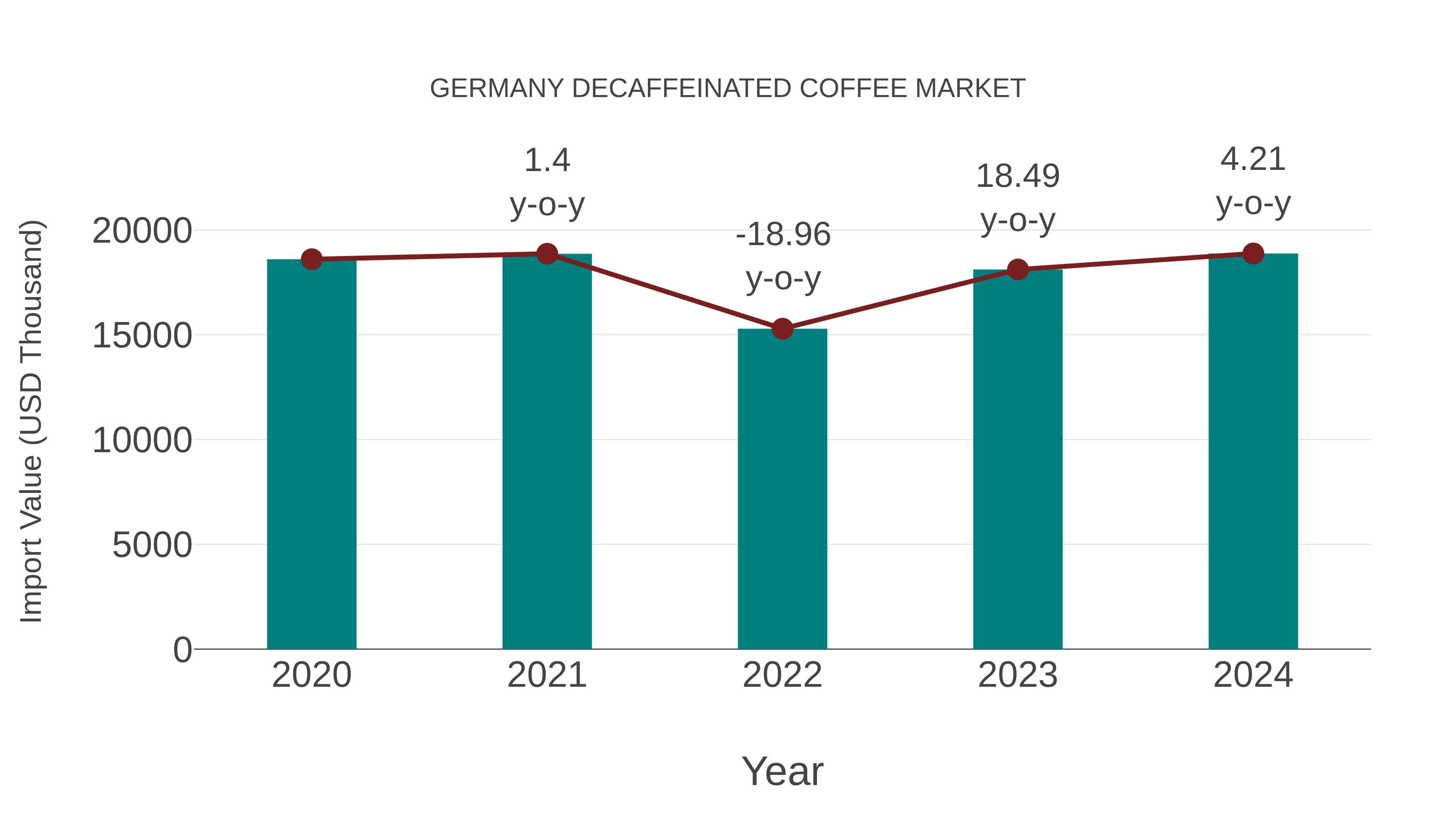
Germany`s import trend for decaffeinated coffee in 2024 showed a growth rate of 4.21%, with a compound annual growth rate (CAGR) of 0.36% from 2020 to 2024. The steady increase in imports could be attributed to evolving consumer preferences towards healthier options, potentially driving demand for decaffeinated coffee in the market.
Germany Decaffeinated Coffee Market Overview
The Germany decaffeinated coffee market is witnessing steady growth due to a rising consumer preference for healthier beverage options without sacrificing the enjoyment of coffee. With increasing awareness about the negative effects of caffeine on health, decaffeinated coffee has gained popularity among health-conscious individuals. The market offers a variety of decaf coffee products, including ground, instant, and whole bean options, catering to diverse consumer preferences. Key players in the market are focusing on product innovation, such as offering organic and sustainably sourced decaf coffee to meet the growing demand for ethical and premium coffee products. The market is also influenced by the trend of specialty coffee consumption in Germany, driving the demand for high-quality decaffeinated coffee among discerning consumers.
Germany Decaffeinated Coffee Market Trends
In the Germany decaffeinated coffee market, there is a notable trend towards increased consumer awareness and demand for healthier and more sustainable decaffeination methods. Consumers are showing a preference for decaffeinated coffee that is processed using natural methods such as the Swiss Water Process or carbon dioxide extraction, as opposed to chemical solvents like ethyl acetate. Additionally, there is a growing interest in decaffeinated coffee options that retain the flavor profile and quality of regular coffee, catering to the evolving taste preferences of discerning consumers. Brands that emphasize transparency in their decaffeination processes and promote ethical sourcing practices are gaining traction in the market as consumers prioritize sustainability and ethical considerations in their purchasing decisions.
Germany Decaffeinated Coffee Market Challenges
In the Germany Decaffeinated Coffee Market, one of the major challenges faced is the perception of decaffeinated coffee as inferior in taste compared to regular coffee. Many consumers still believe that decaf coffee lacks the same rich flavor profile and aroma as regular coffee, leading to lower demand. Additionally, the decaffeination process can sometimes alter the natural flavors of the coffee beans, further contributing to this perception. Another challenge is the limited variety of decaf coffee options available in the market, with fewer choices compared to regular coffee varieties. This lack of diversity can deter consumers who seek different flavor profiles and origins in their decaf coffee selections. Overall, overcoming these challenges requires educating consumers about the quality and taste of decaf coffee, as well as expanding the range of decaffeinated coffee options to meet diverse consumer preferences.
Germany Decaffeinated Coffee Market Investment Opportunities
The Germany Decaffeinated Coffee Market presents several investment opportunities for potential investors. With an increasing consumer trend towards healthier lifestyle choices, there is a growing demand for decaffeinated coffee products in the market. This presents an opportunity for companies to innovate and introduce new decaffeinated coffee varieties to cater to this consumer segment. Additionally, the rise of specialty coffee shops and cafes in Germany provides a platform for premium decaffeinated coffee offerings to gain traction among discerning customers. Investing in marketing strategies that highlight the health benefits of decaffeinated coffee, as well as sustainable sourcing practices, can help attract environmentally conscious consumers. Overall, investing in the Germany Decaffeinated Coffee Market offers the potential for product differentiation, market expansion, and tapping into a niche segment of the coffee industry.
Germany Decaffeinated Coffee Market Government Policy
The government policies related to the Germany Decaffeinated Coffee Market primarily focus on food safety regulations, labeling requirements, and sustainability initiatives. The market is governed by the European Union`s regulations on food and beverage products, ensuring that decaffeinated coffee meets certain quality standards and does not pose any health risks to consumers. Additionally, there are specific labeling requirements in place to provide transparency to consumers regarding the decaffeination process and the origin of the coffee beans. The German government also supports sustainability initiatives in the coffee industry, promoting fair trade practices and environmentally friendly production methods. Overall, these policies aim to maintain consumer trust, promote transparency, and encourage sustainable practices within the decaffeinated coffee market in Germany.
Germany Decaffeinated Coffee Market Future Outlook
The Germany decaffeinated coffee market is expected to show steady growth in the coming years driven by increasing health consciousness among consumers and a growing preference for coffee consumption throughout the day. With a rise in demand for decaffeinated coffee as a healthier alternative, market players are likely to introduce innovative product offerings and expand their distribution channels to cater to evolving consumer preferences. Additionally, the trend of premiumization in the coffee industry is expected to boost the market as consumers seek high-quality decaffeinated options. Sustainability and ethical sourcing practices are also becoming key factors influencing purchasing decisions, leading to an emphasis on environmentally friendly production methods. Overall, the Germany decaffeinated coffee market is poised for continued growth and innovation in the foreseeable future.
Key Highlights of the Report:
- Germany Decaffeinated Coffee Market Outlook
- Market Size of Germany Decaffeinated Coffee Market, 2025
- Forecast of Germany Decaffeinated Coffee Market, 2032
- Historical Data and Forecast of Germany Decaffeinated Coffee Revenues & Volume for the Period 2022 - 2032F
- Germany Decaffeinated Coffee Market Trend Evolution
- Germany Decaffeinated Coffee Market Drivers and Challenges
- Germany Decaffeinated Coffee Price Trends
- Germany Decaffeinated Coffee Porter's Five Forces
- Germany Decaffeinated Coffee Industry Life Cycle
- Historical Data and Forecast of Germany Decaffeinated Coffee Market Revenues & Volume By Product for the Period 2022 - 2032F
- Historical Data and Forecast of Germany Decaffeinated Coffee Market Revenues & Volume By Roasted for the Period 2022 - 2032F
- Historical Data and Forecast of Germany Decaffeinated Coffee Market Revenues & Volume By Raw for the Period 2022 - 2032F
- Historical Data and Forecast of Germany Decaffeinated Coffee Market Revenues & Volume By Species for the Period 2022 - 2032F
- Historical Data and Forecast of Germany Decaffeinated Coffee Market Revenues & Volume By Arabica for the Period 2022 - 2032F
- Historical Data and Forecast of Germany Decaffeinated Coffee Market Revenues & Volume By Robusta for the Period 2022 - 2032F
- Historical Data and Forecast of Germany Decaffeinated Coffee Market Revenues & Volume By Distribution Channel for the Period 2022 - 2032F
- Historical Data and Forecast of Germany Decaffeinated Coffee Market Revenues & Volume By Online for the Period 2022 - 2032F
- Historical Data and Forecast of Germany Decaffeinated Coffee Market Revenues & Volume By Offline for the Period 2022 - 2032F
- Germany Decaffeinated Coffee Import Export Trade Statistics
- Market Opportunity Assessment By Product
- Market Opportunity Assessment By Species
- Market Opportunity Assessment By Distribution Channel
- Germany Decaffeinated Coffee Top Companies Market Share
- Germany Decaffeinated Coffee Competitive Benchmarking By Technical and Operational Parameters
- Germany Decaffeinated Coffee Company Profiles
- Germany Decaffeinated Coffee Key Strategic Recommendations






































