Germany Industrial Radiography Market Size Growth Rate
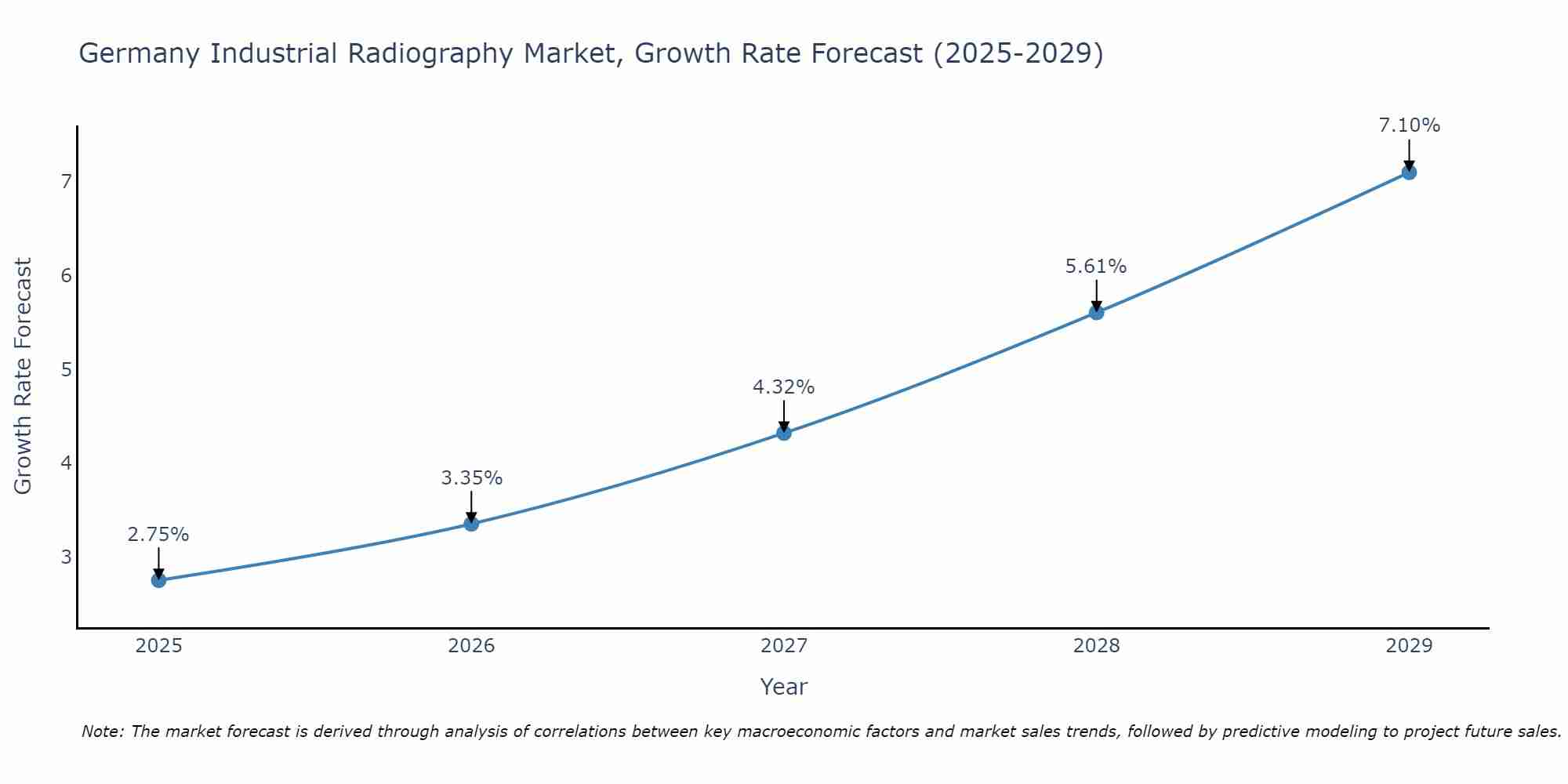
The Germany Industrial Radiography Market is likely to experience consistent growth rate gains over the period 2025 to 2029. The growth rate starts at 2.75% in 2025 and reaches 7.10% by 2029.
Germany Industrial Radiography Market Overview
The industrial radiography market in Germany is experiencing steady growth driven by stringent quality standards and regulatory requirements across industries such as automotive, aerospace, and manufacturing. Industrial radiography techniques, including X-ray and gamma-ray imaging, are used for non-destructive testing (NDT) of materials and components to detect defects, cracks, and anomalies. The market is witnessing technological advancements, such as digital radiography systems and portable imaging solutions, enabling faster inspection and higher resolution imaging for enhanced quality control and safety compliance.
Drivers of the market
The Germany Industrial Radiography market is driven by factors such as stringent quality control requirements, safety regulations, and the increasing adoption of non-destructive testing (NDT) techniques in various industries. Industrial radiography plays a critical role in inspecting the integrity of welds, detecting defects in materials, and ensuring compliance with regulatory standards in sectors such as aerospace, automotive, oil and gas, and manufacturing. As industries strive to enhance product quality, minimize production flaws, and mitigate safety risks, the demand for advanced radiographic imaging solutions continues to grow in Germany. Additionally, technological advancements in imaging equipment, such as digital radiography systems and computed tomography (CT) scanners, are expanding the capabilities and applications of industrial radiography in the country.
Challenges of the market
The Germany Industrial Radiography market faces several challenges, including stringent regulatory requirements, safety concerns, and technological limitations that impact the adoption and deployment of radiographic inspection solutions across industries such as aerospace, automotive, and manufacturing. Manufacturers must adhere to strict safety protocols and radiation exposure limits while ensuring accurate detection and imaging of defects in complex materials and structures. Additionally, the market`s growth is influenced by factors such as the increasing demand for non-destructive testing solutions, advancements in imaging technologies, and the emergence of digital radiography systems, driving manufacturers to invest in research and development to stay competitive. Moreover, the market is characterized by the need for skilled technicians and engineers to operate radiographic equipment effectively, highlighting the importance of training and certification programs to address workforce shortages and competency gaps.
Government Policy of the market
The Germany government regulates the industrial radiography market to ensure radiation safety standards, equipment certification, and operator training. Policies focus on minimizing exposure risks, maintaining accurate imaging quality, and compliance with international guidelines for industrial inspection applications.
Key Highlights of the Report:
- Germany Industrial Radiography Market Outlook
- Market Size of Germany Industrial Radiography Market, 2024
- Forecast of Germany Industrial Radiography Market, 2031
- Historical Data and Forecast of Germany Industrial Radiography Revenues & Volume for the Period 2018 - 2031
- Germany Industrial Radiography Market Trend Evolution
- Germany Industrial Radiography Market Drivers and Challenges
- Germany Industrial Radiography Price Trends
- Germany Industrial Radiography Porter's Five Forces
- Germany Industrial Radiography Industry Life Cycle
- Historical Data and Forecast of Germany Industrial Radiography Market Revenues & Volume By Technology for the Period 2018 - 2031
- Historical Data and Forecast of Germany Industrial Radiography Market Revenues & Volume By Film Radiography for the Period 2018 - 2031
- Historical Data and Forecast of Germany Industrial Radiography Market Revenues & Volume By Computed Radiography for the Period 2018 - 2031
- Historical Data and Forecast of Germany Industrial Radiography Market Revenues & Volume By Direct Radiography for the Period 2018 - 2031
- Historical Data and Forecast of Germany Industrial Radiography Market Revenues & Volume By Computed Tomography for the Period 2018 - 2031
- Historical Data and Forecast of Germany Industrial Radiography Market Revenues & Volume By End-user Industry for the Period 2018 - 2031
- Historical Data and Forecast of Germany Industrial Radiography Market Revenues & Volume By Aerospace & Defense for the Period 2018 - 2031
- Historical Data and Forecast of Germany Industrial Radiography Market Revenues & Volume By Petrochemical & Gas for the Period 2018 - 2031
- Historical Data and Forecast of Germany Industrial Radiography Market Revenues & Volume By Energy & Power for the Period 2018 - 2031
- Historical Data and Forecast of Germany Industrial Radiography Market Revenues & Volume By Construction for the Period 2018 - 2031
- Historical Data and Forecast of Germany Industrial Radiography Market Revenues & Volume By Automotive & Transportation for the Period 2018 - 2031
- Historical Data and Forecast of Germany Industrial Radiography Market Revenues & Volume By Manufacturing for the Period 2018 - 2031
- Historical Data and Forecast of Germany Industrial Radiography Market Revenues & Volume By Other End-user Industries for the Period 2018 - 2031
- Germany Industrial Radiography Import Export Trade Statistics
- Market Opportunity Assessment By Technology
- Market Opportunity Assessment By End-user Industry
- Germany Industrial Radiography Top Companies Market Share
- Germany Industrial Radiography Competitive Benchmarking By Technical and Operational Parameters
- Germany Industrial Radiography Company Profiles
- Germany Industrial Radiography Key Strategic Recommendations






































