Germany Insurance Analytics Market Size & Growth Rate (2026-2032)
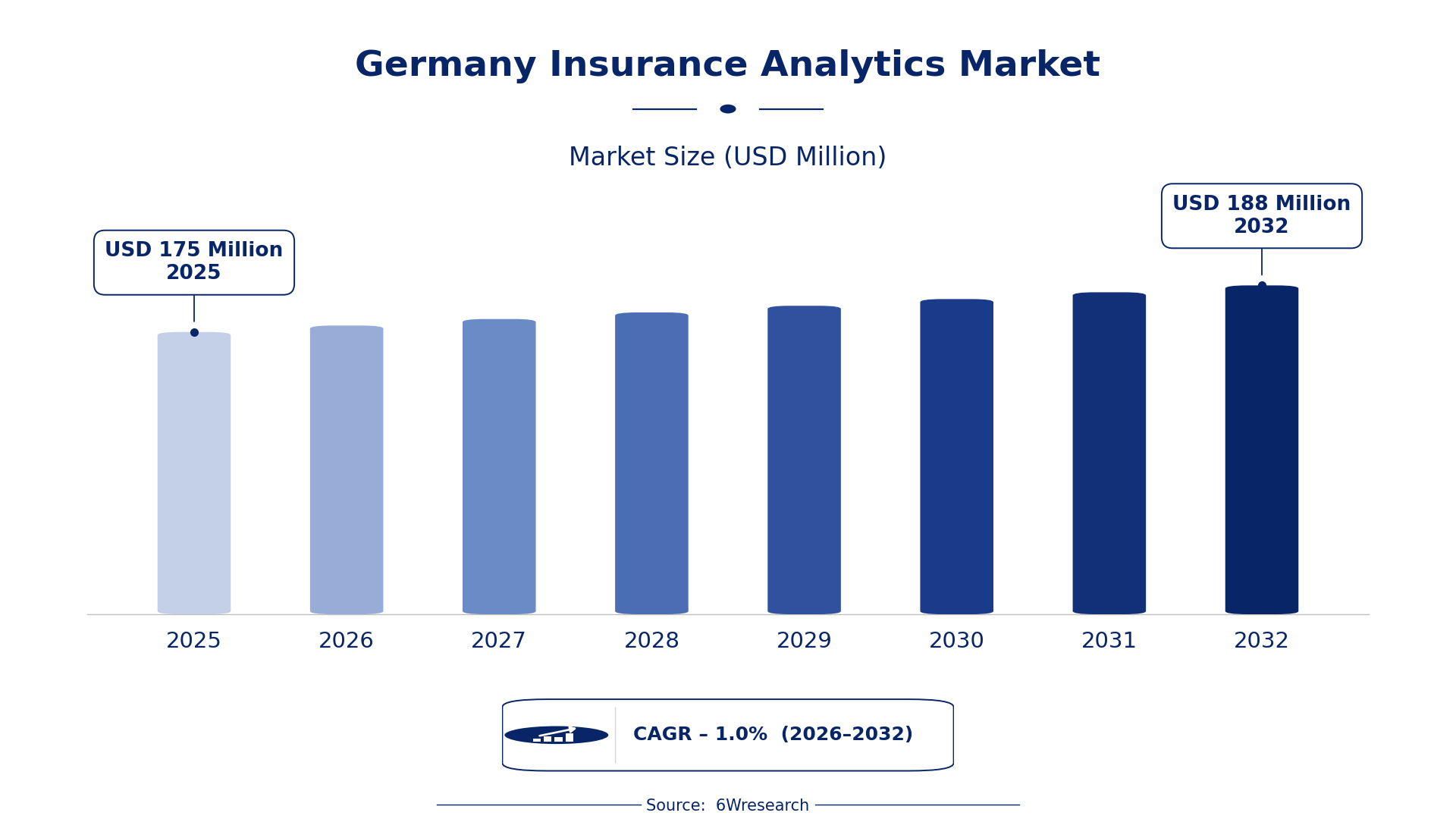
The Germany Insurance Analytics Market was estimated at USD 175 Million in 2025 and is projected to reach USD 188 Million by 2032, growing at a CAGR of 1.0% from 2026 to 2032.
Germany Insurance Analytics Market Synopsis
The surge in demand for data-driven insights is the primary force shaping the Germany Insurance Analytics Market. Insurers are increasingly relying on analytics to enhance their operational efficiencies and improve customer engagement, creating a competitive edge in a crowded marketplace.
As the digital transformation of the insurance industry accelerates, advanced analytics technologies such as artificial intelligence and machine learning are gaining traction. These tools empower insurers to analyze complex data sets for better risk assessment, claims management, and fraud detection, all of which are critical in the current fast-paced environment.
Germany Insurance Analytics Market Year-wise Growth Rate and Key Drivers
This graph illustrates the annual growth rates of the Germany Insurance Analytics Market from 2021 to 2032, highlighting a steady upward trajectory and projected expansion over the forecast period.
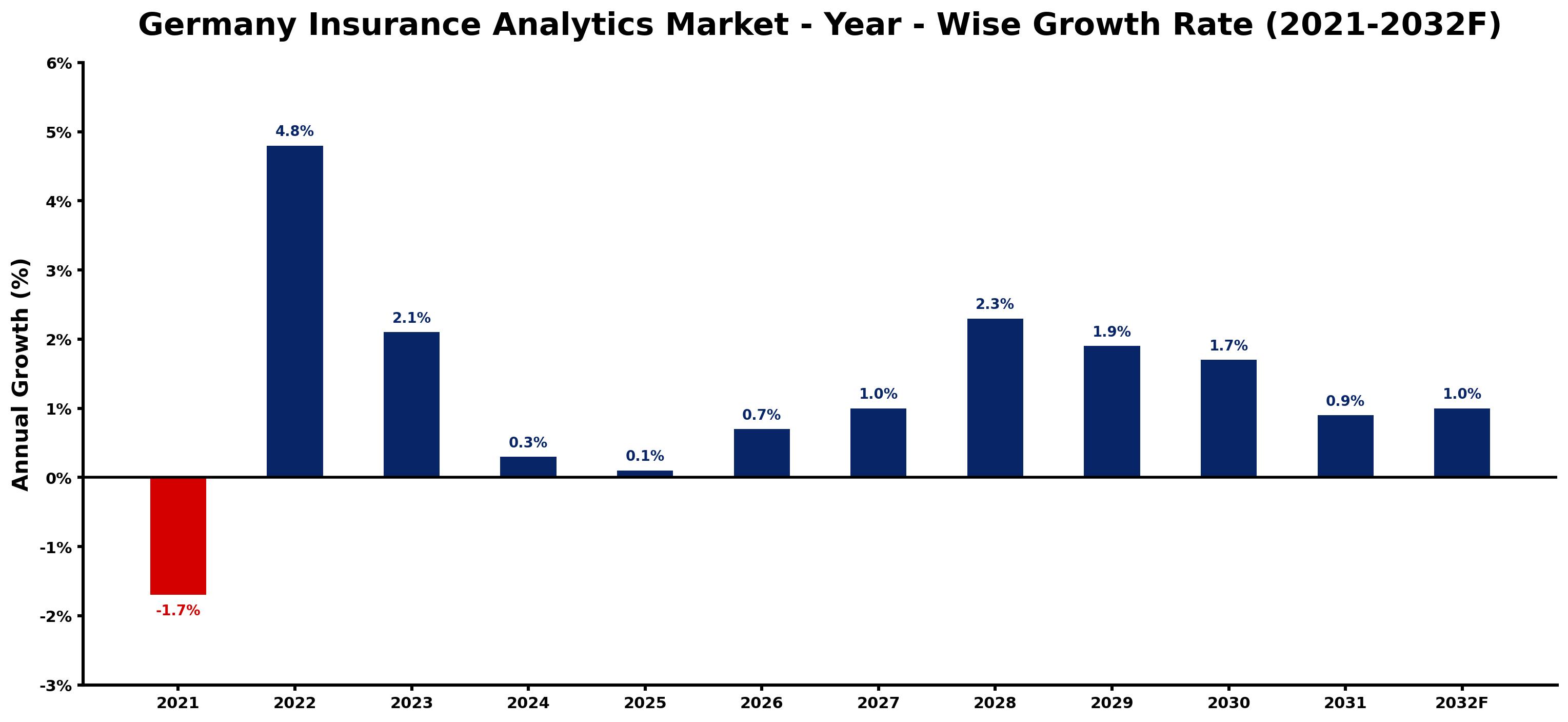
The table below presents the year‑wise growth rates along with the key drivers influencing the market
| Year | Growth Rate | Major Drivers |
| 2021 | -1.7% | GDPR compliance costs hindered analytics implementation efforts. |
| 2022 | 4.8% | Implementation of Solvency II risk management standards. |
| 2023 | 2.1% | Increased demand for predictive analytics in underwriting. |
| 2024 | 0.3% | Focus on fraud detection through advanced data analytics. |
| 2025 | 0.1% | Adoption of AI for personalized insurance offerings. |
| 2026 | 0.7% | Growing integration of IoT data in risk assessment. |
| 2027 | 1.0% | Rising customer expectations for transparency in claims. |
| 2028 | 2.3% | Support from InsurTech innovations fueling analytics growth. |
| 2029 | 1.9% | Regulatory push for data-driven pricing models. |
| 2030 | 1.7% | Increased investments in customer experience analytics tools. |
| 2031 | 0.9% | Demand for compliance analytics post-GDPR enforcement. |
| 2032 | 1.0% | Enhanced use of big data in policy customization. |
Note: Market size estimations and growth projections presented in this report are based on 6Wresearch's proprietary forecasting methodology, utilizing the latest available industry data, government publications, and primary research inputs.
Germany Insurance Analytics Market Key Takeaways
Below are some of the specific key takeaways from the market, including:
- Increased reliance on data analytics is reshaping the decision-making processes within insurance firms.
- Advanced technologies are being integrated into existing frameworks to enhance underwriting accuracy.
- There is a strong push for personalized customer experiences driven by analytics.
- Compliance with regulatory standards is becoming a crucial consideration for analytics solutions.
- The demand for skilled professionals in data analytics is on the rise amid increasing competition.
Evaluation of Restraints in Germany Insurance Analytics Market
Despite its growth potential, the Germany Insurance Analytics Market faces several constraints. Data quality remains a pressing issue, with insurance companies grappling to maintain the accuracy of vast data inflows from various sources. This challenge is compounded by the stringent regulatory landscape, particularly the General Data Protection Regulation (GDPR), which necessitates robust compliance measures. Additionally, the talent shortage in the field of data analytics adds another layer of difficulty, as firms struggle to attract and retain skilled professionals. Integrating new analytics solutions with legacy systems also requires significant investment and strategic planning, further complicating market dynamics.
Germany Insurance Analytics Market Trends
The market is witnessing a shift towards the adoption of predictive analytics tools that allow for more nuanced risk assessments and underwriting processes. Insurers are increasingly investing in artificial intelligence and machine learning technologies to automate claims processing and enhance fraud detection mechanisms. on top of that, there is a growing emphasis on customer-centric analytics, enabling firms to tailor products and services to meet individual client needs. As data privacy concerns rise, transparency in analytics practices is becoming a key trend.
Germany Insurance Analytics Market Opportunities
The landscape presents numerous opportunities for growth and investment. Companies that can offer innovative analytics platforms tailored to the specific needs of the insurance sector stand to gain a competitive advantage. The emergence of insurtech startups focusing on analytics solutions also highlights a vibrant ecosystem ripe for collaboration. on top of that, as more insurers recognize the value of data-driven decision-making, there will be an increasing demand for consultancy and training services in analytics.
Government Initiatives in the Germany Insurance Analytics Market
Government policy plays a crucial role in shaping the Germany Insurance Analytics Market, focusing on the ethical use of data and the promotion of technological advancements. Regulatory frameworks are being developed to ensure that analytics practices align with data protection laws, thereby fostering trust among consumers. This regulatory posture not only addresses privacy concerns but also encourages innovation in analytics technologies.
- A regulatory framework established in 2025 mandates transparency in predictive modeling and analytics practices.
- An ongoing initiative aims to enhance data-sharing protocols among insurers to improve risk assessment accuracy.
- A recently completed program focused on training insurance professionals in data analytics best practices.
- A planned public-private partnership seeks to develop a national analytics infrastructure by 2028, enhancing access to advanced analytics tools.
- Current discussions are underway to update data protection regulations to better accommodate emerging analytics technologies.
Future Insights of the Germany Insurance Analytics Market
Looking ahead to 2026-2032, the Germany Insurance Analytics Market is expected to evolve significantly. As more insurers adopt advanced analytics solutions, the emphasis will shift towards integrating these tools within existing operational frameworks. The focus will be on achieving greater efficiency and personalization in customer interactions. Additionally, companies that prioritize compliance and data governance will likely gain customer trust, solidifying their market positions. Investments in talent development and partnerships with technology providers will also be critical for staying competitive.
Germany Insurance Analytics Market Latest Developments
Over the past year, the Germany Insurance Analytics Market has seen a flurry of activity as firms strive to enhance their analytical capabilities. The integration of artificial intelligence into analytics platforms has become increasingly prevalent, setting the stage for improved operational efficiencies and customer insights. As competition intensifies, firms are focusing on innovation and strategic partnerships to stay ahead.
- A major technology vendor launched a next-generation analytics platform in Q1 2025, aimed at streamlining claims processing.
- In early 2025, a leading regional operator initiated a pilot project to test the effectiveness of AI-driven underwriting tools.
- A strategic partnership between an insurtech startup and a traditional insurer was formed in mid-2025 to enhance data analytics capabilities.
- An upcoming industry conference scheduled for late 2025 will showcase advancements in insurance analytics technologies.
- A rollout of a customer engagement analytics solution is expected to begin in early 2026, focusing on personalized marketing strategies.
Germany Insurance Analytics Market - Key Attractiveness of the Report
- 10 Years of Market Numbers
- Historical Data Starting from 2022 to 2025
- Base Year: 2025
- Forecast Data until 2032
- Key Performance Indicators Impacting the Market
- Major Upcoming Developments and Projects
Key Highlights of the Report:
- Germany Insurance Analytics Market Outlook
- Market Size of Germany Insurance Analytics Market, 2025
- Forecast of Germany Insurance Analytics Market, 2032
- Historical Data and Forecast of Germany Insurance Analytics Revenues & Volume for the Period 2022-2032F
- Germany Insurance Analytics Market Trend Evolution
- Germany Insurance Analytics Market Drivers and Challenges
- Germany Insurance Analytics Price Trends
- Germany Insurance Analytics Porter's Five Forces
- Germany Insurance Analytics Industry Life Cycle
- Historical Data and Forecast of Germany Insurance Analytics Market Revenues & Volume By Component for the Period 2022-2032F
- Historical Data and Forecast of Germany Insurance Analytics Market Revenues & Volume By Tools for the Period 2022-2032F
- Historical Data and Forecast of Germany Insurance Analytics Market Revenues & Volume By Services for the Period 2022-2032F
- Historical Data and Forecast of Germany Insurance Analytics Market Revenues & Volume By Application for the Period 2022-2032F
- Historical Data and Forecast of Germany Insurance Analytics Market Revenues & Volume By Claims Management for the Period 2022-2032F
- Historical Data and Forecast of Germany Insurance Analytics Market Revenues & Volume By Risk Management for the Period 2022-2032F
- Historical Data and Forecast of Germany Insurance Analytics Market Revenues & Volume By Customer Management and Personalization for the Period 2022-2032F
- Historical Data and Forecast of Germany Insurance Analytics Market Revenues & Volume By Process Optimization for the Period 2022-2032F
- Historical Data and Forecast of Germany Insurance Analytics Market Revenues & Volume By Others for the Period 2022-2032F
- Historical Data and Forecast of Germany Insurance Analytics Market Revenues & Volume By Deployment Mode for the Period 2022-2032F
- Historical Data and Forecast of Germany Insurance Analytics Market Revenues & Volume By Cloud for the Period 2022-2032F
- Historical Data and Forecast of Germany Insurance Analytics Market Revenues & Volume By On-premises for the Period 2022-2032F
- Historical Data and Forecast of Germany Insurance Analytics Market Revenues & Volume By End User for the Period 2022-2032F
- Historical Data and Forecast of Germany Insurance Analytics Market Revenues & Volume By Insurance Companies for the Period 2022-2032F
- Historical Data and Forecast of Germany Insurance Analytics Market Revenues & Volume By Government Agencies for the Period 2022-2032F
- Historical Data and Forecast of Germany Insurance Analytics Market Revenues & Volume By Third-party Administrators, Brokers and Consultancies for the Period 2022-2032F
- Historical Data and Forecast of Germany Insurance Analytics Market Revenues & Volume By Organization Size for the Period 2022-2032F
- Historical Data and Forecast of Germany Insurance Analytics Market Revenues & Volume By Large Enterprises for the Period 2022-2032F
- Historical Data and Forecast of Germany Insurance Analytics Market Revenues & Volume By SMEs for the Period 2022-2032F
- Germany Insurance Analytics Import Export Trade Statistics
- Market Opportunity Assessment By Component
- Market Opportunity Assessment By Application
- Market Opportunity Assessment By Deployment Mode
- Market Opportunity Assessment By End User
- Market Opportunity Assessment By Organization Size
- Germany Insurance Analytics Top Companies Market Share
- Germany Insurance Analytics Competitive Benchmarking By Technical and Operational Parameters
- Germany Insurance Analytics Company Profiles
- Germany Insurance Analytics Key Strategic Recommendations






































