Germany Processed Food Market: Import Trend Analysis
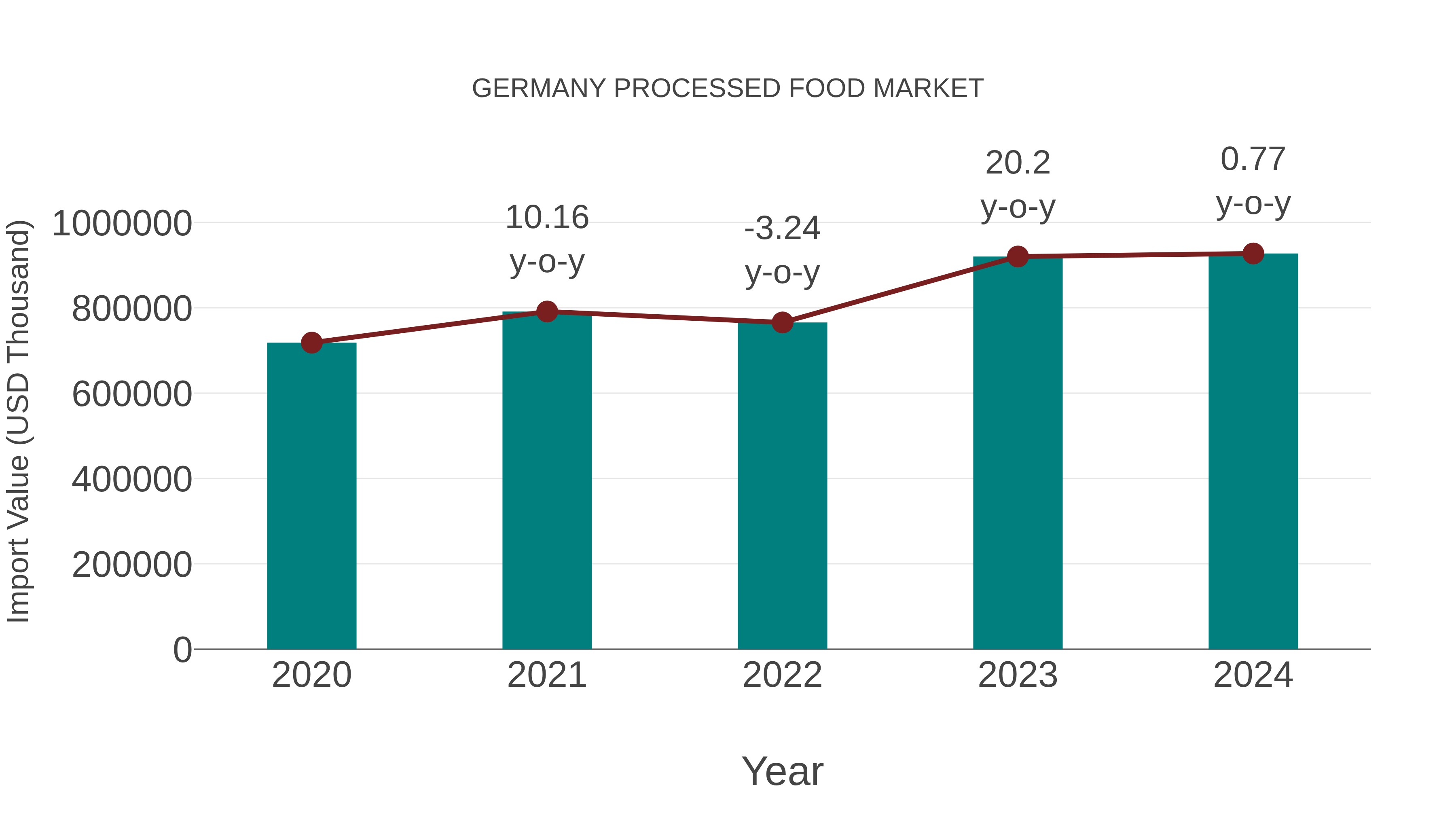
In the Germany processed food market, the import trend exhibited a growth rate of 0.77% from 2023 to 2024, with a compound annual growth rate (CAGR) of 6.59% from 2020 to 2024. This steady import momentum suggests sustained demand for processed food products, likely driven by evolving consumer preferences and stable trade policies during the period.
Germany Processed Food Market Overview
The Germany processed food market continues to witness steady growth driven by changing consumer preferences and lifestyles. With an increasing inclination towards convenience and ready-to-eat options, the demand for processed food products has been on the rise. Moreover, the emphasis on health and wellness has led to a surge in demand for healthier processed food options, including organic and natural products. Key players in the market are focusing on product innovation and expansion of their product portfolios to cater to evolving consumer needs and preferences.
Drivers of the market
The busy lifestyles and changing dietary preferences of consumers drive the growth of the processed food market in Germany. Emphasis on convenience, longer shelf life, and ready-to-eat options contributes to market expansion. Additionally, innovations in packaging and food technology play a significant role in driving market growth.
Challenges of the market
In the processed food market, challenges include consumer demand for healthier options, clean labeling, and sustainable packaging. Developing processed food products that can meet dietary preferences, nutritional requirements, and lifestyle choices is crucial for market success. Moreover, addressing concerns related to food safety, ingredient transparency, and supply chain traceability poses challenges for food manufacturers and retailers. Additionally, navigating regulatory requirements and adapting to market trends pose challenges for product innovation and differentiation.
Government Policy of the market
Germany emphasizes food safety, nutritional value, and sustainability in its policies regarding processed food production and marketing. Government regulations address food labeling standards, ingredient specifications, and manufacturing practices for food processors, ensuring compliance with food safety regulations and consumer protection standards. Policies also support research and development in healthy ingredients, clean label products, and sustainable packaging solutions to promote consumer health and environmental stewardship in the processed food market.
Key Highlights of the Report:
- Germany Processed Food Market Outlook
- Market Size of Germany Processed Food Market, 2024
- Forecast of Germany Processed Food Market, 2031
- Historical Data and Forecast of Germany Processed Food Revenues & Volume for the Period 2018 - 2031
- Germany Processed Food Market Trend Evolution
- Germany Processed Food Market Drivers and Challenges
- Germany Processed Food Price Trends
- Germany Processed Food Porter's Five Forces
- Germany Processed Food Industry Life Cycle
- Historical Data and Forecast of Germany Processed Food Market Revenues & Volume By Process for the Period 2018 - 2031
- Historical Data and Forecast of Germany Processed Food Market Revenues & Volume By Minimally for the Period 2018 - 2031
- Historical Data and Forecast of Germany Processed Food Market Revenues & Volume By Highly for the Period 2018 - 2031
- Historical Data and Forecast of Germany Processed Food Market Revenues & Volume By Product type for the Period 2018 - 2031
- Historical Data and Forecast of Germany Processed Food Market Revenues & Volume By Plant based for the Period 2018 - 2031
- Historical Data and Forecast of Germany Processed Food Market Revenues & Volume By Fruits for the Period 2018 - 2031
- Historical Data and Forecast of Germany Processed Food Market Revenues & Volume By Vegetables for the Period 2018 - 2031
- Historical Data and Forecast of Germany Processed Food Market Revenues & Volume By Legumes for the Period 2018 - 2031
- Historical Data and Forecast of Germany Processed Food Market Revenues & Volume By Extracted foods for the Period 2018 - 2031
- Historical Data and Forecast of Germany Processed Food Market Revenues & Volume By Others for the Period 2018 - 2031
- Historical Data and Forecast of Germany Processed Food Market Revenues & Volume By Animal based for the Period 2018 - 2031
- Historical Data and Forecast of Germany Processed Food Market Revenues & Volume By Milk for the Period 2018 - 2031
- Historical Data and Forecast of Germany Processed Food Market Revenues & Volume By Application for the Period 2018 - 2031
- Historical Data and Forecast of Germany Processed Food Market Revenues & Volume By Baked foods for the Period 2018 - 2031
- Historical Data and Forecast of Germany Processed Food Market Revenues & Volume By Baby food for the Period 2018 - 2031
- Historical Data and Forecast of Germany Processed Food Market Revenues & Volume By Breakfast Cereal for the Period 2018 - 2031
- Historical Data and Forecast of Germany Processed Food Market Revenues & Volume By Biscuits for the Period 2018 - 2031
- Historical Data and Forecast of Germany Processed Food Market Revenues & Volume By Cheese for the Period 2018 - 2031
- Historical Data and Forecast of Germany Processed Food Market Revenues & Volume By Chocolate confectionary for the Period 2018 - 2031
- Historical Data and Forecast of Germany Processed Food Market Revenues & Volume By Ice creams for the Period 2018 - 2031
- Historical Data and Forecast of Germany Processed Food Market Revenues & Volume By Instant Noodles for the Period 2018 - 2031
- Germany Processed Food Import Export Trade Statistics
- Market Opportunity Assessment By Process
- Market Opportunity Assessment By Product type
- Market Opportunity Assessment By Application
- Germany Processed Food Top Companies Market Share
- Germany Processed Food Competitive Benchmarking By Technical and Operational Parameters
- Germany Processed Food Company Profiles
- Germany Processed Food Key Strategic Recommendations






































