Germany Wealth Management Platform Market Size & Growth Rate (2026-2032)
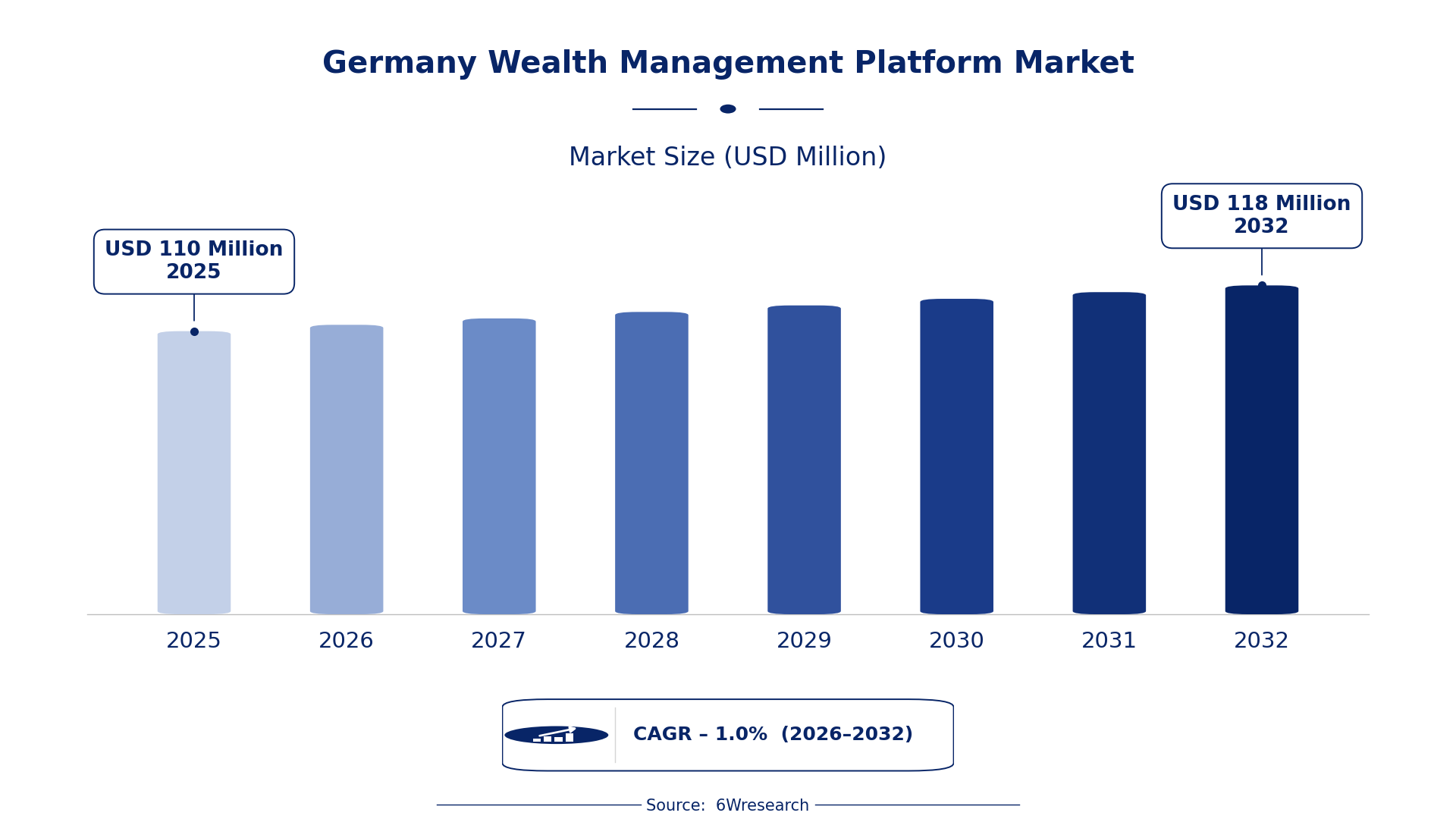
The Germany Wealth Management Platform Market was estimated at USD 110 Million in 2025 and is projected to reach USD 118 Million by 2032, growing at a CAGR of 1.0% from 2026 to 2032.
Germany Wealth Management Platform Market Synopsis
The rapid digital transformation within Germany's financial services sector is reshaping the wealth management platform market. As firms increasingly adopt technological solutions, the demand for sophisticated, data-driven tools is escalating.
High-net-worth individuals are seeking personalized wealth management services tailored to their unique financial goals. This shift in consumer preference is compelling firms to enhance their offerings, incorporating features like goal-based planning and real-time portfolio analytics.
Germany Wealth Management Platform Market Year-wise Growth Rate and Key Drivers
This graph illustrates the annual growth rates of the Germany Wealth Management Platform Market from 2021 to 2032, highlighting a steady upward trajectory and projected expansion over the forecast period.
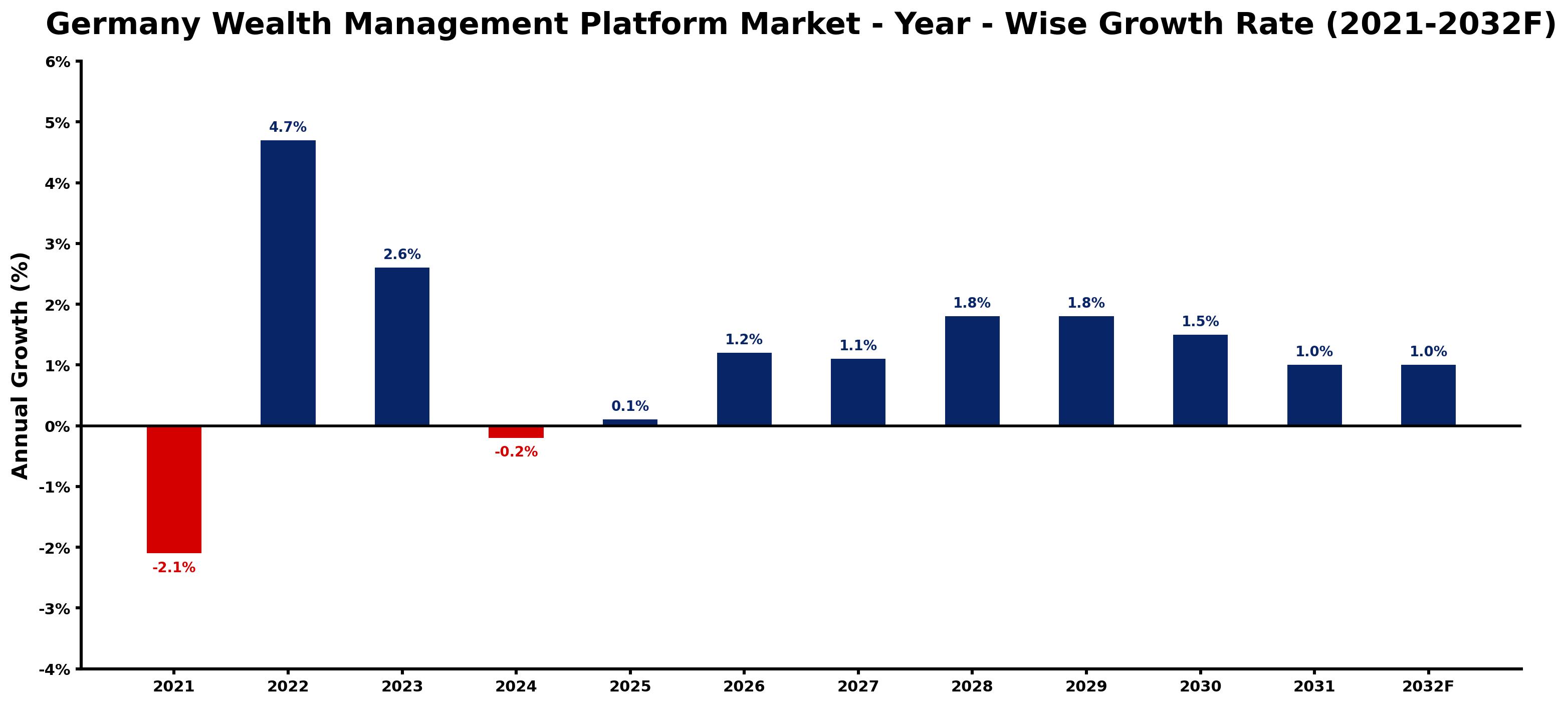
The table below presents the year‑wise growth rates along with the key drivers influencing the market
| Year | Growth Rate | Major Drivers |
| 2021 | -2.1% | Decreased client investment due to negative interest rates |
| 2022 | 4.7% | German financial regulation promoting digital asset services |
| 2023 | 2.6% | Rising interest in personalized wealth management solutions |
| 2024 | -0.2% | Regulatory changes from BaFin limiting platform offerings |
| 2025 | 0.1% | Millennials increasingly inheriting substantial family wealth |
| 2026 | 1.2% | Enhanced digital onboarding regulations streamline client acquisition |
| 2027 | 1.1% | Germany's aging population demands retirement planning services |
| 2028 | 1.8% | Growth of robo-advisors attracting younger investors |
| 2029 | 1.8% | Increased financial literacy initiatives driving wealth management interest |
| 2030 | 1.5% | Corporate pension fund restructuring enhances investment strategies |
| 2031 | 1.0% | Shift towards comprehensive financial wellness programs for clients |
| 2032 | 1.0% | Technological advancements improving client engagement and satisfaction |
Note: Market size estimations and growth projections presented in this report are based on 6Wresearch's proprietary forecasting methodology, utilizing the latest available industry data, government publications, and primary research inputs.
Germany Wealth Management Platform Market Key Takeaways
Below are some of the specific key takeaways from the market, including:
- The market is expected to grow steadily, driven by increasing wealth accumulation among affluent individuals.
- Technological advancements such as AI and machine learning are becoming integral to service offerings.
- Regulatory pressures are reshaping compliance strategies for wealth management platforms.
- Consumer demand for personalized services is pushing firms to innovate continuously.
- Investment in cybersecurity remains a critical focus for building client trust in digital solutions.
Evaluation of Restraints in Germany Wealth Management Platform Market
Despite its growth potential, the Germany Wealth Management Platform Market faces substantial hurdles. Adapting to evolving regulatory requirements is a persistent challenge that demands significant resources and agility. Firms must develop platforms that not only meet compliance standards but also deliver personalized investment advice, all while navigating the complexities of data protection regulations. Cybersecurity concerns further complicate this landscape, as building trust with clients in a digital-first environment is paramount.
Germany Wealth Management Platform Market Trends
A noticeable trend in the market is the increasing adoption of AI-driven analytics for portfolio management. Wealth managers are utilizing these technologies to provide clients with tailored insights and predictive analytics. Another emerging trend is the shift towards fee transparency, as consumers demand clearer pricing structures in their wealth management services. on top of that, sustainability is becoming a key consideration, with clients increasingly favoring investments that align with their ethical values.
Germany Wealth Management Platform Market Opportunities
The landscape is ripe with opportunities for growth. Firms that can integrate advanced analytics and machine learning into their platforms stand to gain a competitive edge. Additionally, the growing interest in sustainable investments presents a unique avenue for wealth managers to differentiate their offerings. As digital channels become more prevalent, those who invest in enhancing user experience and accessibility will likely capture a larger share of the market.
Government Initiatives in the Germany Wealth Management Platform Market
Government policy is a significant influence on the Germany Wealth Management Platform Market, particularly through regulations that govern financial services. Policymakers aim to enhance transparency and trust in wealth management practices, which is crucial for consumer protection in this sector.
- A regulatory framework introduced in 2025 mandates enhanced disclosure standards for wealth management platforms.
- A national initiative to improve investor education is currently underway, aimed at promoting financial literacy among consumers.
- Upcoming legislation expected by 2027 will focus on data protection and compliance standards specific to digital wealth management.
- Recently completed audits of wealth management firms are intended to increase accountability and transparency in the industry.
Future Insights of the Germany Wealth Management Platform Market
Looking ahead to 2026-2032, the Germany Wealth Management Platform Market is on a path of gradual but steady growth. As affluent individuals increasingly seek tailored services, firms will need to enhance their technological capabilities and innovate their service offerings. The integration of AI and machine learning will become more prevalent, allowing wealth managers to provide personalized insights that cater to evolving client needs. on top of that, adapting to regulatory changes will remain critical for sustained success.
Germany Wealth Management Platform Market Latest Developments
Recent months have seen notable activity within the Germany Wealth Management Platform Market. Firms are actively investing in technology upgrades and enhancing service offerings to meet consumer demand for personalized and transparent wealth management solutions.
- A leading financial institution launched a new AI-powered portfolio management tool in early 2025, aimed at providing personalized investment strategies.
- An ongoing initiative to improve cybersecurity measures began in mid-2025, focusing on securing client data and enhancing trust in digital platforms.
- By late 2025, a regional wealth management firm plans to roll out a comprehensive digital education program for clients, enhancing their understanding of investment strategies.
- A major technology vendor is currently developing an upcoming platform feature designed to streamline compliance processes, expected to debut in early 2026.
Germany Wealth Management Platform Market - Key Attractiveness of the Report
- 10 Years of Market Numbers
- Historical Data Starting from 2022 to 2025
- Base Year: 2025
- Forecast Data until 2032
- Key Performance Indicators Impacting the Market
- Major Upcoming Developments and Projects
Key Highlights of the Report:
- Germany Wealth Management Platform Market Outlook
- Market Size of Germany Wealth Management Platform Market, 2025
- Forecast of Germany Wealth Management Platform Market, 2032
- Historical Data and Forecast of Germany Wealth Management Platform Revenues & Volume for the Period 2022-2032F
- Germany Wealth Management Platform Market Trend Evolution
- Germany Wealth Management Platform Market Drivers and Challenges
- Germany Wealth Management Platform Price Trends
- Germany Wealth Management Platform Porter's Five Forces
- Germany Wealth Management Platform Industry Life Cycle
- Historical Data and Forecast of Germany Wealth Management Platform Market Revenues & Volume By Advisory Model for the Period 2022-2032F
- Historical Data and Forecast of Germany Wealth Management Platform Market Revenues & Volume By Human Advisory for the Period 2022-2032F
- Historical Data and Forecast of Germany Wealth Management Platform Market Revenues & Volume By Robo Advisory for the Period 2022-2032F
- Historical Data and Forecast of Germany Wealth Management Platform Market Revenues & Volume By Hybrid for the Period 2022-2032F
- Historical Data and Forecast of Germany Wealth Management Platform Market Revenues & Volume By Business Function for the Period 2022-2032F
- Historical Data and Forecast of Germany Wealth Management Platform Market Revenues & Volume By Financial advice management for the Period 2022-2032F
- Historical Data and Forecast of Germany Wealth Management Platform Market Revenues & Volume By Portfolio, accounting, and trading management for the Period 2022-2032F
- Historical Data and Forecast of Germany Wealth Management Platform Market Revenues & Volume By Performance management for the Period 2022-2032F
- Historical Data and Forecast of Germany Wealth Management Platform Market Revenues & Volume By Risk and compliance management for the Period 2022-2032F
- Historical Data and Forecast of Germany Wealth Management Platform Market Revenues & Volume By Reporting for the Period 2022-2032F
- Historical Data and Forecast of Germany Wealth Management Platform Market Revenues & Volume By Others for the Period 2022-2032F
- Historical Data and Forecast of Germany Wealth Management Platform Market Revenues & Volume By Deployment Model for the Period 2022-2032F
- Historical Data and Forecast of Germany Wealth Management Platform Market Revenues & Volume By Cloud for the Period 2022-2032F
- Historical Data and Forecast of Germany Wealth Management Platform Market Revenues & Volume By On-premises for the Period 2022-2032F
- Historical Data and Forecast of Germany Wealth Management Platform Market Revenues & Volume By End -User Industry for the Period 2022-2032F
- Historical Data and Forecast of Germany Wealth Management Platform Market Revenues & Volume By Banks for the Period 2022-2032F
- Historical Data and Forecast of Germany Wealth Management Platform Market Revenues & Volume By Investment management firms for the Period 2022-2032F
- Historical Data and Forecast of Germany Wealth Management Platform Market Revenues & Volume By Trading and exchange firms for the Period 2022-2032F
- Historical Data and Forecast of Germany Wealth Management Platform Market Revenues & Volume By Brokerage firms for the Period 2022-2032F
- Historical Data and Forecast of Germany Wealth Management Platform Market Revenues & Volume By Others for the Period 2022-2032F
- Germany Wealth Management Platform Import Export Trade Statistics
- Market Opportunity Assessment By Advisory Model
- Market Opportunity Assessment By Business Function
- Market Opportunity Assessment By Deployment Model
- Market Opportunity Assessment By End -User Industry
- Germany Wealth Management Platform Top Companies Market Share
- Germany Wealth Management Platform Competitive Benchmarking By Technical and Operational Parameters
- Germany Wealth Management Platform Company Profiles
- Germany Wealth Management Platform Key Strategic Recommendations






































