Ghana Canvas Market Size, Share & Growth Rate
The Ghana Canvas Market was estimated at USD 406 Million in 2025 and is projected to reach USD 527 Million by 2032, growing at a CAGR of 3.8% from 2026 to 2032. This growth trajectory is primarily driven by the expanding construction sector, which increasingly incorporates canvas for various applications, including temporary shelters and protective covers. Furthermore, rising demand from agriculture and the creative industries is fueling an uptick in canvas products across multiple sectors.
Ghana Canvas Market Year-wise Growth Rate and Key Drivers
This graph highlights how the Ghana Canvas Market has steadily grown over the years, supported by major growth factors.
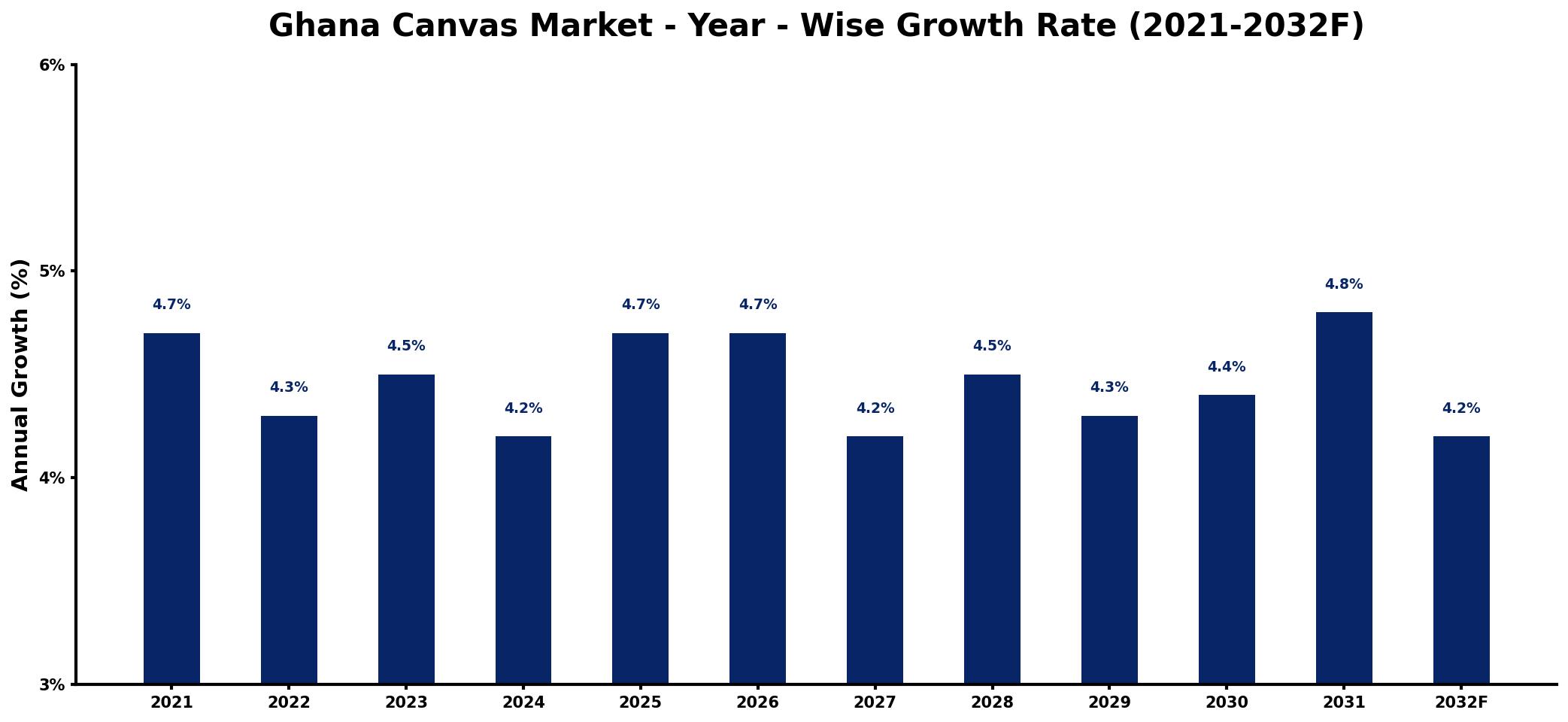
The table below presents the year‑wise growth rates along with the key drivers influencing the market
| Year | Growth Rate | Major Drivers |
| 2021 | 4.7% | rising demand for creative supplies |
| 2022 | 4.3% | increased investment in arts education |
| 2023 | 4.5% | growth in local art exhibitions |
| 2024 | 4.2% | expansion of online retail platforms |
| 2025 | 4.7% | enhanced marketing for local artists |
| 2026 | 4.7% | boost in community art initiatives |
| 2027 | 4.2% | growing interest in DIY projects |
| 2028 | 4.5% | more collaborations with schools |
| 2029 | 4.3% | increased popularity of workshops |
| 2030 | 4.4% | strengthened partnerships with retailers |
| 2031 | 4.8% | surge in international art fairs |
| 2032 | 4.2% | rising presence of art festivals |
Note: Market size estimations and growth projections presented in this report are based on 6Wresearch's proprietary forecasting methodology, utilizing the latest available industry data, government publications, and primary research inputs.
Ghana Canvas Market Synopsis
A significant force currently shaping the Ghana Canvas Market is the robust growth of the construction industry. Infrastructural projects nationwide are heavily reliant on canvas materials for a variety of uses, thereby boosting demand substantially. Additionally, the agricultural sector's need for protective and transportive canvas solutions further reinforces this market's growth dynamics.
Beyond traditional applications, the creative uses of canvas—spanning fashion to home décor—are also on the rise. As consumers increasingly embrace customization and artistic expression, the demand for canvas-based products is expanding, presenting new opportunities for manufacturers and retailers within the Ghana Canvas Market.
Ghana Canvas Market Key Takeaways
- Significant growth is driven by demand in construction and agriculture sectors.
- Canvas is increasingly popular in fashion and creative industries, enhancing market diversity.
- Sustainability challenges could impact production practices and consumer preferences.
- Government initiatives may foster further growth through infrastructure development.
- Technological advancements are likely to improve efficiency and product quality in manufacturing.
Evaluation of Restraints in Ghana Canvas Market
Despite its promising trajectory, the Ghana Canvas Market faces notable restraints that could hinder growth. A primary concern is the competition posed by synthetic alternatives, which offer similar durability and cost benefits. Additionally, environmental sustainability is becoming increasingly important, with rising consumer expectations surrounding eco-friendly production processes. Manufacturers must navigate these challenges, balancing cost, quality, and sustainability to remain competitive in a dynamic market.
Ghana Canvas Market Trends
Current trends indicate a strong shift towards sustainable production practices in the Ghana Canvas Market. Companies are innovating to create more environmentally friendly canvas materials, often integrating recycled fibers into their products. Another trend is the customization of canvas items, with consumers looking for unique, personalized products. This growing appetite for individual expression is pushing manufacturers to diversify their offerings.
Ghana Canvas Market Opportunities
Opportunities for growth in the Ghana Canvas Market lie primarily in the expansion of the outdoor recreation sector, as interest in camping and adventure activities continues to rise. Furthermore, tapping into the growing demand for eco-conscious products could set brands apart in an increasingly competitive landscape. Investment in research and development for innovative canvas applications can also provide a competitive edge.
Government Initiatives in the Ghana Canvas Market
The Ghanaian government is actively engaged in promoting the local textile and canvas market through various initiatives. Policies aimed at enhancing infrastructure, including the construction of processing facilities, are designed to support manufacturers. Financial incentives for producers who utilize sustainable practices are also in discussion, demonstrating a commitment to fostering an environmentally-friendly industry while bolstering the local economy.
Future Insights of the Ghana Canvas Market
Looking ahead to 2026-2032, the Ghana Canvas Market is poised for sustained growth. Anticipated infrastructural projects and increasing agricultural demands are expected to keep the momentum going. The integration of advanced manufacturing techniques will likely enhance product quality and reduce costs, further driving market expansion. Consumer preference for customizable and sustainable products will continue to shape the direction of innovation within the sector.
Ghana Canvas Market Latest Developments (2025 - 2026)
Recent developments in the Ghana Canvas Market reveal a trend toward increased collaboration between manufacturers and sustainability-focused organizations. Innovations in eco-friendly canvas materials are gaining traction, while market participants are exploring strategic partnerships to enhance distribution channels. Furthermore, the creative sector's demand for unique, high-quality canvas products is motivating new entrants to diversify their offerings.
Ghana Canvas Market - Key Attractiveness of the Report
- 10 Years of Market Numbers
- Historical Data Starting from 2022 to 2025
- Base Year: 2025
- Forecast Data until 2032
- Key Performance Indicators Impacting the Market
- Major Upcoming Developments and Projects
Key Highlights of the Report:
- Ghana Canvas Market Outlook
- Market Size of Ghana Canvas Market, 2025
- Forecast of Ghana Canvas Market, 2032
- Historical Data and Forecast of Ghana Canvas Revenues & Volume for the Period 2022-2032F
- Ghana Canvas Market Trend Evolution
- Ghana Canvas Market Drivers and Challenges
- Ghana Canvas Price Trends
- Ghana Canvas Porter's Five Forces
- Ghana Canvas Industry Life Cycle
- Historical Data and Forecast of Ghana Canvas Market Revenues & Volume By Types for the Period 2022-2032F
- Historical Data and Forecast of Ghana Canvas Market Revenues & Volume By Plane Canvas for the Period 2022-2032F
- Historical Data and Forecast of Ghana Canvas Market Revenues & Volume By Duck Canvas for the Period 2022-2032F
- Historical Data and Forecast of Ghana Canvas Market Revenues & Volume By Application for the Period 2022-2032F
- Historical Data and Forecast of Ghana Canvas Market Revenues & Volume By Tent for the Period 2022-2032F
- Historical Data and Forecast of Ghana Canvas Market Revenues & Volume By Luggage Fabric for the Period 2022-2032F
- Historical Data and Forecast of Ghana Canvas Market Revenues & Volume By Automotive Fabric for the Period 2022-2032F
- Historical Data and Forecast of Ghana Canvas Market Revenues & Volume By Apparel for the Period 2022-2032F
- Historical Data and Forecast of Ghana Canvas Market Revenues & Volume By Others for the Period 2022-2032F
- Ghana Canvas Import Export Trade Statistics
- Market Opportunity Assessment By Types
- Market Opportunity Assessment By Application
- Ghana Canvas Top Companies Market Share
- Ghana Canvas Competitive Benchmarking By Technical and Operational Parameters
- Ghana Canvas Company Profiles
- Ghana Canvas Key Strategic Recommendations






































