Ghana Cloud POS Market Size & Growth Rate (2026-2032)
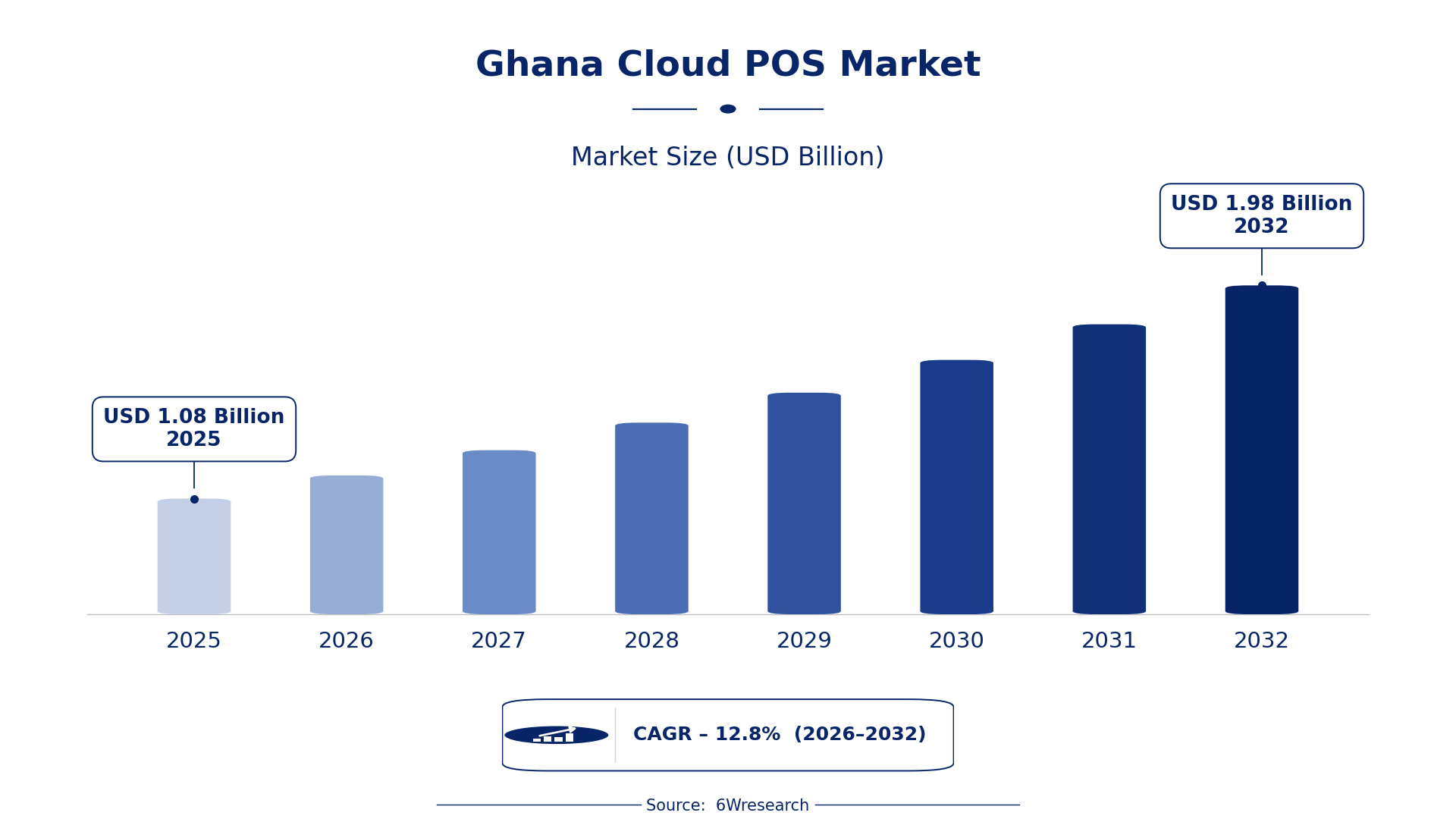
The Ghana Cloud POS Market was estimated at USD 1080 Million in 2025 and is projected to reach USD 1976 Million by 2032, growing at a CAGR of 12.8% from 2026 to 2032.
Ghana Cloud POS Market Synopsis
The increasing need for omnichannel retail solutions is reshaping the Ghana Cloud POS Market. Retailers and hospitality businesses are shifting toward cloud-based systems that enhance flexibility, mobility, and real-time transaction processing, fundamentally changing how they operate.
As e-commerce expands and contactless payments gain traction, businesses are compelled to upgrade their POS systems. This shift not only streamlines operations but also significantly improves customer interactions, driving further adoption in the sector.
Ghana Cloud POS Market Year-wise Growth Rate and Key Drivers
This graph illustrates the annual growth rates of the Ghana Cloud POS Market from 2021 to 2032, highlighting a steady upward trajectory and projected expansion over the forecast period.
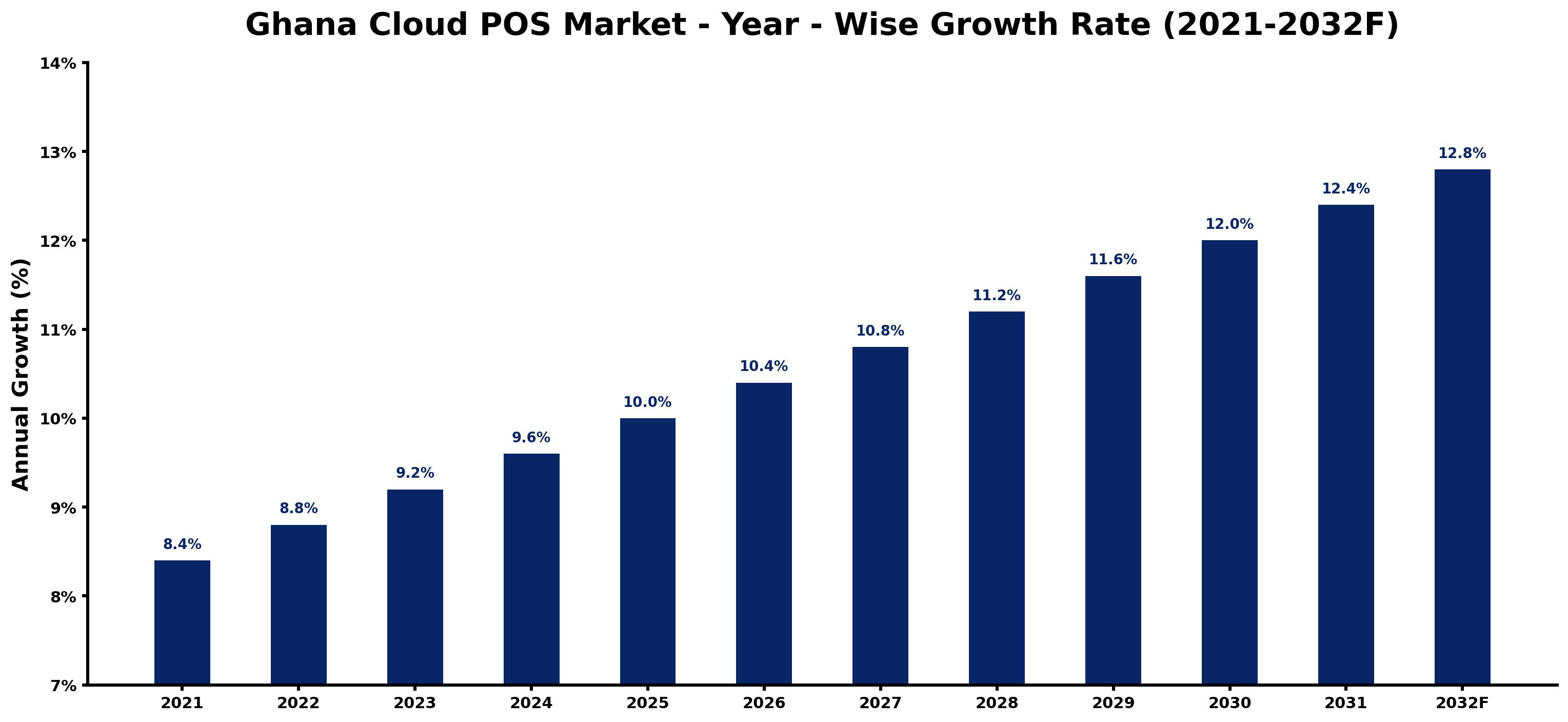
The table below presents the year‑wise growth rates along with the key drivers influencing the market
| Year | Growth Rate | Major Drivers |
| 2021 | 8.4% | Adoption of Ghana's digital payments framework for businesses. |
| 2022 | 8.8% | Increase in SME digitization initiatives by the government. |
| 2023 | 9.2% | Enhanced local data center capabilities boosting cloud reliability. |
| 2024 | 9.6% | Regulatory support for e-commerce fueling POS technology growth. |
| 2025 | 10.0% | Rise in cashless transactions among consumers and retailers. |
| 2026 | 10.4% | Emergence of fintech startups driving cloud POS solutions. |
| 2027 | 10.8% | Government initiatives promoting digital agriculture solutions adoption. |
| 2028 | 11.2% | Growing urbanization leading to increased retail technology usage. |
| 2029 | 11.6% | Integration of local currencies in cloud payment systems. |
| 2030 | 12.0% | National policy encouraging tech innovation in retail sectors. |
| 2031 | 12.4% | Partnerships with banks to improve digital payment systems. |
| 2032 | 12.8% | Increased consumer trust in online shopping and payments. |
Note: Market size estimations and growth projections presented in this report are based on 6Wresearch's proprietary forecasting methodology, utilizing the latest available industry data, government publications, and primary research inputs.
Ghana Cloud POS Market Key Takeaways
Below are some of the specific key takeaways from the market, including:
- The market is witnessing a notable increase in demand due to the growth of e-commerce and contactless payment methods.
- Real-time data processing capabilities are becoming essential for businesses to remain competitive.
- Small businesses face challenges related to internet infrastructure, impacting their adoption of cloud-based solutions.
- Government initiatives are increasingly focusing on enhancing digital payment infrastructure to foster market growth.
- Consumer preferences are shifting towards seamless and efficient transaction experiences, driving POS innovation.
Evaluation of Restraints in Ghana Cloud POS Market
Several limitations hinder the rapid growth of the Ghana Cloud POS Market. Key among these is the challenge of inadequate internet connectivity, particularly in rural regions. This connectivity issue prevents many small businesses from adopting cloud-based solutions. Additionally, concerns about data security and the reliability of cloud services create hesitation among potential users. These factors collectively contribute to slower market penetration, particularly among smaller retail establishments that lack the resources to mitigate such risks.
Ghana Cloud POS Market Trends
The trend toward omnichannel retailing is firmly entrenched in the Ghana Cloud POS Market. Businesses are increasingly looking for systems that integrate online and offline sales channels to provide a unified customer experience. on top of that, the demand for contactless payments is pushing retailers to adopt more advanced POS solutions that cater to this preference.
In addition, advancements in mobile technology are enhancing the capabilities of cloud POS systems. These systems are evolving to offer more than just transaction processing; they now provide comprehensive inventory management, customer relationship management, and analytics tools, making them indispensable for modern retail operations.
Ghana Cloud POS Market Opportunities
The Ghana Cloud POS Market is ripe with opportunities for growth and investment. As more retailers embrace digital transformation, there’s a burgeoning demand for customized cloud solutions tailored to local business needs. on top of that, partnerships with fintech companies can lead to innovative payment solutions that enhance customer experience.
Another area of opportunity lies in training programs for small businesses on the benefits of adopting cloud POS systems. Empowering these enterprises with knowledge can facilitate broader market acceptance and drive overall growth in the sector.
Government Initiatives in the Ghana Cloud POS Market
Government policy is shaping the Ghana Cloud POS Market through various initiatives aimed at enhancing digital payment infrastructure and promoting retail innovation. By establishing regulatory frameworks that prioritize data security and transaction transparency, the government is creating a safer environment for both consumers and businesses. These policies are crucial for building trust and encouraging the adoption of cloud-based systems.
- A national digital infrastructure upgrade program now in its rollout phase aims to improve internet connectivity across the country, facilitating better access for cloud POS systems.
- A regulatory framework introduced in 2025 mandates data protection standards for cloud service providers, enhancing consumer confidence in cloud transactions.
- A public-private initiative focused on expanding payment processing capabilities is currently underway, promoting collaboration between government and industry players.
- Future plans include capacity-building programs for small retailers on cloud technology, expected to launch in late 2026, aimed at fostering digital innovation.
Future Insights of the Ghana Cloud POS Market
Looking ahead to 2026-2032, the Ghana Cloud POS Market is set for substantial growth. With increased government support and the rising trend of digital payment solutions, businesses will likely continue to adopt cloud-based systems. The emphasis on enhanced customer experiences will further drive innovation, compelling providers to deliver more sophisticated and user-friendly solutions. Additionally, as the digital economy matures, more players will enter the market, intensifying competition and further accelerating technological advancements.
Ghana Cloud POS Market Latest Developments
Over the past 12-14 months, the Ghana Cloud POS Market has witnessed dynamic developments, reflecting a keen interest in digital solutions. Businesses are increasingly investing in advanced POS systems that integrate with various payment platforms, signaling a shift towards more adaptable retail environments.
- A major technology vendor launched a new cloud POS solution in Q1 2025, designed specifically for small to medium-sized enterprises, enhancing their operational efficiency.
- An ongoing initiative that began in mid-2025 focuses on upgrading existing POS infrastructure in urban areas, aiming to improve transaction speeds and reliability.
- A planned expansion of cloud POS services targeting rural retailers is expected to kick off in early 2026, addressing the connectivity challenges faced by these businesses.
- A partnership formed in late 2025 between local banks and fintech companies is working to create more accessible payment solutions, currently in the development phase.
Ghana Cloud POS Market - Key Attractiveness of the Report
- 10 Years of Market Numbers
- Historical Data Starting from 2022 to 2025
- Base Year: 2025
- Forecast Data until 2032
- Key Performance Indicators Impacting the Market
- Major Upcoming Developments and Projects
Key Highlights of the Report:
- Ghana Cloud POS Market Outlook
- Market Size of Ghana Cloud POS Market, 2025
- Forecast of Ghana Cloud POS Market, 2032
- Historical Data and Forecast of Ghana Cloud POS Revenues & Volume for the Period 2022-2032F
- Ghana Cloud POS Market Trend Evolution
- Ghana Cloud POS Market Drivers and Challenges
- Ghana Cloud POS Price Trends
- Ghana Cloud POS Porter's Five Forces
- Ghana Cloud POS Industry Life Cycle
- Historical Data and Forecast of Ghana Cloud POS Market Revenues & Volume By Application Areas for the Period 2022-2032F
- Historical Data and Forecast of Ghana Cloud POS Market Revenues & Volume By Retail and Consumer Goods for the Period 2022-2032F
- Historical Data and Forecast of Ghana Cloud POS Market Revenues & Volume By Travel and Hospitality for the Period 2022-2032F
- Historical Data and Forecast of Ghana Cloud POS Market Revenues & Volume By Media and Entertainment for the Period 2022-2032F
- Historical Data and Forecast of Ghana Cloud POS Market Revenues & Volume By Transport and Logistics for the Period 2022-2032F
- Historical Data and Forecast of Ghana Cloud POS Market Revenues & Volume By Healthcare for the Period 2022-2032F
- Historical Data and Forecast of Ghana Cloud POS Market Revenues & Volume By Component for the Period 2022-2032F
- Historical Data and Forecast of Ghana Cloud POS Market Revenues & Volume By Solution for the Period 2022-2032F
- Historical Data and Forecast of Ghana Cloud POS Market Revenues & Volume By Services for the Period 2022-2032F
- Historical Data and Forecast of Ghana Cloud POS Market Revenues & Volume By Service for the Period 2022-2032F
- Historical Data and Forecast of Ghana Cloud POS Market Revenues & Volume By Training, Consulting, and Integration for the Period 2022-2032F
- Historical Data and Forecast of Ghana Cloud POS Market Revenues & Volume By Support and Maintenance for the Period 2022-2032F
- Historical Data and Forecast of Ghana Cloud POS Market Revenues & Volume By Organization Size for the Period 2022-2032F
- Historical Data and Forecast of Ghana Cloud POS Market Revenues & Volume By SMEs for the Period 2022-2032F
- Historical Data and Forecast of Ghana Cloud POS Market Revenues & Volume By Large Enterprises for the Period 2022-2032F
- Ghana Cloud POS Import Export Trade Statistics
- Market Opportunity Assessment By Application Areas
- Market Opportunity Assessment By Component
- Market Opportunity Assessment By Service
- Market Opportunity Assessment By Organization Size
- Ghana Cloud POS Top Companies Market Share
- Ghana Cloud POS Competitive Benchmarking By Technical and Operational Parameters
- Ghana Cloud POS Company Profiles
- Ghana Cloud POS Key Strategic Recommendations






































