Ghana Glass Lens Market Size, Share & Growth Rate
The Ghana Glass Lens Market was estimated at USD 245 Million in 2025 and is projected to reach USD 328 Million by 2032, growing at a CAGR of 4.3% from 2026 to 2032. This growth is primarily driven by the increasing consumer preference for durable and high-quality eyewear, alongside a burgeoning awareness of eye health. With rising disposable incomes and a growing population, the demand for both prescription and fashionable eyewear is expected to significantly contribute to the market's expansion.
Ghana Glass Lens Market Year-wise Growth Rate and Key Drivers
This graph highlights how the Ghana Glass Lens Market has steadily grown over the years, supported by major growth factors.
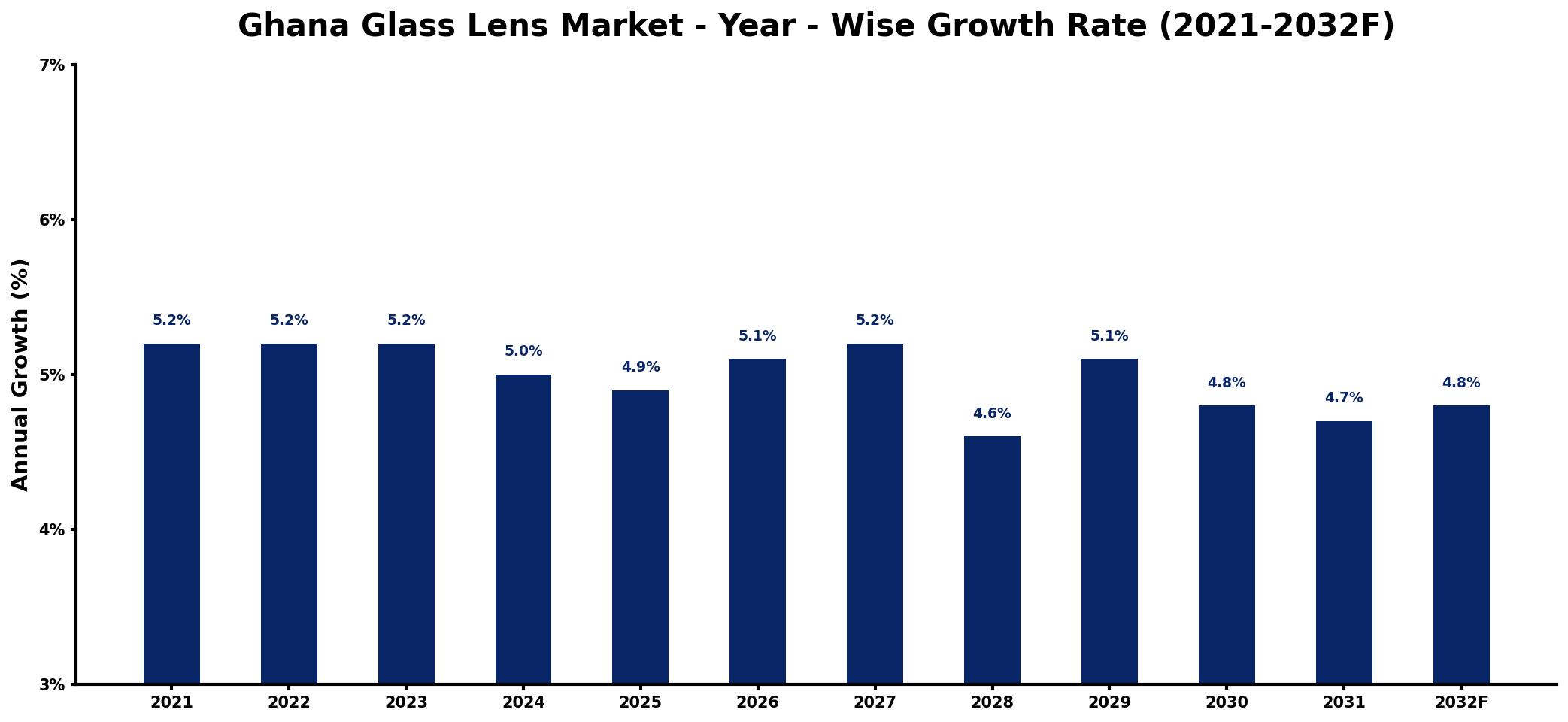
The table below presents the year‑wise growth rates along with the key drivers influencing the market
| Year | Growth Rate | Major Drivers |
| 2021 | 5.2% | Rising consumer health awareness |
| 2022 | 5.2% | Increased urbanization trends observed |
| 2023 | 5.2% | Growing fashion eyewear market demand |
| 2024 | 5.0% | Expansion of retail distribution networks |
| 2025 | 4.9% | Investment in optical technology advancements |
| 2026 | 5.1% | Surge in e-commerce adoption rates |
| 2027 | 5.2% | Increased government health initiatives |
| 2028 | 4.6% | Emerging trends in sustainable materials |
| 2029 | 5.1% | Boost in eyewear advertising campaigns |
| 2030 | 4.8% | Growth in aging population demographics |
| 2031 | 4.7% | Rise in optical research funding |
| 2032 | 4.8% | strengthening underlying market demand |
Note: Market size estimations and growth projections presented in this report are based on 6Wresearch's proprietary forecasting methodology, utilizing the latest available industry data, government publications, and primary research inputs.
Ghana Glass Lens Market Synopsis
The Ghana Glass Lens Market is currently witnessing a robust surge, characterized by a notable shift towards glass lenses over plastic alternatives. This change is largely attributed to the superior optical clarity and durability that glass lenses offer, aligning with consumer preferences for quality and longevity in eyewear.
As consumers become more health-conscious and style-savvy, there is a marked increase in the demand for specialized lenses, including those with blue light blocking and anti-glare features. This trend indicates a shifting landscape, where innovative product offerings are becoming crucial for capturing market share.
Ghana Glass Lens Market Key Takeaways
- The market is experiencing growth driven by the rising demand for eyeglasses and camera lenses.
- Consumers are increasingly choosing glass lenses for their durability and optical clarity.
- There is a notable trend toward specialized lenses, enhancing protection against digital eye strain.
- Investment in technology and training will be essential to overcoming current production challenges.
- Government initiatives are promoting growth and innovation in the sector, supporting local manufacturers.
Evaluation of Restraints in Ghana Glass Lens Market
Despite the promising growth trajectory, the Ghana Glass Lens Market faces significant hurdles. High production costs, stemming from the need to import raw materials, present a persistent challenge for local manufacturers. Additionally, competition from cheaper plastic lens options undermines market potential, making it difficult for glass lens producers to justify higher price points. Furthermore, a shortage of skilled labor affects manufacturing quality and efficiency, complicating efforts to meet increasing consumer demands. Lastly, inconsistent government policies can create an unpredictable business environment, impacting investment and operational stability.
Ghana Glass Lens Market Trends
The market is witnessing an influx of innovative technologies aimed at enhancing lens performance. Increasing consumer demand for features such as anti-glare coatings, UV protection, and scratch resistance is reshaping product offerings. Moreover, the preference for lightweight and aesthetically pleasing designs is leading manufacturers to focus on creating thinner glass lenses that combine function with fashion. Specialty lenses designed to mitigate digital eye strain are also gaining traction, responding to the growing concern over prolonged screen exposure. These trends reflect a dynamic market that is adapting to the evolving needs and preferences of consumers.
Ghana Glass Lens Market Opportunities
Investment opportunities abound in the Ghana Glass Lens Market as demand for quality eyewear continues to grow. With a youthful and expanding population, the need for various lens types, from prescription to fashionable sunglasses, presents a lucrative landscape for investors. Collaborating with local manufacturers to supply high-quality glass lenses can be a strategic move. Additionally, leveraging technological advancements in manufacturing processes can drive innovation, offering customized eyewear solutions to cater to diverse consumer preferences. This market is ripe for companies looking to establish a strong foothold in the optical industry.
Government Initiatives in the Ghana Glass Lens Market
The Ghanaian government is actively fostering growth in the glass lens sector through various initiatives. These include import restrictions that protect local manufacturers and tax incentives aimed at stimulating investment in the industry. Furthermore, the government has prioritized quality control regulations to ensure that products meet safety and industry standards. Initiatives to support research and development are also in place, creating an environment conducive to innovation and competitiveness within the market.
Future Insights of the Ghana Glass Lens Market
Looking ahead to 2026-2032, the Ghana Glass Lens Market is projected to continue its upward trajectory. Key drivers such as rising disposable incomes, increased awareness about eye health, and a growing population will play pivotal roles in this growth. The ongoing expansion of the optical industry, combined with technological advancements in lens production, is set to enhance market opportunities. As consumers increasingly gravitate towards high-quality and fashionable eyewear options, companies that focus on innovation and quality will likely thrive in this evolving landscape.
Ghana Glass Lens Market Latest Developments (2025 - 2026)
Recent months have seen various initiatives aimed at bolstering the Ghana Glass Lens Market. Companies are ramping up their marketing strategies to capitalize on the increasing awareness surrounding eye health and eyewear quality. There has also been a noticeable increase in collaboration between local manufacturers and technology providers, which is enhancing product offerings in terms of innovation and customization. Furthermore, the government continues to advocate for policies that stimulate local production and enhance quality standards across the board.
Ghana Glass Lens Market - Key Attractiveness of the Report
- 10 Years of Market Numbers
- Historical Data Starting from 2022 to 2025
- Base Year: 2025
- Forecast Data until 2032
- Key Performance Indicators Impacting the Market
- Major Upcoming Developments and Projects
Key Highlights of the Report:
- Ghana Glass Lens Market Outlook
- Market Size of Ghana Glass Lens Market, 2025
- Forecast of Ghana Glass Lens Market, 2032
- Historical Data and Forecast of Ghana Glass Lens Revenues & Volume for the Period 2022-2032F
- Ghana Glass Lens Market Trend Evolution
- Ghana Glass Lens Market Drivers and Challenges
- Ghana Glass Lens Price Trends
- Ghana Glass Lens Porter's Five Forces
- Ghana Glass Lens Industry Life Cycle
- Historical Data and Forecast of Ghana Glass Lens Market Revenues & Volume By Product Type for the Period 2022-2032F
- Historical Data and Forecast of Ghana Glass Lens Market Revenues & Volume By Single Vision Lenses for the Period 2022-2032F
- Historical Data and Forecast of Ghana Glass Lens Market Revenues & Volume By Progressive Lenses for the Period 2022-2032F
- Historical Data and Forecast of Ghana Glass Lens Market Revenues & Volume By Bifocal and Trifocal Lenses for the Period 2022-2032F
- Historical Data and Forecast of Ghana Glass Lens Market Revenues & Volume By Photochromic Lenses for the Period 2022-2032F
- Historical Data and Forecast of Ghana Glass Lens Market Revenues & Volume By Polarized Lenses for the Period 2022-2032F
- Historical Data and Forecast of Ghana Glass Lens Market Revenues & Volume By Others for the Period 2022-2032F
- Historical Data and Forecast of Ghana Glass Lens Market Revenues & Volume By Coating for the Period 2022-2032F
- Historical Data and Forecast of Ghana Glass Lens Market Revenues & Volume By Anti-Reflective for the Period 2022-2032F
- Historical Data and Forecast of Ghana Glass Lens Market Revenues & Volume By Blue Light Reduction for the Period 2022-2032F
- Historical Data and Forecast of Ghana Glass Lens Market Revenues & Volume By Scratch-Resistant for the Period 2022-2032F
- Historical Data and Forecast of Ghana Glass Lens Market Revenues & Volume By UV Protection for the Period 2022-2032F
- Historical Data and Forecast of Ghana Glass Lens Market Revenues & Volume By Distribution Channel for the Period 2022-2032F
- Historical Data and Forecast of Ghana Glass Lens Market Revenues & Volume By Offline for the Period 2022-2032F
- Historical Data and Forecast of Ghana Glass Lens Market Revenues & Volume By Online for the Period 2022-2032F
- Ghana Glass Lens Import Export Trade Statistics
- Market Opportunity Assessment By Product Type
- Market Opportunity Assessment By Coating
- Market Opportunity Assessment By Distribution Channel
- Ghana Glass Lens Top Companies Market Share
- Ghana Glass Lens Competitive Benchmarking By Technical and Operational Parameters
- Ghana Glass Lens Company Profiles
- Ghana Glass Lens Key Strategic Recommendations






































