Ghana Oats Market Size, Share & Growth Rate
The Ghana Oats Market was estimated at USD 494 Million in 2025 and is projected to reach USD 662 Million by 2032, growing at a CAGR of 4.3% from 2026 to 2032. This growth is primarily driven by the increasing health consciousness of consumers who are gravitating towards nutritious breakfast alternatives. The surge in innovative oat-based products, alongside the expansion of the retail sector, enhances accessibility and stimulates demand within the urban populace.
Ghana Oats Market Year-wise Growth Rate and Key Drivers
This graph highlights how the Ghana Oats Market has steadily grown over the years, supported by major growth factors.
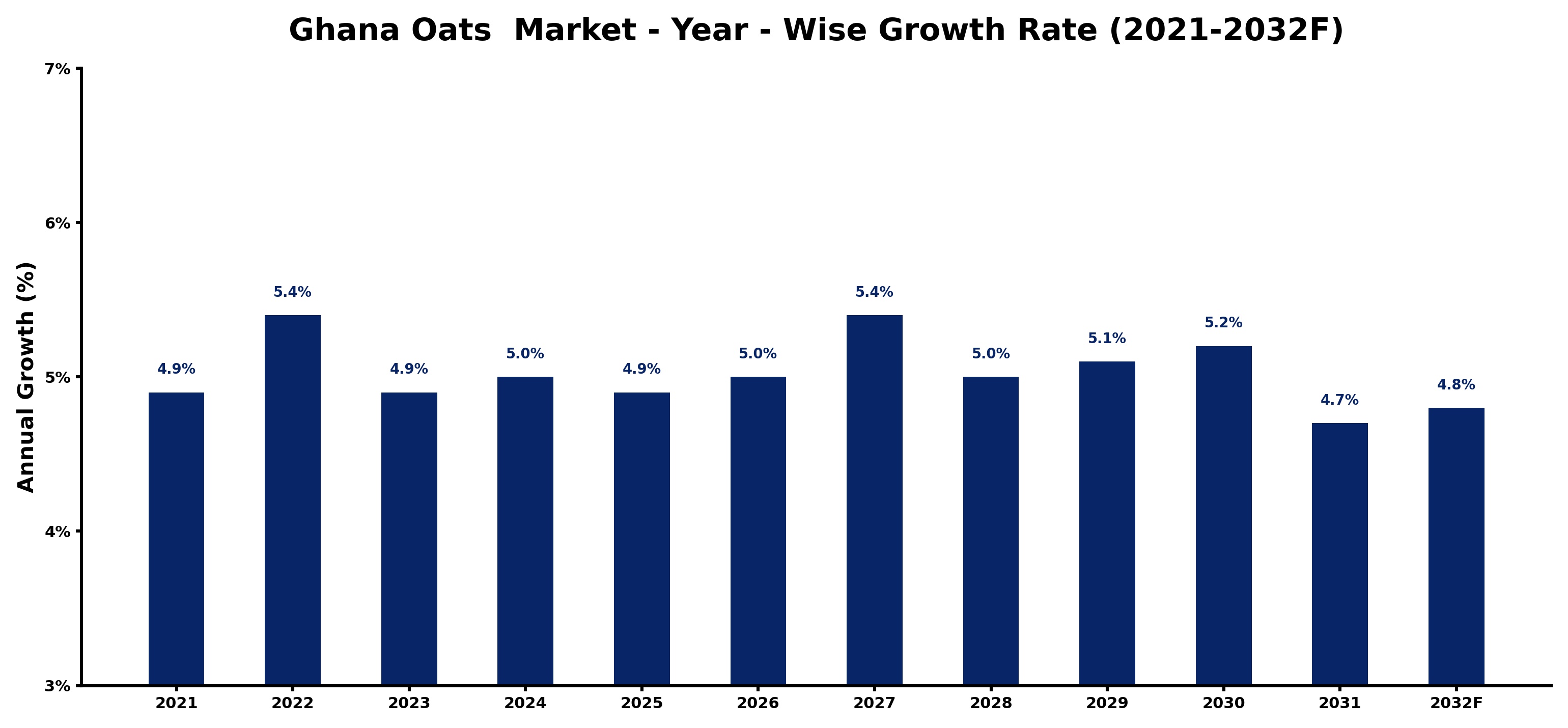
The table below presents the year‑wise growth rates along with the key drivers influencing the market
| Year | Growth Rate | Major Drivers |
| 2021 | 4.9% | Health consciousness drove demand |
| 2022 | 5.4% | Increased urbanization expanded market |
| 2023 | 4.9% | E-commerce growth enhanced accessibility |
| 2024 | 5.0% | New product launches attracted consumers |
| 2025 | 4.9% | Rising disposable incomes fueled purchases |
| 2026 | 5.0% | Nutritional awareness increased consumption |
| 2027 | 5.4% | Culinary trends embraced oats usage |
| 2028 | 5.0% | Sustainability initiatives gained traction |
| 2029 | 5.1% | Breakfast culture promoted oat products |
| 2030 | 5.2% | Fitness trends encouraged healthy eating |
| 2031 | 4.7% | Local sourcing improved supply chain |
| 2032 | 4.8% | Consumer education enhanced product knowledge |
Note - Market size estimations and growth projections presented in this report are based on 6Wresearch's advanced forecasting approach, validated with industry datasets as of June 2026.
Ghana Oats Market Synopsis
The demand for oats in Ghana is significantly influenced by the rising interest in healthy eating habits, particularly among younger consumers. Oats are recognized for their high fiber content and associated health benefits, which resonate well with a population increasingly aware of dietary choices. This growing consumer awareness is pushing manufacturers to adapt and expand their offerings.
Furthermore, the market is experiencing an influx of product innovations such as flavored instant oats and convenient oatmeal bars. These developments cater to a diverse range of preferences, making oats not only a health-conscious choice but also a convenient one, which is vital in today's fast-paced lifestyle.
Ghana Oats Market Key Takeaways
- Rising health consciousness is reshaping consumer preferences, driving demand for nutritious oat products.
- The introduction of innovative oat-based items is enhancing market appeal and consumer engagement.
- Urbanization and an expanding retail landscape are facilitating greater accessibility to oats.
- Investment opportunities exist for local and international players aiming to tap into the health food segment.
- Government initiatives are focusing on enhancing domestic oat production to reduce reliance on imports.
Evaluation of Restraints in Ghana Oats Market
Despite the promising growth trajectory, the Ghana oats market faces several significant constraints. One major hurdle is the high cost associated with imported oats, which limits the affordability of these products for many consumers. Additionally, there exists a general lack of awareness regarding the health benefits of oats, which continues to hinder wider market penetration. Infrastructure challenges, such as insufficient transportation and storage facilities, further complicate distribution efforts. These factors must be addressed to unlock the full potential of the market and facilitate increased consumer access to oat products.
Ghana Oats Market Trends
Current trends indicate a shift towards more health-focused, ready-to-eat breakfast options. Consumers are increasingly demanding products that offer both nutritional value and convenience, driving innovation in the oats market. This trend is complemented by an increasing inclination towards plant-based diets, contributing to the popularity of oat milk and other oat-derived products. Moreover, local manufacturers are recognizing the importance of branding and marketing strategies to better connect with health-conscious consumers.
Ghana Oats Market Opportunities
There are numerous investment opportunities in the Ghana oats market, particularly in the areas of production, distribution, and product development. Investors can consider establishing local oat farming initiatives to ensure a sustainable supply chain while lowering costs associated with imports. Additionally, creating innovative, health-focused oat products could attract a broader consumer base, responding to the increasing trend towards healthier eating habits. Collaborations with local farmers to enhance cultivation techniques can further bolster market growth.
Government Initiatives in the Ghana Oats Market
The Ghanaian government has implemented several initiatives aimed at promoting domestic oat production and ensuring food safety standards. Programs such as the Planting for Food and Jobs initiative are designed to increase oat cultivation among local farmers, thereby reducing the nation's reliance on imported oats. Furthermore, government support includes subsidies, training programs, and access to agricultural inputs, which collectively aim to enhance the productivity and competitiveness of local farmers in the oats market.
Future Insights of the Ghana Oats Market
Looking ahead to 2026-2032, the Ghana oats market is anticipated to continue its upward trend. This expectation is rooted in the increasing demand for health-oriented products and the continued push for local production. The focus on product innovation will likely play a pivotal role in capturing the interest of consumers, while ongoing government support for agriculture will help stabilize supply chains. However, attention must be paid to external factors such as competition from alternative breakfast cereals and price fluctuations in raw materials.
Ghana Oats Market Latest Developments (May 2025 - June 2026)
Recent developments within the Ghana oats market indicate a marked increase in product diversification, with manufacturers launching new, innovative offerings tailored to local tastes. Additionally, there has been a growing collaboration between industry stakeholders and government bodies to enhance awareness about the health benefits of oats. Efforts are being made to address supply chain challenges, indicating a proactive approach to ensuring product availability across regions.
Ghana Oats Market - Key Attractiveness of the Report
- 10 Years of Market Numbers
- Historical Data Starting from 2022 to 2025
- Base Year: 2025
- Forecast Data until 2032
- Key Performance Indicators Impacting the Market
- Major Upcoming Developments and Projects
Key Highlights of the Report:
- Ghana Oats Market Outlook
- Market Size of Ghana Oats Market, 2025
- Forecast of Ghana Oats Market, 2032
- Historical Data and Forecast of Ghana Oats Revenues & Volume for the Period 2022-2032F
- Ghana Oats Market Trend Evolution
- Ghana Oats Market Drivers and Challenges
- Ghana Oats Price Trends
- Ghana Oats Porter's Five Forces
- Ghana Oats Industry Life Cycle
- Historical Data and Forecast of Ghana Oats Market Revenues & Volume By Form for the Period 2022-2032F
- Historical Data and Forecast of Ghana Oats Market Revenues & Volume By Flavoured Oats for the Period 2022-2032F
- Historical Data and Forecast of Ghana Oats Market Revenues & Volume By Base Oats for the Period 2022-2032F
- Historical Data and Forecast of Ghana Oats Market Revenues & Volume By Distribution Channel for the Period 2022-2032F
- Historical Data and Forecast of Ghana Oats Market Revenues & Volume By Supermarket/Hypermarket for the Period 2022-2032F
- Historical Data and Forecast of Ghana Oats Market Revenues & Volume By Convenience Stores for the Period 2022-2032F
- Historical Data and Forecast of Ghana Oats Market Revenues & Volume By Online Channels for the Period 2022-2032F
- Historical Data and Forecast of Ghana Oats Market Revenues & Volume By Others for the Period 2022-2032F
- Ghana Oats Import Export Trade Statistics
- Market Opportunity Assessment By Form
- Market Opportunity Assessment By Distribution Channel
- Ghana Oats Top Companies Market Share
- Ghana Oats Competitive Benchmarking By Technical and Operational Parameters
- Ghana Oats Company Profiles
- Ghana Oats Key Strategic Recommendations






































