Ghana Printed Electronics Market Size, Share & Growth Rate
The Ghana Printed Electronics Market was estimated at USD 329 Million in 2025 and is projected to reach USD 436 Million by 2032, growing at a CAGR of 4.1% from 2026 to 2032. This upward trajectory is primarily driven by the increasing demand for IoT devices and the rapid adoption of innovative printing technologies. Additionally, the focus on real-time monitoring and data analytics across various sectors is further propelling market growth, as printed electronics offer viable, lightweight solutions tailored for specific applications.
Ghana Printed Electronics Market Year-wise Growth Rate and Key Drivers
This graph highlights how the Ghana Printed Electronics Market has steadily grown over the years, supported by major growth factors.
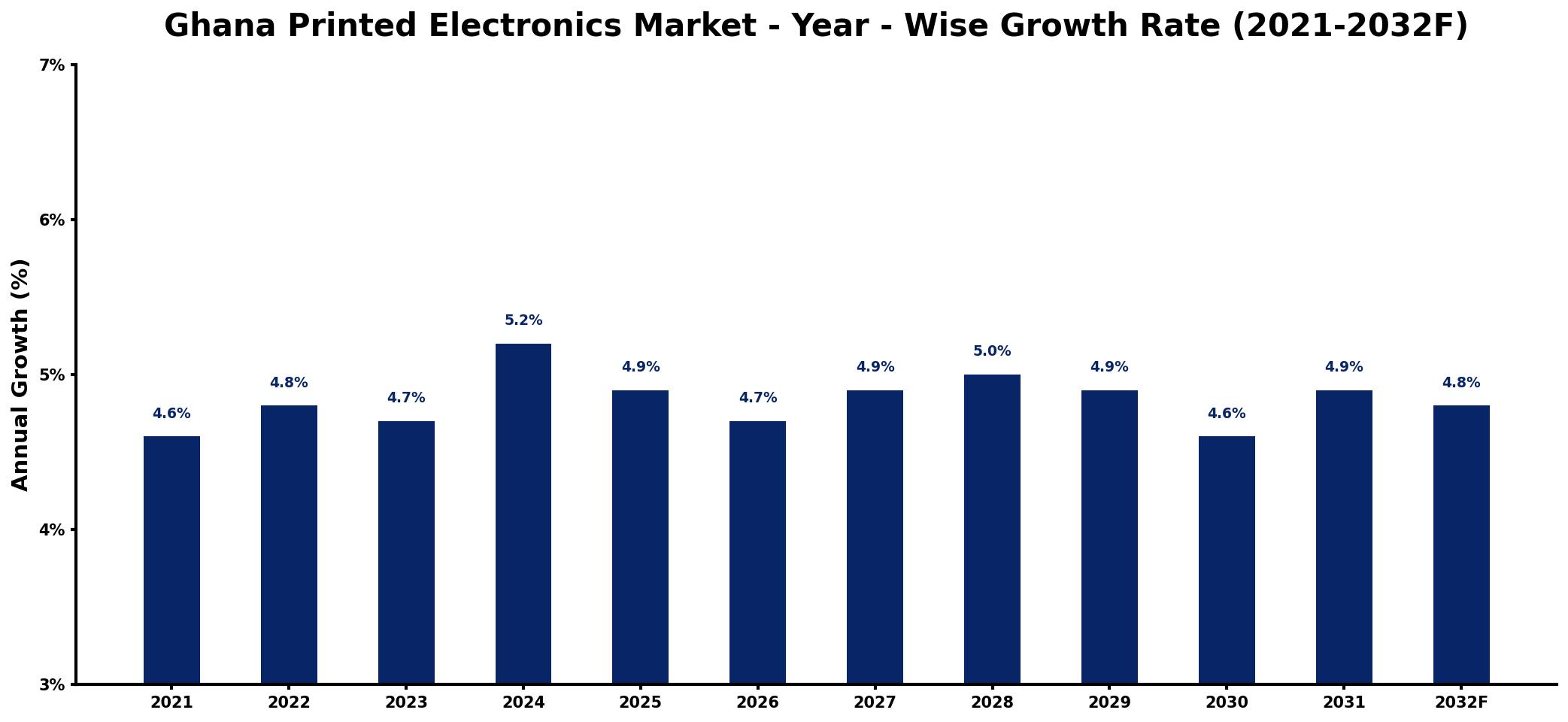
The table below presents the year‑wise growth rates along with the key drivers influencing the market
| Year | Growth Rate | Major Drivers |
| 2021 | 4.6% | Rising consumer demand for innovation |
| 2022 | 4.8% | Increased investments in manufacturing capacity |
| 2023 | 4.7% | Growing applications in packaging sector |
| 2024 | 5.2% | Expansion of renewable energy initiatives |
| 2025 | 4.9% | Development of smart wearable devices |
| 2026 | 4.7% | Surge in healthcare technology adoption |
| 2027 | 4.9% | Emergence of sustainable production practices |
| 2028 | 5.0% | Growing interest in IoT solutions |
| 2029 | 4.9% | Increased collaboration with research institutions |
| 2030 | 4.6% | Demand for customization in products |
| 2031 | 4.9% | Growth in automotive industry applications |
| 2032 | 4.8% | enhanced product quality standards |
Note: Market size estimations and growth projections presented in this report are based on 6Wresearch's proprietary forecasting methodology, utilizing the latest available industry data, government publications, and primary research inputs.
Ghana Printed Electronics Market Synopsis
The printed electronics landscape in Ghana is evolving, marked by an impressive surge in demand for flexible and stretchable electronic components. Applications such as RFID tags, sensors, displays, and smart packaging are becoming increasingly prevalent, reflecting the industry's shift towards more adaptable technology.
As businesses and consumers alike become more attuned to the advantages of printed electronics—especially in sectors like healthcare and automotive—the market is poised for continued growth. The ongoing innovation in materials and processes is enabling Ghanaian manufacturers to develop products that meet both local and international standards.
Ghana Printed Electronics Market Key Takeaways
- The market is expected to grow from USD 329 Million in 2025 to USD 436 Million by 2032.
- Key drivers include the rise of IoT applications and the demand for data-driven insights.
- Innovative printing techniques are reshaping manufacturing capabilities and product offerings.
- Collaboration among stakeholders is essential to overcome material and production challenges.
- Government initiatives are fostering a conducive environment for market growth and R&D.
Evaluation of Restraints in Ghana Printed Electronics Market
Despite the promising outlook for the Ghana Printed Electronics Market, several key constraints are holding back its potential. Material innovation is critical; accessing high-performance and eco-friendly printing materials remains a challenge. The intricacies of ink formulation, deposition, and curing processes further complicate the manufacturing landscape. Additionally, limited access to advanced printing technology and facilities poses hurdles for local companies striving to scale operations while ensuring product consistency. Addressing these limitations through partnerships and investments is vital to unlock the full capabilities of this burgeoning market.
Ghana Printed Electronics Market Trends
A significant trend within the Ghana Printed Electronics Market is the increasing use of printed sensors across various applications. These sensors provide cost-effective, lightweight alternatives that are gaining traction in healthcare, automotive, and environmental monitoring. Furthermore, there is a growing emphasis on sustainability, prompting manufacturers to innovate with eco-friendly inks and materials. Additionally, the proliferation of smart devices is further driving the demand for advanced printed electronics, as consumers and industries seek more efficient solutions.
Ghana Printed Electronics Market Opportunities
The future of the Ghana Printed Electronics Market is rich with opportunities, particularly in sectors such as healthcare and smart packaging. As the demand for customized, cost-effective solutions rises, businesses can leverage innovations in printing technology to cater to niche markets. The potential for developing partnerships with research institutions and material suppliers offers pathways for advancing production capabilities and scaling operations efficiently. Additionally, the ongoing investment in infrastructure can facilitate the growth of startups and SMEs seeking to explore printed electronics applications.
Government Initiatives in the Ghana Printed Electronics Market
The Ghanaian government has recognized the transformative potential of printed electronics and is taking proactive measures to foster growth in this sector. Policies aimed at promoting investment in printing infrastructure and developing capabilities in printing technologies are being implemented. Furthermore, there is a strong emphasis on research and development, ensuring intellectual property rights are protected and facilitating access to resources for startups and small businesses. These initiatives are critical in building a robust ecosystem for printed electronics in Ghana.
Future Insights of the Ghana Printed Electronics Market
Looking ahead to the 2026-2032 period, the Ghana Printed Electronics Market is poised for significant evolution. The continuous push towards digitalization and the integration of smart technologies will likely see an uptick in demand for innovative electronic components. As manufacturers overcome current production challenges and capitalize on government support, the market will likely attract foreign investment and partnership opportunities. By adapting to emerging trends and focusing on sustainability, stakeholders can position themselves to thrive in an increasingly competitive landscape.
Ghana Printed Electronics Market Latest Developments (2025 - 2026)
Recent developments within the Ghana Printed Electronics Market have highlighted a notable shift towards collaborative efforts aimed at enhancing production processes and materials development. Stakeholders are increasingly engaging with research institutions to innovate new printing techniques and improve existing technologies. Additionally, there have been initiatives focused on upskilling the workforce to meet the demands of evolving technology in printed electronics, further contributing to the market's growth potential.
Ghana Printed Electronics Market - Key Attractiveness of the Report
- 10 Years of Market Numbers
- Historical Data Starting from 2022 to 2025
- Base Year: 2025
- Forecast Data until 2032
- Key Performance Indicators Impacting the Market
- Major Upcoming Developments and Projects
Key Highlights of the Report:
- Ghana Printed Electronics Market Outlook
- Market Size of Ghana Printed Electronics Market, 2025
- Forecast of Ghana Printed Electronics Market, 2032
- Historical Data and Forecast of Ghana Printed Electronics Revenues & Volume for the Period 2022-2032F
- Ghana Printed Electronics Market Trend Evolution
- Ghana Printed Electronics Market Drivers and Challenges
- Ghana Printed Electronics Price Trends
- Ghana Printed Electronics Porter's Five Forces
- Ghana Printed Electronics Industry Life Cycle
- Historical Data and Forecast of Ghana Printed Electronics Market Revenues & Volume By Material for the Period 2022-2032F
- Historical Data and Forecast of Ghana Printed Electronics Market Revenues & Volume By Ink for the Period 2022-2032F
- Historical Data and Forecast of Ghana Printed Electronics Market Revenues & Volume By Substrate for the Period 2022-2032F
- Historical Data and Forecast of Ghana Printed Electronics Market Revenues & Volume By Technology for the Period 2022-2032F
- Historical Data and Forecast of Ghana Printed Electronics Market Revenues & Volume By Screen for the Period 2022-2032F
- Historical Data and Forecast of Ghana Printed Electronics Market Revenues & Volume By Inkjet for the Period 2022-2032F
- Historical Data and Forecast of Ghana Printed Electronics Market Revenues & Volume By Flexographic for the Period 2022-2032F
- Historical Data and Forecast of Ghana Printed Electronics Market Revenues & Volume By Gravure for the Period 2022-2032F
- Historical Data and Forecast of Ghana Printed Electronics Market Revenues & Volume By Device for the Period 2022-2032F
- Historical Data and Forecast of Ghana Printed Electronics Market Revenues & Volume By Displays for the Period 2022-2032F
- Historical Data and Forecast of Ghana Printed Electronics Market Revenues & Volume By Photovoltaic for the Period 2022-2032F
- Historical Data and Forecast of Ghana Printed Electronics Market Revenues & Volume By Lighting for the Period 2022-2032F
- Historical Data and Forecast of Ghana Printed Electronics Market Revenues & Volume By RFID for the Period 2022-2032F
- Historical Data and Forecast of Ghana Printed Electronics Market Revenues & Volume By Others for the Period 2022-2032F
- Ghana Printed Electronics Import Export Trade Statistics
- Market Opportunity Assessment By Material
- Market Opportunity Assessment By Technology
- Market Opportunity Assessment By Device
- Ghana Printed Electronics Top Companies Market Share
- Ghana Printed Electronics Competitive Benchmarking By Technical and Operational Parameters
- Ghana Printed Electronics Company Profiles
- Ghana Printed Electronics Key Strategic Recommendations






































