Ghana Wheat Starch Market Size, Share & Growth Rate
The Ghana Wheat Starch Market was estimated at USD 203 Million in 2025 and is projected to reach USD 278 Million by 2032, growing at a CAGR of 4.6% from 2026 to 2032. This growth is primarily driven by the increasing demand for convenience food products, with wheat starch gaining prominence as a key ingredient in various processed foods. The expanding food processing industry in Ghana further propels this demand, as manufacturers seek functional ingredients to enhance the quality and appeal of their offerings.
Ghana Wheat Starch Market Year-wise Growth Rate and Key Drivers
This graph highlights how the Ghana Wheat Starch Market has steadily grown over the years, supported by major growth factors.
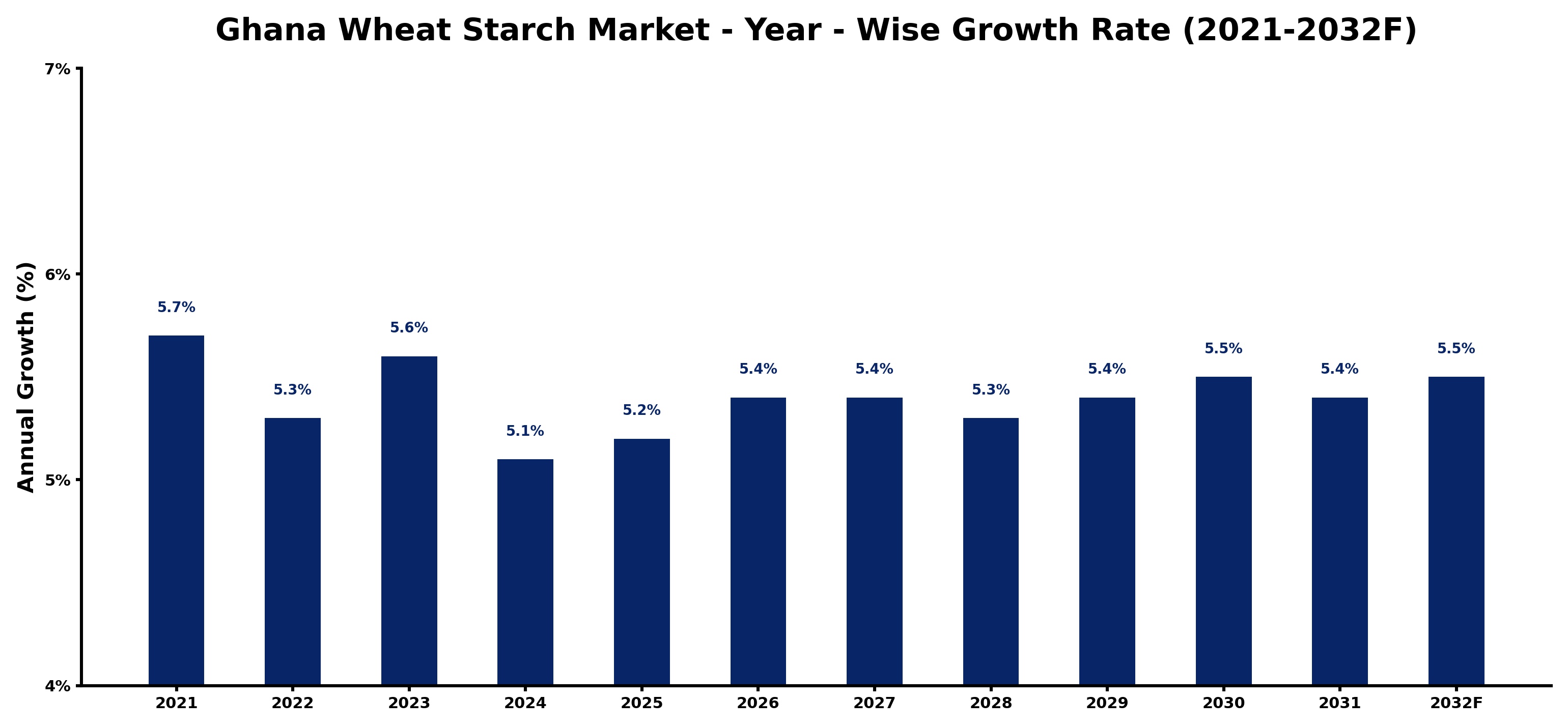
The table below presents the year‑wise growth rates along with the key drivers influencing the market
| Year | Growth Rate | Major Drivers |
| 2021 | 5.7% | Rising demand for gluten-free products |
| 2022 | 5.3% | Increased consumer health awareness |
| 2023 | 5.6% | Expansion of food processing industry |
| 2024 | 5.1% | Growth in bakery product consumption |
| 2025 | 5.2% | Innovative applications in food industry |
| 2026 | 5.4% | Rising popularity of convenience foods |
| 2027 | 5.4% | Increased exports to neighboring countries |
| 2028 | 5.3% | Technological advancements in production |
| 2029 | 5.4% | Sustainable sourcing practices gaining traction |
| 2030 | 5.5% | Growing popularity of organic products |
| 2031 | 5.4% | Emergence of new market players |
| 2032 | 5.5% | Strengthened distribution network efficiency |
Note - Market size estimations and growth projections presented in this report are based on 6Wresearch’s advanced forecasting approach, validated with industry datasets as of June 2026.
Ghana Wheat Starch Market Synopsis
Consumer preferences are the strongest force shaping the Ghana Wheat Starch Market today. As health-conscious choices become more prevalent, the demand for natural and gluten-free ingredients positions wheat starch as a favorable option for manufacturers. This shift is complemented by an increase in disposable incomes, allowing consumers to invest in better quality food products.
Additionally, the presence of both domestic and international suppliers fosters a competitive environment, driving innovation and product diversification. The market is witnessing a rise in organic and non-GMO wheat starch products, reflecting the growing consumer trend towards clean-label products and sustainability.
Ghana Wheat Starch Market Key Takeaways
- Wheat starch is increasingly favored for its functional properties, making it essential in processed foods.
- Changing consumer preferences towards healthier and natural ingredients are reshaping the market landscape.
- The growth of the food processing industry in Ghana offers substantial opportunities for wheat starch suppliers.
- Investment in technological advancements and sustainable practices is key to capturing market potential.
- Government policies are actively promoting domestic production, aiming to reduce import reliance.
Evaluation of Restraints in Ghana Wheat Starch Market
Despite the promising growth prospects, several constraints are influencing the Ghana Wheat Starch Market. A significant challenge lies in the limited domestic production capabilities, which leads to a heavy reliance on imported wheat starch. Fluctuating exchange rates and raw material prices can adversely affect the market, causing variability in costs for producers. Furthermore, competition from alternative starch sources, such as cassava starch, presents another layer of difficulty. These factors necessitate adaptive strategies from market players to maintain competitiveness and ensure product quality.
Ghana Wheat Starch Market Trends
Current trends indicate a significant rise in the demand for organic and non-GMO wheat starch options as consumers prioritize health and sustainability. Innovations in product development are paving the way for new applications of wheat starch, including in gluten-free and functional food products. The emphasis on clean-label ingredients is shaping the landscape as manufacturers respond to the health-conscious consumer base. Furthermore, the increasing penetration of convenience food options is driving the adoption of wheat starch in various food categories.
Ghana Wheat Starch Market Opportunities
The Ghana Wheat Starch Market presents several lucrative investment opportunities. As the food and beverage industry continues to expand, the need for functional food ingredients like wheat starch will likely increase. Investors have the chance to engage in production and distribution ventures to tap into both domestic and regional export markets. Furthermore, advancements in agricultural practices, as well as the adoption of technology in production processes, open new avenues for value addition within the wheat starch supply chain.
Government Initiatives in the Ghana Wheat Starch Market
The Ghanaian government is taking proactive measures to bolster the local wheat starch industry. Initiatives include offering financial incentives and support for wheat starch producers, such as subsidies and tax relief, which aim to stimulate domestic production. Additionally, tariffs on imported wheat starch are designed to protect local manufacturers from foreign competition. Regulatory measures also focus on ensuring product quality and safety standards, further enhancing consumer trust in domestically produced wheat starch.
Future Insights of the Ghana Wheat Starch Market
Looking ahead to the years between 2026 and 2032, the Ghana Wheat Starch Market is poised for sustained growth. With rising disposable incomes and increasing consumer preference for convenience foods, the demand for wheat starch is expected to surge. The ongoing expansion of the food processing sector will likely create additional opportunities for suppliers and manufacturers. However, addressing challenges related to raw material price fluctuations and competition from alternative starch sources will be crucial for maintaining the market's positive trajectory.
Ghana Wheat Starch Market Latest Developments (May 2025 - June 2026)
Recent developments in the Ghana Wheat Starch Market indicate a growing trend towards partnerships and collaborations within the food processing industry. Manufacturers are increasingly seeking innovative solutions to meet consumer demands for healthier options, leading to a greater focus on research and development initiatives. Additionally, consumer awareness campaigns on the benefits of wheat starch are gaining traction, potentially expanding its market reach.
Ghana Wheat Starch Market - Key Attractiveness of the Report
- 10 Years of Market Numbers
- Historical Data Starting from 2022 to 2025
- Base Year: 2025
- Forecast Data until 2032
- Key Performance Indicators Impacting the Market
- Major Upcoming Developments and Projects
Key Highlights of the Report:
- Ghana Wheat Starch Market Outlook
- Market Size of Ghana Wheat Starch Market, 2025
- Forecast of Ghana Wheat Starch Market, 2032
- Historical Data and Forecast of Ghana Wheat Starch Revenues & Volume for the Period 2022-2032F
- Ghana Wheat Starch Market Trend Evolution
- Ghana Wheat Starch Market Drivers and Challenges
- Ghana Wheat Starch Price Trends
- Ghana Wheat Starch Porter's Five Forces
- Ghana Wheat Starch Industry Life Cycle
- Historical Data and Forecast of Ghana Wheat Starch Market Revenues & Volume By Type for the Period 2022-2032F
- Historical Data and Forecast of Ghana Wheat Starch Market Revenues & Volume By Native Wheat Starch for the Period 2022-2032F
- Historical Data and Forecast of Ghana Wheat Starch Market Revenues & Volume By Modified Wheat Starch for the Period 2022-2032F
- Historical Data and Forecast of Ghana Wheat Starch Market Revenues & Volume By Grade for the Period 2022-2032F
- Historical Data and Forecast of Ghana Wheat Starch Market Revenues & Volume By Food Grade for the Period 2022-2032F
- Historical Data and Forecast of Ghana Wheat Starch Market Revenues & Volume By Industrial Grade for the Period 2022-2032F
- Historical Data and Forecast of Ghana Wheat Starch Market Revenues & Volume By End-Users Industry for the Period 2022-2032F
- Historical Data and Forecast of Ghana Wheat Starch Market Revenues & Volume By Food and Beverages for the Period 2022-2032F
- Historical Data and Forecast of Ghana Wheat Starch Market Revenues & Volume By Cosmetics for the Period 2022-2032F
- Historical Data and Forecast of Ghana Wheat Starch Market Revenues & Volume By Others for the Period 2022-2032F
- Ghana Wheat Starch Import Export Trade Statistics
- Market Opportunity Assessment By Type
- Market Opportunity Assessment By Grade
- Market Opportunity Assessment By End-Users Industry
- Ghana Wheat Starch Top Companies Market Share
- Ghana Wheat Starch Competitive Benchmarking By Technical and Operational Parameters
- Ghana Wheat Starch Company Profiles
- Ghana Wheat Starch Key Strategic Recommendations






































