Global Boat Market Highlights
| Market Size (2025) | USD 56 Billion |
| Forecast Size (2032) | USD 76 Billion |
| CAGR | 4.40% |
| Base Year | 2025 |
| Forecast Period | 2026-2032 |
| Largest Region | North America |
| Fastest Growing Region | Asia-Pacific |
| Largest Segment | Motorized Boats |
| Fastest Growing Segment | Electric Boats |
| Leading Companies | Brunswick Corporation, Yamaha Motor Co., Ltd., Azimut-Benetti Group, Sunseeker International, Groupe Beneteau |
Global Boat Market Size & Growth Rate (2026-2032)
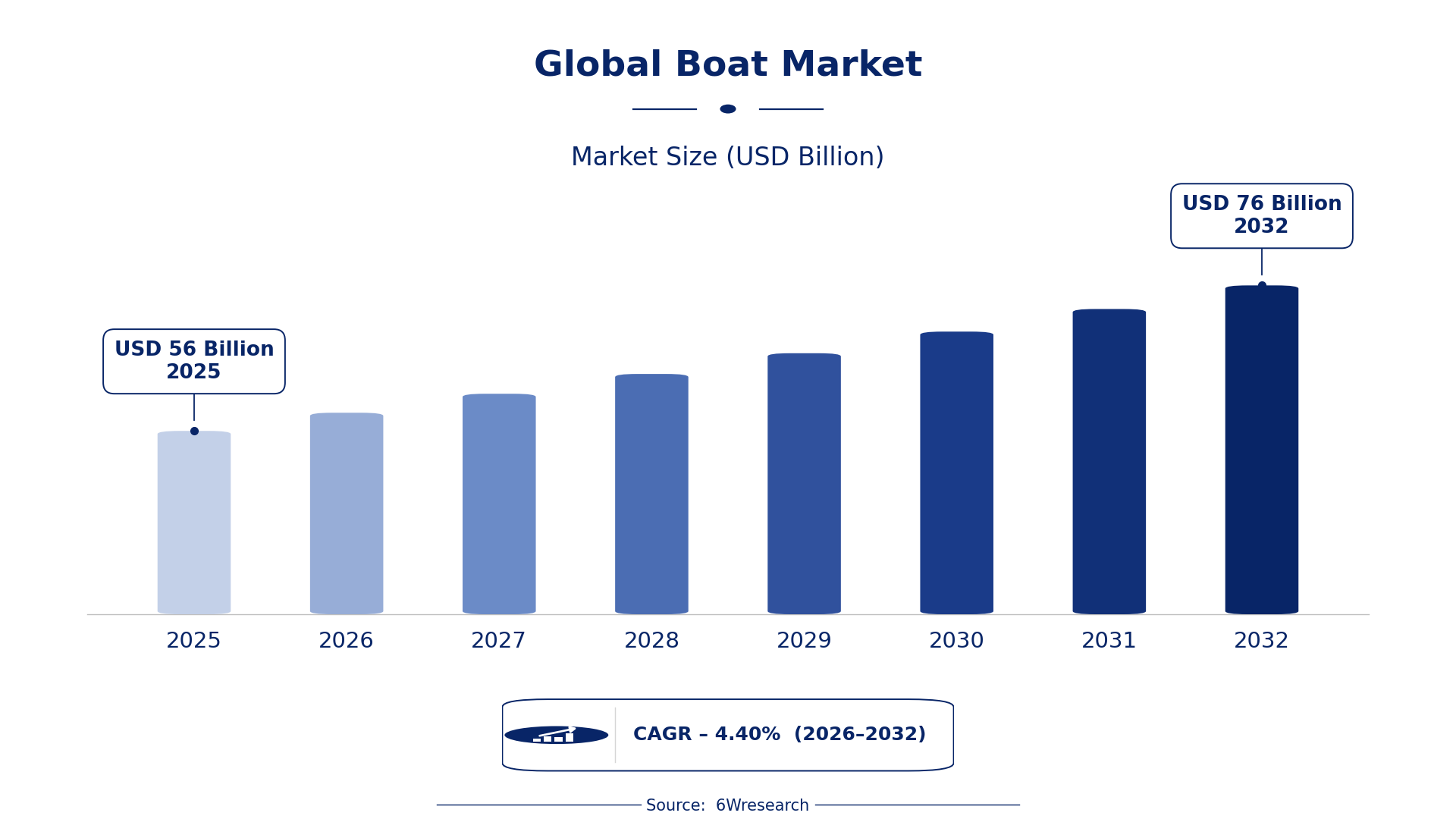
The Global Boat Market was estimated at USD 56 Billion in 2025 and is projected to reach USD 76 Billion by 2032, growing at a CAGR of 4.40% from 2026 to 2032.
Global Boat Market Synopsis
The Global Boat Market is undergoing a significant transformation, driven by technological advancements and evolving consumer preferences. The shift towards electric propulsion systems is reshaping the industry, with manufacturers like Azimut-Benetti Group leading the charge in integrating sustainable technologies into their vessels. This transition is not only reducing the carbon footprint of boating but also attracting a new demographic of environmentally conscious consumers.
Concurrently, the market is witnessing a surge in demand for luxury yachts, particularly in the Asia-Pacific region. The expansion of affluent middle classes in countries such as China and India is fueling this trend, as evidenced by the increased sales of high-end yachts in these markets. This growth is further supported by the development of advanced marine infrastructure and favorable government policies promoting tourism and leisure activities.
Global Boat Market Year-wise Growth Rate and Key Drivers
This graph illustrates the annual growth rates of the Global Boat Market from 2022 to 2032, highlighting a steady upward trajectory and projected expansion over the forecast period.
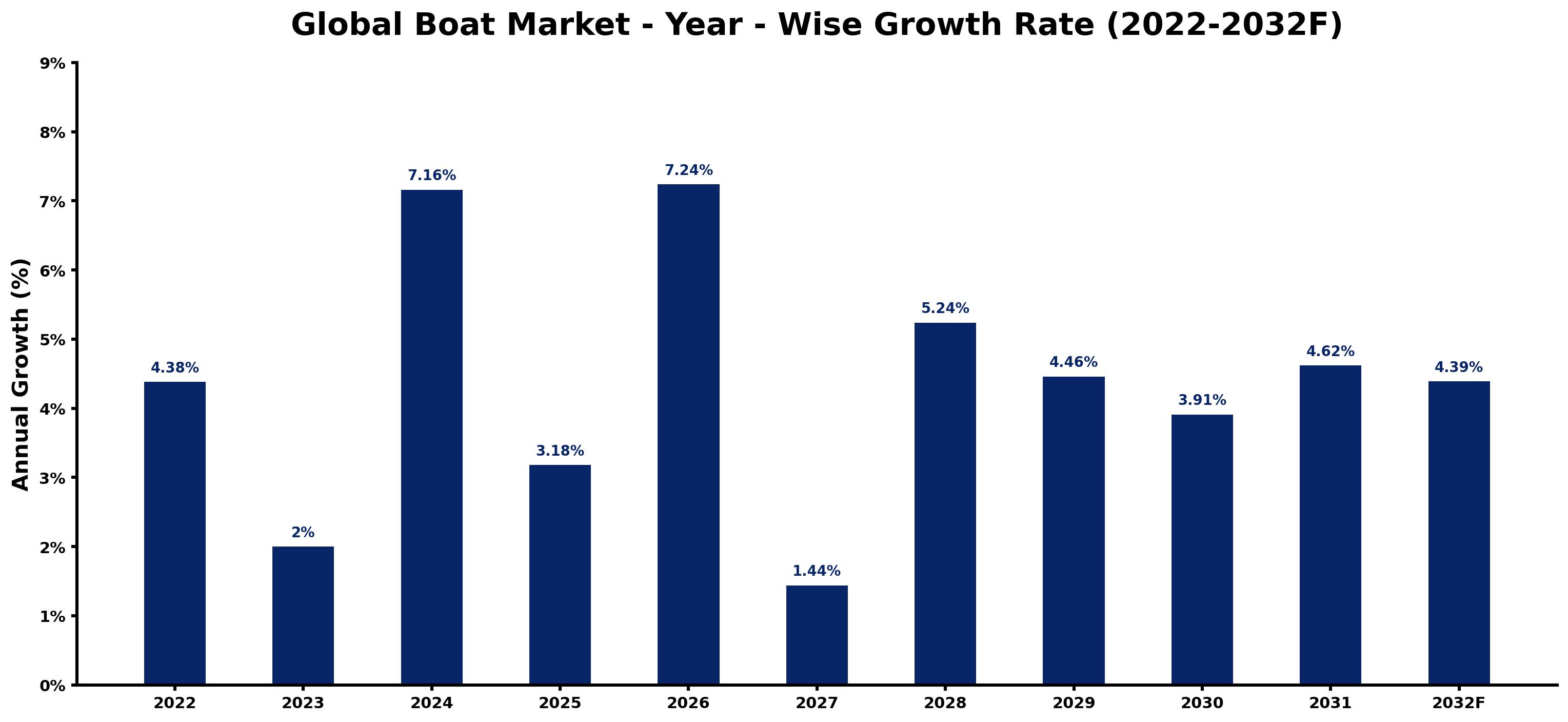
The table below presents the year‑wise growth rates along with the key drivers influencing the market
| Year | Growth Rate (%) | Major Drivers |
| 2022 | 4.38 | Consumer preferences for recreational boating increase demand for various boat types. |
| 2023 | 2 | In Europe, stricter environmental regulations drive the adoption of eco-friendly boat designs. |
| 2024 | 7.16 | A shift toward differentiated boating experiences enhances competition among leading manufacturers. |
| 2025 | 3.18 | End-users in the luxury segment seek unique features in high-performance boats. |
| 2026 | 7.24 | Distributors are expanding into emerging regions, increasing the accessibility of recreational boats. |
| 2027 | 1.44 | As skilled labor shortages affect production timelines, manufacturers reassess workforce training priorities. |
| 2028 | 5.24 | Growing awareness of sustainability impacts market offerings in the recreational boat sector. |
| 2029 | 4.46 | While raw material costs fluctuate, manufacturers strive to maintain competitive pricing for boats. |
| 2030 | 3.91 | Electric propulsion technology offers innovative solutions for environmentally-conscious boaters. |
| 2031 | 4.62 | Retail channels for premium boat brands adapt to evolving consumer preferences and lifestyle choices. |
| 2032 | 4.39 | Encouraging investment in boat production facilities improves overall market competitiveness. |
Note - Market size estimations and growth projections presented in this report are based on 6Wresearch's proprietary research methodology, combining internal industry data, secondary research, and primary validation, updated periodically to reflect current market conditions. As markets evolve rapidly, figures for certain industries may vary slightly and are intended as informed estimates rather than absolute figures. For the most current market sizing, we recommend validating figures with a 6Wresearch analyst.
Global Boat Market Key Takeaways
Below are some of the specific key takeaways from the market, including:
- The Global Boat Market was valued at USD 56 Billion in 2025 and is projected to reach USD 76 Billion by 2032, growing at a CAGR of 4.40% from 2026 to 2032.
- North America held the largest market share in 2025, accounting for approximately 50.88% of the global revenue.
- The electric boat segment is expected to grow at a CAGR of 8.5% from 2026 to 2032, driven by advancements in battery technology and increasing environmental awareness.
- The Asia-Pacific region is projected to be the fastest-growing market, with a CAGR of 6.2% from 2026 to 2032, fueled by rising disposable incomes and a growing interest in recreational boating.
- Brunswick Corporation, Yamaha Motor Co., Ltd., Azimut-Benetti Group, Sunseeker International, and Groupe Beneteau are leading players in the market, contributing significantly to innovation and market expansion.
Evaluation of Restraints in Global Boat Market
The Global Boat Market faces several challenges that could impede its growth trajectory. One significant restraint is the high cost of raw materials, particularly for luxury yachts. For instance, the price of high-grade fiberglass has increased by approximately 15% over the past two years, impacting production costs and, consequently, the final price of boats. Additionally, stringent environmental regulations, such as the International Maritime Organization's Energy Efficiency Existing Ship Index (EEXI) and Carbon Intensity Indicator (CII) requirements, necessitate costly retrofitting of existing vessels to comply with new standards. These regulations, effective from January 2023, mandate that ships improve their energy efficiency and reduce greenhouse gas emissions, imposing financial burdens on boat manufacturers and owners. Moreover, the market is contending with supply chain disruptions, leading to longer delivery times and increased costs. The combination of these factors presents a complex landscape for stakeholders aiming to navigate the market's growth potential.
Global Boat Market Trends
The Global Boat Market is experiencing several key trends that are reshaping its landscape. One prominent trend is the increasing adoption of electric propulsion systems. Manufacturers like Azimut-Benetti Group are integrating sustainable technologies into their vessels, reducing the carbon footprint of boating and attracting environmentally conscious consumers. For example, Azimut-Benetti Group has introduced a line of electric yachts, setting a new standard for eco-friendly luxury boating. Another significant trend is the growing demand for luxury yachts in the Asia-Pacific region. The expansion of affluent middle classes in countries such as China and India is fueling this demand, supported by the development of advanced marine infrastructure and favorable government policies promoting tourism and leisure activities. This shift is evident in the increased sales of high-end yachts in these markets, indicating a robust growth trajectory. Additionally, the market is witnessing technological advancements in navigation and safety systems. The integration of AI and IoT technologies is enhancing the boating experience, providing real-time data and predictive maintenance capabilities. This innovation is not only improving safety but also offering new avenues for customization and user engagement, thereby elevating the overall appeal of boating activities.
Global Boat Market Opportunities
The Global Boat Market presents several lucrative opportunities for growth and innovation. One notable opportunity lies in the development of hydrogen-powered boats. As the industry seeks sustainable alternatives to traditional fuels, hydrogen presents a viable option, offering longer ranges and faster refueling times compared to battery-electric systems. Companies like Hyundai Heavy Industries are investing in hydrogen fuel cell technology for maritime applications, signaling a shift towards cleaner propulsion methods. Another opportunity is the expansion of boat-sharing services. With urbanization and changing leisure preferences, consumers are increasingly opting for shared boating experiences over ownership. This trend is leading to the emergence of platforms that facilitate boat rentals and shared ownership models, catering to a broader audience and generating new revenue streams. Additionally, the integration of advanced materials, such as carbon fiber composites, is opening avenues for lighter and more fuel-efficient boat designs. Manufacturers are leveraging these materials to enhance performance and reduce environmental impact, aligning with the industry's sustainability goals and meeting consumer demand for high-performance vessels.
Global Boat Market by Boat Type
In the Global Boat Market, motorized boats lead the market with a share of approximately 60% in 2025. This dominance is attributed to their versatility and widespread use in both recreational and commercial applications. The electric boat segment is the fastest-growing, with a projected CAGR of 8.5% from 2026 to 2032. This growth is driven by advancements in battery technology and increasing environmental awareness among consumers. The shift towards electric propulsion is not only reducing the carbon footprint of boating but also attracting a new demographic of environmentally conscious consumers. Manufacturers are responding to this trend by investing in research and development to produce more efficient and affordable electric boats, thereby expanding their market presence and meeting the evolving demands of the boating community.
Global Boat Market by Application
In the Global Boat Market, the recreational segment leads with a share of approximately 70% in 2025. This dominance is driven by the increasing popularity of leisure activities and the desire for outdoor experiences. The fishing segment is the fastest-growing, with a projected CAGR of 6.2% from 2026 to 2032. This growth is fueled by rising disposable incomes and a growing interest in recreational boating. The expansion of affluent middle classes in countries such as China and India is contributing to this trend, as evidenced by the increased sales of fishing boats in these markets. This shift is further supported by the development of advanced marine infrastructure and favorable government policies promoting tourism and leisure activities, creating a conducive environment for the growth of the fishing boat segment.
Global Boat Market by Power Source
In the Global Boat Market, internal combustion engine (ICE) boats lead with a share of approximately 80% in 2025. This dominance is due to their established performance and reliability. The electric boat segment is the fastest-growing, with a projected CAGR of 8.5% from 2026 to 2032. This growth is driven by advancements in battery technology and increasing environmental awareness among consumers. The shift towards electric propulsion is not only reducing the carbon footprint of boating but also attracting a new demographic of environmentally conscious consumers. Manufacturers are responding to this trend by investing in research and development to produce more efficient and affordable electric boats, thereby expanding their market presence and meeting the evolving demands of the boating community.
Global Boat Market by Region
In the Global Boat Market, North America leads with a share of approximately 50.88% in 2025. This dominance is attributed to the region's well-established boating culture, extensive waterways, and high disposable incomes. The Asia-Pacific region is the fastest-growing, with a projected CAGR of 6.2% from 2026 to 2032. This growth is fueled by rising disposable incomes and a growing interest in recreational boating. The expansion of affluent middle classes in countries such as China and India is contributing to this trend, as evidenced by the increased sales of boats in these markets. This shift is further supported by the development of advanced marine infrastructure and favorable government policies promoting tourism and leisure activities, creating a conducive environment for the growth of the boat market in the Asia-Pacific region.
Government Initiatives in the Global Boat Market
The regulatory landscape for the Global Boat Market is evolving, with various government initiatives aimed at promoting sustainability, safety, and innovation within the industry. These initiatives are shaping the market dynamics and influencing the strategic decisions of manufacturers and stakeholders.
- The International Maritime Organization (IMO) adopted the 2023 IMO Strategy on Reduction of GHG Emissions from Ships in July 2023. This strategy includes enhanced targets to reduce greenhouse gas emissions from international shipping, aiming for net-zero emissions by or around 2050. The initiative is expected to drive the adoption of alternative fuels and energy-efficient technologies in the boating sector.
- The European Union's FuelEU maritime initiative, adopted in July 2023, aims to decarbonize the maritime sector by increasing the demand for renewable and low-carbon fuels. This regulation is expected to provide legal certainty for ship operators and fuel producers, encouraging the large-scale production of sustainable maritime fuels and contributing to the EU's climate targets.
- The United States' National Oceanic and Atmospheric Administration (NOAA) released its 2023 Report to Congress on Improving International Fisheries Management in August 2023. The report identifies nations engaged in illegal, unreported, and unregulated (IUU) fishing and outlines measures to address these activities. This initiative aims to promote sustainable fishing practices and protect marine ecosystems, indirectly impacting the boating industry by ensuring the health of fish populations.
- The United Kingdom's Maritime and Coastguard Agency launched a consultation in September 2023 into the Draft Merchant Shipping (Special Measures to Enhance Maritime Safety) Regulations 2024. These regulations propose measures to tackle shipping fraud and enhance safety at sea, including requirements for identification numbers for ships and owners, as well as a continuous synopsis record. The initiative aims to improve maritime safety and security, affecting the operational standards within the boating industry.
Future Insights of the Global Boat Market
As the Global Boat Market progresses toward 2032, a structural shift is anticipated, particularly with the transition towards sustainable technologies. Companies like Brunswick Corporation are focusing on advanced composite materials which enhance durability and performance while reducing weight. Moreover, investment in integrated smart technology will redefine user experiences, with features such as real-time monitoring and predictive maintenance becoming expected standards. This evolution, coupled with a heightened focus on environmental regulations, indicates that innovation in fuel efficiency and eco-friendly designs will be pivotal for companies aiming to maintain competitive advantages.
Global Boat Market Latest Developments
In the ever-evolving Global Boat Market, key players are actively pursuing developments that set them apart. The following recent advancements illustrate this trend:
- In early 2023, Yamaha Motor Co., Ltd. launched a new line of electric propulsion systems aimed at commercial vessels, allowing operators to reduce emissions while improving operational efficiency.
- Recently, Azimut-Benetti Group introduced a luxury electric yacht series, showcasing innovative battery technology that significantly extends cruising ranges, thus appealing to eco-conscious high-net-worth individuals.
- Sunseeker International is currently expanding its production facilities in the UK to meet rising demand for its luxury yachts, enhancing its manufacturing capability and regional presence by mid-2024.
- In late 2023, Groupe Beneteau announced a strategic partnership with a renewable energy firm to integrate solar technology into its boat designs, targeting the growing segment of sustainable boating consumers.
Global Boat Market Key Players and Industry Positioning
The competitive structure of the Global Boat Market is characterized by a mix of consolidated and fragmented segments. Prominent companies dominate the higher-end luxury segment while smaller, niche manufacturers are flourishing in specialized applications such as electric boats. This dynamic fosters innovation and drives competition across various market segments.
| Leading Company | Core Strength | Strategic Focus |
|---|---|---|
| Brunswick Corporation | Strong R&D capabilities with a focus on leisure and utility boats. | Innovation in hybrid technologies and market diversification. |
| Yamaha Motor Co., Ltd. | Renowned for high-performance engines and versatile designs. | Expansion into sustainable boating solutions with electric propulsion. |
| Azimut-Benetti Group | Luxury yacht manufacturing with bespoke design options. | Commitment to sustainable luxury through electric and hybrid vessels. |
| Sunseeker International | Notable for craftsmanship and customized yachts. | Enhancing production capacity while integrating smart technologies. |
| Groupe Beneteau | Diverse portfolio covering multiple boating segments. | Strategic partnerships to promote renewable energy integration. |
The positioning of these key players highlights the diverse strategies employed to maintain market leadership amid evolving consumer expectations and regulatory pressures.
Key Attractiveness of the Report
- 10 Years of Market Numbers
- Historical Data Starting from 2022 to 2025
- Base Year: 2025
- Forecast Data until 2032
- Key Performance Indicators Impacting the Market
- Major Upcoming Developments and Projects
Key Highlights of the Report:
- Global Boat Market Outlook
- Market Size of Global Boat Market, 2025
- Forecast of Global Boat Market, 2032
- Historical Data and Forecast of Global Boat Revenues & Volume for the Period 2022-2032
- Global Boat Market Trend Evolution
- Global Boat Market Drivers and Challenges
- Global Boat Price Trends
- Global Boat Porter's Five Forces
- Global Boat Industry Life Cycle
- Historical Data and Forecast of Global Boat Market Revenues & Volume
- Historical Data and Forecast of Global Boat Market Revenues & Volume By Boat Type for the Period 2022-2032
- Historical Data and Forecast of Global Boat Market Revenues & Volume By Inboard Boats for the Period 2022-2032
- Historical Data and Forecast of Global Boat Market Revenues & Volume By Outboard Boats for the Period 2022-2032
- Historical Data and Forecast of Global Boat Market Revenues & Volume By Personal Watercraft Boats for the Period 2022-2032
- Historical Data and Forecast of Global Boat Market Revenues & Volume By Other Boat Types for the Period 2022-2032
- Historical Data and Forecast of Global Boat Market Revenues & Volume By Application for the Period 2022-2032
- Historical Data and Forecast of Global Boat Market Revenues & Volume By Watersports for the Period 2022-2032
- Historical Data and Forecast of Global Boat Market Revenues & Volume By Fishing for the Period 2022-2032
- Historical Data and Forecast of Global Boat Market Revenues & Volume By Power Source for the Period 2022-2032
- Historical Data and Forecast of Global Boat Market Revenues & Volume By Internal Combustion Engine for the Period 2022-2032
- Historical Data and Forecast of Global Boat Market Revenues & Volume By Electric for the Period 2022-2032
- Historical Data and Forecast of North America Boat Market Revenues & Volume By Boat Type for the Period 2022-2032
- Historical Data and Forecast of North America Boat Market Revenues & Volume By Inboard Boats for the Period 2022-2032
- Historical Data and Forecast of North America Boat Market Revenues & Volume By Outboard Boats for the Period 2022-2032
- Historical Data and Forecast of North America Boat Market Revenues & Volume By Personal Watercraft Boats for the Period 2022-2032
- Historical Data and Forecast of North America Boat Market Revenues & Volume By Other Boat Types for the Period 2022-2032
- Historical Data and Forecast of North America Boat Market Revenues & Volume By Application for the Period 2022-2032
- Historical Data and Forecast of North America Boat Market Revenues & Volume By Watersports for the Period 2022-2032
- Historical Data and Forecast of North America Boat Market Revenues & Volume By Fishing for the Period 2022-2032
- Historical Data and Forecast of North America Boat Market Revenues & Volume By Power Source for the Period 2022-2032
- Historical Data and Forecast of North America Boat Market Revenues & Volume By Internal Combustion Engine for the Period 2022-2032
- Historical Data and Forecast of North America Boat Market Revenues & Volume By Electric for the Period 2022-2032
- Historical Data and Forecast of United States of America Boat Market Revenues & Volume for the Period 2022-2032
- Historical Data and Forecast of Canada Boat Market Revenues & Volume for the Period 2022-2032
- Historical Data and Forecast of Rest of North America Boat Market Revenues & Volume for the Period 2022-2032
- Historical Data and Forecast of Latin America (LATAM) Boat Market Revenues & Volume By Boat Type for the Period 2022-2032
- Historical Data and Forecast of Latin America (LATAM) Boat Market Revenues & Volume By Inboard Boats for the Period 2022-2032
- Historical Data and Forecast of Latin America (LATAM) Boat Market Revenues & Volume By Outboard Boats for the Period 2022-2032
- Historical Data and Forecast of Latin America (LATAM) Boat Market Revenues & Volume By Personal Watercraft Boats for the Period 2022-2032
- Historical Data and Forecast of Latin America (LATAM) Boat Market Revenues & Volume By Other Boat Types for the Period 2022-2032
- Historical Data and Forecast of Latin America (LATAM) Boat Market Revenues & Volume By Application for the Period 2022-2032
- Historical Data and Forecast of Latin America (LATAM) Boat Market Revenues & Volume By Watersports for the Period 2022-2032
- Historical Data and Forecast of Latin America (LATAM) Boat Market Revenues & Volume By Fishing for the Period 2022-2032
- Historical Data and Forecast of Latin America (LATAM) Boat Market Revenues & Volume By Power Source for the Period 2022-2032
- Historical Data and Forecast of Latin America (LATAM) Boat Market Revenues & Volume By Internal Combustion Engine for the Period 2022-2032
- Historical Data and Forecast of Latin America (LATAM) Boat Market Revenues & Volume By Electric for the Period 2022-2032
- Historical Data and Forecast of Brazil Boat Market Revenues & Volume for the Period 2022-2032
- Historical Data and Forecast of Mexico Boat Market Revenues & Volume for the Period 2022-2032
- Historical Data and Forecast of Argentina Boat Market Revenues & Volume for the Period 2022-2032
- Historical Data and Forecast of Rest of LATAM Boat Market Revenues & Volume for the Period 2022-2032
- Historical Data and Forecast of Asia Boat Market Revenues & Volume By Boat Type for the Period 2022-2032
- Historical Data and Forecast of Asia Boat Market Revenues & Volume By Inboard Boats for the Period 2022-2032
- Historical Data and Forecast of Asia Boat Market Revenues & Volume By Outboard Boats for the Period 2022-2032
- Historical Data and Forecast of Asia Boat Market Revenues & Volume By Personal Watercraft Boats for the Period 2022-2032
- Historical Data and Forecast of Asia Boat Market Revenues & Volume By Other Boat Types for the Period 2022-2032
- Historical Data and Forecast of Asia Boat Market Revenues & Volume By Application for the Period 2022-2032
- Historical Data and Forecast of Asia Boat Market Revenues & Volume By Watersports for the Period 2022-2032
- Historical Data and Forecast of Asia Boat Market Revenues & Volume By Fishing for the Period 2022-2032
- Historical Data and Forecast of Asia Boat Market Revenues & Volume By Power Source for the Period 2022-2032
- Historical Data and Forecast of Asia Boat Market Revenues & Volume By Internal Combustion Engine for the Period 2022-2032
- Historical Data and Forecast of Asia Boat Market Revenues & Volume By Electric for the Period 2022-2032
- Historical Data and Forecast of China Boat Market Revenues & Volume for the Period 2022-2032
- Historical Data and Forecast of India Boat Market Revenues & Volume for the Period 2022-2032
- Historical Data and Forecast of Japan Boat Market Revenues & Volume for the Period 2022-2032
- Historical Data and Forecast of Rest of Asia Boat Market Revenues & Volume for the Period 2022-2032
- Historical Data and Forecast of Africa Boat Market Revenues & Volume By Boat Type for the Period 2022-2032
- Historical Data and Forecast of Africa Boat Market Revenues & Volume By Inboard Boats for the Period 2022-2032
- Historical Data and Forecast of Africa Boat Market Revenues & Volume By Outboard Boats for the Period 2022-2032
- Historical Data and Forecast of Africa Boat Market Revenues & Volume By Personal Watercraft Boats for the Period 2022-2032
- Historical Data and Forecast of Africa Boat Market Revenues & Volume By Other Boat Types for the Period 2022-2032
- Historical Data and Forecast of Africa Boat Market Revenues & Volume By Application for the Period 2022-2032
- Historical Data and Forecast of Africa Boat Market Revenues & Volume By Watersports for the Period 2022-2032
- Historical Data and Forecast of Africa Boat Market Revenues & Volume By Fishing for the Period 2022-2032
- Historical Data and Forecast of Africa Boat Market Revenues & Volume By Power Source for the Period 2022-2032
- Historical Data and Forecast of Africa Boat Market Revenues & Volume By Internal Combustion Engine for the Period 2022-2032
- Historical Data and Forecast of Africa Boat Market Revenues & Volume By Electric for the Period 2022-2032
- Historical Data and Forecast of South Africa Boat Market Revenues & Volume for the Period 2022-2032
- Historical Data and Forecast of Nigeria Boat Market Revenues & Volume for the Period 2022-2032
- Historical Data and Forecast of Egypt Boat Market Revenues & Volume for the Period 2022-2032
- Historical Data and Forecast of Rest of Africa Boat Market Revenues & Volume for the Period 2022-2032
- Historical Data and Forecast of Europe Boat Market Revenues & Volume By Boat Type for the Period 2022-2032
- Historical Data and Forecast of Europe Boat Market Revenues & Volume By Inboard Boats for the Period 2022-2032
- Historical Data and Forecast of Europe Boat Market Revenues & Volume By Outboard Boats for the Period 2022-2032
- Historical Data and Forecast of Europe Boat Market Revenues & Volume By Personal Watercraft Boats for the Period 2022-2032
- Historical Data and Forecast of Europe Boat Market Revenues & Volume By Other Boat Types for the Period 2022-2032
- Historical Data and Forecast of Europe Boat Market Revenues & Volume By Application for the Period 2022-2032
- Historical Data and Forecast of Europe Boat Market Revenues & Volume By Watersports for the Period 2022-2032
- Historical Data and Forecast of Europe Boat Market Revenues & Volume By Fishing for the Period 2022-2032
- Historical Data and Forecast of Europe Boat Market Revenues & Volume By Power Source for the Period 2022-2032
- Historical Data and Forecast of Europe Boat Market Revenues & Volume By Internal Combustion Engine for the Period 2022-2032
- Historical Data and Forecast of Europe Boat Market Revenues & Volume By Electric for the Period 2022-2032
- Historical Data and Forecast of United Kingdom Boat Market Revenues & Volume for the Period 2022-2032
- Historical Data and Forecast of France Boat Market Revenues & Volume for the Period 2022-2032
- Historical Data and Forecast of Germany Boat Market Revenues & Volume for the Period 2022-2032
- Historical Data and Forecast of Rest of Europe Boat Market Revenues & Volume for the Period 2022-2032
- Historical Data and Forecast of Middle East Boat Market Revenues & Volume By Boat Type for the Period 2022-2032
- Historical Data and Forecast of Middle East Boat Market Revenues & Volume By Inboard Boats for the Period 2022-2032
- Historical Data and Forecast of Middle East Boat Market Revenues & Volume By Outboard Boats for the Period 2022-2032
- Historical Data and Forecast of Middle East Boat Market Revenues & Volume By Personal Watercraft Boats for the Period 2022-2032
- Historical Data and Forecast of Middle East Boat Market Revenues & Volume By Other Boat Types for the Period 2022-2032
- Historical Data and Forecast of Middle East Boat Market Revenues & Volume By Application for the Period 2022-2032
- Historical Data and Forecast of Middle East Boat Market Revenues & Volume By Watersports for the Period 2022-2032
- Historical Data and Forecast of Middle East Boat Market Revenues & Volume By Fishing for the Period 2022-2032
- Historical Data and Forecast of Middle East Boat Market Revenues & Volume By Power Source for the Period 2022-2032
- Historical Data and Forecast of Middle East Boat Market Revenues & Volume By Internal Combustion Engine for the Period 2022-2032
- Historical Data and Forecast of Middle East Boat Market Revenues & Volume By Electric for the Period 2022-2032
- Historical Data and Forecast of Saudi Arabia Boat Market Revenues & Volume for the Period 2022-2032
- Historical Data and Forecast of UAE Boat Market Revenues & Volume for the Period 2022-2032
- Historical Data and Forecast of Turkey Boat Market Revenues & Volume for the Period 2022-2032
- Historical Data and Forecast of Rest of Middle East Boat Market Revenues & Volume for the Period 2022-2032
- Global Boat Market - Key Performance Indicators
- Global Boat Market - Import Export Trade Statistics
- Global Boat Market - Opportunity Assessment By Countries
- Global Boat Market - Opportunity Assessment By Boat Type
- Global Boat Market - Opportunity Assessment By Application
- Global Boat Market - Opportunity Assessment By Power Source
- Global Boat Market - Top Companies Market Share
- Global Boat Market - Top Companies Profiles
- Global Boat Market - Comparison of Players in Technical and Operating Parameters
- Global Boat Market - Strategic Recommendations
Markets Covered
The Global Boat Market report provides a detailed analysis of the following market segments:
By Regions and Countries:
- North America
- Europe
- LATAM
- Middle East
- Asia
- Africa
By Boat Type:
- Inboard Boats
- Outboard Boats
- Personal Watercraft Boats
- Other Boat Types
By Application:
- Watersports
- Fishing
By Power Source:
- Internal Combustion Engine
- Electric






































