Global Broadcast Antenna Market Highlights
| Market Size (2025) | USD 3.9 Billion |
| Forecast Size (2032) | USD 6.2 Billion |
| CAGR | 5.61% |
| Base Year | 2025 |
| Forecast Period | 2026-2032 |
| Largest Region | North America |
| Fastest Growing Region | Asia-Pacific |
| Largest Segment | Television |
| Fastest Growing Segment | FM |
| Leading Companies | Sony Corporation, Harris Corporation, Rohde & Schwarz, Cisco Systems, Inc. |
Global Broadcast Antenna Market Size & Growth Rate (2026-2032)
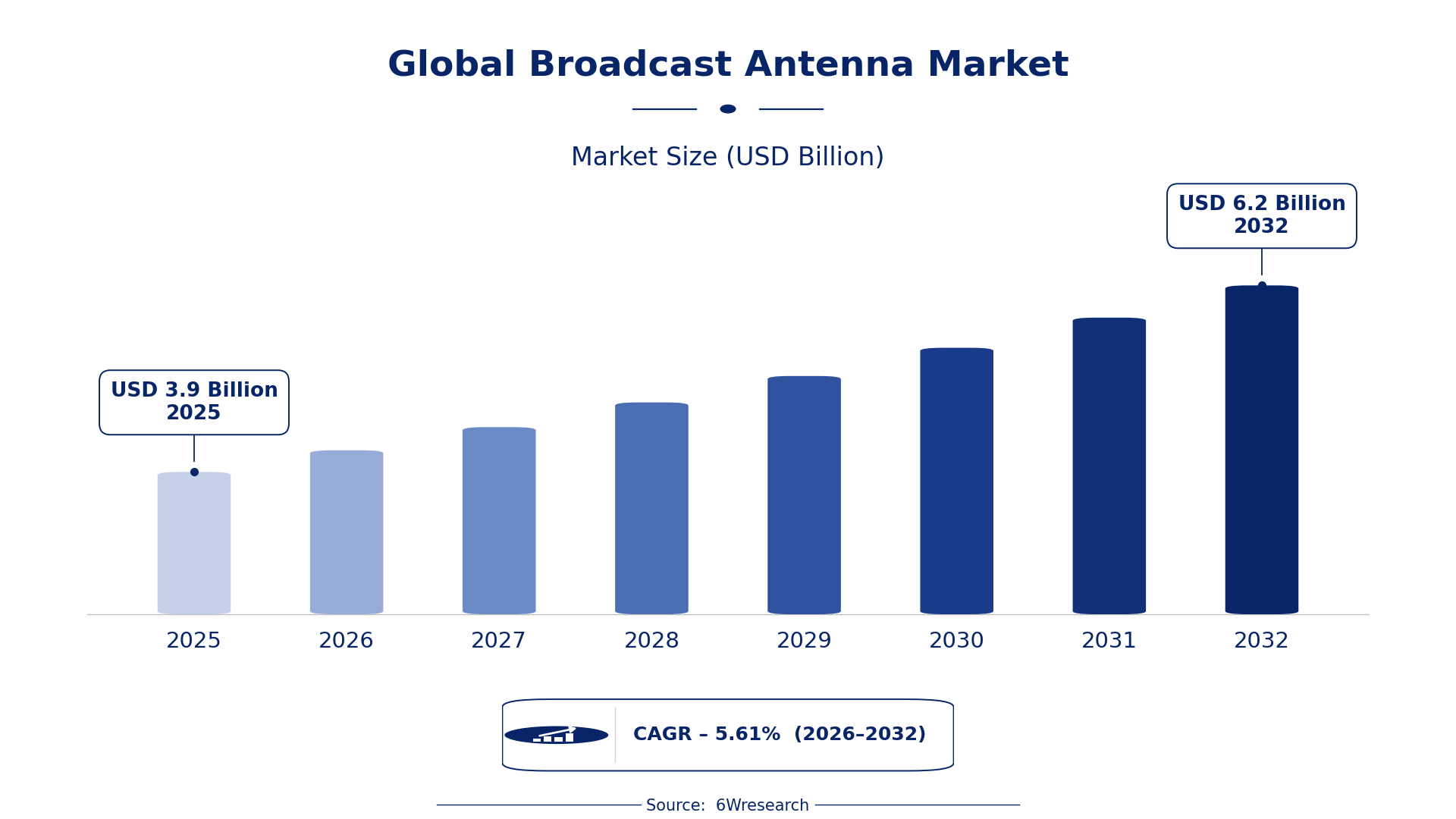
The Global Broadcast Antenna Market was estimated at USD 3.9 Billion in 2025 and is projected to reach USD 6.2 Billion by 2032, growing at a CAGR of 5.61% from 2026 to 2032.
Global Broadcast Antenna Market Synopsis
The Global Broadcast Antenna Market is currently shifting toward enhanced technological capabilities, driven by the need for clearer signals and improved broadcasting efficiency. The transition from analog to digital broadcasting has necessitated upgrades in existing infrastructure, propelling investments in innovative antenna designs. As consumer preferences lean towards high-definition and 4K content, broadcasters are aligning their offerings with advanced solutions that support these formats.
Furthermore, the emergence of Over-The-Top (OTT) platforms is fundamentally altering viewership dynamics, influencing the type of broadcasting technologies being adopted. With content delivery at the forefront, antennas that can support seamless streaming are becoming indispensable. This market transformation carries implications not only for broadcasters but also for technology providers seeking to lead in this specialized sector.
Global Broadcast Antenna Market Year-wise Growth Rate and Key Drivers
This graph illustrates the annual growth rates of the Global Broadcast Antenna Market from 2022 to 2032, highlighting a steady upward trajectory and projected expansion over the forecast period.
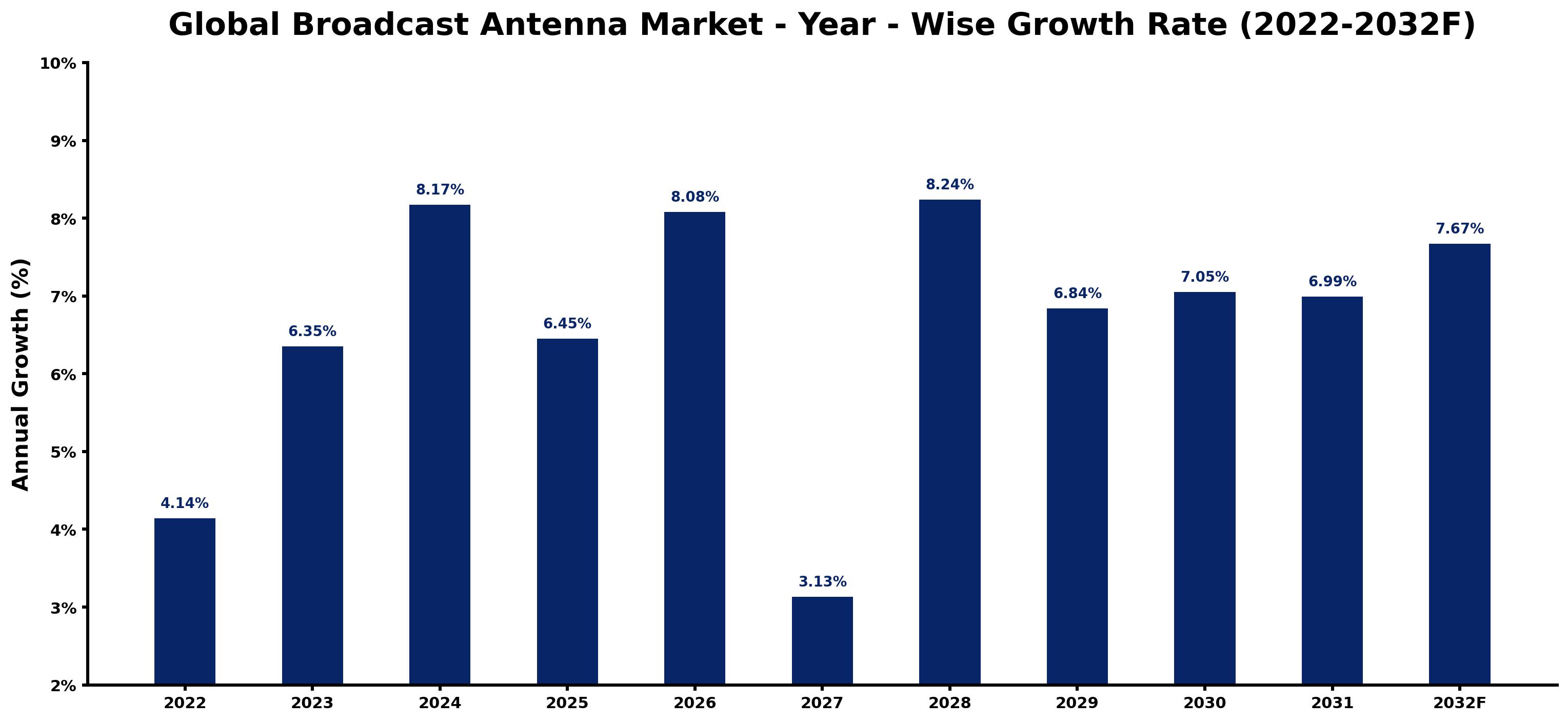
The table below presents the year‑wise growth rates along with the key drivers influencing the market
| Year | Growth Rate (%) | Major Drivers |
| 2022 | 4.14 | Broadcast antenna demand surged as users adopted advanced wireless communication solutions. |
| 2023 | 6.35 | Having trained telecom technicians improves installation speed for broadcast antenna systems. |
| 2024 | 8.17 | As policy changes encourage digital infrastructure, broadcast antenna deployment becomes paramount. |
| 2025 | 6.45 | Telecom operators increasingly favor broadcast antennas for enhancing consumer connectivity experiences. |
| 2026 | 8.08 | In North America, sustainability initiatives lead to the adoption of eco-friendly broadcast antennas. |
| 2027 | 3.13 | Telecom infrastructure expansion accelerates the availability of broadcast antennas in emerging markets. |
| 2028 | 8.24 | Investing in new technologies for broadcasting enhances antenna capabilities and market competitiveness. |
| 2029 | 6.84 | Supply chain disruptions create challenges for manufacturers of broadcast antennas, prompting innovation. |
| 2030 | 7.05 | Technological advancements in broadcast antennas enable improved signal strength and coverage area. |
| 2031 | 6.99 | Television networks demand more efficient broadcast antennas due to increasing content delivery competition. |
| 2032 | 7.67 | A shift toward rising raw material costs affects pricing strategies for broadcast antenna manufacturers. |
Note - Market size estimations and growth projections presented in this report are based on 6Wresearch's proprietary research methodology, combining internal industry data, secondary research, and primary validation, updated periodically to reflect current market conditions. As markets evolve rapidly, figures for certain industries may vary slightly and are intended as informed estimates rather than absolute figures. For the most current market sizing, we recommend validating figures with a 6Wresearch analyst.
Global Broadcast Antenna Market Key Takeaways
Below are some of the specific key takeaways from the market, including:
- North America is projected to command a market share of approximately 42% in 2025, benefiting from advanced broadcasting technologies and consumer demand.
- Asia-Pacific is anticipated to show a CAGR of 7.2% from 2026 to 2032, driven by increasing investments in digital broadcasting infrastructure.
- Television antennas are expected to dominate, comprising nearly 75% of the market share in 2025, as viewers continue to utilize traditional cable services alongside newer platforms.
- The integration of smart antennas into broadcasting solutions is gaining traction, thanks in part to innovations from companies like Rohde & Schwarz.
- Emerging markets, particularly in Africa and Asia, are projected to create substantial opportunities for growth, thanks to rising numbers of broadcasting stations.
Evaluation of Restraints in Global Broadcast Antenna Market
The Global Broadcast Antenna Market faces several pertinent restraints that could hinder its growth trajectory. High initial investments required for transitioning to digital systems often pose a significant burden, with estimates suggesting that up to $500,000 may be necessary for upgrading broadcasting infrastructure in mid-sized markets. For example, while countries like the U.S. are successfully making the switch, many regions still lag due to funding gaps and limited technological outreach. Additionally, increasing competition from satellite and cable alternatives adds pressure on traditional broadcast operators to modernize and effectively allocate resources toward advanced antenna technologies.
Global Broadcast Antenna Market Trends
A series of trends are shaping the operational landscape of the Global Broadcast Antenna Market. The rise of smart antennas—capable of adapting signal patterns and optimizing performance—represents a technological shift. Companies like Cisco Systems are leading the charge, with their smart antenna solutions now implemented in over 20 major U.S. cities as of 2023. This technology enhances signal quality and extends coverage areas, catering to an increasingly mobile audience.
Furthermore, the shift towards integration with 5G protocols indicates a new phase in broadcast technology, with significant implications for device design and manufacturing processes. In this context, antennas must accommodate high-frequency signals that come with 5G, pushing industries to innovate continually. Increased collaborations between antenna manufacturers and telecom companies are also being evidenced as a strategy to leverage improved broadcasting efficiency.
Global Broadcast Antenna Market Opportunities
The Global Broadcast Antenna Market is positioned to benefit from various lucrative opportunities in emerging sectors. For instance, as the automotive industry gears up for a more interconnected future, the demand for antennas in connected vehicles is likely to expand significantly. Companies like Sony are already exploring partnerships with automotive manufacturers to provide integrated broadcasting solutions for infotainment systems.
Additionally, the increasing focus on enhancing broadcast capabilities for rural areas presents an avenue for revenue generation. Initiatives aimed at improving infrastructure in underserved regions may lead to market growth, with estimates suggesting revenues could reach upwards of $1 billion in newly strengthened networks by 2030. Projects geared towards integrating renewable energy solutions into broadcasting facilities also indicate a shift towards sustainable practices, opening up another dimension for investment.
Global Broadcast Antenna Market by Type
Television antennas currently hold the largest share in the Global Broadcast Antenna Market, commanding approximately 75% share in 2025. This dominance stems from their widespread use and consumer preference for traditional broadcasting methods. Conversely, FM antennas are emerging as the fastest-growing segment, projected to achieve a CAGR of 7.5% from 2026 to 2032, driven by an upsurge in FM radio station establishments and consumer interest in local broadcasts. The unique integration of FM technology with digital platforms positions this segment favorably in an evolving media environment.
Global Broadcast Antenna Market by Region
North America is the largest region in the Global Broadcast Antenna Market, with an estimated share of around 42% in 2025, fuelled by extensive infrastructure investments and mature technology sectors. On the other hand, Asia-Pacific is forecasted to be the fastest-growing region, expected to exhibit a CAGR of 7.8% from 2026 to 2032, primarily due to increasing consumer access to broadcasting services and enhanced production capabilities. Government initiatives aimed at expanding digital coverage across rural areas further accelerate growth in this region.
Government Initiatives in the Global Broadcast Antenna Market
A robust regulatory environment underpins the Global Broadcast Antenna Market, characterized by incentives aimed at enhancing broadcasting capabilities and facilitating technological advancements. Policymakers at various levels are increasingly recognizing the importance of digital infrastructure in keeping pace with global standards.
- Federal Communications Commission (FCC)—Digital television transition, June 12, 2009. This initiative mandated the switch from analog to digital broadcasting, enhancing signal clarity and quality.
- European Commission (EC)—Action Plan for the Digital Single Market, September 2015. This ongoing program promotes the modernization of broadcasting frameworks across European Union countries, fostering cross-border content delivery.
- U.S. Department of Agriculture (USDA)—Rural Broadband Initiative, June 2021. This program aims to enhance broadcasting capabilities in rural regions, providing federal funding for improving infrastructure.
- National Telecommunications and Information Administration (NTIA)—Broadband Technology Opportunities Program (BTOP), March 2010. This completed initiative funded over $4 billion to expand broadband access, indirectly supporting the development of broadcasting technologies in underserved areas.
- Indian Ministry of Information and Broadcasting—Broadcasting Infrastructure Development Plan, April 2022. This future-focused initiative aims to enhance digital broadcast transmission technologies across the country, targeting investments of around $440 million.
Future Insights of the Global Broadcast Antenna Market
As technology progresses, the Global Broadcast Antenna Market is expected to undergo transformative changes, particularly in the integration of 5G capabilities. Companies like Rohde & Schwarz are actively developing antennas that optimize high-frequency signals associated with advanced broadcasting methods. This advancement could reshape broadcasting frameworks, encouraging migration towards smart antennas that not only enhance signal quality but also adapt in real-time to varying conditions. An emphasis on green technologies is anticipated as sustainable practices gain traction, with investments potentially directed towards eco-friendly materials in antenna manufacturing.
Global Broadcast Antenna Market Latest Developments
Recent developments in the Global Broadcast Antenna Market illustrate the ongoing evolution of technology and strategic positioning among leading companies. The following initiatives highlight significant impacts on industry dynamics:
- Rohde & Schwarz recently completed the rollout of their innovative smart antenna technology in multiple key U.S. cities, significantly enhancing signal range. This positions the company as a leader in urban broadcasting solutions.
- In early 2023, Sony Corporation announced plans for a research partnership focused on integrating antennas into automotive infotainment systems, which aims to tap into the growing connected vehicles market.
- Harris Corporation is currently developing a next-generation antenna system expected to streamline digital transmission processes across various platforms, slated for release by mid-2024. This will likely set new standards for system efficiency.
- Cisco Systems, Inc. is working on enhancing existing broadcasting infrastructures by integrating AI-driven optimization tools into their antenna solutions, with a pilot program scheduled for late 2023. This move aims to improve operational effectiveness and adaptability.
Global Broadcast Antenna Market Key Players and Industry Positioning
The Global Broadcast Antenna Market is characterized by a moderately consolidated competitive structure, with several key players dominating the landscape. While major companies hold significant market shares, innovative startups are emerging, driven by technology advancements and niche applications. Established firms are increasingly focused on strategic partnerships and research investments to maintain competitive advantages and enhance product offerings.
| Leading Company | Core Strength | Strategic Focus |
|---|---|---|
| Sony Corporation | Expertise in consumer electronics and media | Integration of antennas into next-gen media solutions |
| Harris Corporation | Stronghold in communication and transmission technologies | Development of efficient broadcast systems |
| Rohde & Schwarz | Leadership in wireless communications | Innovating smart antenna technologies |
| Cisco Systems, Inc. | Expertise in networking solutions | AI-driven broadcast solutions |
| Cisco Systems, Inc. | Diverse portfolio with strong R&D capabilities | Focus on integrating broadcast antennas with digital networks |
In summary, the competitive positioning within the Global Broadcast Antenna Market is continuously evolving as companies seek to leverage innovations to enhance their market roles. Collaborative approaches and advancements in technology will likely further shape this sector.
Key Attractiveness of the Report
- 10 Years of Market Numbers
- Historical Data Starting from 2022 to 2025
- Base Year: 2025
- Forecast Data until 2032
- Key Performance Indicators Impacting the Market
- Major Upcoming Developments and Projects
Key Highlights of the Report:
- Global Broadcast Antenna Market Outlook
- Market Size of Global Broadcast Antenna Market, 2025
- Forecast of Global Broadcast Antenna Market, 2032
- Historical Data and Forecast of Global Broadcast Antenna Revenues & Volume for the Period 2022-2032
- Global Broadcast Antenna Market Trend Evolution
- Global Broadcast Antenna Market Drivers and Challenges
- Global Broadcast Antenna Price Trends
- Global Broadcast Antenna Porter's Five Forces
- Global Broadcast Antenna Industry Life Cycle
- Historical Data and Forecast of Global Broadcast Antenna Market Revenues & Volume
- Historical Data and Forecast of Global Broadcast Antenna Market Revenues & Volume By Type for the Period 2022-2032
- Historical Data and Forecast of Global Broadcast Antenna Market Revenues & Volume By Television for the Period 2022-2032
- Historical Data and Forecast of Global Broadcast Antenna Market Revenues & Volume By FM for the Period 2022-2032
- Historical Data and Forecast of North America Broadcast Antenna Market Revenues & Volume By Type for the Period 2022-2032
- Historical Data and Forecast of North America Broadcast Antenna Market Revenues & Volume By Television for the Period 2022-2032
- Historical Data and Forecast of North America Broadcast Antenna Market Revenues & Volume By FM for the Period 2022-2032
- Historical Data and Forecast of United States of America Broadcast Antenna Market Revenues & Volume for the Period 2022-2032
- Historical Data and Forecast of Canada Broadcast Antenna Market Revenues & Volume for the Period 2022-2032
- Historical Data and Forecast of Rest of North America Broadcast Antenna Market Revenues & Volume for the Period 2022-2032
- Historical Data and Forecast of Latin America (LATAM) Broadcast Antenna Market Revenues & Volume By Type for the Period 2022-2032
- Historical Data and Forecast of Latin America (LATAM) Broadcast Antenna Market Revenues & Volume By Television for the Period 2022-2032
- Historical Data and Forecast of Latin America (LATAM) Broadcast Antenna Market Revenues & Volume By FM for the Period 2022-2032
- Historical Data and Forecast of Brazil Broadcast Antenna Market Revenues & Volume for the Period 2022-2032
- Historical Data and Forecast of Mexico Broadcast Antenna Market Revenues & Volume for the Period 2022-2032
- Historical Data and Forecast of Argentina Broadcast Antenna Market Revenues & Volume for the Period 2022-2032
- Historical Data and Forecast of Rest of LATAM Broadcast Antenna Market Revenues & Volume for the Period 2022-2032
- Historical Data and Forecast of Asia Broadcast Antenna Market Revenues & Volume By Type for the Period 2022-2032
- Historical Data and Forecast of Asia Broadcast Antenna Market Revenues & Volume By Television for the Period 2022-2032
- Historical Data and Forecast of Asia Broadcast Antenna Market Revenues & Volume By FM for the Period 2022-2032
- Historical Data and Forecast of China Broadcast Antenna Market Revenues & Volume for the Period 2022-2032
- Historical Data and Forecast of India Broadcast Antenna Market Revenues & Volume for the Period 2022-2032
- Historical Data and Forecast of Japan Broadcast Antenna Market Revenues & Volume for the Period 2022-2032
- Historical Data and Forecast of Rest of Asia Broadcast Antenna Market Revenues & Volume for the Period 2022-2032
- Historical Data and Forecast of Africa Broadcast Antenna Market Revenues & Volume By Type for the Period 2022-2032
- Historical Data and Forecast of Africa Broadcast Antenna Market Revenues & Volume By Television for the Period 2022-2032
- Historical Data and Forecast of Africa Broadcast Antenna Market Revenues & Volume By FM for the Period 2022-2032
- Historical Data and Forecast of South Africa Broadcast Antenna Market Revenues & Volume for the Period 2022-2032
- Historical Data and Forecast of Nigeria Broadcast Antenna Market Revenues & Volume for the Period 2022-2032
- Historical Data and Forecast of Egypt Broadcast Antenna Market Revenues & Volume for the Period 2022-2032
- Historical Data and Forecast of Rest of Africa Broadcast Antenna Market Revenues & Volume for the Period 2022-2032
- Historical Data and Forecast of Europe Broadcast Antenna Market Revenues & Volume By Type for the Period 2022-2032
- Historical Data and Forecast of Europe Broadcast Antenna Market Revenues & Volume By Television for the Period 2022-2032
- Historical Data and Forecast of Europe Broadcast Antenna Market Revenues & Volume By FM for the Period 2022-2032
- Historical Data and Forecast of United Kingdom Broadcast Antenna Market Revenues & Volume for the Period 2022-2032
- Historical Data and Forecast of France Broadcast Antenna Market Revenues & Volume for the Period 2022-2032
- Historical Data and Forecast of Germany Broadcast Antenna Market Revenues & Volume for the Period 2022-2032
- Historical Data and Forecast of Rest of Europe Broadcast Antenna Market Revenues & Volume for the Period 2022-2032
- Historical Data and Forecast of Middle East Broadcast Antenna Market Revenues & Volume By Type for the Period 2022-2032
- Historical Data and Forecast of Middle East Broadcast Antenna Market Revenues & Volume By Television for the Period 2022-2032
- Historical Data and Forecast of Middle East Broadcast Antenna Market Revenues & Volume By FM for the Period 2022-2032
- Historical Data and Forecast of Saudi Arabia Broadcast Antenna Market Revenues & Volume for the Period 2022-2032
- Historical Data and Forecast of UAE Broadcast Antenna Market Revenues & Volume for the Period 2022-2032
- Historical Data and Forecast of Turkey Broadcast Antenna Market Revenues & Volume for the Period 2022-2032
- Historical Data and Forecast of Rest of Middle East Broadcast Antenna Market Revenues & Volume for the Period 2022-2032
- Global Broadcast Antenna Market - Key Performance Indicators
- Global Broadcast Antenna Market - Import Export Trade Statistics
- Global Broadcast Antenna Market - Opportunity Assessment By Countries
- Global Broadcast Antenna Market - Opportunity Assessment By Type
- 0
- Global Broadcast Antenna Market - Top Companies Market Share
- Global Broadcast Antenna Market - Top Companies Profiles
- Global Broadcast Antenna Market - Comparison of Players in Technical and Operating Parameters
- Global Broadcast Antenna Market - Strategic Recommendations
Markets Covered
The Global Broadcast Antenna Market report provides a detailed analysis of the following market segments:
By Regions and Countries:
- North America
- Europe
- LATAM
- Middle East
- Asia
- Africa
By Type:
- Television
- FM






































