Global Household Textile Market Highlights
| Indicator | Value |
|---|---|
| Market Size (2025) | USD 50 Billion |
| Forecast Size (2032) | USD 68 Billion |
| CAGR | 4.50% |
| Base Year | 2025 |
| Forecast Period | 2026-2032 |
| Largest Region | Asia-Pacific |
| Fastest Growing Region | Latin America |
| Largest Segment | Woven Textile |
| Fastest Growing Segment | Non-woven Textile |
| Leading Companies | Tencel, Welspun, Trident Group, H&M, IKEA |
Global Household Textile Market Size & Growth Rate (2026-2032)
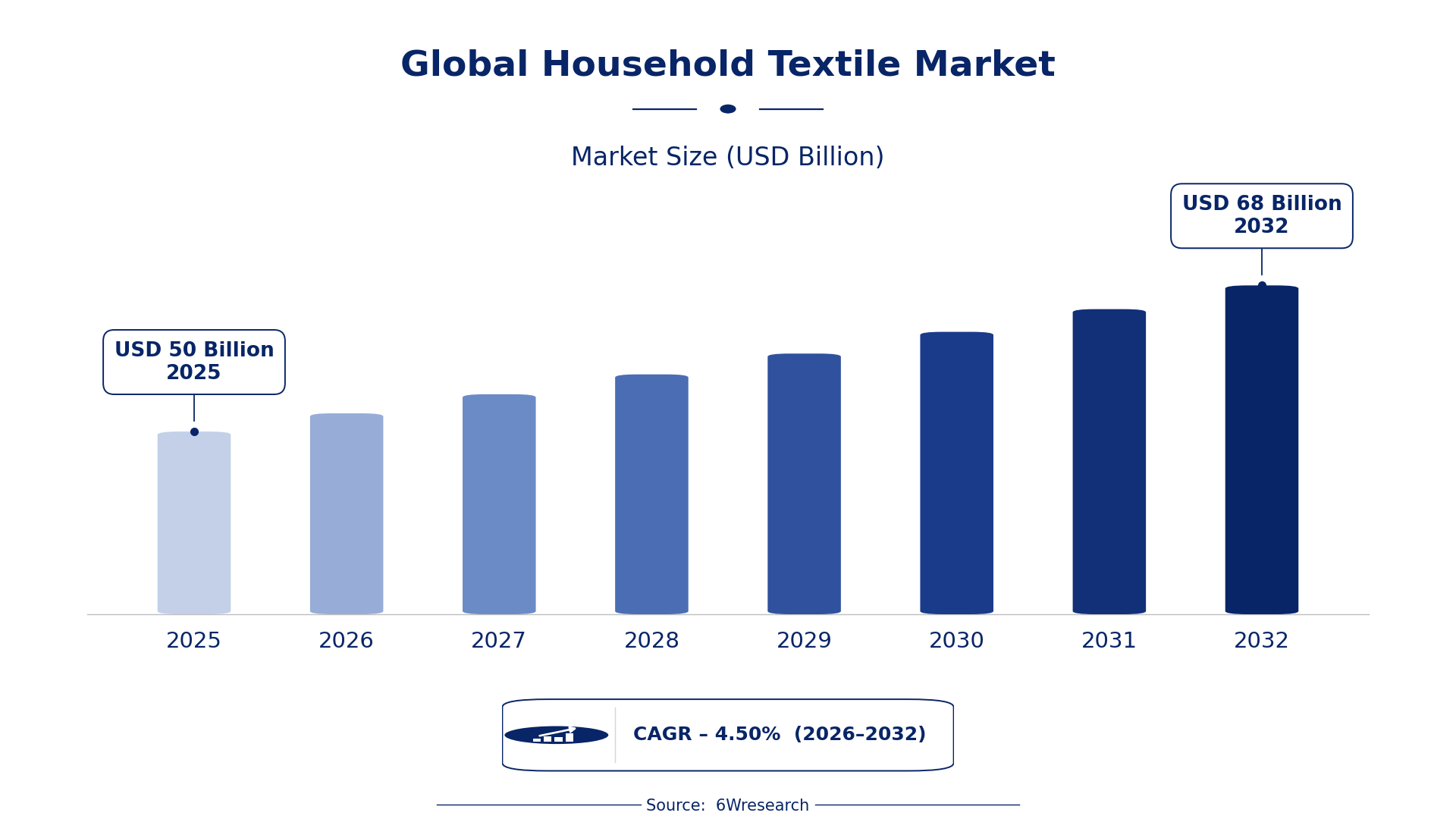
The Global Household Textile Market was estimated at USD 50 Billion in 2025 and is projected to reach USD 68 Billion by 2032, growing at a CAGR of 4.50% from 2026 to 2032.
Global Household Textile Market Synopsis
The Global Household Textile Market is poised to undergo substantial transformations as consumer preferences shift towards sustainable and innovative textile solutions. Key factors include the rise in eco-awareness among consumers and the increased demand for products that align with their values. Manufacturers are now prioritizing eco-friendly materials, elevating the importance of sustainable production techniques in the household textile sector.
This market is not only crucial for enhancing home aesthetics but also reflects broader lifestyle changes driven by urbanization and disposable income growth. Changes in consumer behavior regarding home decor and functionality standards result in evolving design trends. This creates avenues for companies to introduce unique and customizable textile options, thus further diversifying the market landscape.
Global Household Textile Market Year-wise Growth Rate and Key Drivers
This graph illustrates the annual growth rates of the Global Household Textile Market from 2022 to 2032, highlighting a steady upward trajectory and projected expansion over the forecast period.
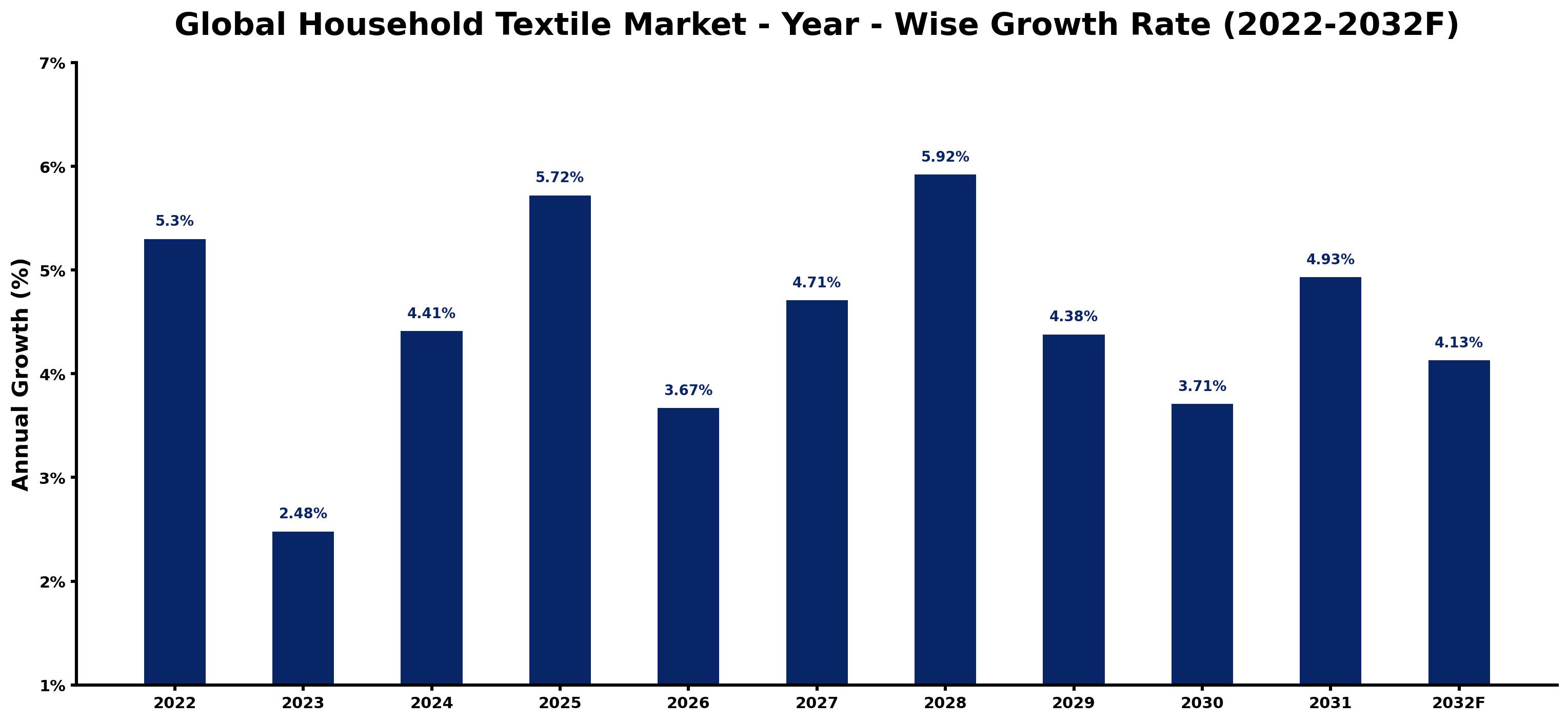
The table below presents the year‑wise growth rates along with the key drivers influencing the market
| Year | Growth Rate (%) | Major Drivers |
| 2022 | 5.3 | A shift in consumer priorities towards quality household textiles encourages market stability. |
| 2023 | 2.48 | In North America, increased M&A activity among brands enhances household textile offerings. |
| 2024 | 4.41 | Manufacturers recognize rising consumer preference for sustainable household textile materials. |
| 2025 | 5.72 | Implementing clean-label formulations in products drives engagement in household textiles. |
| 2026 | 3.67 | Expanding e-commerce channel capabilities enhances accessibility of household textile products. |
| 2027 | 4.71 | Retail shelf penetration of eco-friendly household textiles aligns with changing regulations. |
| 2028 | 5.92 | As raw material costs stabilize, household textile producers gain pricing confidence. |
| 2029 | 4.38 | Smart textiles capture attention, driving innovation in the household textile segment. |
| 2030 | 3.71 | A shift toward eco-conscious brands alters competitive dynamics in household textiles. |
| 2031 | 4.93 | The evolving preferences of millennials influence supply chain strategies for household textiles. |
| 2032 | 4.13 | Rising demand for skilled labor in sustainable production enhances the household textile sector. |
Note - Market size estimations and growth projections presented in this report are based on 6Wresearch's proprietary research methodology, combining internal industry data, secondary research, and primary validation, updated periodically to reflect current market conditions. As markets evolve rapidly, figures for certain industries may vary slightly and are intended as informed estimates rather than absolute figures. For the most current market sizing, we recommend validating figures with a 6Wresearch analyst.
Global Household Textile Market Key Takeaways
Below are some of the specific key takeaways from the market, including:
- Asia-Pacific dominates the market, holding approximately 44% share in 2025.
- The shift towards smart textiles is notable, with growth projected at a CAGR of 6.2% from 2026 to 2032 due to rising interest in multifunctional home setups.
- Incorporation of AI-driven design processes by companies like IKEA has streamlined production, enhancing customization capabilities.
- Woven textiles constitute nearly 60% of the market share as of 2025, reinforcing their established preference in household applications.
- Investment in renewable materials is accelerating, with major players committed to increasing eco-friendly product lines by 25% by 2030.
Evaluation of Restraints in Global Household Textile Market
The Global Household Textile Market faces several constraints that could hinder its growth trajectory. Fluctuating raw material prices are a significant concern, for instance, cotton prices have seen volatility, with averages fluctuating between $0.60 to $0.80 per pound over the past year. This impacts production costs for manufacturers who rely heavily on these materials. For example, manufacturers who adhere to sustainable practices face higher sourcing costs, which can deter investment in eco-friendly initiatives. Regulatory challenges further complicate the landscape, as compliance with diverse international standards increases operational difficulties and costs.
Global Household Textile Market Trends
Current trends in the Global Household Textile Market highlight a pivot towards sustainability and technological integration. The increasing adoption of recycled and organic materials by companies like Welspun is reshaping product lines, as consumers demand environmentally responsible choices. Furthermore, advancements in digital printing technology have allowed for greater customization, enabling brands to offer bespoke designs effectively. For example, a pilot project initiated by Trident Group in early 2023 showcased the potential of digital printing to reduce production time by up to 50%, aligning with consumer demands for unique products. This technological evolution, coupled with a focus on consumer awareness, sets the stage for a dynamic market environment.
Global Household Textile Market Opportunities
The Global Household Textile Market is ripe with opportunities as companies pivot to address evolving consumer needs. For example, Tencel's recent development of plant-based textiles provides a significant avenue for expanding product lines and tapping into eco-conscious consumer bases. Additionally, the increasing demand for products incorporating antimicrobial properties, driven by post-pandemic hygiene concerns, offers a notable revenue stream — projected growth in this segment is estimated at 8.5% from 2026 to 2032. This focus on innovative applications means the market can better meet contemporary consumer expectations, further fueling growth.
Global Household Textile Market by Type
In the Global Household Textile Market, Woven Textile holds the largest share, commanding approximately 60% share in 2025. This segment's popularity is driven by its extensive applications across bedding and upholstery, aligning well with consumer preferences for durability and aesthetics. Meanwhile, the Non-woven Textile segment is noted as the fastest-growing, projected to expand at a CAGR of 6.0% from 2026 to 2032 as manufacturers innovate lightweight and versatile solutions for various home applications, including decor and cleaning products.
Global Household Textile Market by Application
Among applications in the Global Household Textile Market, the Bed category leads with a significant share of approximately 50% as of 2025. This reflects the persistent demand for bedding products, emphasized by trends towards comfort and quality sleep. Conversely, the fastest-growing application segment is Dining & Wash, expected to grow at a CAGR of 5.5% from 2026 to 2032, as consumers increasingly prioritize table linens and absorbent towels in their domestic environments. The rise in this segment underscores shifting lifestyle choices towards enhanced dining experiences.
Global Household Textile Market by Region
The Asia-Pacific region is the largest market for household textiles, accounting for about 44% market share in 2025. Driven by rapid urbanization and rising middle-class populations, this region's demand for textiles is substantial. Concurrently, Latin America is emerging as the fastest-growing region, with a projected CAGR of 5.2% from 2026 to 2032. This growth is attributed to increasing disposable incomes and the burgeoning trend in home decoration, particularly in urban centers.
Government Initiatives in the Global Household Textile Market
The regulatory environment surrounding the Global Household Textile Market is increasingly supportive of sustainable practices and innovation. Various government initiatives are being implemented to promote eco-friendly manufacturing processes and enhance market accessibility for domestic players.
- Ministry of Textiles, India: "Textiles Policy 2022," introduced in January 2022, aims to increase sustainable textile production by providing financial incentives and subsidies, enhancing export capabilities.
- U.S. Department of Agriculture: "Risk Management Agency Cooperative Agreement," initiated in March 2023, supports domestic cotton growers through subsidies of $60 million aimed at ensuring a sustainable supply chain.
- European Commission: "Green Deal Initiative," launched in December 2019, outlines stringent regulations promoting sustainable textile production practices, affecting all EU member states through compliance requirements.
- Ministry of Environment, Brazil: "Eco-Friendly Textiles Program," announced in August 2024, will allocate $20 million for developing environmentally sustainable textile practices across local manufacturers.
Future Insights of the Global Household Textile Market
As the Global Household Textile Market progresses toward 2032, we anticipate substantial shifts driven by sustainability and technological advancements. For instance, Tencel's recent focus on plant-based textiles positions it as a leader in eco-friendly solutions, catering to the rising consumer demand for environmentally responsible products. Additionally, the continued push for smart textiles is expected to enable manufacturers to integrate multifunctional features into their offerings, meeting evolving consumer preferences and enhancing overall market competitiveness.
Global Household Textile Market Latest Developments
Recent advancements within the Global Household Textile Market underscore an active landscape as companies strive to enhance sustainability and product diversity. The following are notable developments:
- Welspun completed its new eco-friendly production facility in July 2023, aiming to reduce its carbon footprint and enhance production capacity for sustainable textiles.
- In April 2023, Trident Group launched a collection of antimicrobial textiles, responding to heightened hygiene concerns in households stemming from the COVID-19 pandemic.
- H&M announced plans in January 2024 to launch a new line of recycled home products, reflecting a broader market shift toward circular economy principles.
- IKEA is set to introduce smart textiles in March 2025, aiming to integrate technology into traditional textiles to enhance user convenience and functionality.
Global Household Textile Market Key Players and Industry Positioning
The Global Household Textile Market is relatively fragmented, with numerous players vying for market share. While some companies focus on sustainability, others prioritize technology-driven product innovations. This diversity fosters competition while offering varied product portfolios to consumers.
| Leading Company | Core Strength | Strategic Focus |
|---|---|---|
| Tencel | Expertise in sustainable fiber production. | Expanding eco-friendly product lines. |
| Welspun | Strong manufacturing capabilities. | Investing in renewable materials and green technology. |
| Trident Group | Innovative textile solutions and R&D focus. | Enhancing product offerings with smart technology. |
| H&M | Pioneering sustainable fashion initiatives. | Targeting the circular economy and recycling. |
| IKEA | Strong brand recognition and global reach. | Integrating technology with home textiles. |
The competitive dynamics of the market will likely evolve further as companies harness innovation and sustainability to meet emerging consumer demands, setting the stage for a vibrant future.
Key Attractiveness of the Report
- 10 Years of Market Numbers
- Historical Data Starting from 2022 to 2025
- Base Year: 2025
- Forecast Data until 2032
- Key Performance Indicators Impacting the Market
- Major Upcoming Developments and Projects
Key Highlights of the Report:
- Global Household Textile Market Outlook
- Market Size of Global Household Textile Market, 2025
- Forecast of Global Household Textile Market, 2032
- Historical Data and Forecast of Global Household Textile Revenues & Volume for the Period 2022-2032
- Global Household Textile Market Trend Evolution
- Global Household Textile Market Drivers and Challenges
- Global Household Textile Price Trends
- Global Household Textile Porter's Five Forces
- Global Household Textile Industry Life Cycle
- Historical Data and Forecast of Global Household Textile Market Revenues & Volume
- Historical Data and Forecast of Global Household Textile Market Revenues & Volume By Type for the Period 2022-2032
- Historical Data and Forecast of Global Household Textile Market Revenues & Volume By Non-woven Textile for the Period 2022-2032
- Historical Data and Forecast of Global Household Textile Market Revenues & Volume By Woven Textile for the Period 2022-2032
- Historical Data and Forecast of Global Household Textile Market Revenues & Volume By Application for the Period 2022-2032
- Historical Data and Forecast of Global Household Textile Market Revenues & Volume By Bed for the Period 2022-2032
- Historical Data and Forecast of Global Household Textile Market Revenues & Volume By Furniture for the Period 2022-2032
- Historical Data and Forecast of Global Household Textile Market Revenues & Volume By Door & Window for the Period 2022-2032
- Historical Data and Forecast of Global Household Textile Market Revenues & Volume By Dining & Wash for the Period 2022-2032
- Historical Data and Forecast of Global Household Textile Market Revenues & Volume By Ground for the Period 2022-2032
- Historical Data and Forecast of North America Household Textile Market Revenues & Volume By Type for the Period 2022-2032
- Historical Data and Forecast of North America Household Textile Market Revenues & Volume By Non-woven Textile for the Period 2022-2032
- Historical Data and Forecast of North America Household Textile Market Revenues & Volume By Woven Textile for the Period 2022-2032
- Historical Data and Forecast of North America Household Textile Market Revenues & Volume By Application for the Period 2022-2032
- Historical Data and Forecast of North America Household Textile Market Revenues & Volume By Bed for the Period 2022-2032
- Historical Data and Forecast of North America Household Textile Market Revenues & Volume By Furniture for the Period 2022-2032
- Historical Data and Forecast of North America Household Textile Market Revenues & Volume By Door & Window for the Period 2022-2032
- Historical Data and Forecast of North America Household Textile Market Revenues & Volume By Dining & Wash for the Period 2022-2032
- Historical Data and Forecast of North America Household Textile Market Revenues & Volume By Ground for the Period 2022-2032
- Historical Data and Forecast of United States of America Household Textile Market Revenues & Volume for the Period 2022-2032
- Historical Data and Forecast of Canada Household Textile Market Revenues & Volume for the Period 2022-2032
- Historical Data and Forecast of Rest of North America Household Textile Market Revenues & Volume for the Period 2022-2032
- Historical Data and Forecast of Latin America (LATAM) Household Textile Market Revenues & Volume By Type for the Period 2022-2032
- Historical Data and Forecast of Latin America (LATAM) Household Textile Market Revenues & Volume By Non-woven Textile for the Period 2022-2032
- Historical Data and Forecast of Latin America (LATAM) Household Textile Market Revenues & Volume By Woven Textile for the Period 2022-2032
- Historical Data and Forecast of Latin America (LATAM) Household Textile Market Revenues & Volume By Application for the Period 2022-2032
- Historical Data and Forecast of Latin America (LATAM) Household Textile Market Revenues & Volume By Bed for the Period 2022-2032
- Historical Data and Forecast of Latin America (LATAM) Household Textile Market Revenues & Volume By Furniture for the Period 2022-2032
- Historical Data and Forecast of Latin America (LATAM) Household Textile Market Revenues & Volume By Door & Window for the Period 2022-2032
- Historical Data and Forecast of Latin America (LATAM) Household Textile Market Revenues & Volume By Dining & Wash for the Period 2022-2032
- Historical Data and Forecast of Latin America (LATAM) Household Textile Market Revenues & Volume By Ground for the Period 2022-2032
- Historical Data and Forecast of Brazil Household Textile Market Revenues & Volume for the Period 2022-2032
- Historical Data and Forecast of Mexico Household Textile Market Revenues & Volume for the Period 2022-2032
- Historical Data and Forecast of Argentina Household Textile Market Revenues & Volume for the Period 2022-2032
- Historical Data and Forecast of Rest of LATAM Household Textile Market Revenues & Volume for the Period 2022-2032
- Historical Data and Forecast of Asia Household Textile Market Revenues & Volume By Type for the Period 2022-2032
- Historical Data and Forecast of Asia Household Textile Market Revenues & Volume By Non-woven Textile for the Period 2022-2032
- Historical Data and Forecast of Asia Household Textile Market Revenues & Volume By Woven Textile for the Period 2022-2032
- Historical Data and Forecast of Asia Household Textile Market Revenues & Volume By Application for the Period 2022-2032
- Historical Data and Forecast of Asia Household Textile Market Revenues & Volume By Bed for the Period 2022-2032
- Historical Data and Forecast of Asia Household Textile Market Revenues & Volume By Furniture for the Period 2022-2032
- Historical Data and Forecast of Asia Household Textile Market Revenues & Volume By Door & Window for the Period 2022-2032
- Historical Data and Forecast of Asia Household Textile Market Revenues & Volume By Dining & Wash for the Period 2022-2032
- Historical Data and Forecast of Asia Household Textile Market Revenues & Volume By Ground for the Period 2022-2032
- Historical Data and Forecast of China Household Textile Market Revenues & Volume for the Period 2022-2032
- Historical Data and Forecast of India Household Textile Market Revenues & Volume for the Period 2022-2032
- Historical Data and Forecast of Japan Household Textile Market Revenues & Volume for the Period 2022-2032
- Historical Data and Forecast of Rest of Asia Household Textile Market Revenues & Volume for the Period 2022-2032
- Historical Data and Forecast of Africa Household Textile Market Revenues & Volume By Type for the Period 2022-2032
- Historical Data and Forecast of Africa Household Textile Market Revenues & Volume By Non-woven Textile for the Period 2022-2032
- Historical Data and Forecast of Africa Household Textile Market Revenues & Volume By Woven Textile for the Period 2022-2032
- Historical Data and Forecast of Africa Household Textile Market Revenues & Volume By Application for the Period 2022-2032
- Historical Data and Forecast of Africa Household Textile Market Revenues & Volume By Bed for the Period 2022-2032
- Historical Data and Forecast of Africa Household Textile Market Revenues & Volume By Furniture for the Period 2022-2032
- Historical Data and Forecast of Africa Household Textile Market Revenues & Volume By Door & Window for the Period 2022-2032
- Historical Data and Forecast of Africa Household Textile Market Revenues & Volume By Dining & Wash for the Period 2022-2032
- Historical Data and Forecast of Africa Household Textile Market Revenues & Volume By Ground for the Period 2022-2032
- Historical Data and Forecast of South Africa Household Textile Market Revenues & Volume for the Period 2022-2032
- Historical Data and Forecast of Nigeria Household Textile Market Revenues & Volume for the Period 2022-2032
- Historical Data and Forecast of Egypt Household Textile Market Revenues & Volume for the Period 2022-2032
- Historical Data and Forecast of Rest of Africa Household Textile Market Revenues & Volume for the Period 2022-2032
- Historical Data and Forecast of Europe Household Textile Market Revenues & Volume By Type for the Period 2022-2032
- Historical Data and Forecast of Europe Household Textile Market Revenues & Volume By Non-woven Textile for the Period 2022-2032
- Historical Data and Forecast of Europe Household Textile Market Revenues & Volume By Woven Textile for the Period 2022-2032
- Historical Data and Forecast of Europe Household Textile Market Revenues & Volume By Application for the Period 2022-2032
- Historical Data and Forecast of Europe Household Textile Market Revenues & Volume By Bed for the Period 2022-2032
- Historical Data and Forecast of Europe Household Textile Market Revenues & Volume By Furniture for the Period 2022-2032
- Historical Data and Forecast of Europe Household Textile Market Revenues & Volume By Door & Window for the Period 2022-2032
- Historical Data and Forecast of Europe Household Textile Market Revenues & Volume By Dining & Wash for the Period 2022-2032
- Historical Data and Forecast of Europe Household Textile Market Revenues & Volume By Ground for the Period 2022-2032
- Historical Data and Forecast of United Kingdom Household Textile Market Revenues & Volume for the Period 2022-2032
- Historical Data and Forecast of France Household Textile Market Revenues & Volume for the Period 2022-2032
- Historical Data and Forecast of Germany Household Textile Market Revenues & Volume for the Period 2022-2032
- Historical Data and Forecast of Rest of Europe Household Textile Market Revenues & Volume for the Period 2022-2032
- Historical Data and Forecast of Middle East Household Textile Market Revenues & Volume By Type for the Period 2022-2032
- Historical Data and Forecast of Middle East Household Textile Market Revenues & Volume By Non-woven Textile for the Period 2022-2032
- Historical Data and Forecast of Middle East Household Textile Market Revenues & Volume By Woven Textile for the Period 2022-2032
- Historical Data and Forecast of Middle East Household Textile Market Revenues & Volume By Application for the Period 2022-2032
- Historical Data and Forecast of Middle East Household Textile Market Revenues & Volume By Bed for the Period 2022-2032
- Historical Data and Forecast of Middle East Household Textile Market Revenues & Volume By Furniture for the Period 2022-2032
- Historical Data and Forecast of Middle East Household Textile Market Revenues & Volume By Door & Window for the Period 2022-2032
- Historical Data and Forecast of Middle East Household Textile Market Revenues & Volume By Dining & Wash for the Period 2022-2032
- Historical Data and Forecast of Middle East Household Textile Market Revenues & Volume By Ground for the Period 2022-2032
- Historical Data and Forecast of Saudi Arabia Household Textile Market Revenues & Volume for the Period 2022-2032
- Historical Data and Forecast of UAE Household Textile Market Revenues & Volume for the Period 2022-2032
- Historical Data and Forecast of Turkey Household Textile Market Revenues & Volume for the Period 2022-2032
- Historical Data and Forecast of Rest of Middle East Household Textile Market Revenues & Volume for the Period 2022-2032
- Global Household Textile Market - Key Performance Indicators
- Global Household Textile Market - Import Export Trade Statistics
- Global Household Textile Market - Opportunity Assessment By Countries
- Global Household Textile Market - Opportunity Assessment By Type
- Global Household Textile Market - Opportunity Assessment By Application
- Global Household Textile Market - Top Companies Market Share
- Global Household Textile Market - Top Companies Profiles
- Global Household Textile Market - Comparison of Players in Technical and Operating Parameters
- Global Household Textile Market - Strategic Recommendations
Markets Covered
The Global Household Textile Market report provides a detailed analysis of the following market segments:
By Regions and Countries:
- North America
- Europe
- LATAM
- Middle East
- Asia
- Africa
By Type:
- Non-woven Textile
- Woven Textile
By Application:
- Bed
- Furniture
- Door & Window
- Dining & Wash
- Ground






































