Global Instant Noodle Market Highlights
| Market Size (2025) | USD 41.5 Billion |
| Forecast Size (2032) | USD 58.2 Billion |
| CAGR | 7.00% |
| Base Year | 2025 |
| Forecast Period | 2026-2032 |
| Largest Region | Asia |
| Fastest Growing Region | Latin America |
| Largest Segment | Fried Instant Noodles |
| Fastest Growing Segment | Non-Fried Instant Noodles |
| Leading Companies | Nissin Foods, Uni-President Enterprises Corporation, Tingyi (Master Kong), Maruchan, Samyang Foods |
Global Instant Noodle Market Size & Growth Rate (2026-2032)
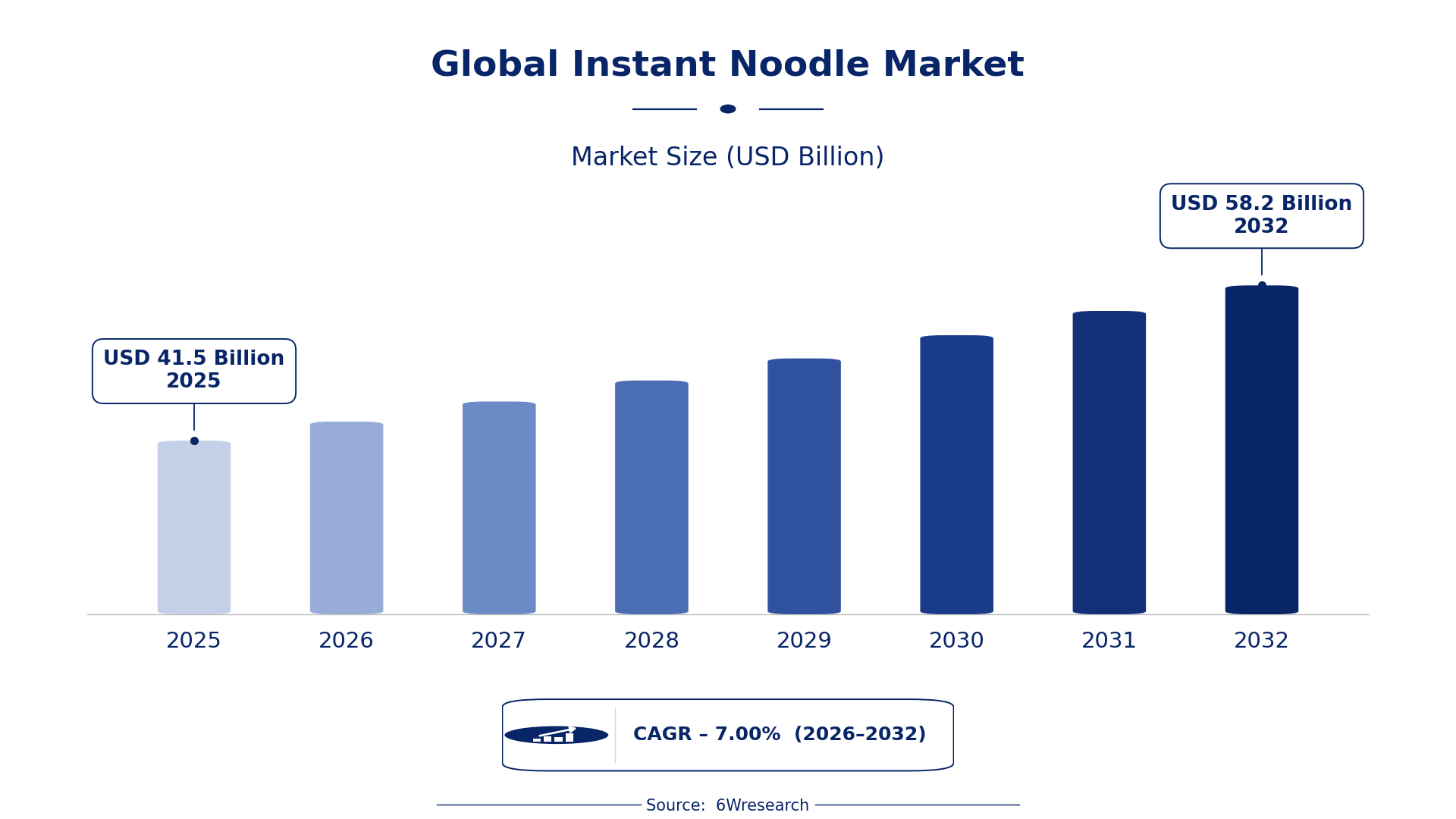
The Global Instant Noodle Market was estimated at USD 41.5 Billion in 2025 and is projected to reach USD 58.2 Billion by 2032, growing at a CAGR of 7.00% from 2026 to 2032.
Global Instant Noodle Market Synopsis
The Global Instant Noodle Market is undergoing a structural transformation, driven by evolving consumer lifestyles that emphasize convenience and affordability. Significant urbanization, particularly in emerging economies, has led to a surge in demand for quick meal solutions. Companies are increasingly catering to health-oriented consumers, introducing options that align with changing dietary preferences.
This sector stands apart from adjacent markets through its unique blend of competitive pricing and diverse flavor offerings. The rise of e-commerce platforms has further fueled market growth, providing convenient channels for consumers to access an increasingly wide variety of instant noodle products. The shift toward organic and low-sodium options showcases responsiveness to consumer health trends and signals potential for future growth.
Global Instant Noodle Market Year-wise Growth Rate and Key Drivers
This graph illustrates the annual growth rates of the Global Instant Noodle Market from 2022 to 2032, highlighting a steady upward trajectory and projected expansion over the forecast period.
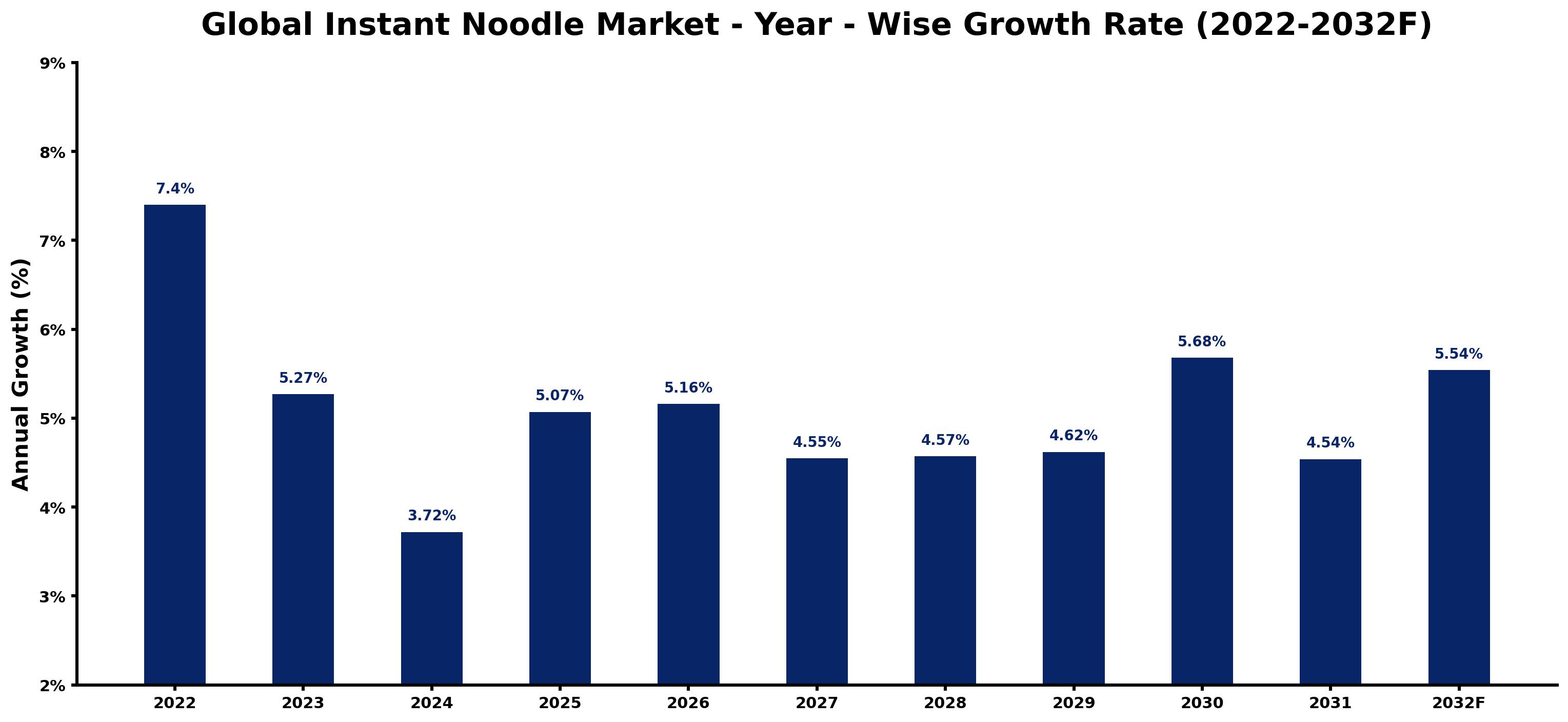
The table below presents the year‑wise growth rates along with the key drivers influencing the market
| Year | Growth Rate (%) | Major Drivers |
| 2022 | 7.4 | A shift toward regional expansion changes the dynamics of the instant noodle market. |
| 2023 | 5.27 | While private-label competition intensifies, brand loyalty programs retain customer engagement in instant noodles. |
| 2024 | 3.72 | Increasing health consciousness among consumers influences demand for clean-label instant noodle options. |
| 2025 | 5.07 | Implementing new food safety regulations enhances the quality standards for instant noodles. |
| 2026 | 5.16 | Retail distribution channels adapt, improving supply chain efficiency for instant noodle manufacturers. |
| 2027 | 4.55 | Consumers with rising disposable income drive premiumization trends in instant noodle offerings. |
| 2028 | 4.57 | Innovative packaging materials enhance sustainability for instant noodle brands aiming to attract eco-conscious buyers. |
| 2029 | 4.62 | In Europe, sustainability initiatives gradually reshape consumer preferences for instant noodle products. |
| 2030 | 5.68 | Instant noodle brands experiencing shifts in consumer behavior capitalize on e-commerce penetration. |
| 2031 | 4.54 | Manufacturers of instant noodles face fluctuating raw material costs affecting price strategies. |
| 2032 | 5.54 | A surge in investment activity signals confidence in the growth potential of the instant noodle sector. |
Note - Market size estimations and growth projections presented in this report are based on 6Wresearch's proprietary research methodology, combining internal industry data, secondary research, and primary validation, updated periodically to reflect current market conditions. As markets evolve rapidly, figures for certain industries may vary slightly and are intended as informed estimates rather than absolute figures. For the most current market sizing, we recommend validating figures with a 6Wresearch analyst.
Global Instant Noodle Market Key Takeaways
Below are some of the specific key takeaways from the market, including:
- Asia dominates the market, accounting for approximately 54% share in 2025.
- The segment for Non-Fried Instant Noodles is projected to grow at a CAGR of 9% from 2026 to 2032.
- Nissin Foods reported a revenue of $4 billion in 2023, positioning itself as a leader in innovative flavor offerings.
- Sustainability initiatives have led to over 25% of brands integrating eco-friendly packaging by 2025.
- E-commerce sales are expected to reach 16% of total market share by 2032.
Evaluation of Restraints in Global Instant Noodle Market
The Global Instant Noodle Market faces notable challenges, primarily driven by rising health concerns tied to high sodium levels and artificial preservatives found in traditional products. For example, a recent survey indicated that up to 40% of consumers in North America are now actively avoiding high-sodium food options, which directly impacts instant noodle sales. Competitors are also presenting threats—ready-to-eat meal kits and meal delivery services have escalated competition. Additionally, fluctuating raw material costs, including a rise of 15% in wheat prices in the past year, further strain profit margins, influencing market dynamics.
Global Instant Noodle Market Trends
Three main trends are shaping the Global Instant Noodle Market landscape. First, health-conscious choices are prompting brands like Master Kong to innovate with low-sodium and organic options, catering to increasing consumer demands. For instance, Master Kong launched an organic noodle line in 2022, experiencing a sales spike of 30% within the first year. Second, flavor diversification is noteworthy; companies are introducing fusion flavors that resonate with local tastes. Maruchan's launch of a Spicy Seafood noodle variant in 2021 saw significant consumer appeal, reflecting evolving palates. Lastly, sustainability measures are gaining traction, with brands like Uni-President committing to using 50% recyclable packaging by 2026, appealing to environmentally aware consumers.
Global Instant Noodle Market Opportunities
Future opportunities in the Global Instant Noodle Market are robust. The shift toward plant-based diets is a noteworthy trend, with companies like Samyang Foods investing in plant-based noodle varieties projected to capture 10% of the market by 2032. E-commerce platforms offer another avenue; by enhancing online visibility, brands can reach broader segments. For example, by 2031, as much as 20% of the consumer base could be purchasing these product lines online, especially in Latin America where internet penetration is rising rapidly. Moreover, collaborating with health and wellness influencers for promotional initiatives represents a lucrative strategy to reach health-conscious consumers more effectively.
Global Instant Noodle Market by Product
In the Global Instant Noodle Market, Fried Instant Noodles lead with a substantial share of approximately 60% as of 2025. This category benefits from its taste and texture, which appeals to a loyal consumer base. On the other hand, Non-Fried Instant Noodles are fastest-growing, anticipated to experience a CAGR of 9% from 2026 to 2032. This growth can be attributed to increasing health concerns about fried products, encouraging consumers to seek healthier, non-fried alternatives.
Global Instant Noodle Market by Distribution Channel
Supermarkets dominate the Global Instant Noodle Market, holding an estimated share of 50% in 2025 due to their extensive reach and consumer accessibility. Nevertheless, online sales are the fastest-growing distribution channel with a projected CAGR of 12% from 2026 to 2032, driven by the convenience of shopping and rising internet penetration, particularly among younger demographics.
Global Instant Noodle Market by Region
Asia is the largest region in the Global Instant Noodle Market, accounting for approximately 54% share in 2025, influenced by high consumption rates in countries like China and Japan. Conversely, Latin America is positioned as the fastest-growing region, expected to achieve a CAGR of 9% from 2026 to 2032, driven by urbanization trends and increasing availability of instant products in retail outlets across major cities.
Government Initiatives in the Global Instant Noodle Market
The regulatory environment for the Global Instant Noodle Market is evolving, as governments recognize the importance of food safety and health standards. Regulatory bodies are developing policies aimed at improving food production systems and enhancing consumer health. These initiatives range from health regulations to support for local production enterprises.
- Food Safety and Standards Authority of India - Food Safety Standards for Ready-to-Eat Noodles, implemented in January 2021. This regulation enhances safety parameters and benefits local noodle manufacturers by ensuring compliance.
- U.S. Department of Agriculture - National Organic Program, revised guidelines in 2023, offering benefits to brands creating organic noodle alternatives through certification.
- Ministry of Consumer Affairs, Government of India - Consumer Food Price Monitoring, initiated in March 2022, aimed at addressing pricing anomalies in the instant noodle market and benefiting consumers.
- European Commission - Food Information Regulation, set to be implemented in 2024, mandating nutritional labeling on instant noodles to enhance consumer awareness and product transparency.
Future Insights of the Global Instant Noodle Market
As the Global Instant Noodle Market evolves, manufacturers are transitioning towards greater technological integration. Current trends suggest an increasing adoption of automation in production processes, enhancing efficiency and reducing costs. Companies like Nissin Foods are investing in advanced food technology, supporting the development of healthier product lines such as organic noodles. This strategic focus is likely to lead to a more diversified offering, capturing a broader consumer base, particularly in health-conscious demographics throughout the forecast period.
Global Instant Noodle Market Latest Developments
Several companies are actively reshaping their strategies within the Global Instant Noodle Market. Recent key developments are highlighted below:
- Nissin Foods launched a new range of plant-based instant noodles in early 2023, aimed at health-conscious consumers, thereby expanding its product portfolio to include sustainable options.
- In late 2022, Tingyi (Master Kong) announced a major partnership with local agricultural producers to ensure the sourcing of high-quality raw materials, enhancing its supply chain resilience.
- Samyang Foods is expanding its distribution networks in Latin America as of mid-2023, targeting regions with increasing demand for instant noodle products, thereby capitalizing on emerging market trends.
- Uni-President Enterprises Corporation recently initiated a project focused on developing low-sodium instant noodle options with a nutritional profile tailored to meet modern dietary needs, set to launch in 2024.
Global Instant Noodle Market Key Players and Industry Positioning
The competitive structure of the Global Instant Noodle Market is characterized by a blend of established players and emerging brands, creating a largely fragmented landscape. Leading companies leverage their strong brand recognition and product diversity to maintain market share while innovating for future growth.
| Leading Company | Core Strength | Strategic Focus |
|---|---|---|
| Nissin Foods | Innovative flavors and product diversification. | Expansion into organic and plant-based offerings. |
| Uni-President Enterprises Corporation | Strong supply chain management. | Focus on health-oriented product development. |
| Tingyi (Master Kong) | Market leadership in Asia. | Emphasis on local sourcing and sustainability. |
| Maruchan | Wide distribution network across North America. | Launch of regional flavors to appeal to diverse demographics. |
| Samyang Foods | Reputation for unique, spicy flavors. | Expansion into Latin American markets for growth. |
The competitive dynamics within the Global Instant Noodle Market highlight both opportunities and challenges, as companies must adapt to shifting consumer preferences while maintaining operational efficiencies.
Key Attractiveness of the Report
- 10 Years of Market Numbers
- Historical Data Starting from 2022 to 2025
- Base Year: 2025
- Forecast Data until 2032
- Key Performance Indicators Impacting the Market
- Major Upcoming Developments and Projects
Key Highlights of the Report:
- Global Instant Noodle Market Outlook
- Market Size of Global Instant Noodle Market, 2025
- Forecast of Global Instant Noodle Market, 2032
- Historical Data and Forecast of Global Instant Noodle Revenues & Volume for the Period 2022-2032
- Global Instant Noodle Market Trend Evolution
- Global Instant Noodle Market Drivers and Challenges
- Global Instant Noodle Price Trends
- Global Instant Noodle Porter's Five Forces
- Global Instant Noodle Industry Life Cycle
- Historical Data and Forecast of Global Instant Noodle Market Revenues & Volume
- Historical Data and Forecast of Global Instant Noodle Market Revenues & Volume By Product for the Period 2022-2032
- Historical Data and Forecast of Global Instant Noodle Market Revenues & Volume By Fried Instant Noodles for the Period 2022-2032
- Historical Data and Forecast of Global Instant Noodle Market Revenues & Volume By Non-Fried Instant Noodles for the Period 2022-2032
- Historical Data and Forecast of Global Instant Noodle Market Revenues & Volume By Distribution Channel for the Period 2022-2032
- Historical Data and Forecast of Global Instant Noodle Market Revenues & Volume By Supermarket for the Period 2022-2032
- Historical Data and Forecast of Global Instant Noodle Market Revenues & Volume By Convenience Stores for the Period 2022-2032
- Historical Data and Forecast of Global Instant Noodle Market Revenues & Volume By Online for the Period 2022-2032
- Historical Data and Forecast of Global Instant Noodle Market Revenues & Volume By Others for the Period 2022-2032
- Historical Data and Forecast of North America Instant Noodle Market Revenues & Volume By Product for the Period 2022-2032
- Historical Data and Forecast of North America Instant Noodle Market Revenues & Volume By Fried Instant Noodles for the Period 2022-2032
- Historical Data and Forecast of North America Instant Noodle Market Revenues & Volume By Non-Fried Instant Noodles for the Period 2022-2032
- Historical Data and Forecast of North America Instant Noodle Market Revenues & Volume By Distribution Channel for the Period 2022-2032
- Historical Data and Forecast of North America Instant Noodle Market Revenues & Volume By Supermarket for the Period 2022-2032
- Historical Data and Forecast of North America Instant Noodle Market Revenues & Volume By Convenience Stores for the Period 2022-2032
- Historical Data and Forecast of North America Instant Noodle Market Revenues & Volume By Online for the Period 2022-2032
- Historical Data and Forecast of North America Instant Noodle Market Revenues & Volume By Others for the Period 2022-2032
- Historical Data and Forecast of United States of America Instant Noodle Market Revenues & Volume for the Period 2022-2032
- Historical Data and Forecast of Canada Instant Noodle Market Revenues & Volume for the Period 2022-2032
- Historical Data and Forecast of Rest of North America Instant Noodle Market Revenues & Volume for the Period 2022-2032
- Historical Data and Forecast of Latin America (LATAM) Instant Noodle Market Revenues & Volume By Product for the Period 2022-2032
- Historical Data and Forecast of Latin America (LATAM) Instant Noodle Market Revenues & Volume By Fried Instant Noodles for the Period 2022-2032
- Historical Data and Forecast of Latin America (LATAM) Instant Noodle Market Revenues & Volume By Non-Fried Instant Noodles for the Period 2022-2032
- Historical Data and Forecast of Latin America (LATAM) Instant Noodle Market Revenues & Volume By Distribution Channel for the Period 2022-2032
- Historical Data and Forecast of Latin America (LATAM) Instant Noodle Market Revenues & Volume By Supermarket for the Period 2022-2032
- Historical Data and Forecast of Latin America (LATAM) Instant Noodle Market Revenues & Volume By Convenience Stores for the Period 2022-2032
- Historical Data and Forecast of Latin America (LATAM) Instant Noodle Market Revenues & Volume By Online for the Period 2022-2032
- Historical Data and Forecast of Latin America (LATAM) Instant Noodle Market Revenues & Volume By Others for the Period 2022-2032
- Historical Data and Forecast of Brazil Instant Noodle Market Revenues & Volume for the Period 2022-2032
- Historical Data and Forecast of Mexico Instant Noodle Market Revenues & Volume for the Period 2022-2032
- Historical Data and Forecast of Argentina Instant Noodle Market Revenues & Volume for the Period 2022-2032
- Historical Data and Forecast of Rest of LATAM Instant Noodle Market Revenues & Volume for the Period 2022-2032
- Historical Data and Forecast of Asia Instant Noodle Market Revenues & Volume By Product for the Period 2022-2032
- Historical Data and Forecast of Asia Instant Noodle Market Revenues & Volume By Fried Instant Noodles for the Period 2022-2032
- Historical Data and Forecast of Asia Instant Noodle Market Revenues & Volume By Non-Fried Instant Noodles for the Period 2022-2032
- Historical Data and Forecast of Asia Instant Noodle Market Revenues & Volume By Distribution Channel for the Period 2022-2032
- Historical Data and Forecast of Asia Instant Noodle Market Revenues & Volume By Supermarket for the Period 2022-2032
- Historical Data and Forecast of Asia Instant Noodle Market Revenues & Volume By Convenience Stores for the Period 2022-2032
- Historical Data and Forecast of Asia Instant Noodle Market Revenues & Volume By Online for the Period 2022-2032
- Historical Data and Forecast of Asia Instant Noodle Market Revenues & Volume By Others for the Period 2022-2032
- Historical Data and Forecast of China Instant Noodle Market Revenues & Volume for the Period 2022-2032
- Historical Data and Forecast of India Instant Noodle Market Revenues & Volume for the Period 2022-2032
- Historical Data and Forecast of Japan Instant Noodle Market Revenues & Volume for the Period 2022-2032
- Historical Data and Forecast of Rest of Asia Instant Noodle Market Revenues & Volume for the Period 2022-2032
- Historical Data and Forecast of Africa Instant Noodle Market Revenues & Volume By Product for the Period 2022-2032
- Historical Data and Forecast of Africa Instant Noodle Market Revenues & Volume By Fried Instant Noodles for the Period 2022-2032
- Historical Data and Forecast of Africa Instant Noodle Market Revenues & Volume By Non-Fried Instant Noodles for the Period 2022-2032
- Historical Data and Forecast of Africa Instant Noodle Market Revenues & Volume By Distribution Channel for the Period 2022-2032
- Historical Data and Forecast of Africa Instant Noodle Market Revenues & Volume By Supermarket for the Period 2022-2032
- Historical Data and Forecast of Africa Instant Noodle Market Revenues & Volume By Convenience Stores for the Period 2022-2032
- Historical Data and Forecast of Africa Instant Noodle Market Revenues & Volume By Online for the Period 2022-2032
- Historical Data and Forecast of Africa Instant Noodle Market Revenues & Volume By Others for the Period 2022-2032
- Historical Data and Forecast of South Africa Instant Noodle Market Revenues & Volume for the Period 2022-2032
- Historical Data and Forecast of Nigeria Instant Noodle Market Revenues & Volume for the Period 2022-2032
- Historical Data and Forecast of Egypt Instant Noodle Market Revenues & Volume for the Period 2022-2032
- Historical Data and Forecast of Rest of Africa Instant Noodle Market Revenues & Volume for the Period 2022-2032
- Historical Data and Forecast of Europe Instant Noodle Market Revenues & Volume By Product for the Period 2022-2032
- Historical Data and Forecast of Europe Instant Noodle Market Revenues & Volume By Fried Instant Noodles for the Period 2022-2032
- Historical Data and Forecast of Europe Instant Noodle Market Revenues & Volume By Non-Fried Instant Noodles for the Period 2022-2032
- Historical Data and Forecast of Europe Instant Noodle Market Revenues & Volume By Distribution Channel for the Period 2022-2032
- Historical Data and Forecast of Europe Instant Noodle Market Revenues & Volume By Supermarket for the Period 2022-2032
- Historical Data and Forecast of Europe Instant Noodle Market Revenues & Volume By Convenience Stores for the Period 2022-2032
- Historical Data and Forecast of Europe Instant Noodle Market Revenues & Volume By Online for the Period 2022-2032
- Historical Data and Forecast of Europe Instant Noodle Market Revenues & Volume By Others for the Period 2022-2032
- Historical Data and Forecast of United Kingdom Instant Noodle Market Revenues & Volume for the Period 2022-2032
- Historical Data and Forecast of France Instant Noodle Market Revenues & Volume for the Period 2022-2032
- Historical Data and Forecast of Germany Instant Noodle Market Revenues & Volume for the Period 2022-2032
- Historical Data and Forecast of Rest of Europe Instant Noodle Market Revenues & Volume for the Period 2022-2032
- Historical Data and Forecast of Middle East Instant Noodle Market Revenues & Volume By Product for the Period 2022-2032
- Historical Data and Forecast of Middle East Instant Noodle Market Revenues & Volume By Fried Instant Noodles for the Period 2022-2032
- Historical Data and Forecast of Middle East Instant Noodle Market Revenues & Volume By Non-Fried Instant Noodles for the Period 2022-2032
- Historical Data and Forecast of Middle East Instant Noodle Market Revenues & Volume By Distribution Channel for the Period 2022-2032
- Historical Data and Forecast of Middle East Instant Noodle Market Revenues & Volume By Supermarket for the Period 2022-2032
- Historical Data and Forecast of Middle East Instant Noodle Market Revenues & Volume By Convenience Stores for the Period 2022-2032
- Historical Data and Forecast of Middle East Instant Noodle Market Revenues & Volume By Online for the Period 2022-2032
- Historical Data and Forecast of Middle East Instant Noodle Market Revenues & Volume By Others for the Period 2022-2032
- Historical Data and Forecast of Saudi Arabia Instant Noodle Market Revenues & Volume for the Period 2022-2032
- Historical Data and Forecast of UAE Instant Noodle Market Revenues & Volume for the Period 2022-2032
- Historical Data and Forecast of Turkey Instant Noodle Market Revenues & Volume for the Period 2022-2032
- Historical Data and Forecast of Rest of Middle East Instant Noodle Market Revenues & Volume for the Period 2022-2032
- Global Instant Noodle Market - Key Performance Indicators
- Global Instant Noodle Market - Import Export Trade Statistics
- Global Instant Noodle Market - Opportunity Assessment By Countries
- Global Instant Noodle Market - Opportunity Assessment By Product
- Global Instant Noodle Market - Opportunity Assessment By Distribution Channel
- Global Instant Noodle Market - Top Companies Market Share
- Global Instant Noodle Market - Top Companies Profiles
- Global Instant Noodle Market - Comparison of Players in Technical and Operating Parameters
- Global Instant Noodle Market - Strategic Recommendations
Markets Covered
The Global Instant Noodle Market report provides a detailed analysis of the following market segments:
By Regions and Countries:
- North America
- Europe
- LATAM
- Middle East
- Asia
- Africa
By Product:
- Fried Instant Noodles
- Non-Fried Instant Noodles
By Distribution Channel:
- Supermarket
- Convenience Stores
- Online
- Others






































