Global Malocclusion Market Highlights
| Market Size (2025) | USD 0.5 Billion |
| Forecast Size (2032) | USD 0.7 Billion |
| CAGR | 4.70% |
| Base Year | 2025 |
| Forecast Period | 2026-2032 |
| Largest Region | North America |
| Fastest Growing Region | Asia |
| Largest Segment | Class II |
| Fastest Growing Segment | Class III |
| Leading Companies | Align Technology, Inc., Dentsply Sirona, Ormco Corporation, 3M Company, Henry Schein, Inc. |
Global Malocclusion Market Size & Growth Rate (2026-2032)
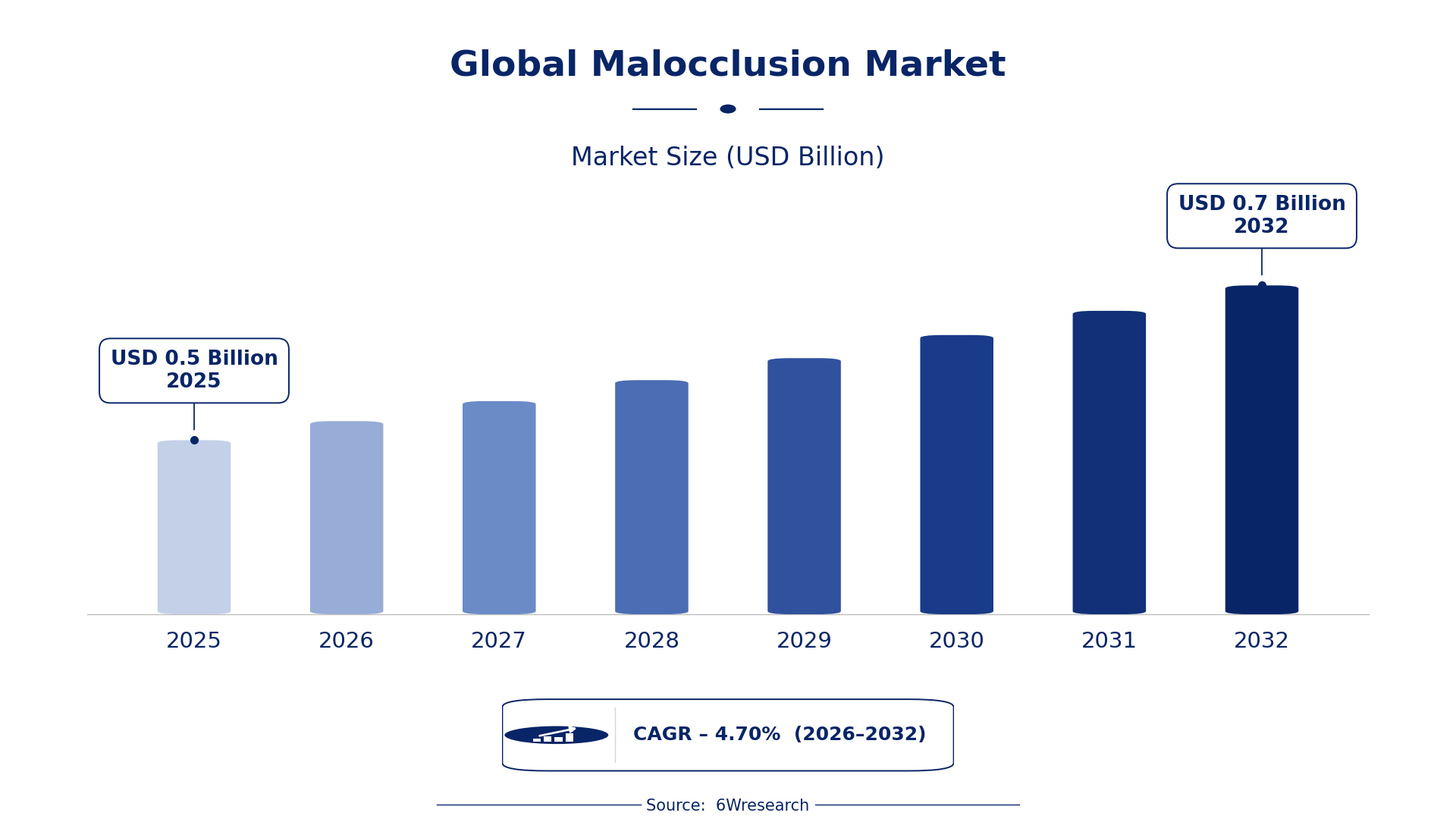
The Global Malocclusion Market was estimated at USD 0.5 Billion in 2025 and is projected to reach USD 0.7 Billion by 2032, growing at a CAGR of 4.70% from 2026 to 2032.
Global Malocclusion Market Synopsis
The Global Malocclusion Market is currently witnessing a transformative phase, spurred by demographic shifts and increased awareness surrounding oral health. More individuals, particularly children and adolescents, are seeking orthodontic treatments, leading to a surge in demand for both traditional and innovative solutions. The market is becoming increasingly intertwined with technological advancements, such as digital dentistry and 3D printing, which streamline treatment processes and improve patient outcomes.
Moreover, the evolution of customer expectations is driving the orthodontic landscape. Patients are more educated and value aesthetics, normalization, and convenience in treatment options, prompting manufacturers to innovate around clear aligners and user-friendly devices. This shift not only enhances patient satisfaction but also lays the groundwork for sustainable market growth.
Global Malocclusion Market Year-wise Growth Rate and Key Drivers
This graph illustrates the annual growth rates of the Global Malocclusion Market from 2022 to 2032, highlighting a steady upward trajectory and projected expansion over the forecast period.
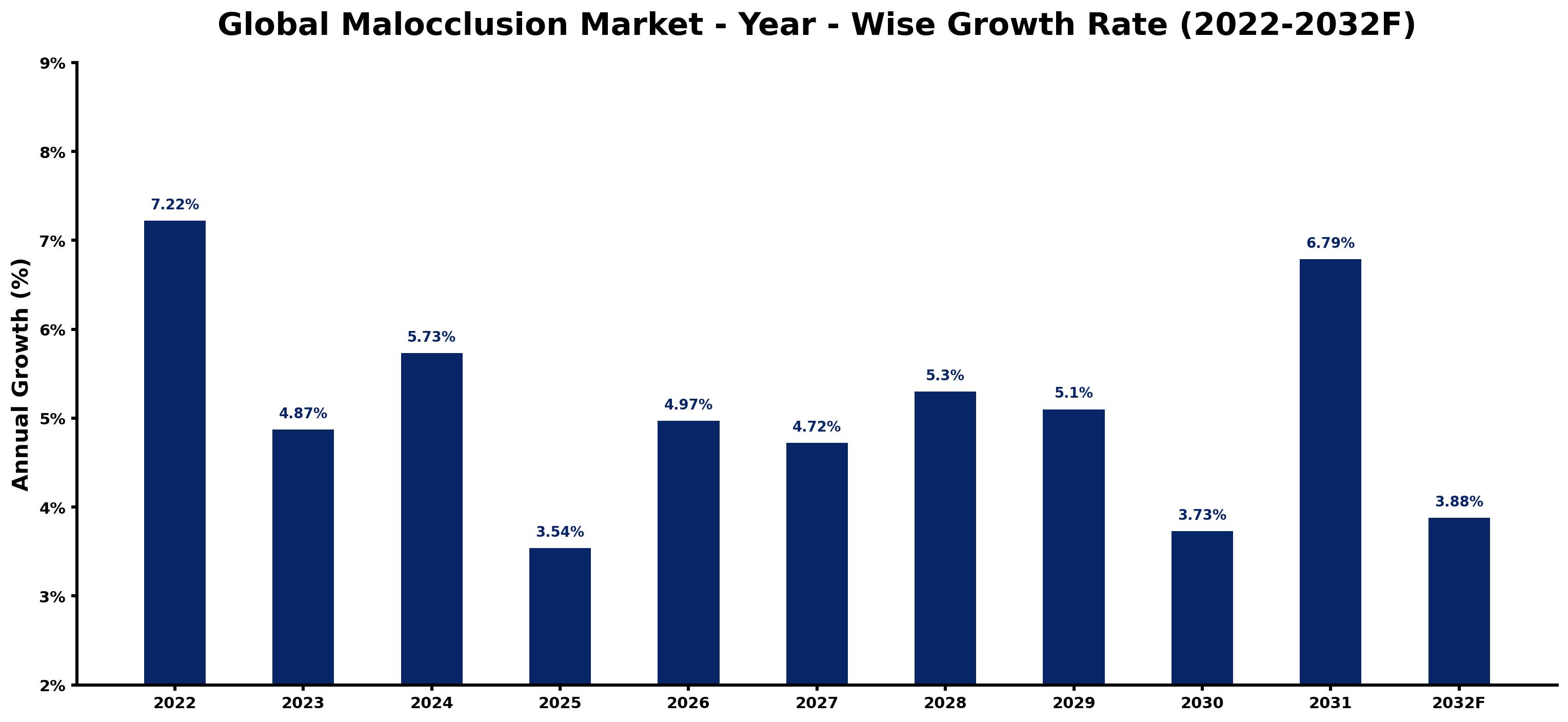
The table below presents the year‑wise growth rates along with the key drivers influencing the market
| Year | Growth Rate (%) | Major Drivers |
| 2022 | 7.22 | Geographic expansion in the malocclusion market enhances treatment accessibility for patients. |
| 2023 | 4.87 | Growing awareness among patients promotes increased consultations about malocclusion treatments. |
| 2024 | 5.73 | A shift toward efficient supply chain management improves malocclusion product availability. |
| 2025 | 3.54 | Diagnostic imaging advancements reduce the costs of malocclusion assessment and treatment planning. |
| 2026 | 4.97 | Patients increasingly seek telehealth platforms for malocclusion consultations and follow-ups. |
| 2027 | 4.72 | Innovative biosensor technology enhances real-time monitoring of malocclusion treatment outcomes. |
| 2028 | 5.3 | In North America, significant investments are fueling advancements in digital therapeutics for malocclusion. |
| 2029 | 5.1 | Healthcare providers are adapting to new reimbursement policies for malocclusion therapies. |
| 2030 | 3.73 | While focusing on sustainable practices, companies are enhancing malocclusion treatment methodologies. |
| 2031 | 6.79 | Intensifying competition among malocclusion service providers is leading to improved patient solutions. |
| 2032 | 3.88 | Upskilling healthcare professionals enhances the delivery of malocclusion treatments across clinics. |
Note - Market size estimations and growth projections presented in this report are based on 6Wresearch's proprietary research methodology, combining internal industry data, secondary research, and primary validation, updated periodically to reflect current market conditions. As markets evolve rapidly, figures for certain industries may vary slightly and are intended as informed estimates rather than absolute figures. For the most current market sizing, we recommend validating figures with a 6Wresearch analyst.
Global Malocclusion Market Key Takeaways
Below are some of the specific key takeaways from the market, including:
- The prevalence of malocclusion is reported at approximately 70% among children, creating a substantial patient base for orthodontic solutions.
- Align Technology, known for its Invisalign system, anticipates revenues of around USD 1.9 billion in 2026, reflecting their robust market position.
- The Class II segment captured around 48% of the market share as of 2025, cementing its dominant position.
- The fastest-growing segment, Class III, is projected to grow at a CAGR of 6.5% from 2026 to 2032, driven by increasing cases of skeletal discrepancies.
- Innovative treatments, such as self-ligating braces, have gained over 20% market traction due to their efficiency and reduced treatment times.
Evaluation of Restraints in Global Malocclusion Market
Despite the promising growth trajectory, the Global Malocclusion Market is encumbered by several noteworthy restraints. One major barrier is the high cost of orthodontic treatment, which can range from USD 3,000 to USD 8,000, making access difficult for lower-income families. Additionally, limited insurance coverage for orthodontic procedures exacerbates the financial strain on patients, hindering early intervention efforts. For example, in the United States, it is reported that only about 30% of dental insurance plans provide any orthodontic benefits.
Global Malocclusion Market Trends
Current trends in the Global Malocclusion Market reveal a significant shift toward digital transformation within orthodontics. The integration of digital imaging technologies—such as cone beam computed tomography (CBCT)—is enhancing diagnostic accuracy and treatment planning. For instance, companies like 3M began utilizing these advanced imaging techniques in 2025 to reduce treatment time while improving patient experience. Another notable trend is the growing preference for aesthetic treatments, particularly clear aligners, which are expected to hold a larger share of the market as patient awareness of alternatives increases. Furthermore, specialized software designed for orthodontic practices is gaining traction, enabling better patient management and service efficiency.
Global Malocclusion Market Opportunities
Looking toward the future, several opportunities exist for revenue growth in the Global Malocclusion Market. The increasing prevalence of adult patients seeking orthodontic treatments presents a lucrative demographic untapped by traditional marketing channels. For example, Ormco Corporation is set to launch a new product line targeting adult patients, projecting an expansion of their market share by at least 15% in the next five years. Additionally, the incorporation of artificial intelligence in treatment design is poised to enhance personalized orthodontics, offering customized solutions that cater to individual patient needs. This innovation not only enhances treatment outcomes but also opens avenues for partnerships with tech companies seeking entry into healthcare.
Global Malocclusion Market by Class
In the Global Malocclusion Market, the Class II segment is the largest, commanding approximately 48% share in 2025. On the other hand, Class III is the fastest-growing segment, anticipated to expand at a CAGR of 6.5% from 2026 to 2032. The growing recognition of the treatment complexities associated with Class III malocclusion, often resulting from both dental and skeletal discrepancies, contributes to its accelerated growth rate. As practitioners and patients alike seek tailored solutions, advancements in treatment modalities specific to this class are expected to drive further demand.
Global Malocclusion Market by Treatment
Orthodontic braces are currently the leading treatment in the Global Malocclusion Market, representing about 60% of the total market share as of 2025. Meanwhile, the surgery segment is emerging as the fastest-growing treatment type, projected to grow at a CAGR of 5.5% from 2026 to 2032. This growth is attributed to the increasing incidence of severe malocclusion cases requiring surgical intervention, especially among adolescents. The demand for orthodontic braces remains robust due to their long-standing effectiveness in treating various malocclusion types, reinforcing their dominant position within the market.
Global Malocclusion Market by End User
Dental Clinics dominate the Global Malocclusion Market, holding approximately 70% share in 2025. However, Hospitals & Clinics are the fastest-growing segment, with a projected CAGR of 5.0% from 2026 to 2032. The increasing preference for treatment within hospital settings, particularly for complex cases that require multidisciplinary care, is driving this growth. Dental clinics continue to operate as primary care centers, but the rise in complex malocclusion cases necessitates integrated approaches commonly found in hospital environments.
Global Malocclusion Market by Region
North America is the largest region in the Global Malocclusion Market, accounting for approximately 45% share as of 2025. Asia, however, is expected to be the fastest-growing region, with a CAGR of 6.0% from 2026 to 2032. This growth can be attributed to the increasing urbanization, higher awareness of dental aesthetics, and expanding healthcare infrastructure in countries like China and India. The concentration of manufacturing capabilities and advancements in orthodontic practices in North America also contribute significantly to its market dominance, setting a competitive benchmark for other regions.
Government Initiatives in the Global Malocclusion Market
The regulatory landscape for the Global Malocclusion Market is characterized by various government initiatives aimed at improving oral health outcomes. These initiatives influence market dynamics by promoting awareness, providing funding for dental education, and ensuring better access to orthodontic care. The focus is often on preventive measures, encouraging early diagnosis and treatment of malocclusion.
- Centers for Disease Control and Prevention (CDC) - "National Oral Health Program," established in 2018, aims to enhance oral health education and access to care across the United States.
- National Institute of Dental and Craniofacial Research (NIDCR) - "Dental Caries and Malocclusions Prevention Initiative," launched in 2021, provides funding for research on effective treatment options for malocclusion.
- European Commission - "Oral Health Action Plan," proposed in 2023, focuses on improving public health policies related to orthodontics and ensuring comprehensive coverage for treatments.
- Health Canada - "Funding for Orthodontic Services Initiative," initiated in 2022, invests CAD 10 million to support community-based orthodontic programs for underserved populations.
Future Insights of the Global Malocclusion Market
As the Global Malocclusion Market progresses towards 2032, major structural transformations are anticipated. The shift towards teleorthodontics, highlighted by companies like Align Technology, is revolutionizing patient engagement through virtual consultations and monitoring. This development not only enhances accessibility but also reduces treatment durations, aligning with evolving patient expectations. Investments in AI-powered diagnostic tools are likely to surge, enabling more tailored treatment plans and improving efficiency within orthodontic practices. Such advancements promise not only to advance competitive positioning but also to reshape traditional patient care models.
Global Malocclusion Market Latest Developments
Recent developments in the Global Malocclusion Market showcase significant strategic moves by key players, aiming to enhance their competitive edge and market standing.
- Align Technology recently launched an advanced version of its Invisalign system in early 2023, incorporating AI technologies to optimize treatment plans. This enhancement is expected to improve patient outcomes and expand their market share further.
- Dentsply Sirona is in the process of expanding its production capabilities in Europe, expected to be completed by mid-2025. This move will significantly boost their local supply chain efficiency and meet the growing demand for orthodontic solutions in that region.
- 3M Company is set to introduce a new line of aesthetic braces aimed at younger demographics later in 2024, focusing on a blend of style and function that appeals to adolescent patients.
- Henry Schein, Inc. is investing in technological training programs for dentists starting in 2023, aiming to elevate the standard of care provided by orthodontic professionals and meet contemporary treatment expectations.
Global Malocclusion Market Key Players and Industry Positioning
The Global Malocclusion Market is somewhat fragmented, characterized by multiple key players competing for market share through product differentiation and strategic advancements. The strengths of these companies are reflected in their targeted approaches, focusing on different aspects of orthodontic care.
| Leading Company | Core Strength | Strategic Focus |
|---|---|---|
| Align Technology, Inc. | Market leader in clear aligner technology with robust innovation. | Focusing on digital solutions and teleorthodontics. |
| Dentsply Sirona | Strong portfolio in orthodontic instruments and CAD/CAM technologies. | Expanding manufacturing capabilities in strategic regions. |
| Ormco Corporation | Expertise in self-ligating brackets and innovative orthodontics. | Targeting adult orthodontic solutions and expanding product range. |
| 3M Company | Diverse offerings in dental products, including braces and bonding systems. | Developing aesthetic options and reducing treatment times. |
| Henry Schein, Inc. | Strong distribution network and customer service in healthcare products. | Investing in training and educational resources for professionals. |
These players exhibit distinct competitive advantages that inform their strategic decisions, enabling them to respond to market trends effectively while enhancing patient care.
Key Attractiveness of the Report
- 10 Years of Market Numbers
- Historical Data Starting from 2022 to 2025
- Base Year: 2025
- Forecast Data until 2032
- Key Performance Indicators Impacting the Market
- Major Upcoming Developments and Projects
Key Highlights of the Report:
- Global Malocclusion Market Outlook
- Market Size of Global Malocclusion Market, 2025
- Forecast of Global Malocclusion Market, 2032
- Historical Data and Forecast of Global Malocclusion Revenues & Volume for the Period 2022-2032
- Global Malocclusion Market Trend Evolution
- Global Malocclusion Market Drivers and Challenges
- Global Malocclusion Price Trends
- Global Malocclusion Porter's Five Forces
- Global Malocclusion Industry Life Cycle
- Historical Data and Forecast of Global Malocclusion Market Revenues & Volume
- Historical Data and Forecast of Global Malocclusion Market Revenues & Volume By Class for the Period 2022-2032
- Historical Data and Forecast of Global Malocclusion Market Revenues & Volume By Class I for the Period 2022-2032
- Historical Data and Forecast of Global Malocclusion Market Revenues & Volume By Class II for the Period 2022-2032
- Historical Data and Forecast of Global Malocclusion Market Revenues & Volume By Class III for the Period 2022-2032
- Historical Data and Forecast of Global Malocclusion Market Revenues & Volume By Treatment for the Period 2022-2032
- Historical Data and Forecast of Global Malocclusion Market Revenues & Volume By Orthodontic Braces for the Period 2022-2032
- Historical Data and Forecast of Global Malocclusion Market Revenues & Volume By Surgery for the Period 2022-2032
- Historical Data and Forecast of Global Malocclusion Market Revenues & Volume By End User for the Period 2022-2032
- Historical Data and Forecast of Global Malocclusion Market Revenues & Volume By Hospitals & Clinics for the Period 2022-2032
- Historical Data and Forecast of Global Malocclusion Market Revenues & Volume By Dental Clinics for the Period 2022-2032
- Historical Data and Forecast of North America Malocclusion Market Revenues & Volume By Class for the Period 2022-2032
- Historical Data and Forecast of North America Malocclusion Market Revenues & Volume By Class I for the Period 2022-2032
- Historical Data and Forecast of North America Malocclusion Market Revenues & Volume By Class II for the Period 2022-2032
- Historical Data and Forecast of North America Malocclusion Market Revenues & Volume By Class III for the Period 2022-2032
- Historical Data and Forecast of North America Malocclusion Market Revenues & Volume By Treatment for the Period 2022-2032
- Historical Data and Forecast of North America Malocclusion Market Revenues & Volume By Orthodontic Braces for the Period 2022-2032
- Historical Data and Forecast of North America Malocclusion Market Revenues & Volume By Surgery for the Period 2022-2032
- Historical Data and Forecast of North America Malocclusion Market Revenues & Volume By End User for the Period 2022-2032
- Historical Data and Forecast of North America Malocclusion Market Revenues & Volume By Hospitals & Clinics for the Period 2022-2032
- Historical Data and Forecast of North America Malocclusion Market Revenues & Volume By Dental Clinics for the Period 2022-2032
- Historical Data and Forecast of United States of America Malocclusion Market Revenues & Volume for the Period 2022-2032
- Historical Data and Forecast of Canada Malocclusion Market Revenues & Volume for the Period 2022-2032
- Historical Data and Forecast of Rest of North America Malocclusion Market Revenues & Volume for the Period 2022-2032
- Historical Data and Forecast of Latin America (LATAM) Malocclusion Market Revenues & Volume By Class for the Period 2022-2032
- Historical Data and Forecast of Latin America (LATAM) Malocclusion Market Revenues & Volume By Class I for the Period 2022-2032
- Historical Data and Forecast of Latin America (LATAM) Malocclusion Market Revenues & Volume By Class II for the Period 2022-2032
- Historical Data and Forecast of Latin America (LATAM) Malocclusion Market Revenues & Volume By Class III for the Period 2022-2032
- Historical Data and Forecast of Latin America (LATAM) Malocclusion Market Revenues & Volume By Treatment for the Period 2022-2032
- Historical Data and Forecast of Latin America (LATAM) Malocclusion Market Revenues & Volume By Orthodontic Braces for the Period 2022-2032
- Historical Data and Forecast of Latin America (LATAM) Malocclusion Market Revenues & Volume By Surgery for the Period 2022-2032
- Historical Data and Forecast of Latin America (LATAM) Malocclusion Market Revenues & Volume By End User for the Period 2022-2032
- Historical Data and Forecast of Latin America (LATAM) Malocclusion Market Revenues & Volume By Hospitals & Clinics for the Period 2022-2032
- Historical Data and Forecast of Latin America (LATAM) Malocclusion Market Revenues & Volume By Dental Clinics for the Period 2022-2032
- Historical Data and Forecast of Brazil Malocclusion Market Revenues & Volume for the Period 2022-2032
- Historical Data and Forecast of Mexico Malocclusion Market Revenues & Volume for the Period 2022-2032
- Historical Data and Forecast of Argentina Malocclusion Market Revenues & Volume for the Period 2022-2032
- Historical Data and Forecast of Rest of LATAM Malocclusion Market Revenues & Volume for the Period 2022-2032
- Historical Data and Forecast of Asia Malocclusion Market Revenues & Volume By Class for the Period 2022-2032
- Historical Data and Forecast of Asia Malocclusion Market Revenues & Volume By Class I for the Period 2022-2032
- Historical Data and Forecast of Asia Malocclusion Market Revenues & Volume By Class II for the Period 2022-2032
- Historical Data and Forecast of Asia Malocclusion Market Revenues & Volume By Class III for the Period 2022-2032
- Historical Data and Forecast of Asia Malocclusion Market Revenues & Volume By Treatment for the Period 2022-2032
- Historical Data and Forecast of Asia Malocclusion Market Revenues & Volume By Orthodontic Braces for the Period 2022-2032
- Historical Data and Forecast of Asia Malocclusion Market Revenues & Volume By Surgery for the Period 2022-2032
- Historical Data and Forecast of Asia Malocclusion Market Revenues & Volume By End User for the Period 2022-2032
- Historical Data and Forecast of Asia Malocclusion Market Revenues & Volume By Hospitals & Clinics for the Period 2022-2032
- Historical Data and Forecast of Asia Malocclusion Market Revenues & Volume By Dental Clinics for the Period 2022-2032
- Historical Data and Forecast of China Malocclusion Market Revenues & Volume for the Period 2022-2032
- Historical Data and Forecast of India Malocclusion Market Revenues & Volume for the Period 2022-2032
- Historical Data and Forecast of Japan Malocclusion Market Revenues & Volume for the Period 2022-2032
- Historical Data and Forecast of Rest of Asia Malocclusion Market Revenues & Volume for the Period 2022-2032
- Historical Data and Forecast of Africa Malocclusion Market Revenues & Volume By Class for the Period 2022-2032
- Historical Data and Forecast of Africa Malocclusion Market Revenues & Volume By Class I for the Period 2022-2032
- Historical Data and Forecast of Africa Malocclusion Market Revenues & Volume By Class II for the Period 2022-2032
- Historical Data and Forecast of Africa Malocclusion Market Revenues & Volume By Class III for the Period 2022-2032
- Historical Data and Forecast of Africa Malocclusion Market Revenues & Volume By Treatment for the Period 2022-2032
- Historical Data and Forecast of Africa Malocclusion Market Revenues & Volume By Orthodontic Braces for the Period 2022-2032
- Historical Data and Forecast of Africa Malocclusion Market Revenues & Volume By Surgery for the Period 2022-2032
- Historical Data and Forecast of Africa Malocclusion Market Revenues & Volume By End User for the Period 2022-2032
- Historical Data and Forecast of Africa Malocclusion Market Revenues & Volume By Hospitals & Clinics for the Period 2022-2032
- Historical Data and Forecast of Africa Malocclusion Market Revenues & Volume By Dental Clinics for the Period 2022-2032
- Historical Data and Forecast of South Africa Malocclusion Market Revenues & Volume for the Period 2022-2032
- Historical Data and Forecast of Nigeria Malocclusion Market Revenues & Volume for the Period 2022-2032
- Historical Data and Forecast of Egypt Malocclusion Market Revenues & Volume for the Period 2022-2032
- Historical Data and Forecast of Rest of Africa Malocclusion Market Revenues & Volume for the Period 2022-2032
- Historical Data and Forecast of Europe Malocclusion Market Revenues & Volume By Class for the Period 2022-2032
- Historical Data and Forecast of Europe Malocclusion Market Revenues & Volume By Class I for the Period 2022-2032
- Historical Data and Forecast of Europe Malocclusion Market Revenues & Volume By Class II for the Period 2022-2032
- Historical Data and Forecast of Europe Malocclusion Market Revenues & Volume By Class III for the Period 2022-2032
- Historical Data and Forecast of Europe Malocclusion Market Revenues & Volume By Treatment for the Period 2022-2032
- Historical Data and Forecast of Europe Malocclusion Market Revenues & Volume By Orthodontic Braces for the Period 2022-2032
- Historical Data and Forecast of Europe Malocclusion Market Revenues & Volume By Surgery for the Period 2022-2032
- Historical Data and Forecast of Europe Malocclusion Market Revenues & Volume By End User for the Period 2022-2032
- Historical Data and Forecast of Europe Malocclusion Market Revenues & Volume By Hospitals & Clinics for the Period 2022-2032
- Historical Data and Forecast of Europe Malocclusion Market Revenues & Volume By Dental Clinics for the Period 2022-2032
- Historical Data and Forecast of United Kingdom Malocclusion Market Revenues & Volume for the Period 2022-2032
- Historical Data and Forecast of France Malocclusion Market Revenues & Volume for the Period 2022-2032
- Historical Data and Forecast of Germany Malocclusion Market Revenues & Volume for the Period 2022-2032
- Historical Data and Forecast of Rest of Europe Malocclusion Market Revenues & Volume for the Period 2022-2032
- Historical Data and Forecast of Middle East Malocclusion Market Revenues & Volume By Class for the Period 2022-2032
- Historical Data and Forecast of Middle East Malocclusion Market Revenues & Volume By Class I for the Period 2022-2032
- Historical Data and Forecast of Middle East Malocclusion Market Revenues & Volume By Class II for the Period 2022-2032
- Historical Data and Forecast of Middle East Malocclusion Market Revenues & Volume By Class III for the Period 2022-2032
- Historical Data and Forecast of Middle East Malocclusion Market Revenues & Volume By Treatment for the Period 2022-2032
- Historical Data and Forecast of Middle East Malocclusion Market Revenues & Volume By Orthodontic Braces for the Period 2022-2032
- Historical Data and Forecast of Middle East Malocclusion Market Revenues & Volume By Surgery for the Period 2022-2032
- Historical Data and Forecast of Middle East Malocclusion Market Revenues & Volume By End User for the Period 2022-2032
- Historical Data and Forecast of Middle East Malocclusion Market Revenues & Volume By Hospitals & Clinics for the Period 2022-2032
- Historical Data and Forecast of Middle East Malocclusion Market Revenues & Volume By Dental Clinics for the Period 2022-2032
- Historical Data and Forecast of Saudi Arabia Malocclusion Market Revenues & Volume for the Period 2022-2032
- Historical Data and Forecast of UAE Malocclusion Market Revenues & Volume for the Period 2022-2032
- Historical Data and Forecast of Turkey Malocclusion Market Revenues & Volume for the Period 2022-2032
- Historical Data and Forecast of Rest of Middle East Malocclusion Market Revenues & Volume for the Period 2022-2032
- Global Malocclusion Market - Key Performance Indicators
- Global Malocclusion Market - Import Export Trade Statistics
- Global Malocclusion Market - Opportunity Assessment By Countries
- Global Malocclusion Market - Opportunity Assessment By Class
- Global Malocclusion Market - Opportunity Assessment By Treatment
- Global Malocclusion Market - Opportunity Assessment By End User
- Global Malocclusion Market - Top Companies Market Share
- Global Malocclusion Market - Top Companies Profiles
- Global Malocclusion Market - Comparison of Players in Technical and Operating Parameters
- Global Malocclusion Market - Strategic Recommendations
Markets Covered
The Global Malocclusion Market report provides a detailed analysis of the following market segments:
By Regions and Countries:
- North America
- Europe
- LATAM
- Middle East
- Asia
- Africa
By Class:
- Class I
- Class II
- Class III
By Treatment:
- Orthodontic Braces
- Surgery
By End User:
- Hospitals & Clinics
- Dental Clinics






































