Global Meal Replacement Market Highlights
| Market Size (2025) | USD 11.3 Billion |
| Forecast Size (2032) | USD 17.4 Billion |
| CAGR | 6.10% |
| Base Year | 2025 |
| Forecast Period | 2026-2032 |
| Largest Region | North America |
| Fastest Growing Region | Asia-Pacific |
| Largest Segment | Ready-to-Drink |
| Fastest Growing Segment | Powder |
| Leading Companies | Herbalife, SlimFast, Abbott Nutrition, Soylent, Orgain |
Global Meal Replacement Market Size & Growth Rate (2026-2032)
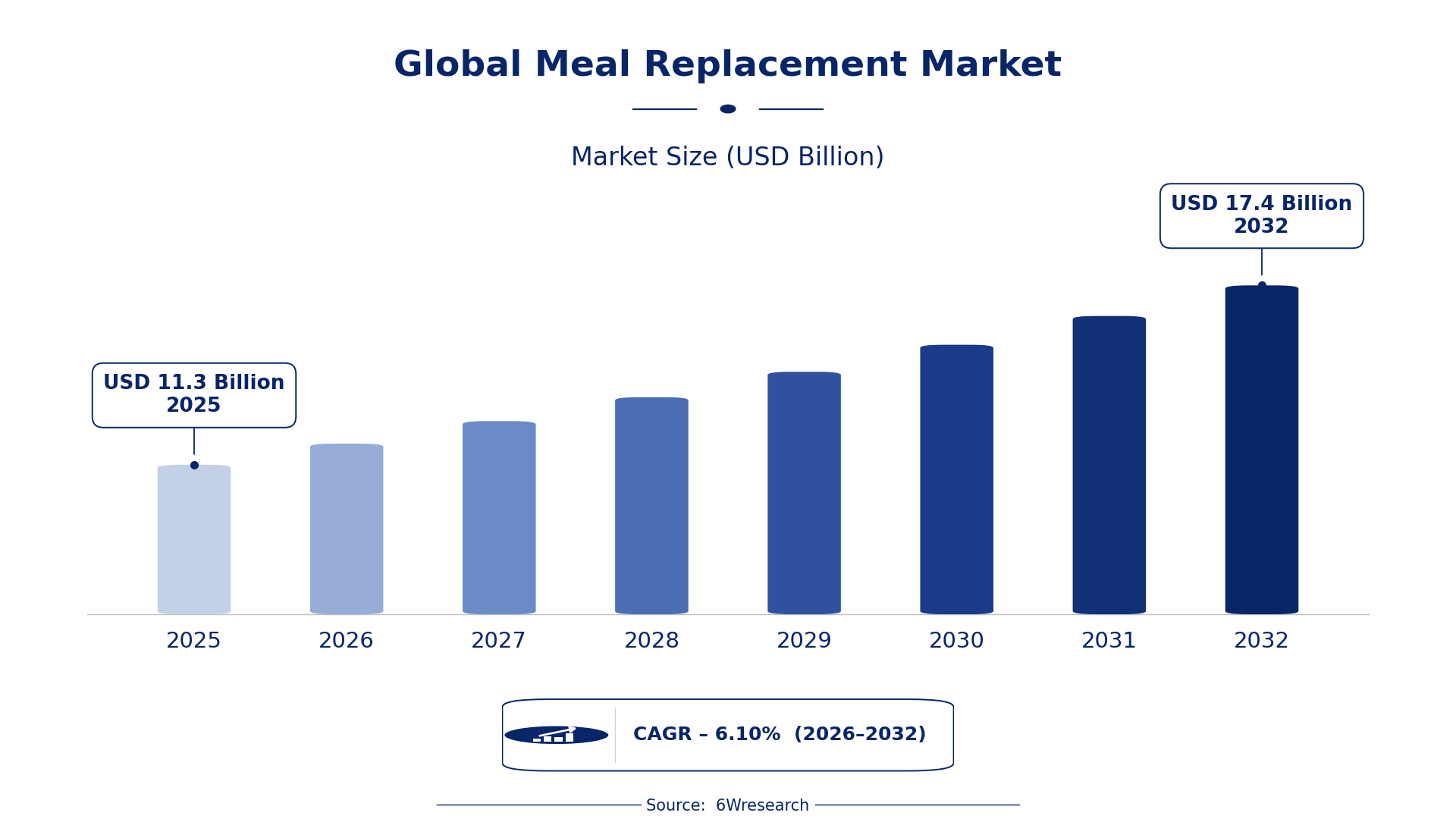
The Global Meal Replacement Market was estimated at USD 11.3 Billion in 2025 and is projected to reach USD 17.4 Billion by 2032, growing at a CAGR of 6.10% from 2026 to 2032.
Global Meal Replacement Market Synopsis
The Global Meal Replacement Market is witnessing fundamental shifts in consumer behavior, largely driven by a surge in health consciousness and busy lifestyles. Consumers are increasingly gravitating toward meal replacements that offer convenience without compromising nutritional value. This transformation is not merely a trend; it's indicative of a broader movement toward efficient meal solutions that blend nutrition and practicality.
As various demographics embrace healthier eating practices, industries such as fitness, healthcare, and even corporate wellness programs are integrating meal replacements into their offerings. With the advent of personalized nutrition solutions, companies are rapidly adapting product lines to cater to individual dietary requirements, setting the stage for competitive differentiation in a crowded market.
Global Meal Replacement Market Year-wise Growth Rate and Key Drivers
This graph illustrates the annual growth rates of the Global Meal Replacement Market from 2022 to 2032, highlighting a steady upward trajectory and projected expansion over the forecast period.
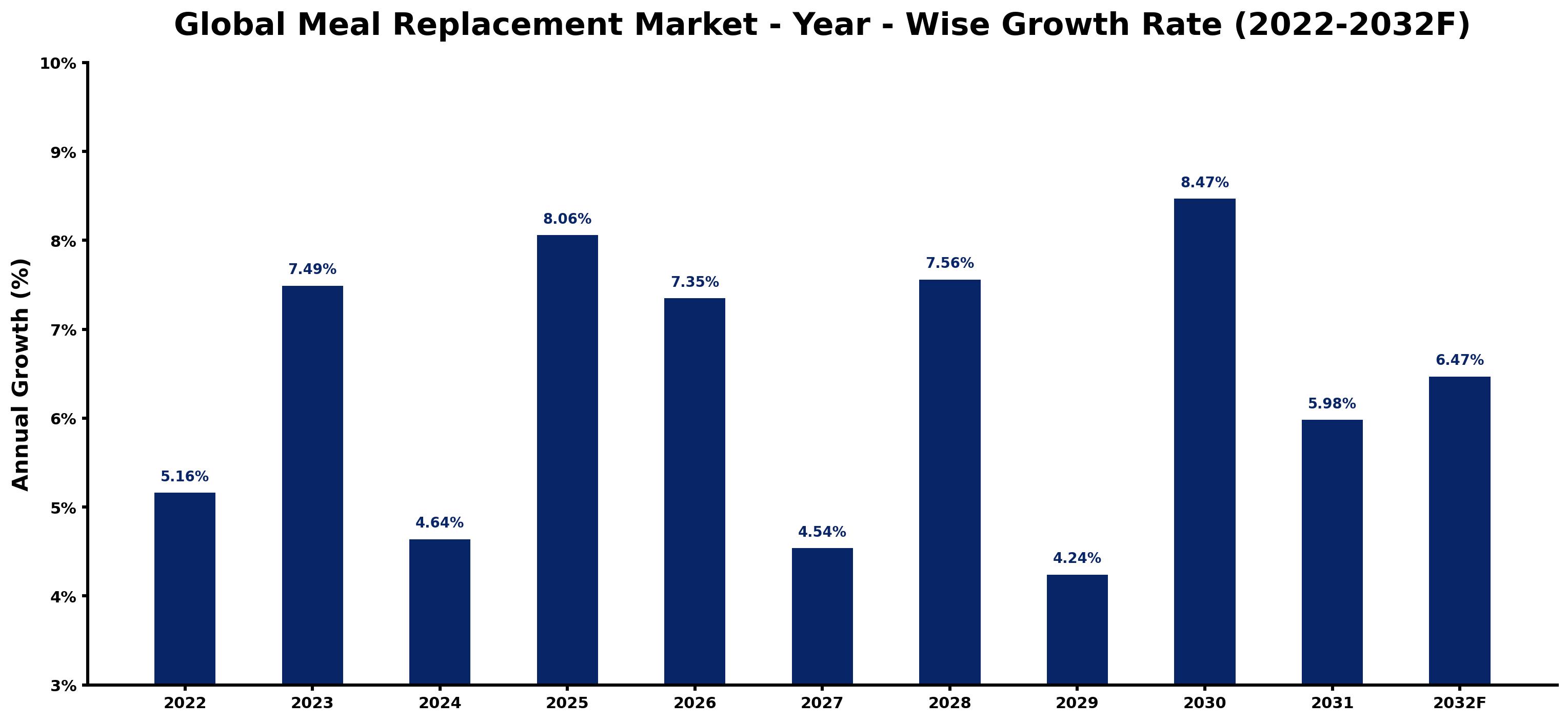
The table below presents the year‑wise growth rates along with the key drivers influencing the market
| Year | Growth Rate (%) | Major Drivers |
| 2022 | 5.16 | Geographic expansion across emerging markets contributes to foundational growth in meal replacements. |
| 2023 | 7.49 | Clean-label formulations resonate with eco-conscious consumers, enhancing meal replacement appeal. |
| 2024 | 4.64 | The rise in health awareness drives consumer preferences for convenient meal replacement options. |
| 2025 | 8.06 | E-commerce platforms enhance accessibility, spurring innovative meal replacement product offerings. |
| 2026 | 7.35 | Supply chain optimization for raw ingredients reduces costs, benefiting meal replacement pricing. |
| 2027 | 4.54 | As private-label competition increases, established brands must innovate meal replacement offerings. |
| 2028 | 7.56 | Expanding workforce skills in nutrition science supports the development of tailored meal replacements. |
| 2029 | 4.24 | Health-conscious consumers prioritize high-quality ingredients in their meal replacement purchases. |
| 2030 | 8.47 | A shift toward convenience eating reshapes consumer choices in meal replacement products. |
| 2031 | 5.98 | In North America, regulatory changes shape labeling standards for meal replacement options. |
| 2032 | 6.47 | Manufacturers are increasingly investing in sustainable packaging for meal replacement solutions. |
Note - Market size estimations and growth projections presented in this report are based on 6Wresearch's proprietary research methodology, combining internal industry data, secondary research, and primary validation, updated periodically to reflect current market conditions. As markets evolve rapidly, figures for certain industries may vary slightly and are intended as informed estimates rather than absolute figures. For the most current market sizing, we recommend validating figures with a 6Wresearch analyst.
Global Meal Replacement Market Key Takeaways
Below are some of the specific key takeaways from the market, including:
- Ready-to-Drink products command a market share of approximately 45% in 2025, driven by consumer preference for on-the-go solutions.
- In 2021, SlimFast launched a new line of high-protein shakes, increasing its market footprint significantly.
- The Asia-Pacific region is projected to exhibit a CAGR of 8.7% from 2026 to 2032, indicative of rising health awareness among urban populations.
- Personalization trends are capturing consumer interest, with companies like Herbalife reporting a 20% increase in sales of tailored meal solutions.
Evaluation of Restraints in Global Meal Replacement Market
Despite growing interest, the Global Meal Replacement Market grapples with numerous challenges. One noteworthy restraint is consumer skepticism regarding the authenticity of nutritional claims; for instance, 40% of consumers express concerns about the long-term health implications of meal replacements. Regulatory obstacles further complicate market dynamics, as varying requirements across countries hinder introduction in diverse markets. A recent case involved the European Union imposing stricter guidelines on protein claims, leading to potential revenue losses for non-compliant brands.
Global Meal Replacement Market Trends
Significant trends are reshaping the Global Meal Replacement Market as companies adapt to evolving consumer demands. A pronounced shift toward plant-based meal replacements has emerged, with brands like Orgain capturing market attention through organic and vegan options. For example, in 2022, the company reported a 25% year-on-year sales increase attributed to its clean ingredient messaging. Another notable trend is enhanced functionality, with products now incorporating probiotics and adaptogens, catering to a more health-savvy audience. This aligns with the growing preference for products that offer functional benefits beyond basic nutrition.
Global Meal Replacement Market Opportunities
The Global Meal Replacement Market presents several lucrative future revenue opportunities. One promising area is the shift toward meal replacements tailored for specific lifestyles, particularly among athletes and fitness enthusiasts. Companies like Herbalife have been formulating products with premium ingredients that target performance nutrition, resulting in 15% revenue growth in this segment last year. Moreover, the rise of personalized nutrition offers a fertile ground for innovations in flavors and formulations. For example, Abbott's new line of customized powder blends is expected to tap into the growing demand for individualized meal solutions, aiming for a market share increase of 10% in the upcoming years.
Global Meal Replacement Market by Product Type
In the Global Meal Replacement Market, Ready-to-Drink products lead with a substantial share, capturing approximately 45% in 2025. This segment's dominance can be attributed to its convenience and wide acceptance among busy consumers. On the other hand, the Powder segment is projected as the fastest-growing, with a CAGR of 7.5% from 2026 to 2032. This growth is driven by increased consumer interest in customizable nutrition options, allowing for easy adaptation to various dietary preferences.
Global Meal Replacement Market by Distribution Channel
The Global Meal Replacement Market sees Offline distribution channels holding the largest share, estimated at 60% in 2025. Traditional retail stores remain popular among consumers seeking immediate product availability. Contrastingly, Online channels are rapidly emerging as the fastest-growing segment, with a CAGR of 9.2% from 2026 to 2032, reflecting changing shopping habits driven by convenience and the broader e-commerce evolution.
Global Meal Replacement Market by Region
North America dominates the Global Meal Replacement Market, accounting for around 50% of the share in 2025, largely due to established consumer bases and robust distribution networks. Meanwhile, the Asia-Pacific region is positioned as the fastest-growing area, expected to achieve a CAGR of 8.7% from 2026 to 2032, fueled by increasing urbanization and health consciousness, especially among younger demographics.
Government Initiatives in the Global Meal Replacement Market
The regulatory landscape for the Global Meal Replacement Market is shaped by various government initiatives aimed at promoting healthier eating and nutritional education. These policies often provide essential support to manufacturers and consumers alike, influencing product development and marketing strategies.
- United States Department of Agriculture - Nutrition Incentive Program, May 2022. This program aims to improve access to healthy food options, benefiting the meal replacement sector by supporting local producers.
- Food Safety and Standards Authority of India - Draft Regulations for Meal Replacement Products, January 2023. This initiative seeks to standardize product formulations, fostering consumer trust and potentially increasing market size.
- European Food Safety Authority - New Nutritional Claims Guidelines, March 2021. These guidelines affect labeling practices for meal replacements, ensuring transparency and consumer confidence in nutritional claims.
- Government of Canada - Healthy Eating Strategy, 2020. This initiative encourages food manufacturers to offer healthier meal options, creating a favorable environment for meal replacement products.
Future Insights of the Global Meal Replacement Market
As health trends evolve, the landscape of the Global Meal Replacement Market is set to transform significantly. Expect a surge in personalized meal solutions, particularly as companies like Abbott Nutrition develop customized products tailored to specific dietary needs. This shift is supported by the growing consumer preference for functional benefits and quality ingredients. Innovations in manufacturing techniques will likely streamline production while enhancing nutritional efficacy, paving the way for competitive differentiation and expanding the target demographic beyond traditional consumers.
Global Meal Replacement Market Latest Developments
The competitive landscape of the Global Meal Replacement Market has witnessed notable advancements recently, with key players enhancing their portfolios and expanding their market presence. Below are some significant developments that illustrate this momentum:
- In June 2023, Soylent launched a new line of ready-to-drink meal replacements enriched with added fiber, aimed at improving digestive health.
- Recently, in April 2023, Herbalife unveiled a vegan protein shake line, expanding its reach within health-conscious consumers focused on plant-based diets.
- Abbott Nutrition is expected to introduce an advanced line of meal replacement powders containing adaptogens by early 2024, targeting functional food enthusiasts.
- SlimFast announced a partnership in March 2023 with a leading fitness app to expand its direct-to-consumer sales channel, focusing on personalized nutrition plans.
Global Meal Replacement Market Key Players and Industry Positioning
The Global Meal Replacement Market is characterized by a relatively fragmented competitive structure, with several key players competing for market share through product diversification and strategic alliances. Companies are focusing on enhancing their offerings to cater to the changing consumer preferences for health and convenience.
| Leading Company | Core Strength | Strategic Focus |
|---|---|---|
| Herbalife | Strong brand recognition and personalized nutrition solutions. | Targeting diverse demographic segments through tailored products. |
| SlimFast | Robust marketing strategies and established distribution channels. | Expanding online presence to capture evolving consumer habits. |
| Abbott Nutrition | Leading-edge research and development in functional nutrition. | Innovating personalized nutrition products for specific health needs. |
| Soylent | Focus on convenient meal solutions with a nutritional approach. | Diversifying product range to include functional and healthy choices. |
| Orgain | Emphasis on organic, plant-based meal replacements. | Strengthening product formulations to meet consumer health trends. |
In summary, the competitive dynamics in the Global Meal Replacement Market hinge on players' abilities to innovate and adapt to consumer preferences. Strategic investments in product development and marketing will be crucial in defining future market leaders.
Key Attractiveness of the Report
- 10 Years of Market Numbers
- Historical Data Starting from 2022 to 2025
- Base Year: 2025
- Forecast Data until 2032
- Key Performance Indicators Impacting the Market
- Major Upcoming Developments and Projects
Key Highlights of the Report:
- Global Meal Replacement Market Outlook
- Market Size of Global Meal Replacement Market, 2025
- Forecast of Global Meal Replacement Market, 2032
- Historical Data and Forecast of Global Meal Replacement Revenues & Volume for the Period 2022-2032
- Global Meal Replacement Market Trend Evolution
- Global Meal Replacement Market Drivers and Challenges
- Global Meal Replacement Price Trends
- Global Meal Replacement Porter's Five Forces
- Global Meal Replacement Industry Life Cycle
- Historical Data and Forecast of Global Meal Replacement Market Revenues & Volume
- Historical Data and Forecast of Global Meal Replacement Market Revenues & Volume By Product Type for the Period 2022-2032
- Historical Data and Forecast of Global Meal Replacement Market Revenues & Volume By Ready-to-Drink for the Period 2022-2032
- Historical Data and Forecast of Global Meal Replacement Market Revenues & Volume By Bars for the Period 2022-2032
- Historical Data and Forecast of Global Meal Replacement Market Revenues & Volume By Powder for the Period 2022-2032
- Historical Data and Forecast of Global Meal Replacement Market Revenues & Volume By Distribution Channel for the Period 2022-2032
- Historical Data and Forecast of Global Meal Replacement Market Revenues & Volume By Offline for the Period 2022-2032
- Historical Data and Forecast of Global Meal Replacement Market Revenues & Volume By Online for the Period 2022-2032
- Historical Data and Forecast of North America Meal Replacement Market Revenues & Volume By Product Type for the Period 2022-2032
- Historical Data and Forecast of North America Meal Replacement Market Revenues & Volume By Ready-to-Drink for the Period 2022-2032
- Historical Data and Forecast of North America Meal Replacement Market Revenues & Volume By Bars for the Period 2022-2032
- Historical Data and Forecast of North America Meal Replacement Market Revenues & Volume By Powder for the Period 2022-2032
- Historical Data and Forecast of North America Meal Replacement Market Revenues & Volume By Distribution Channel for the Period 2022-2032
- Historical Data and Forecast of North America Meal Replacement Market Revenues & Volume By Offline for the Period 2022-2032
- Historical Data and Forecast of North America Meal Replacement Market Revenues & Volume By Online for the Period 2022-2032
- Historical Data and Forecast of United States of America Meal Replacement Market Revenues & Volume for the Period 2022-2032
- Historical Data and Forecast of Canada Meal Replacement Market Revenues & Volume for the Period 2022-2032
- Historical Data and Forecast of Rest of North America Meal Replacement Market Revenues & Volume for the Period 2022-2032
- Historical Data and Forecast of Latin America (LATAM) Meal Replacement Market Revenues & Volume By Product Type for the Period 2022-2032
- Historical Data and Forecast of Latin America (LATAM) Meal Replacement Market Revenues & Volume By Ready-to-Drink for the Period 2022-2032
- Historical Data and Forecast of Latin America (LATAM) Meal Replacement Market Revenues & Volume By Bars for the Period 2022-2032
- Historical Data and Forecast of Latin America (LATAM) Meal Replacement Market Revenues & Volume By Powder for the Period 2022-2032
- Historical Data and Forecast of Latin America (LATAM) Meal Replacement Market Revenues & Volume By Distribution Channel for the Period 2022-2032
- Historical Data and Forecast of Latin America (LATAM) Meal Replacement Market Revenues & Volume By Offline for the Period 2022-2032
- Historical Data and Forecast of Latin America (LATAM) Meal Replacement Market Revenues & Volume By Online for the Period 2022-2032
- Historical Data and Forecast of Brazil Meal Replacement Market Revenues & Volume for the Period 2022-2032
- Historical Data and Forecast of Mexico Meal Replacement Market Revenues & Volume for the Period 2022-2032
- Historical Data and Forecast of Argentina Meal Replacement Market Revenues & Volume for the Period 2022-2032
- Historical Data and Forecast of Rest of LATAM Meal Replacement Market Revenues & Volume for the Period 2022-2032
- Historical Data and Forecast of Asia Meal Replacement Market Revenues & Volume By Product Type for the Period 2022-2032
- Historical Data and Forecast of Asia Meal Replacement Market Revenues & Volume By Ready-to-Drink for the Period 2022-2032
- Historical Data and Forecast of Asia Meal Replacement Market Revenues & Volume By Bars for the Period 2022-2032
- Historical Data and Forecast of Asia Meal Replacement Market Revenues & Volume By Powder for the Period 2022-2032
- Historical Data and Forecast of Asia Meal Replacement Market Revenues & Volume By Distribution Channel for the Period 2022-2032
- Historical Data and Forecast of Asia Meal Replacement Market Revenues & Volume By Offline for the Period 2022-2032
- Historical Data and Forecast of Asia Meal Replacement Market Revenues & Volume By Online for the Period 2022-2032
- Historical Data and Forecast of China Meal Replacement Market Revenues & Volume for the Period 2022-2032
- Historical Data and Forecast of India Meal Replacement Market Revenues & Volume for the Period 2022-2032
- Historical Data and Forecast of Japan Meal Replacement Market Revenues & Volume for the Period 2022-2032
- Historical Data and Forecast of Rest of Asia Meal Replacement Market Revenues & Volume for the Period 2022-2032
- Historical Data and Forecast of Africa Meal Replacement Market Revenues & Volume By Product Type for the Period 2022-2032
- Historical Data and Forecast of Africa Meal Replacement Market Revenues & Volume By Ready-to-Drink for the Period 2022-2032
- Historical Data and Forecast of Africa Meal Replacement Market Revenues & Volume By Bars for the Period 2022-2032
- Historical Data and Forecast of Africa Meal Replacement Market Revenues & Volume By Powder for the Period 2022-2032
- Historical Data and Forecast of Africa Meal Replacement Market Revenues & Volume By Distribution Channel for the Period 2022-2032
- Historical Data and Forecast of Africa Meal Replacement Market Revenues & Volume By Offline for the Period 2022-2032
- Historical Data and Forecast of Africa Meal Replacement Market Revenues & Volume By Online for the Period 2022-2032
- Historical Data and Forecast of South Africa Meal Replacement Market Revenues & Volume for the Period 2022-2032
- Historical Data and Forecast of Nigeria Meal Replacement Market Revenues & Volume for the Period 2022-2032
- Historical Data and Forecast of Egypt Meal Replacement Market Revenues & Volume for the Period 2022-2032
- Historical Data and Forecast of Rest of Africa Meal Replacement Market Revenues & Volume for the Period 2022-2032
- Historical Data and Forecast of Europe Meal Replacement Market Revenues & Volume By Product Type for the Period 2022-2032
- Historical Data and Forecast of Europe Meal Replacement Market Revenues & Volume By Ready-to-Drink for the Period 2022-2032
- Historical Data and Forecast of Europe Meal Replacement Market Revenues & Volume By Bars for the Period 2022-2032
- Historical Data and Forecast of Europe Meal Replacement Market Revenues & Volume By Powder for the Period 2022-2032
- Historical Data and Forecast of Europe Meal Replacement Market Revenues & Volume By Distribution Channel for the Period 2022-2032
- Historical Data and Forecast of Europe Meal Replacement Market Revenues & Volume By Offline for the Period 2022-2032
- Historical Data and Forecast of Europe Meal Replacement Market Revenues & Volume By Online for the Period 2022-2032
- Historical Data and Forecast of United Kingdom Meal Replacement Market Revenues & Volume for the Period 2022-2032
- Historical Data and Forecast of France Meal Replacement Market Revenues & Volume for the Period 2022-2032
- Historical Data and Forecast of Germany Meal Replacement Market Revenues & Volume for the Period 2022-2032
- Historical Data and Forecast of Rest of Europe Meal Replacement Market Revenues & Volume for the Period 2022-2032
- Historical Data and Forecast of Middle East Meal Replacement Market Revenues & Volume By Product Type for the Period 2022-2032
- Historical Data and Forecast of Middle East Meal Replacement Market Revenues & Volume By Ready-to-Drink for the Period 2022-2032
- Historical Data and Forecast of Middle East Meal Replacement Market Revenues & Volume By Bars for the Period 2022-2032
- Historical Data and Forecast of Middle East Meal Replacement Market Revenues & Volume By Powder for the Period 2022-2032
- Historical Data and Forecast of Middle East Meal Replacement Market Revenues & Volume By Distribution Channel for the Period 2022-2032
- Historical Data and Forecast of Middle East Meal Replacement Market Revenues & Volume By Offline for the Period 2022-2032
- Historical Data and Forecast of Middle East Meal Replacement Market Revenues & Volume By Online for the Period 2022-2032
- Historical Data and Forecast of Saudi Arabia Meal Replacement Market Revenues & Volume for the Period 2022-2032
- Historical Data and Forecast of UAE Meal Replacement Market Revenues & Volume for the Period 2022-2032
- Historical Data and Forecast of Turkey Meal Replacement Market Revenues & Volume for the Period 2022-2032
- Historical Data and Forecast of Rest of Middle East Meal Replacement Market Revenues & Volume for the Period 2022-2032
- Global Meal Replacement Market - Key Performance Indicators
- Global Meal Replacement Market - Import Export Trade Statistics
- Global Meal Replacement Market - Opportunity Assessment By Countries
- Global Meal Replacement Market - Opportunity Assessment By Product Type
- Global Meal Replacement Market - Opportunity Assessment By Distribution Channel
- Global Meal Replacement Market - Top Companies Market Share
- Global Meal Replacement Market - Top Companies Profiles
- Global Meal Replacement Market - Comparison of Players in Technical and Operating Parameters
- Global Meal Replacement Market - Strategic Recommendations
Markets Covered
The Global Meal Replacement Market report provides a detailed analysis of the following market segments:
By Regions and Countries:
- North America
- Europe
- LATAM
- Middle East
- Asia
- Africa
By Product Type:
- Ready-to-Drink
- Bars
- Powder
By Distribution Channel:
- Offline
- Online






































